
What is Heuristic Testing?
 |

Things go sideways more often than not when checking software. Requirements shift without warning. Deadlines get pulled in tighter. Products deploy quicker than anyone planned. In the middle of that mess, someone still expects testers to catch what really matters. That chaos? It’s exactly where quick thinking under pressure proves useful.
Testing like this skips long checklists and fixed steps. Driven by gut feel, shaped by what’s worked before. Truth is clear, everything won’t get checked, so choices matter more.
Picture a tester chasing clues through code. What if rules of thumb shaped their search? That kind of thinking drives heuristic testing – loose patterns instead of strict scripts. Movement in software builds quickens; old ways slow down progress. So testers borrow flexibility, letting experience guide checks. Tools once demanded rigid steps. Now, some adapt on the fly.
Humans probe blind spots machines miss. Devices repeat, scale, and endure boredom. Together, judgment and automation balance each other out. This isn’t about replacing thought with bots. It’s giving intuition sharper tools.
| Key Takeaways: |
|---|
|
What is Heuristic Testing in Software Testing?

Finding issues in software often relies on gut instinct mixed with past runs through similar systems. Testers lean on rough rules of thumb that guide where to look and how deep to dig. These guiding patterns aren’t strict formulas but learned habits shaped by real-world poking around. What gets checked, and the way it’s checked, flows from know-how built over time. Judgment calls replace rigid steps when navigating uncharted codebases.
A fresh thought might help where rules fail. Often, patterns point toward trouble spots before they grow big. From historical knowledge, some areas tend to act up when pushed hard. Experience whispers where flaws like to hide.
When time runs short, testers lean on gut instincts shaped by experience. These rough rules guide choices without needing full details. A tester watches how software behaves, then adjusts. Knowledge mixes with hunches about hidden flaws. What shows up on screen changes the next move. Historical patterns meet present clues. Guesswork gets focused, not random. Fast thinking fills gaps where plans fall short.
- Where are bugs most likely hiding?
- Where does the setup seem unstable?
- Next, what step fits right after this knowledge? Where does it lead without repeating steps already taken?
Finding things by trial (heuristic testing) often lines up well with poking around without a plan (exploratory testing), checking quickly on the fly, or looking at fresh builds just starting out.
Understanding Heuristics: Rules of Thumb
What stands out when thinking about heuristics is their lack of certainty. They point a way forward without promising results. A guess might help, yet it won’t always hold true. Their value lies in usefulness, even if they sometimes fail. Relying on them means accepting uncertainty as part of the process.
A quick rule of thumb can speed up choices. Because time matters, near-right works fine in many cases. Software checks? They usually aim there anyway – close counts when moving fast.
- “New features tend to have more bugs than old ones.”
- “Edge cases break more often than happy paths.”
- “If something was recently fixed, it might break again.”
Not every idea holds up all the time. Still, many stand solid when tested.
Surprises? They’re part of the process, not a flaw. When things get messy, people, not just machines, make sense of them.
How Heuristic Testing Works in Practice
Heuristic testing still tends to unfold in a rough pattern. Most people doing it wind up moving through similar phases, even if loosely.
Right off, the tester gets up to speed with context. By looking into what the product does, who uses it, what’s changed lately, possible issues, and what matters most to the company. Heuristics make little sense without that background.
After that, ideas from previous work or relevant heuristics help decide the choice. Picking useful shortcuts often depends on what has worked before, sometimes pulled from known patterns people depend on when handling similar tasks.
Now the real testing begins. Moving through the system, the tester relies on heuristics. When a strange detail pops up, curiosity takes over. A single flaw found might open doors to several new checks.
A fresh thought often follows a test. Loops shape how testers work. What turns up changes where they look next.
What gives heuristic testing its strength is the endless cycle of learning and then adapting, which also explains why it resists complete automation by itself.
Common Heuristic Testing Techniques and Examples
Testers often rely on heuristics, not always aware of what they’re called.
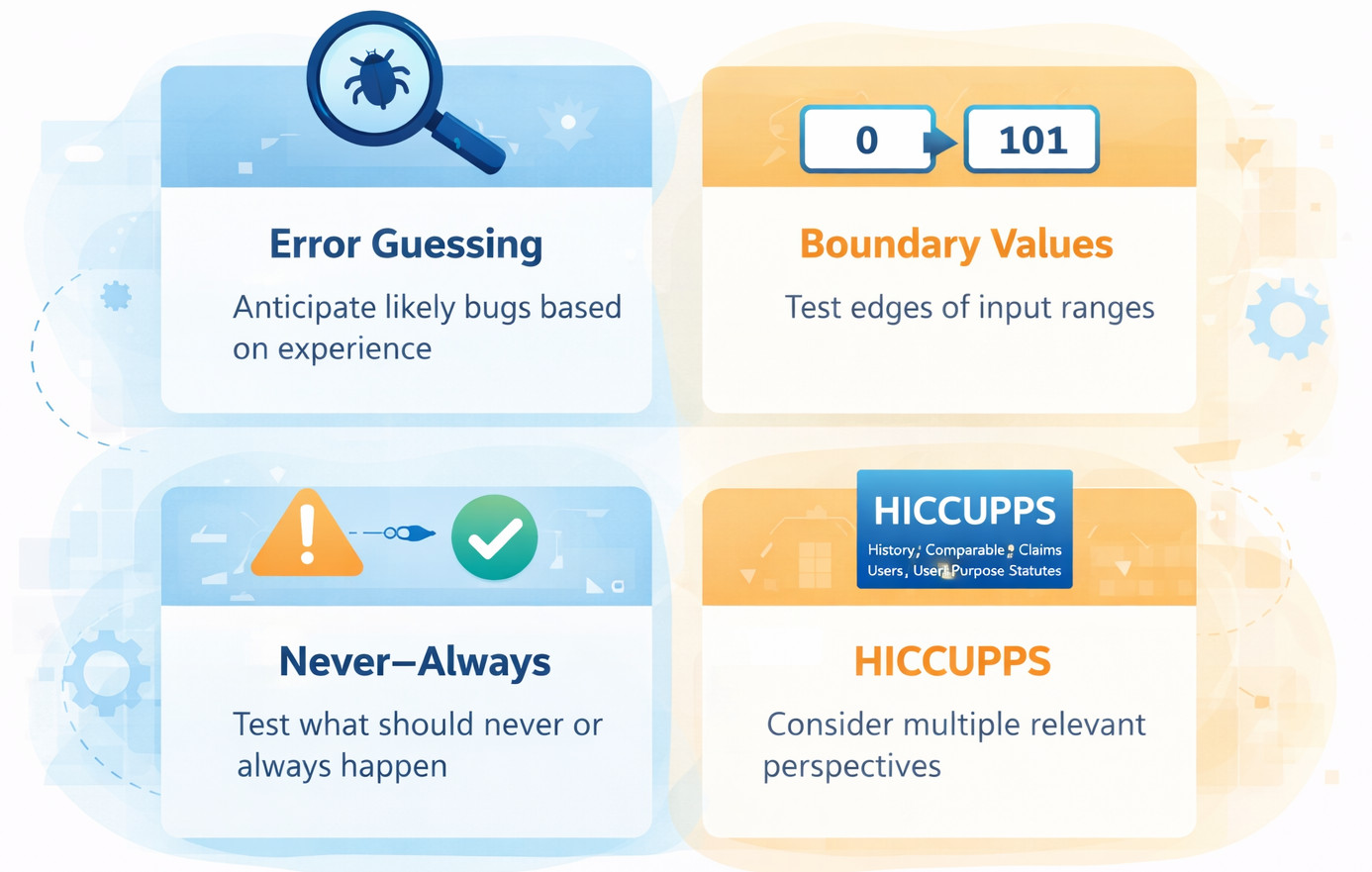
Error Guessing as a Heuristic Testing Technique
Out of the blue, testers use what they’ve learned over time to spot possible flaws. This approach is called error guessing; it has been around longer than most methods people now call modern. Instead of following strict rules, someone might think back on past bugs to predict new ones. Experience shapes these hunches about where things could go wrong.
When someone runs into trouble with login timing out, they tend to check those spots first. Areas like uploading files often come under scrutiny after problems have popped up elsewhere before.
The funny thing is, this method works far better than you’d guess, especially in the hands of those who know the process inside out.
Boundary Value Heuristics
Bugs often show up at boundaries. That edge between the two parts? A favorite spot for errors to hide.
When a system takes input between one and a hundred, people test zero just before the start. One pops up because it marks the beginning edge. A hundred gets checked since it sits at the far end. A single test can reveal big problems fast. Most take little time to set up, yet catch flaws that matter.
Never-Always Heuristics in Software Testing
- Does it ever happen never?
- Or every single time?
- A user should never see another user’s data.
- A successful payment should always generate a confirmation.
Once money moves, a clear sign that it has gone through must follow. Confirmation comes right after things work. When the system registers payment, proof shows up. Payment is done when the receipt appears. Only when funds are set is acknowledgment sent.
Broken expectations usually reveal flaws hidden underneath.
HICCUPPS: A Heuristic Framework for Exploratory Testing
- History – Past failures
- Image – Visual and UI concerns
- Comparable products – Similar systems and their issues
- Claims – What the product promises
- Users – Real user behavior
- Purpose – Why the product exists
- Statutes – Legal and regulatory constraints
This framework is often referenced in heuristic and exploratory testing discussions because it encourages deeper thinking beyond just functionality.
Advantages of Heuristic Testing
- First, speed matters. Testers can skip waiting for complete documentation or step-by-step testing plans.
- Second, finding actual problems works well here, particularly when it comes to how people interact with systems, the flow of tasks, or rare situations. What stands out is its knack for uncovering glitches users might hit only under specific conditions.
- Third, change happens fast in Agile and DevOps settings. This fits right in because quick adjustments matter most there. Short feedback cycles keep things moving without delay.
What stands out is that heuristic testing uses human judgment. A tool simply cannot imitate.
Limits and Challenges in Heuristic Testing
- One user might see a problem that another overlooks, simply because people think differently. When someone lacks practice, key details slip through – attention lands where it shouldn’t.
- Finding clear scores isn’t easy here. Many leaders lean on figures, reach stats, or simple yes-or-no outcomes – yet this kind of evaluation rarely fits that mold.
- Few realize how well heuristic checks perform alongside automation and structured testing, yet they shine only when paired with organized methods instead of swapping them out.
Heuristic Testing vs. Traditional Scripted Testing
Traditional scripted testing uses set steps that come with predicted outcomes. Because of this setup, it stays organized and can be done again without issues. Tracking progress feels straightforward since everything follows a clear path.
- Requirements are unclear or changing
- The product is new or unstable
- Time is limited
- Facing danger comes without warning. Every step could bring trouble. Uncertainty shadows each move taken
One way isn’t automatically superior. Most seasoned teams mix both methods in practice.
Falling short? That is when heuristic testing steps in. Scripts may cover old ground well enough – yet miss what changes. Safety comes from both, not just one feeding the other.
| Feature | Heuristic Testing | Traditional Scripted Testing |
|---|---|---|
| Testing Approach | Experience-based and flexible | Predefined and structured |
| Test Design | Created on the fly using heuristics | Written in advance as test cases |
| Adaptability | High; adapts as new insights appear | Low; changes require updates to scripts |
| Tester Involvement | Depends highly on human judgment | Follows documented steps |
| Best Suited For | Exploratory testing, early stages, high-risk areas | Regression testing, stable features |
| Documentation Level | Light and dynamic | Detailed and fixed |
| Speed of Execution | Easy to start, learn, and adjust | Slower upfront due to preparation |
| Bug Discovery Style | Finds unexpected and edge-case issues | Finds expected and repeatable issues |
Heuristic Testing and Exploratory Testing: How Are They Related?
Though often seen together, these two aren’t identical. One builds on patterns of experience, the other thrives on spontaneous investigation. While one follows mental shortcuts to spot issues fast, the other dives in without a script, learning as it goes. Their paths cross frequently, yet each holds its own ground. Think of them as teammates who work well together – yet bring different strengths. Sometimes used interchangeably, they still serve separate roles. Together they cover more ground than either could alone.
Testing unfolds while you learn, shape each step on the fly. Guidance comes from rough rules, shaped by experience.
Heuristic testing guides you much like a compass might. Where exploratory testing takes you feels more like wandering than planning.
Exploratory testing without rules may lead nowhere. Sticking only to rules means never testing if they work.
People team up, creating a method that works well when put to the test.
Heuristic Testing in Modern Agile and DevOps Teams
Frequent releases are the identity of today’s software teams. Multiple deployments can appear within a single day.
- What needs attention in this sprint
- What shifts carry danger
- Where automation should focus
A gut-driven heuristic guides choices under uncertainty. Sometimes, guessing beats waiting. What feels right now shapes next steps later.
When Should You Use Heuristic Testing?
- At the start of making a new product
- When things shift fast or get reworked
- When documentation is incomplete
- For usability and workflow validation
- Few moments left, though care stays sharp
This tool isn’t here to take over official checks. It works best when used alongside them, thoughtfully filling gaps where needed.
Conclusion
Tools grow smarter, yes. Yet judgment, curiosity, intuition – those don’t come from code. A machine follows paths laid out ahead. Humans spot what’s odd, unclear, broken in ways scripts miss. Clever algorithms help, sure. They speed things up. But they won’t pause, tilt their head, ask why something feels off. That moment of doubt – that hunch – is where real discovery begins.
Now here’s a thought: skill, wonder, and smart choices haven’t lost their value. This way of testing pushes people to question assumptions, shift direction fast, and pay attention to what counts.
| Achieve More Than 90% Test Automation | |
| Step by Step Walkthroughs and Help | |
| 14 Day Free Trial, Cancel Anytime |