A Simpler Alternative to Tricentis Tosca
 |
What is Tosca?
Tricentis Tosca is an enterprise test automation platform designed for end-to-end testing across modern and legacy applications. It’s widely used by large organizations to automate functional, regression, API, and enterprise system testing.
At its core, Tosca uses a model-based testing approach. Instead of writing test scripts, teams first create a model of the application by scanning its UI or APIs. These models act as reusable building blocks (often called modules), which are then combined to create test cases.
When the application changes, updates are made to the model, and those changes are reflected across all related test cases. This helps reduce the need to update each test individually.
Tosca also supports risk-based testing, where test coverage is prioritized based on areas most likely to fail, helping teams focus their efforts more effectively.
- Visual recognition (Vision AI) to identify UI elements
- Self-healing tests that adapt to UI changes
- AI-assisted test case generation and optimization
These features are aimed at improving test stability and reducing manual effort, especially in complex enterprise environments.
Advantages of Tricentis Tosca
- Model-based approach reduces duplication: Reusable modules allow teams to create multiple test cases from a single model.
- Supports large enterprise ecosystems: Works across web, mobile, APIs, SAP, and legacy systems in one platform.
- Codeless test creation: Tests can be created without heavy coding, making it accessible beyond developers.
- AI-powered features improve resilience: Vision AI and self-healing capabilities help tests handle UI changes better.
- Test Data Management (TDM): This allows you to create, manage, and have stateful synthetic data for complex end-to-end tests.
- Risk-based testing optimization: Helps prioritize high-impact test scenarios instead of running everything.
- Strong fit for SAP and enterprise systems: Widely adopted in organizations with complex, multi-system environments.
Disadvantages of Tricentis Tosca
- Requires upfront model creation: Teams must build and maintain models before writing tests, which can slow initial adoption.
- Learning curve for model-based testing: While codeless, the approach still requires training and understanding of Tosca’s structure.
- Maintenance needed for version compatibility: Upgrading to new versions of Tosca can sometimes be complex, requiring careful migration of the common repository and database.
- Longer setup and onboarding time: Implementations can take weeks or more in enterprise environments.
- Higher cost compared to simpler tools: Typically positioned as an enterprise-grade, premium solution.
- AI features are helpful but not fully hands-off: While AI improves resilience, teams still need to manage models, test design, and workflows.
- Heavy on system resources: Tosca is a heavy application. It requires significant RAM and local processing power for the Commander (the desktop IDE), which can lead to performance lag on older machines.
How testRigor is Different
While Tricentis Tosca focuses on a structured, model-based approach, testRigor takes a much simpler path to test automation. testRigor is an AI-driven test automation tool that lets you achieve high speed of test authoring, ultra-low maintenance, and true accessibility for non-technical users.
A Faster and Simpler Way to Create Tests
With testRigor, there’s no need to build or maintain application models. Tests are written directly in plain English, making them easy to create, read, and update. Instead of defining technical elements or reusable modules first, you can start writing meaningful test scenarios right away.
Here are all the ways in which your team can create English test cases in testRigor – All-inclusive guide to test case creation in testRigor
Less Maintenance, More Stability
In traditional approaches, including model-based testing, changes in the application still require updates – either in test scripts or shared models. testRigor reduces this effort by allowing tests to work at a higher level of abstraction. This means fewer updates when UI elements change and more stable test suites over time. See how you can reduce test maintenance time with testRigor.
Easier to Get Started With Automation
- Launch the testRigor app on the web and choose the desired settings for your test suite.
- Entering test steps in plain English language. (want to know more about the supported commands? Take a look here)
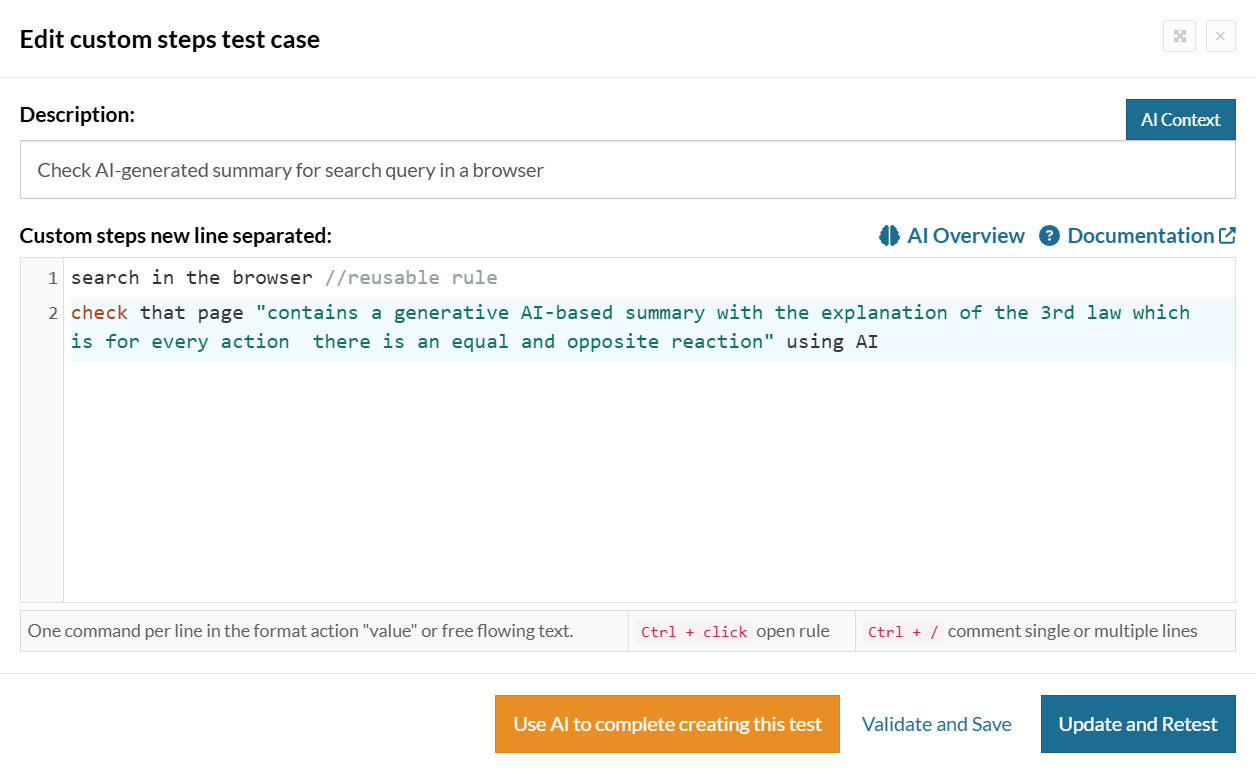
- All that’s left is to click the ‘Save and Run’ button.
Built For The Whole Team
- QA testers
- Product managers
- Business analysts
Because tests are written in plain language, more people can contribute to test automation without needing coding or tool-specific expertise.
Works Well in Dynamic Environments
For teams working on applications that change often, maintaining complex models can become a bottleneck. testRigor keeps things flexible and lightweight, making it easier to keep tests aligned with ongoing product changes.
AI Where it Actually Helps
- Identifying UI elements more reliably (like how a human would)
- Reducing test breakage by adapting to changing UI
- Keeping tests stable as applications evolve by suggesting and implementing changes
The focus is on minimizing manual effort rather than adding complexity to the workflow.
What Teams Achieve With testRigor
- Faster and simpler test creation and execution without heavy initial setup
- Reliable indication of the application’s quality
- Shift-left testing across a variety of platforms and browsers
- Reduced maintenance effort
- Lower dependency on automation specialists
- Improved release speed
- Democratized QA leading to more team members contributing to quality
testRigor vs Tricentis Tosca – Feature Comparison
| Feature | testRigor | Tricentis Tosca |
|---|---|---|
| Test creation approach | Plain English test steps (no coding required) | Model-based approach using reusable modules |
| Ease of use | Designed for non-technical users and fast onboarding | Requires learning model-based structure and tool concepts |
| Setup time | Quick start (minimal setup required) | Longer setup due to model creation and configuration |
| Test maintenance | AI-based adaptation to changing UIs, which leads to ultra-low test maintenance | Maintenance is handled via model updates, which can incur maintenance costs |
| AI capabilities | AI-driven test creation and execution in plain English | AI-assisted test design, vision-based element recognition |
| Test coverage | Web, mobile, APIs, end-to-end workflows, mainframes, enterprise apps (Salesforce) | Web, mobile, APIs, end-to-end workflows, enterprise apps (SAP, legacy systems) |
| Handling UI changes | Designed to reduce test failures using vision AI | Updates required in shared models when UI changes |
| Target users | QA, product managers, business users | Primarily QA engineers and trained automation teams |
| Enterprise system support | Supports common applications and workflows | Strong support for SAP and complex enterprise ecosystems |
| Shift-left testing | Because testRigor uses English, Product Managers and BAs can write the test cases before the code is even written | With Tosca, you generally need the application to be ready so you can scan it to create the necessary models |
| Test design approach | End-user perspective (business-readable tests) | Risk-based and model-driven test design |
| Cross-platform flexibility | testRigor is fully cloud-based, allowing for seamless testing across web, mobile (native and hybrid), and desktop without managing complex local infrastructure | Windows is Tosca’s primary environment, but it can test applications across web and mobile |
| Speed of scaling automation | Faster due to simpler test creation and lower overhead | Slower due to model dependencies and structure |
Choose testRigor if You Want to:
- Start automation quickly without long onboarding
- Want a solution that is fully AI-driven
- Eliminate the test maintenance bottleneck
- Enable your whole team, even non-technical team members, to contribute
- Move fast with frequent releases
- Minimize infrastructure overhead
Conclusion
Choosing the right test automation tool comes down to how quickly you want to move and how much complexity your team is willing to manage. Tricentis Tosca offers a structured, enterprise-focused approach, but that often comes with longer setup times and ongoing overhead.
testRigor takes an easier path – helping teams start faster, reduce maintenance, and involve more people in the testing process. If your goal is to scale automation without adding complexity, testRigor is built to help you get there sooner.
| Achieve More Than 90% Test Automation | |
| Step by Step Walkthroughs and Help | |
| 14 Day Free Trial, Cancel Anytime |