
What Are Solitary and Sociable Unit Testing?
 |
What Are Solitary and Sociable Unit Testing?
Fresh out the gate, unit testing seems straightforward enough. A tiny check here, a quick run there: green lights boost morale right away. But real life rarely stays clean for long. Outside connections start sneaking into places they should not be. Fake objects spread like weeds across files. The checks themselves snap under slight changes. Before anyone fully notices, more hours go toward patching those tests than building anything new.
Here’s when talk of solitary versus sociable test writing starts to matter.
One way looks at testing like this, another sees it differently. Not better, not worse – just distinct. Each picks a path based on what matters most in the moment. Seeing these choices clearly lets teams build tests that help progress, not block it.
What does it mean to test solitary versus sociable? The answer shifts depending on context. One way focuses on solitary checks, another leans on sociable behavior. Each has moments where it fits better. Tools today adapt to both styles. Some even use smart patterns to learn. Testing isn’t stuck in one mode anymore. Choices shape results more than rules do. Clarity comes from practice, not theory. How you validate matters as much as what you check.
| Key Takeaways: |
|---|
|
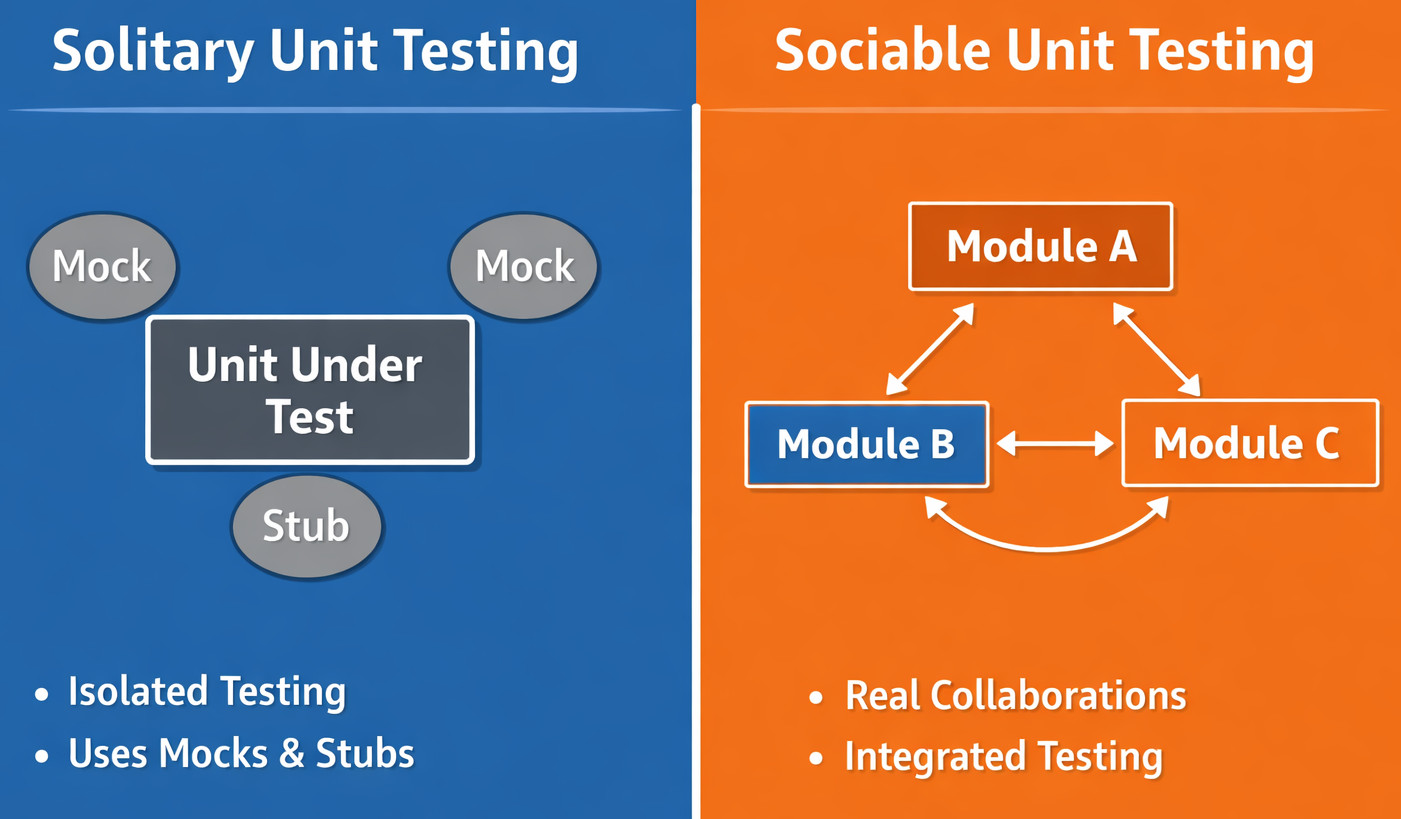
Unit Testing Styles: Why This Conversation Exists
What makes solitary and sociable unit tests different? First, consider why we even label them that way.
When systems get bigger, more pieces come into play. One function seldom acts on its own. Instead, it connects with various classes, reaches out to services, uses utilities, and occasionally even taps into external platforms. Testing just that one piece brings up the same puzzle again and again for developers.
“How much of the system should this test include?”
- Solitary unit testing
- Sociable unit testing
People rely on them a lot. You’ll spot each one running live setups somewhere. One hand brings gains, the other tosses up hurdles.
What is Solitary Unit Testing?
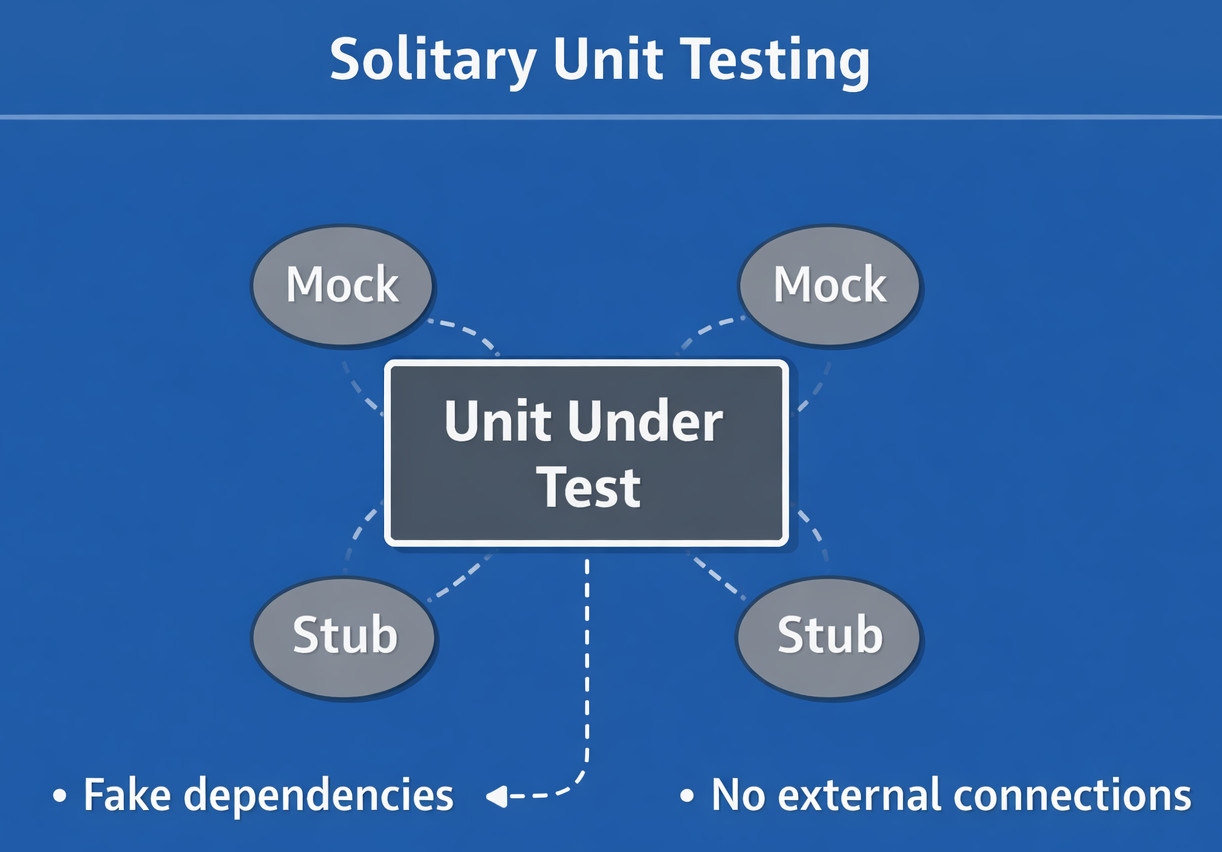
One way to run tests focuses only on a single piece of code at a time. That part works on its own, cut off from anything it usually connects to. Instead of real helpers, pretend versions step in: mocks, stubs, fakes take their place. Each outside link gets swapped out, no exceptions. The goal? Watch that one unit behave when nothing else interferes. It acts by itself, seen clearly, stripped bare of distractions. How it responds matters more than what surrounds it. Isolation shows its proper shape. Nothing shared, nothing borrowed – just pure function doing its job. This approach watches behavior without noise.
On its own, that’s what the unit does. Solitary gets its meaning right there.
A single class might lean on three others – each one gets mocked during testing. What matters here is the code within, not what it connects to. Inside that unit, the real behavior shows up, untouched by outside actions.
Key Characteristics of Solitary Unit Testing
- Strong isolation
- Testing happens using simulated participants instead of actual people
- Too many mocks show up. Stubs appear often, too. Sometimes they hide real problems. Testing gets tricky when these take over. Real behavior might be missed completely
- Instead of running them live, dependencies get mimicked. What shows up isn’t real execution – just a stand-in version acting like one
- Very fast execution
- Faster results come because the environment stays controlled within the module
- Clear failure signals
- A failure points straight to the faulty piece. That part stands out when things go wrong
Finding flaws early? That’s where single-unit checks shine for coders focused on accuracy without delays.
Benefits of Solitary Unit Testing
- One solitary test alone tells you plenty.
- Right away, you get exact feedback. If a test fails, the problem usually lies right inside that specific piece being tested, nowhere else in the setup.
- Speed often spikes when tests are run solitary. With hardly any links between pieces, there’s almost nothing slowing things down. Because they’re quick, people run them more. That kind of habit tends to stick around.
Starting solitary makes it easier to work with TDD. Before anything else is built, shape a class by setting up mock responses that act like real parts later.
Drawbacks of Solitary Unit Testing
- When mocks are based on guesses, trouble follows. A mock collaborator acting unlike the real thing can trick tests into passing – yet everything breaks later live. Reality does not care about shortcuts.
- Fragile tests often cause trouble. Tied too closely to how code works, they fail when changes happen – even small ones. People grow annoyed. Eventually, some stop paying attention to the results.
- Eventually, effort shifts toward checking connections instead of actions. More tests appear. Trust stays flat.
What is Sociable Unit Testing?
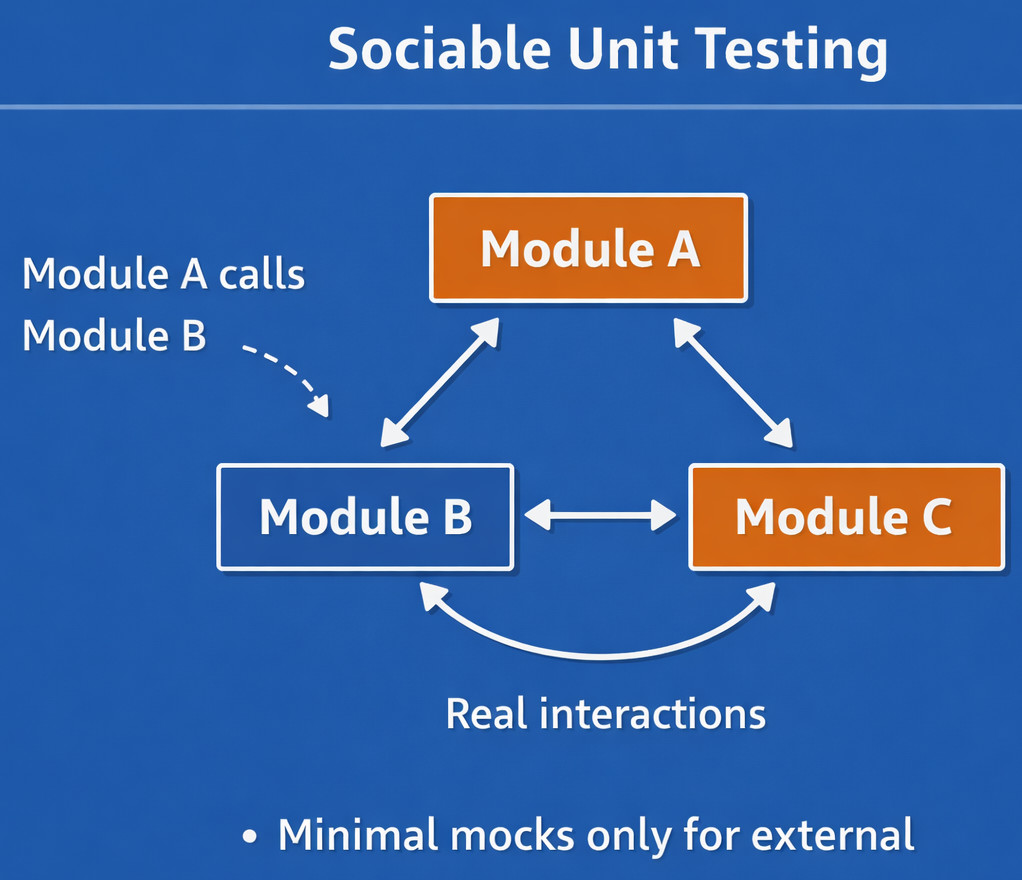
What happens when tests work together? That is what sociable unit testing explores. It shifts focus from isolation to interaction.
Sociable checks work by letting the tested piece connect with actual parts it relies on: provided they’re small, fast, and sitting inside the system itself. What matters is keeping things light while still working together.
A single thought drives it, objects connect just like out in the world. Their communication mirrors what happens every day.
Key Characteristics of Sociable Unit Testing
- Minimal mocking
- What gets swapped out is strictly outside components
- Real collaboration
- Classes work together inside the test
- Broader test scope
- A single test touches more routes through the code
- More realistic behavior validation
- Funny thing is, the results show exactly what happens when the system runs for real
Teams tend to find this approach fits better when teamwork matters more than rigid boundaries.
Benefits of Sociable Unit Testing
- Teams working together make testing more honest. When things go wrong, chances are high it’s actually broken, no fake errors from mismatched mocks.
- When code gets rearranged, sociable tests usually still work. Changes inside don’t break them if what they do remains unchanged. Behavior matters more than structure here.
- Last of all, they cut down on too many mocks. With fewer test doubles, tests tend to become easier to follow. What matters is clarity showing up more often.
Drawbacks of Sociable Unit Testing
- When things go wrong, it takes more time to spot why several pieces work together. One broken test could mean tracing through layers.
- Faster than full integration checks, yet speed dips when more people join in. Team size creeps up, performance lags a bit, solitary versions handle growth better.
Solitary vs. Sociable Unit Testing: Key Differences
A Side-by-Side Comparison
| Aspect | Solitary Unit Testing | Sociable Unit Testing |
|---|---|---|
| Dependency Handling | Fully mocked | Mostly real |
| Test Scope | Very narrow | Broader |
| Speed | Very fast | Fast, but slightly slower |
| Failure Diagnosis | Easy | Requires investigation |
| Refactor Friendliness | Lower | Higher |
| Realism | Lower | Higher |
The table makes it clear. This is not about good versus bad. It’s about trade-offs.
Mocking vs. Real Dependencies in Unit Testing
One question usually lies at the heart of this discussion:
Is mocking this dependency the right move?
Most times, testing alone says yes. Sociable unit testing answers “only if we must.”
- Slow
- Unreliable
- External (databases, APIs, networks)
- Fast
- Deterministic
- At the heart of what the system actually does
What matters most is balance between extremes, not in chasing a single approach without thought.
When to Use Solitary Unit Testing
- Logic alone is what you are checking right now
- Quick replies matter most when things move quickly
- You’re writing low-level components
- You want precise control over interactions
During the initial stages, it helps a lot. When tests demand speed, it matters.
When to Use Sociable Unit Testing
- Behavior matters more than interactions
- Classes are tightly related
- Refactoring is frequent
- Try using situations that mimic everyday life. Real moments show what actually works. That tells you more than made-up scenarios ever could
Over time, some groups notice these social-style checks just work better. A few even say they’re simpler to keep going.
Mixing Solitary and Sociable Unit Testing in Real Projects
Facing facts, plenty of successful teams never ditch one for the sake of the other.
They mix both.
- Besides single scenarios, try solitary checks when things get tangled or unusual
- Use sociable tests for workflows and collaboration
- Let external dependencies live only in broader tests
Fewer imbalances show up when tests are balanced this way.
Solitary and Sociable Unit Testing vs. Integration Testing
A solitary test checks one piece alone. A sociable test shares the stage with helpers. People mix up these team players with full integration tests. Not identical at all.
- Run fast
- Stay clear of actual databases or network systems
- Stay within process boundaries
Where integration tests reach across system borders, sociable tests stay within their own space.
What sets them apart becomes key, think about how you set up deployment pipelines.
How Unit Testing Styles Affect Deployment Strategies
When tests are written a certain way, it shapes how ready a team is to release updates. The approach to verifying code can quietly steer when and how changes go live.
A solitary test runs quickly, yet overlooks how pieces fit together. With sociable tests, behavior feels more real, still gaps hide in rare situations.
- Speed to keep pipelines flowing
- Confidence to avoid rollbacks
This changes everything when it comes to testing tools.
The Role of Test Automation in Modern Unit Testing
When things grow bigger, doing manual tests falls behind. Automation must take over instead.
- High maintenance
- Technical complexity
- Slow feedback loops
Fear of breaking something makes tests feel untouchable.
Choosing the Right Unit Testing Approach
Not every situation follows the same pattern.
- Team experience
- Codebase size
- Deployment speed
- Maintenance tolerance
Choice guided by intention means more than routine. What you decide on purpose shapes your path differently.
Solitary and sociable unit testing are tools. The real skill lies in picking the right moment, then applying it well, this choice shapes whether tests break easily or hold strong.
Conclusion
Looking back at solitary versus sociable unit tests, they do not fight each other. Each offers a way to see differently. Something here zeroes in on being alone, sharpness matters most. Then again, separation shapes how things stand apart cleanly. One focuses on working together, grounded in what’s real. Facing tough checks means knowing each method, mixing both wisely, backed by tools that fit just right.
What matters most, when it comes down to it, is how well testing works in practice.
| Achieve More Than 90% Test Automation | |
| Step by Step Walkthroughs and Help | |
| 14 Day Free Trial, Cancel Anytime |