
What is Delta Testing and How you Do it
 |
Software development is essentially a change-oriented activity. Each and every software product, big or small, from any domain, will grow with time. New features are introduced, current behavior is adjusted, bugs are fixed, performance improvements are made, and new configurations and use cases emerge. While this is necessary for growth and relevance, it brings with it an element of the unknown. Each change, no matter how insignificant it may seem, can cause the system to behave unpredictably.
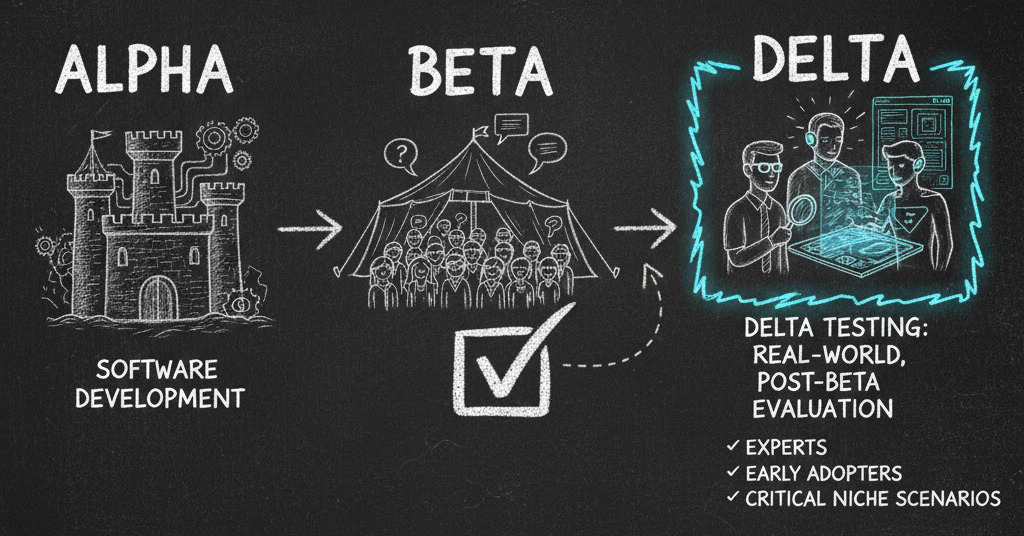
Delta testing tackles this problem by testing only what has changed between two system versions. Instead of validating the whole application after each update, Delta testing reduces the scope of testing to a delta, the difference between the previous and next version.
In these early development stages, agility and speed are key, yet delta testing allows teams to maintain confidence in quality without blocking the production pipeline. It is especially applicable in iterative development methodologies where changes are often small and frequent rather than large, infrequent alterations.
| Key Takeaways: |
|---|
|
Understanding the Meaning of “Delta” in Software Testing
The name delta comes from the worlds of mathematics and science, where it is used to represent a change or difference between two things. Specific to software testing, delta is the change between:
- An earlier version of a software system
- A new or modified version of that system
These changes could be code pushes, configuration changes to the infrastructure, or the result of a manual response.
Definition of Delta Testing
Delta testing is a focused testing process that aims at validating the modifications in a software and those areas influenced by such modifications. Rather than regression testing the entire application, though, it checks for new or changed behavior to work as expected without breaking any changes that have been previously made as part of the overall system.
This strategy focuses on smart testing instead of reduced coverage. Focused on the right sort of changes and their ripple effects, Delta testing accelerates feedback loops at the team level while maintaining confidence in software quality.
Essential components of Delta Testing:
- Identification of changes: Make it easy to notice what has been added, changed or deleted in the new build so testing efforts can be focused on relevant areas.
- Validation of modified functionality: Verify that the modified behavior functions as expected and does not cause any new bugs in the feature itself.
- Verification of impacted areas: Verify related or connected features to ensure that any negative side-effects of the changes have not crept into other parts of the system.
Read: Test Design and Test Coverage Techniques for Tech Leaders.
Core Characteristics of Delta Testing
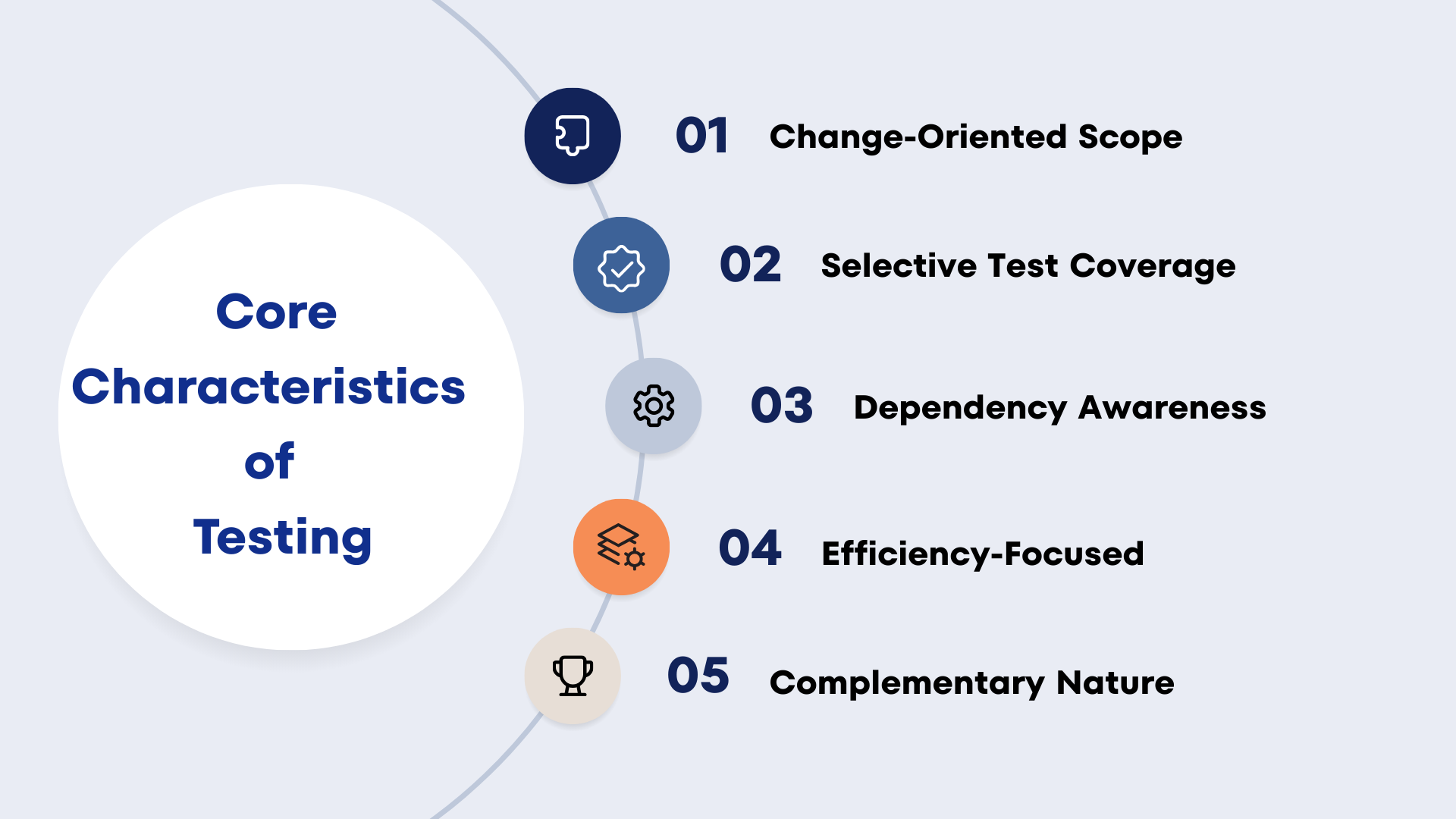
Delta testing is characterized by a focused set of characteristics that describe how testing should be planned and done after the change. Instead of starting fresh with each release, it determines what has actually changed within the system and restricts the scope of testing accordingly. This allows teams to find the balance between speed and reliability by testing smarter, not wider. This is where delta testing shines, especially in rapid development cycles.
- Change-Oriented Scope: The coverage in delta testing is based solely on the differences between system versions. The first step in planning tests is to determine what has changed and constrain validation to just those parts.
- Selective Test Coverage: Only relevant test cases that are related to the change or its functionality impact are executed. This would help avoid executing non-relevant tests, while still having significant coverage.
- Dependency Awareness: Delta testing includes the components and their dependencies across which the change in functionality is invoked. This way, indirect side effects and integration problems are identified as early as possible.
- Efficiency-Focused: The challenge is to reduce the redundancy of testing while not mangling confidence in the system. A team can get faster feedback and a shorter release cycle if they narrow their test set.
- Complementary Nature: Delta testing is not a substitute for regression, system or exploratory testing. Instead, it supports them by providing an independent layer of validation around recent changes.
Why Delta Testing is Needed
Traditional testing methods are based on the assumption that each change requires full retesting of the complete system, resulting in long lead times and releases. In the world of contemporary software development, where speed and adaptability are critical, this approach can be hard to support. Delta testing becomes a pragmatic solution in the face of such constraints by maximizing testing work based on realistic system changes. It allows a team to maintain its quality while also being able to accommodate fast delivery demands.

- Accelerated Development Cycles: Agile and DevOps methodologies encourage small and incremental updates. Execution of full test suites for every small change causes delays in delivery and slows down development velocity.
- Resource Constraints: Time and expert resources are generally restricted for testing teams. Delta testing maximizes these resources by focusing on high-impact areas.
- Change Localization: Many changes to code or configuration only impact a limited area of the system. Delta testing understands this and tests changes without retesting items of functionality that have not changed.
- Faster Feedback Loops: Developers must have rapid feedback on whether recent changes work as expected. Delta testing offers quick validation that helps identify and patch the bug earlier than the code development cycle.
Read: Defect-based Testing: A Complete Overview.
Types of Changes Addressed by Delta Testing
Delta testing is general-purpose and applicable to a wide variety of software evolution changes. Whether the change is to code, configuration or external dependencies. However, the goal stays consistent – validate what has changed and its reach. This is why delta testing works well for small incremental changes, but also for more functional changes. It is model-driven and resolution-independent, which means that by adjusting to various change types, its quality and testing overhead remain consistent.
- Functional Enhancements: When new functionality or modifications are added, delta testing makes sure that the new behavior introduced is as expected. And it will also take care that the improvement doesn’t break any related workflows.
- Bug Fixes: They are normally geared toward particular logic and may be accompanied by some unforeseen effects. Delta testing confirms that the bug is fixed and doesn’t affect other areas around it.
- User Interface Updates: Alterations in design, navigation, or appearance can also affect usability. Delta testing ensures the latest UI updates work without problems and do not worsen any usability aspects.
- Configuration Modifications: Changes to environment variables, feature gates or configurations can cause the app behavior to change without code modification. Delta testing helps verify that such changes lead to the expected outcomes in every environment.
- Integration Updates: API changes, data contract changes, or third-party service changes can impact several consuming components. With those changes completed, delta testing tests that the integrations still work as expected.
Read: What Are Regression Defects? Causes, Examples & How to Prevent Them.
How does Delta Testing Work?
Delta testing focuses on reducing the uncertainty induced by software changes. Instead of thinking of each new release as a completely new system, similarity is noted between releases. Changing this mindset empowers teams to test with intent rather than broad validation.
If the changes are found, they evaluate their possible effects on other parts and processes. To this, testing is performed on updated features only and those parts that might get impacted. This focused validation maintains stability while preserving a quick testing pace well-suited for fast-moving development.
At a high level, delta testing follows five essential steps, each contributing to a structured, reasoning-driven approach to change-focused testing. Let’s see them in detail.
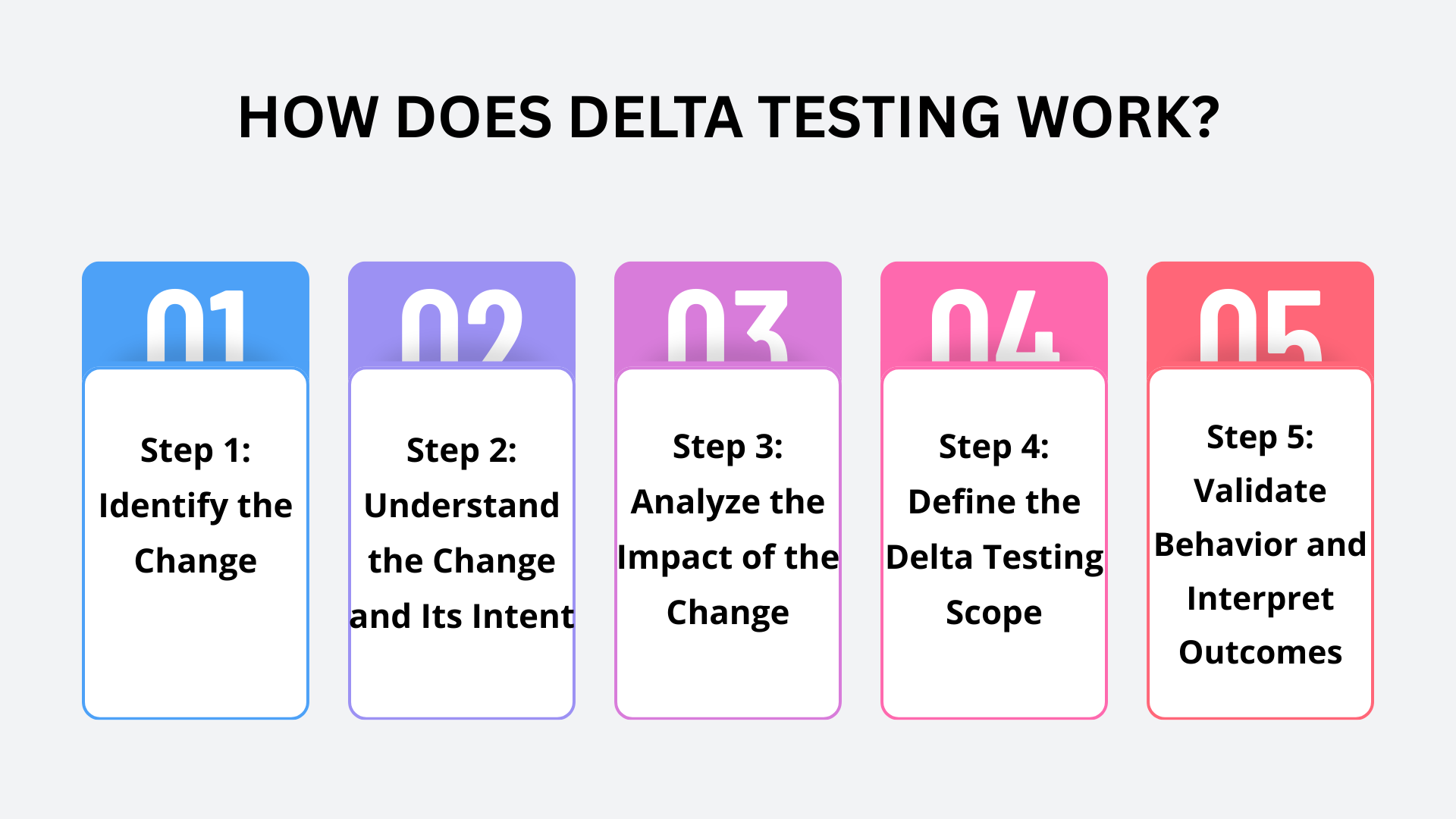
Step 1: Identify the Change
The first step in delta testing is to determine what has changed between the two versions of your software. These differences form the delta.
Changes could also include updated logic, workflows, system functions or how components interact. Some changes are immediately visible, while others are embedded within internal processing or conditional logic.
Accurate identification is critical. An unrecognized change is simply an unmonitored change, while a misidentified change can cause false validation. At this point, delta testing relies on accuracy to make sure that testing effort is not spent in vain.
Step 2: Understand the Change and its Intent
Once the change has been located, delta testing needs to determine what the specific change is trying to do and how it changes system behavior.
This step determines if the change adds new functionality, changes existing behavior or affects system conditions under specified circumstances. When understood, one will clearly know what correct behavior should “do” after the change.
Delta testing confirms behavior in comparison to intent, not assumption. Without that knowledge, validation could be as dangerous as checking only that something does work when we can’t establish if it works the way it’s supposed to.
Step 3: Analyze the Impact of the Change
Software is seldom modified in isolation. An essential point in delta testing is to examine how a change propagates from one part of the system to another.
Impact analysis, in turn, analyzes dependencies that may exist between artifacts, such as shared data, interaction flows, logical coupling, and outcome dependencies. Because what happens in one place can affect behavior in another, even if the other was not directly modified.
This procedure is necessary to avoid having delta testing be limited not only to the changes themselves but also to extend through their effects and impact on the overall system.
Step 4: Define the Delta Testing Scope
The delta testing scope is specified on the basis of the identified change and its expected impact. This scope of reference is particular, but not arbitrary.
Scope includes the validation of changed behavior and any related functionality, which may be affected during the change. If these areas are not modified or affected, they are excluded from direct validation as a conscious decision.
Clear determination of scope is that which makes delta testing fast, yet allows for maintaining stability confidence.
Step 5: Validate Behavior and Interpret Outcomes
The last stage of delta testing consists of validating altered and affected behaviors. Also, interpreting the partial or whole result obtained.
Validation aims at verifying that modified logic behaves as expected, and that other affected functionalities do not break down. The observed behavior is then compared to expected behavior based on change intent and known baseline behavior.
Unintended differences, whether failures or minor discrepancies, mean a change may not only include the intended effect. These results are used in making decisions regarding readiness, correction or further exploration.
Delta testing concludes with informed confidence rather than absolute certainty.
Read: Why Critical and Lateral Thinking Matter for Testers.
Delta Testing Framework
A delta testing framework is developed to verify if a refactored rule-based system produces expected results compared with the original version. Fundamentally, the framework works by running identical input data against two different rule sets and comparing the results.
These two sets of rules are often known as the Champion and the Challenger.
- The champion rule set is the source, established version of the rules in use and known to be accurate.
- The challenger rule set is the modification or refactored form of complementary rules. It is used to include new specifications, optimization, or design changes.
For a typical delta testing model, the same input data is run through both Champion and Challenger rule sets. The resulting outputs are compared with the expected output to see if the changes produce anticipated behavior. It is not only our aim to detect differences; just as important, it is to evaluate whether these differences are consistent with the purpose of alteration.
Delta testing within such a framework is generally classified into two broad categories: Quantitative Delta Testing and Qualitative Delta Testing.
Quantitative Delta Testing
The quantitative delta testing looks only for measurable numerical deltas between the outputs of the Champion and Challenger rule sets. This technique is especially applicable when it can be predicted that changes should give rise to quantifiable differences in the observed results.
In such tests, outputs from both rules are tested against each other with respect to defined equivalence or comparison operations. This is to determine if the differences observed are not just within expected values.
For example, consider that the pricing or rating of a product will often change due to business rules. When you make such a change, the Challenger rule set can calculate a new base rate. Quantitative delta testing confirms that the difference in base rate output between Champion and Challenger rule sets accurately reflects the updated business logic.
The emphasis here is not on whether the outputs are identical, but on whether the numerical difference is correct, intentional, and consistent with the defined change.
Qualitative Delta Testing
This focuses on variances that cannot be tested by simple number comparison. Instead, it concentrates on logical consistency, topological soundness, and system performance post-modification.
This form of delta testing is commonly used to assess two key dimensions: correctness of rules and system stability in relation to change.
- Correctness of Rules: Confirms that the rule set after refactoring or modification is the same as it was before for all inputs, which shouldn’t contain an intended change. This ensures that no change in architecture/logic will cause an impact on the original business requirement.
- System Stability in Relation to Change: Tests whether the rest of the system still works (as it used to) against both rule sets. This can be used to ensure that new or changed requirements do not adversely affect what is already present.
Read: What is Cost of Poor Quality (COPQ)?
Characteristics that Define Delta Testing
The scope and execution of delta testing are directly orchestrated according to change, which differentiates it from the rest. It is focused on precision, impact awareness, and stability rather than a wide range of repetitive validations.
- Scope Defined by Differences: The range of testing is also based on a comparison between software versions, and not by all features or requirements.
- Focused Test Execution: Only test cases that are directly relevant to the change and its potential impact are executed.
- Dependency-Driven Validation: Dependent and interacting components are checked to ensure their indirect effects of changes are recognized.
- Emphasis on Stability Verification: Delta testing makes sure that new or altered behavior does not introduce any destabilization in your current system.
- Strategic Complementarity: Delta testing is most effective when used in conjunction with other testing techniques as part of an overall quality strategy.
Read: What is Gamma Testing?
Types of Changes Addressed by Delta Testing
Delta testing is general and can be instantiated for different types of change in a software system. It concentrates on verifying modified behavior and affected areas.
- Functional Behavior Changes: Delta testing ensures that the new business logic performs as intended and does not break associated features.
- Corrections and Adjustments: It helps to qualify defect fixes to verify that a particular problem is fixed without undesired side effects elsewhere in the system.
- Interface and Interaction Changes: Ensures that new user interactions work as required and maintain expected levels of usability.
- Configuration-driven Changes: Verifies that layout modifications lead to intended behavior across applicable environments.
- Integration-level Changes: Delta testing tests whether any modified interactions with a new system still work properly.
Delta Testing vs. Regression Testing
This highlights how two complementary approaches differ in focus, scope, and purpose while working together to ensure software quality.
| Aspect | Delta Testing | Regression Testing |
|---|---|---|
| Primary Focus | Validates only the changes introduced and their direct or indirect impact. | Ensures previously working functionality continues to behave correctly. |
| Scope | Narrow and change-driven, based on differences between versions. | Broad, covering a wide range of existing system behavior. |
| Test Selection | Executes only tests relevant to modified areas and dependencies. | Executes a large set or full suite of existing test cases. |
| Execution Frequency | Performed frequently after small or incremental changes. | Often executed at major milestones or before releases. |
| Time and Cost | Faster and more cost-effective due to limited test execution. | Slower and more resource-intensive due to extensive coverage. |
| Change Awareness | Explicitly analyzes change impact before testing. | May not always differentiate between changed and unchanged areas. |
| Role in Strategy | Acts as a focused subset within the regression testing strategy. | Serves as a comprehensive safety net for system stability. |
Read: What is OCR-based Testing? How testRigor Does It.
Situations where Delta Testing Alone is Insufficient
Despite its advantages, delta testing is not universally applicable. Generalized structural changes often have numerous impacts on a system in complex ways. For these situations, selective testing may not provide a high degree of assurance.
Highly interconnected systems have a similar problem. When code is tightly coupled together, small changes can lead to some serious side effects that are not easily predictable. In regulated or safety-critical domains, full validation is mandated irrespective of the magnitude of change.
Delta testing should therefore be seen as one tool within a range of tools, used situationally and not ubiquitously.
Conclusion
Delta testing represents a contemporary style of software quality assurance that emphasizes understanding and validating change over retesting entire systems. It isn’t a shortcut or substitute for other testing services, but it is a focused approach balancing efficiency and confidence around change, impact, and risk. By affirming the impact of changes and what they affect, teams can ensure a stable system even as software changes at an increasingly rapid speed.
| Achieve More Than 90% Test Automation | |
| Step by Step Walkthroughs and Help | |
| 14 Day Free Trial, Cancel Anytime |