What Is “Vibe Slopping”? The Hidden Risk Behind AI-Powered Coding
 |
AI has modified the manner in which software is built faster than almost any other change in recent times. “Vibe coding,” which entails developing features by instructing an AI tool what you want to do, has replaced the traditional coding workflows in many teams. With this, developers can come up with ideas, write code, and release it in hours, instead of the months it took earlier. The potential with this tech is huge.
But this speed has introduced a new risk: Vibe Slopping.
If vibe coding is the fancy front door to AI-assisted development, then vibe slopping is the messy back door. It encourages ambiguous decisions, technical debt mounting, and shortcuts piling up. As it keeps up, the mess can’t be ignored any longer.
What is Vibe Slopping? Why is it such a critical conversation that is a must-have for engineering teams? What does a real Vibe Slopping Example look like? Most importantly, how can you prevent the high-quality automation, processes, and guardrails?
| Key Takeaways: |
|---|
|
Let us discuss all of these in the blog below. We will also explore how tools can help you prevent vibe slop from being introduced in your product in a strategic manner.
What Is Vibe Slopping? The Dark Twin of Vibe Coding
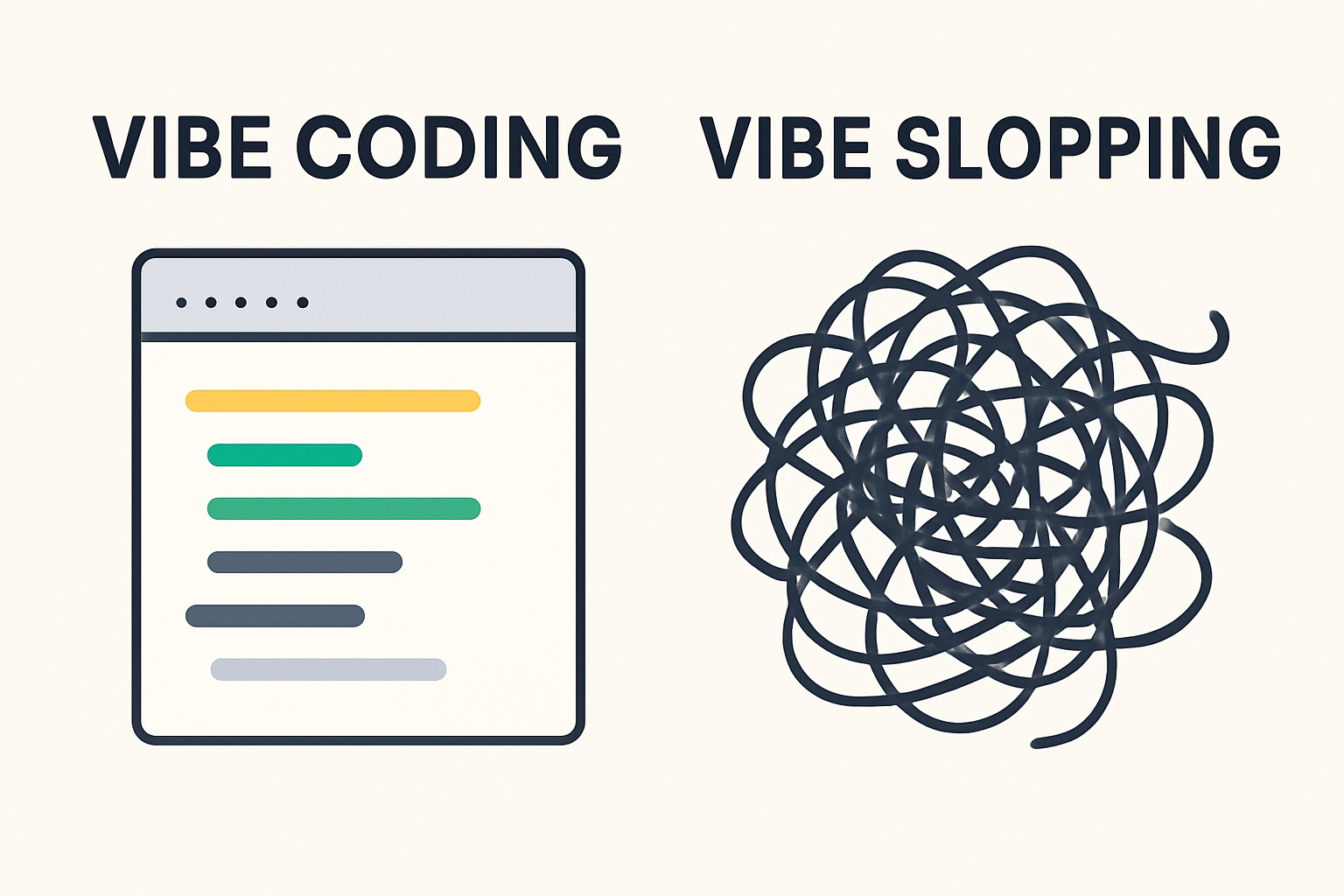
To understand vibe slopping, you first need to understand vibe coding.
It is the practice of describing a feature in natural language and then letting AI generate most of it, or even proceed with the implementation. So instead of writing the code manually, developers work with an AI tool that does the majority of the heavy lifting. It goes faster. It is more accessible. It removes friction.
But it also opens the gateway to…
Vibe Slopping Defined
Vibe Slopping occurs when AI code is produced faster and builds up a lot of messiness, inconsistencies, shortcuts, and hidden errors. It results in a lot of technical debt that costs a lot of money and takes a longer time to fix.
This is called “vibe slopping” when teams leverage AI to get things completed faster. However, they don’t pay attention to code quality testing discipline, structure, or review.
It is not always clear at first what a “slop” is. Everyone is over the moon about the new acceleration because the code functions and the features are deployed. However, below that, the new feature may be:
- Bloated, unrefactored functions.
- Wrong assumptions baked in by the AI.
- Silent logic errors that are missed by reviews.
- Hard-coded values and mysterious edge cases.
- Package hallucinations or insecure dependencies.
- Incomplete or brittle tests, that is, if any tests exist at all.
As more team members play around with vibe coding, these slops stack and multiply. Eventually, the AI-generated codebase is harder to maintain than one created by humans. For the simple reason that humans struggle to understand AI-produced logic that was never meant to be read, only generated.
Why Vibe Slopping Is Growing Faster Than Teams Realize
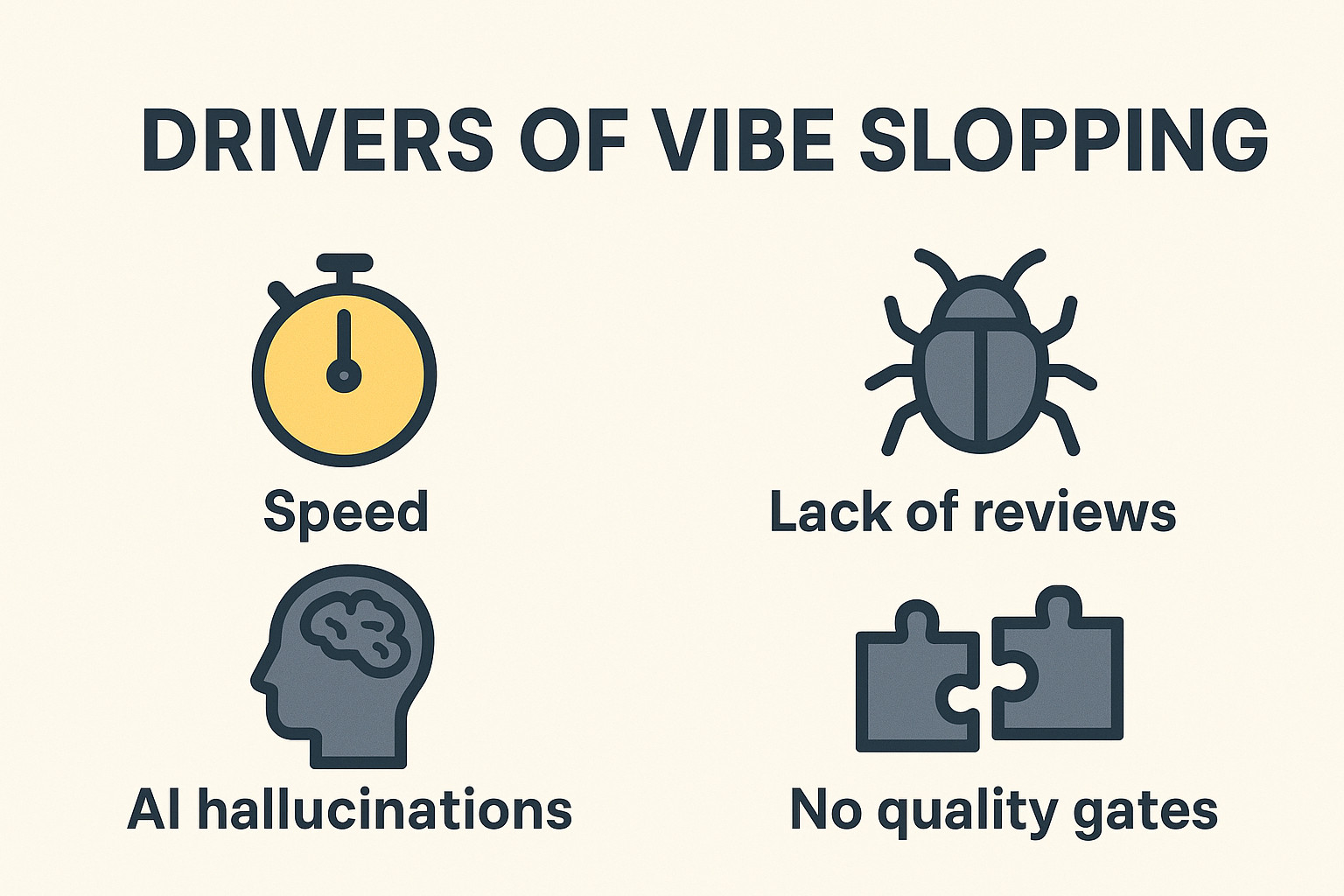
Most organizations embracing AI-assisted development expect faster delivery and reduced developer workload. And to be fair, they get it, at least at first.
So why is vibe slopping escalating behind the scenes?
Here are the biggest drivers:
AI’s Job Is to Produce Code, Not Good Code
LLMs strive to build something believable rather than something perfect, safe, or sustainable. Without appropriate guardrails, the output can quickly degenerate into “slop,” which is functional but fragile.
Developers Skip Traditional Safeguards
Teams often cut back or fully eliminate when AI handles the majority of the implementation:
- Manual code reviews
- Deep architectural thinking
- Detailed refactoring
- Thorough testing (especially automated testing)
- Dependency scrutiny
Teams rarely look back to clean up after they become used to the speed.
Hallucinated Dependencies Create Security Risks
Inventing package names or suggesting obscure libraries is one of the more severe types of vibe slop that results from an LLM. Attackers have now started registering these hallucinated libraries with malicious payloads.
This subset risk even has its own name: slop squatting.
Humans Lose Context Over Code They Didn’t Write
Developers excel when it comes to maintaining code; they understand. However, code built by AI is often ambiguous, annoyingly wordy, or oddly structured. This makes debugging much more difficult in the future.
Rapid Win Culture Encourages Cutting Corners
The leadership wants to maintain the momentum after observing a sharp increase in output speed. Meanwhile, engineering teams may not have the organizational backing to implement more testing, architectural discipline, or quality checks.
Speed thrills, until slop accumulates.
A Real Vibe Slopping Example: When Fast Code Becomes Slow Pain
Here are some practical Vibe Slopping Examples based on trends reported across engineering teams using AI tools to display how easily this takes place:
Scenario: A team needs a fast workflow for customer onboarding.
A developer prompts their AI tool to: “Build a Python API endpoint that creates a new customer, validates email, sends a welcome email, and logs the event.”
In seconds, the AI would have generated:
- A new controller
- A validation function
- A 100-line email helper
- A hard-coded SMTP handler
- Logging with no level control
- Silent error swallowing
- A new dependency that the team has never heard of
Everything works when tested manually.
The team ships it.
After a few months…
Customers began to complain about intermittent onboarding problems.
Debugging exposed:
- The email helper made blocking calls and is duplicated into two other locations due to additional AI-generated features.
- The obscure package utilized for email validation hasn’t been updated in two years and has multiple security issues.
- Logging hides critical errors, making failures nearly invisible.
- Another AI-generated endpoint reused part of the onboarding code in unexpected ways, leading to race conditions.
- No automated tests exist, so refactoring feels risky.
While originally, the team built a “simple” onboarding workflow in less than an hour.
It took multiple engineers at least two weeks to fix.
That is vibe slopping.
The code was unsustainable, but it wasn’t incorrect. Additionally, cleaning up AI code is often more difficult than writing it manually due to its tendency to be verbose and inconsistent.
Why Vibe Slopping Matters Now More Than Ever
Vibe slop leads to risks in a number of critical areas as more organizations embrace AI coding workflows:
- Security: Unvalidated or hallucinogenic dependencies.
- Performance: Excessively complicated generated logic.
- Maintainability: Code that no human really understands.
- Cost: Cleanup often takes longer than initial development.
- Scalability: Unstructured code slows down future work.
- Quality: The final product becomes more brittle.
And the biggest risk of all:
Slop Compounds.
Technical debt is exponential rather than linear, as AI tools often build on top of existing slop.
For this reason, in the age of AI coding, a proactive engineering discipline is critical compared to reactive cleanup.
How to Avoid the Slop: Practical Strategies for Keeping AI Development Clean
It is not required to fully reject AI tools or slow down advancements in order to eliminate vibe slop. It includes putting in place the proper processes, automation, and guardrails to make sure that code quality is not compromised for speed.
Here are some tips for preventing the slop while still taking advantage of AI’s productivity advantages.
Treat AI-Generated Code as a Draft, Not a Deliverable
Assuming that AI output is ready for production is the fastest way to accumulate slop. It rarely is.
Developers must:
- Examine each generated code segment.
- Refactor aggressively.
- Simplify and restructure logic.
- Remove unnecessary abstractions.
- Add comments and explain ambiguous behavior.
While AI can produce code faster, developers still need to review it.
Standardize Architecture and Coding Conventions
When there are guardrails in place, AI tools ultimately perform better. Offer them:
- Architectural template.
- Style guides.
- Coding patterns.
- Design tokens or shared frameworks.
- This reduces inconsistent slop.
Force All Dependencies Through Security and Verification Checks
Never believe a package just because it was recommended by an AI. Your pipeline will:
- Validate dependency age.
- Check for known vulnerabilities.
- Verify community trust and popularity.
- Audit licenses.
- Reject packages with suspicious metadata.
This drastically reduces the risk of slop squatting.
Use Test Automation to Catch Hidden AI Errors
As AI-generated code usually lacks automated tests, manual testing is unable to detect everything. Vibe slop’s most dangerous feature is that errors are often hidden until production. Vibe slop is unavoidable in the absence of automated testing. You need intelligent test automation tools to help you uncover these hidden issues, and it doesn’t hurt to leverage AI here! An AI-powered tool like testRigor is just the tool to help you counter the woes of AI-generated code.
How testRigor Fits Into a Sustainable AI Coding Strategy
As the utilization of AI-generated code increases, QA teams are under massive pressure to validate functionality as quickly as AI can write code. Code-based automation, brittle UI scripts, and labor-intensive manual testing are all examples of traditional testing techniques that just cannot keep pace. testRigor offers multiple advantages in AI-heavy development environments that let you:
- Adopt AI coding without sacrificing quality.
- Scale test automation far beyond human capacity.
- Write tests in natural language (good for vibe coding workflows).
- Maintain test stability even as the UI evolves.
- Reducing regression testing cycles from days to minutes.
- Detect slop before it hits production.
Here are some more distinct provisions of testRigor:
-
Tests in Plain English: Perfect for AI WorkflowstestRigor tests blend in well with environments where developments already utilize conversational language to define behavior because they are written in natural language. Instead of building fragile code-based scripts, teams can translate their intent straight into tests in plain English.
-
Catch Sloppy Logic EarlyAI-generated code often works well on the surface but breaks in extreme situations. testRigor’s robust automation identifies:
- Unexpected flows.
- UI inconsistencies.
- Logic gaps.
- Broken integrations.
- Missing validations.
Slop is forced to the surface before customers encounter it. -
Prevent Regression Slop Over TimeRegressions become more regular as teams generate more AI code because no human can fully understand all the dependencies. Regression suites generated by testRigor are readable, reliable, and resilient to rapid iteration.
-
Reduce QA Bottlenecks Caused by Fast AI DevelopmentQA often becomes the hurdle as development picks up speed. Releases can take place hourly or daily with AI-assisted coding. High-volume test coverage is automated by testRigor, allowing QA to stay up to date.
-
Make Refactoring SafeFear of touching sensitive code is one of the main issues with vibe slop. This anxiety is eliminated, and cleanup is encouraged by a robust automated test suite.To put it simply, AI in testing accelerates development. testRigor ensures this by giving you quality that remains consistent.
Implement Mandatory Code Review Policies
The code must be approved by humans even if it is written by AI. The following should be checked by reviews:
- Excessive complexity.
- Hidden errors.
- Silent failure paths.
- Inefficient loops or queries.
- Suspicious dependencies.
- Overly long functions.
- Untested logic.
Code reviews stop slop from leaking into production, even though AI can generate code faster.
Track and Remove Slop Proactively
Slop is unavoidable. Early detection and cleaning are critical.
Monthly refactoring quotas, a “slop dashboard” that monitors hotspots, automated code quality scanning, and architecture review cycles are all possible.
Long-term health is managed by teams that consider slop as a critical engineering concern.
Build a Culture That Values Maintainability, Not Just Speed
A mindset, not a tool, is the ideal defense against vibe slop.
When leadership rewards:
- Stability
- Quality
- Ownership
- Resilience
- Long-term thinking.
… teams naturally resist slop.
Speed matters. But sustainable speed matters more.
The Future of Vibe Coding Will Depend on How Well We Manage Vibe Slopping
AI-assisted development is here to stay. Compared to traditional teams, engineers who harness it will ship, iterate, and solve issues more quickly.
Teams that embrace vibe coding without discipline will drown in slop.
The organizations that thrive will be those that:
- Embrace speed.
- Maintain testing rigor.
- Keep humans in the loop.
- Establish architectural guardrails.
- Use automated tools like testRigor to maintain quality.
Build Fast, But Build Clean
The natural consequence of using AI to deliver code rapidly without implementing quality standards is vibe slopping. Implementing procedures and tools that allow you to move faster while maintaining your safety is the answer, not slowing down.
The following are important if you wish to leverage AI coding without accumulating dangerous amounts of slop:
- Integrating automated testing early.
- Using testRigor to validate AI-generated features.
- Performing rigorous code reviews.
- Controlling dependencies.
- Refactoring continuously.
- Building architectural patterns that AI tools can follow.
- Software development is transforming due to AI.
The next decade of innovation will be steered by teams that are skilled at vibe coding and eliminate vibe slopping.
Related Reads
- AI Slop: Are We Ready for It?
- Why Gen AI Adoptions are Failing – Stats, Causes, and Solutions
- Is AI Slowing Down Test Automation? – Here’s How to Fix It
| Achieve More Than 90% Test Automation | |
| Step by Step Walkthroughs and Help | |
| 14 Day Free Trial, Cancel Anytime |