
What is the Inverted Testing Pyramid?
 |
Testing philosophies change over time, just as development practices do. What has long been accepted as a “gold standard” approach can, years later, be outdated or even counterproductive.
This is exactly what occurred with the classic Test Pyramid, a framework that shaped the testing strategies of countless teams for more than a decade.

But with the emergence of cloud native architectures, microservices, fast release cycles, AI-augmented development, and modern automation tools, the Test Pyramid is no longer the only standard it once was. Most engineering teams end up moving toward an entirely different shape that they actively planned against: The Inverted Pyramid.
| Key Takeaways: |
|---|
|
The Test Pyramid
The traditional Test Pyramid, as proposed by Mike Cohn, represents the practice of proper distribution of various types of automated tests for a typical software system. It focuses on having a very good, stable base of fast unit tests with good test coverage, some mid-level integration tests, and a small number of UI-level tests at the top. This architecture enables teams to have stability, speed, and maintainability within their testing strategy.
Read: Test Automation Pyramid Done Right.
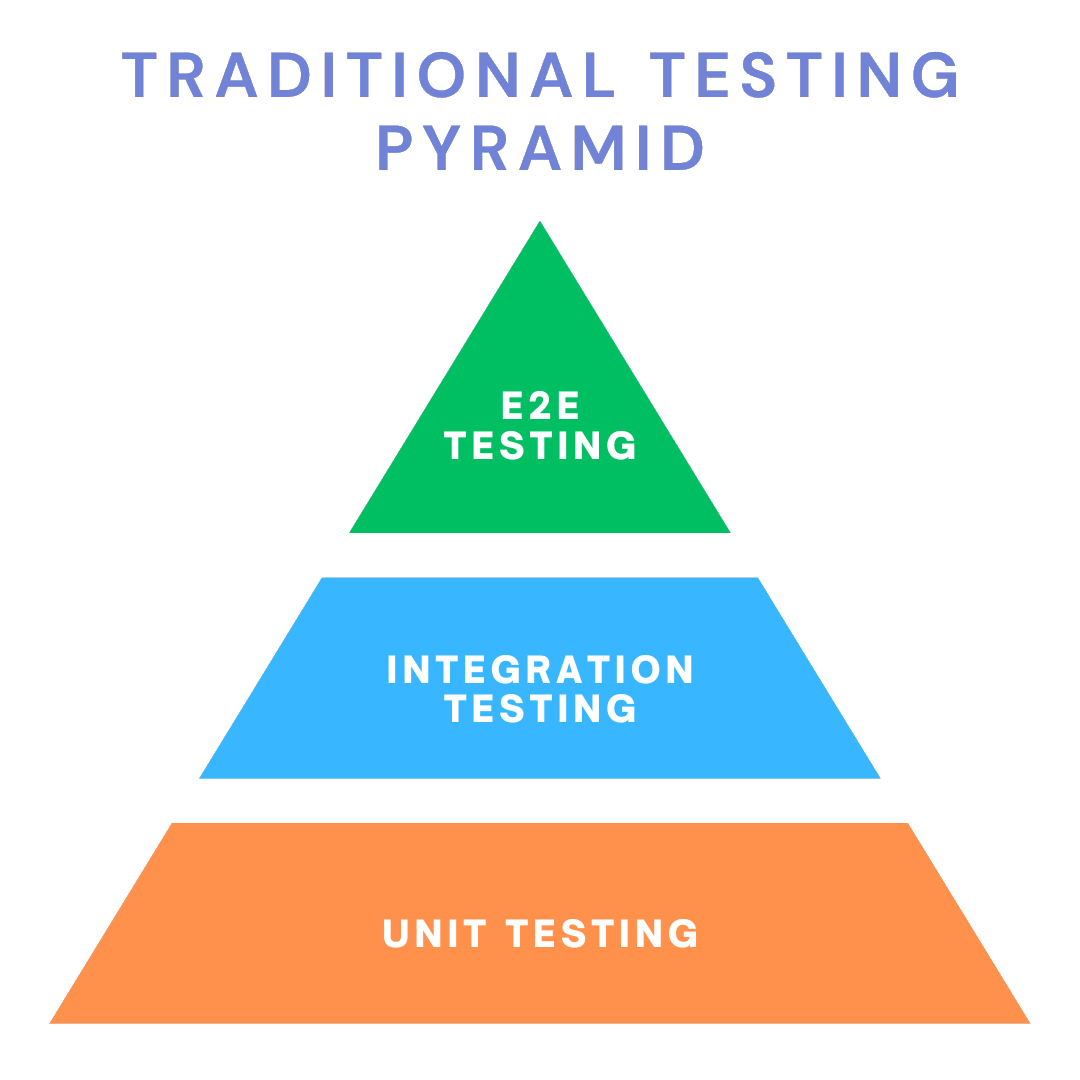
- Bottom layer, unit tests: These are quick, lightweight tests that test single functions or components in isolation. They’re there to make sure the underlings of the system will follow orders without any further dependence on external influences. Read: Unit Testing: Best Practices for Efficient Code Validation.
- Middle layer, integration tests: These tests verify that components or services work together as a whole. Their goal is to discover issues that arise when different components of the system interact or communicate. Read: Integration Testing: Definition, Types, Tools, and Best Practices.
- Top layer, end-to-end (E2E) tests: These are the tests that go through the application from beginning to end on a typical user workflow. They verify that the system works end-to-end when all pieces are in place and running at scale. Read: End-to-end Testing.
The shape says a simple rule: Have a lot of unit tests, a few integration tests, and very few E2E tests. The pyramid structure gives an idea like:
- Lower layers are very fast, so having more of them keeps the test suite quick.
- Higher layers are costly, slow, or fragile, so be cautious with them.
- Any logic should be checkable by unit tests.
- E2E tests should only cover “happy paths”, not edge cases.
Most bugs, the early practitioners claimed, resulted from flawed logic that unit tests could detect. This model served well in the traditional software environment, where we had relatively simpler, tightly coupled systems that were released less frequently. It worked really well for monolithic applications, server-rendered patterns, and teams with straightforward UIs. It was also a good fit for companies, with the longer release cycle and limited exposure to higher-level automation.
Read: How to Customize the Testing Pyramid: The Complete Guide.
The Inverted Pyramid: A Shift Toward Realism
The focus on the inverted pyramid is reversed from the traditional model. Instead of unit tests, end-to-end tests are on top, because this is the most effective approach for testing real user workflows. Integration tests follow, which will test that service interactions with databases and APIs function as intended in a realistic scenario. This model does not recommend generating additional end-to-end tests compared to unit tests solely for numerical purposes. Instead, it puts the test types that are best at finding real bugs and making sure the system works as it should at the top of the list.
Read: The Ice Cream Cone Testing Approach: Benefits & Pitfalls.
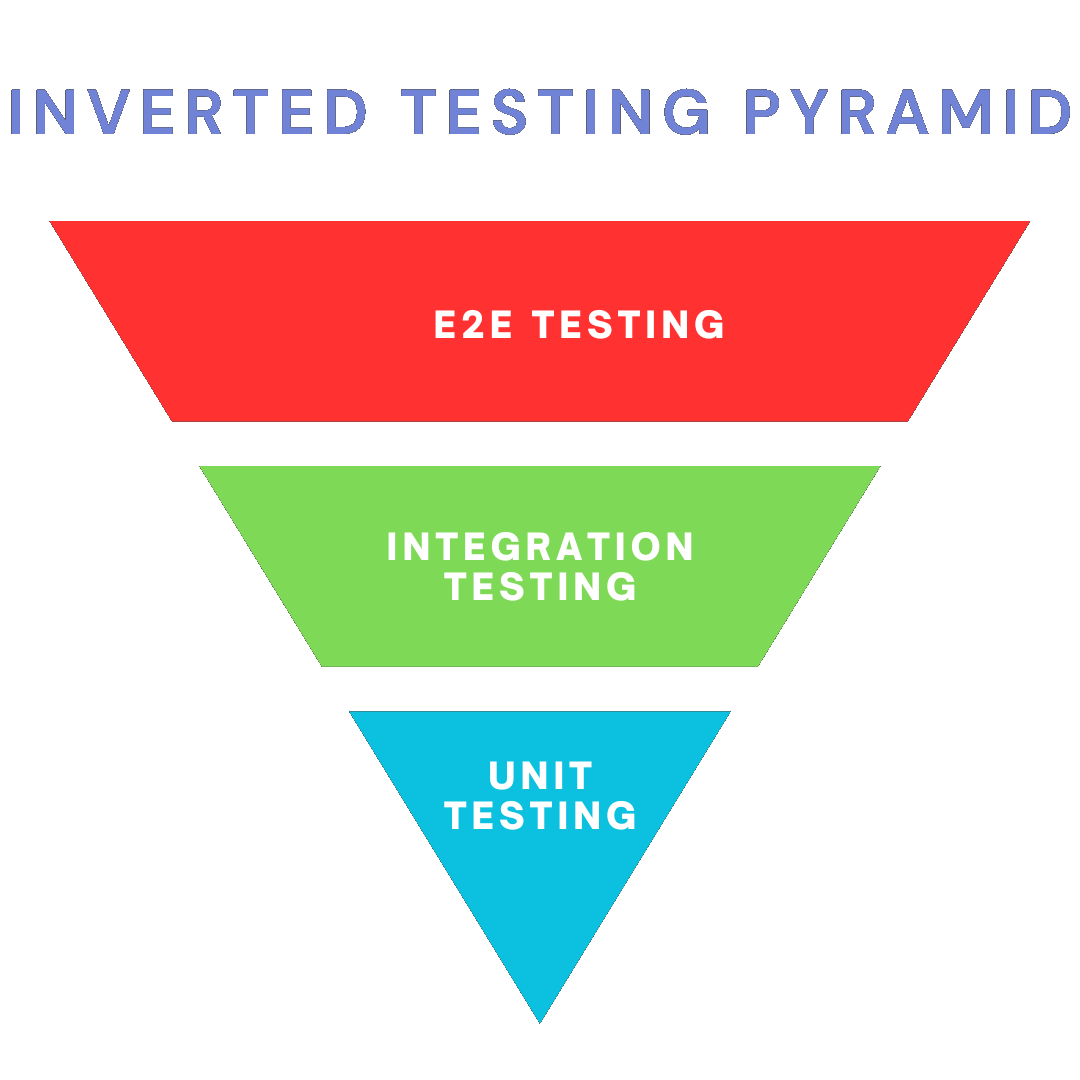
Under the inverted model:
- End-to-end tests form the broadest layer.
- Integration tests follow closely, validating real boundaries.
- Unit tests remain valuable but are fewer and more targeted.
The most crucial change is a conceptual one. The inverted pyramid encourages teams to test the system in the way that the users do, not in a manner that developers think behind-the-scenes functionality functions. It emphasizes behaviors and workflows over individual functions.
That does not make unit tests useless. Instead, it reframes their purpose. Unit tests in the inverted model are surgical instruments applied directly where there is some high-value logic that can not be validated efficiently through higher-level tests.
Why E2E and Integration Tests Matter More Today?
The inverted pyramid reflects an undeniable reality about modern software: the integration is where the real complexity lies. When your applications were monolithic, logic was mostly in functions and methods, and you could write a lot of unit tests to catch most bugs. In the distributed architectural world of today, it’s the edges that are more brittle than the core.
Why Unit Tests Alone Can’t Save You Anymore
A REST API could rely on validation services in some form, data serialization, message queues, and even shared schemas. Even tiny discrepancies in expectations can break entire features. A microservice can depend on other services to be up and running, or on its version or contract format. A stateful UI can even introduce confusion by showing incorrect data in response to slight differences in API responses. These problems don’t show up in unit tests filled with mocks; they always crop up when the system components engage with each other.
Realistic Testing is Now Affordable
Today, integration testing is no longer so expensive. With test containers, ephemeral databases, and local clusters, it’s now trivial to create a realistic system under test compared to a decade ago. The excuse for super-isolated unit tests is a lot less appealing when you can afford to be realistic. Additionally, tools such as testRigor that focus on testing the application from the end-user perspective and remove brittle locator dependencies show how stable and robust E2E automation is. Read more about testRigor Locators.
As a result, the inverted pyramid amplifies the importance of tests that validate actual user journeys and system interactions.
How the Inverted Pyramid Reduces False Confidence
One of the biggest and most misleading problems in traditional testing approaches is the illusion of stability created by having a large number of passing unit tests. A system can look completely healthy when examined through the narrow view of isolated tests, yet still hide serious issues in the parts where components actually work together. Unit tests can check that a function behaves correctly on its own. However, they cannot confirm:
- The APIs return the right structure
- The database queries match the schema
- The services agree on contract expectations
- The data flows correctly from the frontend to the backend
- The behaviors remain correct when interacting with real dependencies
The inverted pyramid minimizes the risk of false confidence by confirming behavior where it actually counts: in the system as a whole. Rather than asking, “Does this method work? It inquires “How well does the workflow work when all moving parts interact?” The latter issue is much more important to actual users.
Rethinking the Role of Unit Tests
The inverted pyramid also does not throw unit tests away. Instead, it clarifies where they provide real value. Current teams discover that the productive unit test coverage tends to surround code logic:
- Computationally complex
- Highly conditional
- Critical to correctness
- Hard to validate through higher-level flows
- Independent of external systems
- Sensitive to edge cases
Examples would be tax computations, pricing logic, encryption algorithms, parsing config settings, and data transformers. You wouldn’t get too far without those tests, because they play a vital role in validating correctness at a granular level. What the inverted pyramid takes away is the overinflated practice of writing unit tests just to meet some coverage number. Boilerplate tests, testing getter and setter methods or single-line methods that just return a value, are noise, not value.
The inverted model repositions unit tests as tools of precision rather than tools of volume.
Integration Testing as the Backbone of Reliability
Integration tests verify the logic between component services, APIs, databases, external providers, caches, event streams or anything else you connect to. Since the most fragile places are boundary zones, integration tests have an extremely high value in a contemporary system. These tests verify:
- Whether queries succeed against real schemas
- Whether services respond with accurate data
- Whether API endpoints adhere to expected contracts
- Whether events are published and consumed correctly
- Whether authentication and authorization behave as designed
- Whether messaging systems synchronize state correctly
The inverted pyramid derives its strength from the fact that integration tests verify reality, rather than theory. They do not infer mocks to reflect behavior; they clock the real components’ genuine behaviour. This makes a strong safety net, catching mismatches and failures that developers can’t think of when working in their sandbox.
End-to-End Testing as the Ultimate Source of Truth
End-to-end testing rides on top of the inverted pyramid as it is not the least number of tests, but rather is a way that gives us the most confidence. These tests simulate full user flows, allowing you to make sure that the whole system, involving UI, backend, database, and all integrations, works well together. Today, E2E tests don’t mean slow or flaky automation anymore. Parallel running, good browsers, working selectors, API-level instrumentation, and great test runners brought E2E testing to the light of a pragmatic and stable approach.
Read: What are Flaky Tests in Software Testing? Causes, Impacts, and Solutions.
E2E tests answer a very specific question that no other test can answer: Does the system behave as a user would expect?
Architectural Insights from the Inverted Pyramid
One of the unintended consequences of the inverted pyramid is architectural feedback. Systems that are difficult to test end-to-end frequently indicate larger architectural concerns:
- Excessive coupling
- Hidden dependencies
- Undocumented data flows
- Rigid service interactions
- Fragile APIs
- Implicit assumptions between components
When the tests struggle, the architecture is often to blame.
Thus, the inverted pyramid is not just a test strategy; it serves as a diagnostic tool. Systems that allow an easy verification process are probably well-designed systems, with a modular and adequate level of abstraction. This is the opposite of the traditional pyramid, where tests hid design flaws by putting each part behind mocks. The inverted model shows the truth instead of hiding it.
Takeaways from the Inverted Testing Pyramid
Here are a few points that need to be addressed while working with the inverted testing pyramid:
Aligning Testing with Real-World Risk
The inverted pyramid is a crucial framework for modern teams because it creates efforts of testing to the actual sources of risks we face in today’s systems. Unlike in the past, when small logic errors within single operations used to be the cause of most failures, today they arise from interactions between components at different levels. Issues like incompatible integrations, version differences, dirty-cache mishandling, or configuration errors only show up when a system is in flight.
These are system-level issues, not unit testing problems, so it should be no surprise that you don’t find them with traditional testing. Thus, testing tactics need to focus mainly on workflows, behaviours, and interactions rather than focusing exclusively on isolated correctness. The inverted pyramid definitely exhibits such a risk distribution and emphasizes the need to test how the whole system will operate in actual conditions.
A Philosophical Shift Toward Behavior
Fundamentally, the idea behind the inverted pyramid is to shift from code-centric testing towards behaviour-centric testing. Traditional unit testing tests for internal correctness, but the inverted pyramid is centered around checking external correctness, the way the system behaves from the user’s point of view.
Testing exists to verify the results rather than just checking whether specific functions work properly in isolation. Users do not care how many unit tests a system has. They care if it does what they want to achieve, and that’s exactly the idea behind the inverted pyramid: real behavior is more important than isolated behavior.
A Mindset, Not a Shape
Although the inverted pyramid is something one can “see” and identify, its true worth is in the way it trains you to think. It’s not a numbers game or a layers game; it’s about understanding where and how systems work, and where things really break.
It encourages teams to build testing strategies that mimic what users see, how real data moves, and how complex processes are actually executed across integrations. It is a fluid, flexible approach that’s well-suited to the real-world demands of modern engineering.
Conclusion
The inverted pyramid of testing is a new and realistic way to test software that takes into account how complicated, interconnected, and user-driven today’s software systems are. By focusing on E2E and integration testing, it makes sure that teams test the workflows, data flows, and system behaviors that are most important. It’s not a trend or a rejection of the past; it’s just a practical model that matches how modern systems really work.
| Achieve More Than 90% Test Automation | |
| Step by Step Walkthroughs and Help | |
| 14 Day Free Trial, Cancel Anytime |