What is an AI Center of Excellence?
 |
The AI Center of Excellence (AI CoE) is the most effective approach for a company to get AI to work and grow. It serves as a hub for knowledge and best practices to make sure that AI projects are in line with business goals, ethical standards, and legal requirements. An AI CoE helps organizations get the most out of AI by letting them work together, standardize their work, and keep learning.

| Key Takeaways: |
|---|
|
What is an AI Center of Excellence?
An AI Center of Excellence is a group or department in an organization that is in charge of planning, carrying out, and overseeing AI projects. Its main job is to lead, support, and guide AI projects in all of the company’s business units. The AI CoE is the center for all things AI, making sure that everyone is on the same page when it comes to scale, adherence, and other issues.
The concept of the Center of Excellence is not new; it has been used in many areas, such as IT, testing (TCoE), cybersecurity, and digital transformation. But now that AI has raised the stakes, it makes sense to have research hubs that focus only on the problems and possibilities of AI. These centers will be in charge of setting the strategic direction for AI, making rules and policies for testing and using AI, and making sure that there is a culture of honesty and innovation.
Understanding the AI Center of Excellence
AI CoEs are not just teams of data scientists or engineers. It’s a diverse function that pulls together experts from what ranges from data science, machine learning, and software engineering, to data management, research operations & ethics. The AI CoE sets strategy for the company’s use of Artificial Intelligence, establishes governance and workflow processes, and ensures that the team is focused on delivering business value.
The AI CoE also acts as a knowledge-sharing and talent enablement team. It provides training and resources to employees in the skills necessary for working with AI technologies. Additionally, the AI CoE is teaching intersilos and knowledge sharing as well.
The Purpose of the AI Center of Excellence
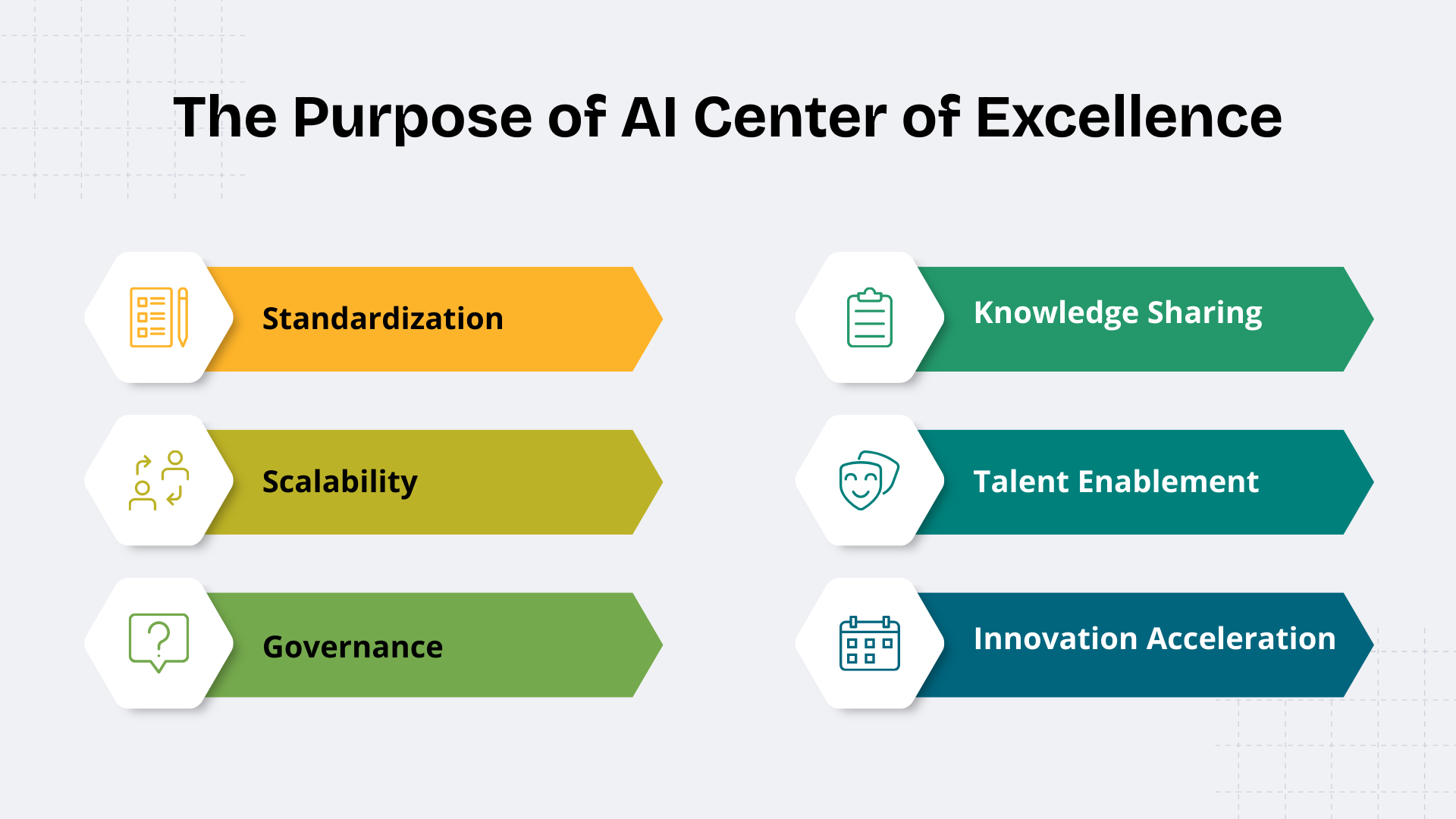
The main job of the AI CoE is to make sure that long-term strategic enterprise AI projects are successful and in line with the business. This includes a number of important tasks:
Standardization
One of the biggest problems with using AI is that there is no standard way to do it. Different teams may be using different technologies, following different procedures, and obtaining their data from various sources, all of which can lower efficiency and quality. At the core of this is the AI CoE that establishes a common pattern or “way” of doing both development and deployment, so projects are run consistently. This has to do with data governance framework and tools, things that are the standards, policy or process for managing data.
Scalability
AI efforts typically begin as small pilots or experiments, yet the ultimate objective should be scaling across the organization. The AI CoE provides scalable AI capabilities that multiple LOBs (Line of Businesses) and use cases can consume. That requires creating dependable infrastructure, automating processes, and making sure AI models work with the existing system.
Governance
There is momentum building on AI governance to make sure that AI work is ethical, transparent, and not playing by some unsaid rules. The AI CoE also develops the governance mechanisms that detail and assign responsibilities and roles, as well as the decision-making processes for any given project utilising AI. This applies to ethics committees, risk assessments, and oversight to make sure that AI systems do not become biased or otherwise tarnished. Read: AI Compliance for Software.
Knowledge Sharing
It’s a place of learning inside the company where employees can be trained and get access to AI information. It offers workshops, webinars and other types of group interaction to help spread best practices and bring a culture of continuous learning. The AI CoE also writes documentation and best-practice guidance to enable teams to successfully deploy AI solutions.
Talent Enablement
AI is a blend of data science and machine learning, combined with software development and domain knowledge. AI CoE is also tasked with recognizing talent gaps and creating programs to reskill the workforce. It works closely with HR to help recruit and retain great AI talent.
Innovation Acceleration
The AI CoE aims to incentivize an innovation mindset by encouraging experimentation and cooperation. It provides resources and support to teams that want to try new AI technology, as well as pilots for use cases. AI CoE partners with external entities like educational institutions, startups, etc., to be at the ecosystem level of R&D in AI.
Key Objectives of AI CoE
For AI projects to be successful and deliver value, the AI CoE must meet a number of important goals.
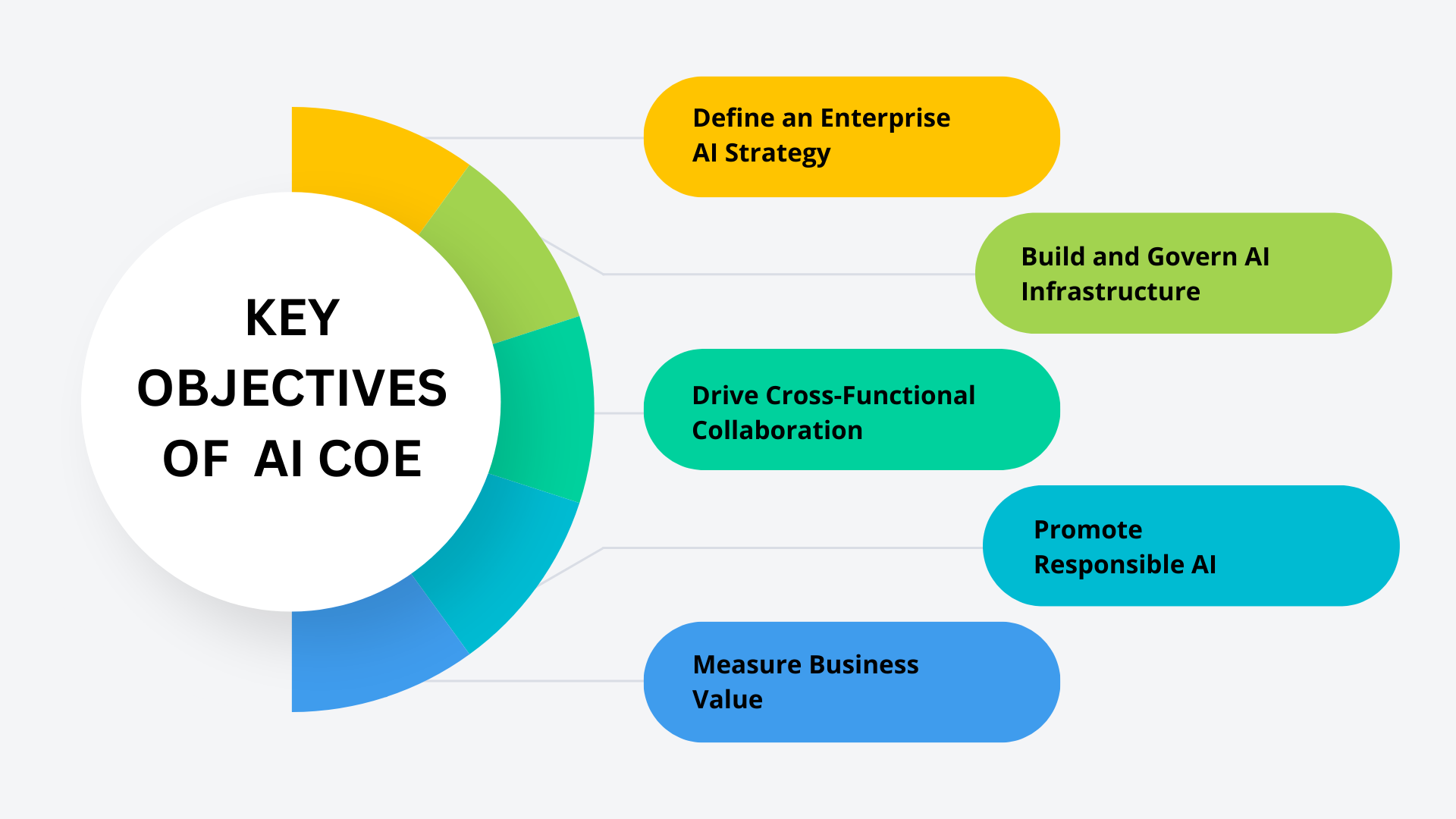
Define an Enterprise AI Strategy
The AI Center of Excellence is tasked with painting an end-to-end AI vision, capturing the organisation’s objectives in the big picture. This involves finding high-value use cases, ranking them, and creating AI adoption roadmaps. Or to put it another way, your AI strategy should be adaptable over time, accommodating changes in business needs and shifts in technology.
Build and Govern AI Infrastructure
The AI CoE creates and maintains the infrastructure that makes it possible for an organization to adopt AI. That comes down to storage and processing systems, machine learning platforms, and a pipeline for deployment. The AI CoE provides governance models for security, reliability, and compliance of the AI platform.
Drive Cross-Functional Collaboration
AI projects usually have a lot of people from different departments, such as IT, data science, business lines, and law. The AI CoE gets rid of barriers between departments and encourages people to share ideas and best practices. It also lets teams share their resources and knowledge.
Promote Responsible AI
The AI CoE’s role is to encourage the responsible use of AI, part of which is openness, honesty, and being accountable. It lays down rules and standards for the creation and use of AI, ensuring that AI systems are fair, unbiased, and obey rules. The AI CoE also performs regular audits and risk assessments to identify and resolve issues before they arise.
Measure Business Value
The AI CoE is responsible for establishing exactly how much money AI projects will make for the company. That includes defining key performance indicators (KPIs), having a way of measuring progress, and letting stakeholders know what happened. The AI CoE also evaluates the cost and benefit of its AI projects to ensure that they have been worth the money.
Structure of AI Center of Excellence
Depending on how big and complicated the organization is, the structure of an AI CoE can be different. But most AI CoEs have the following parts:
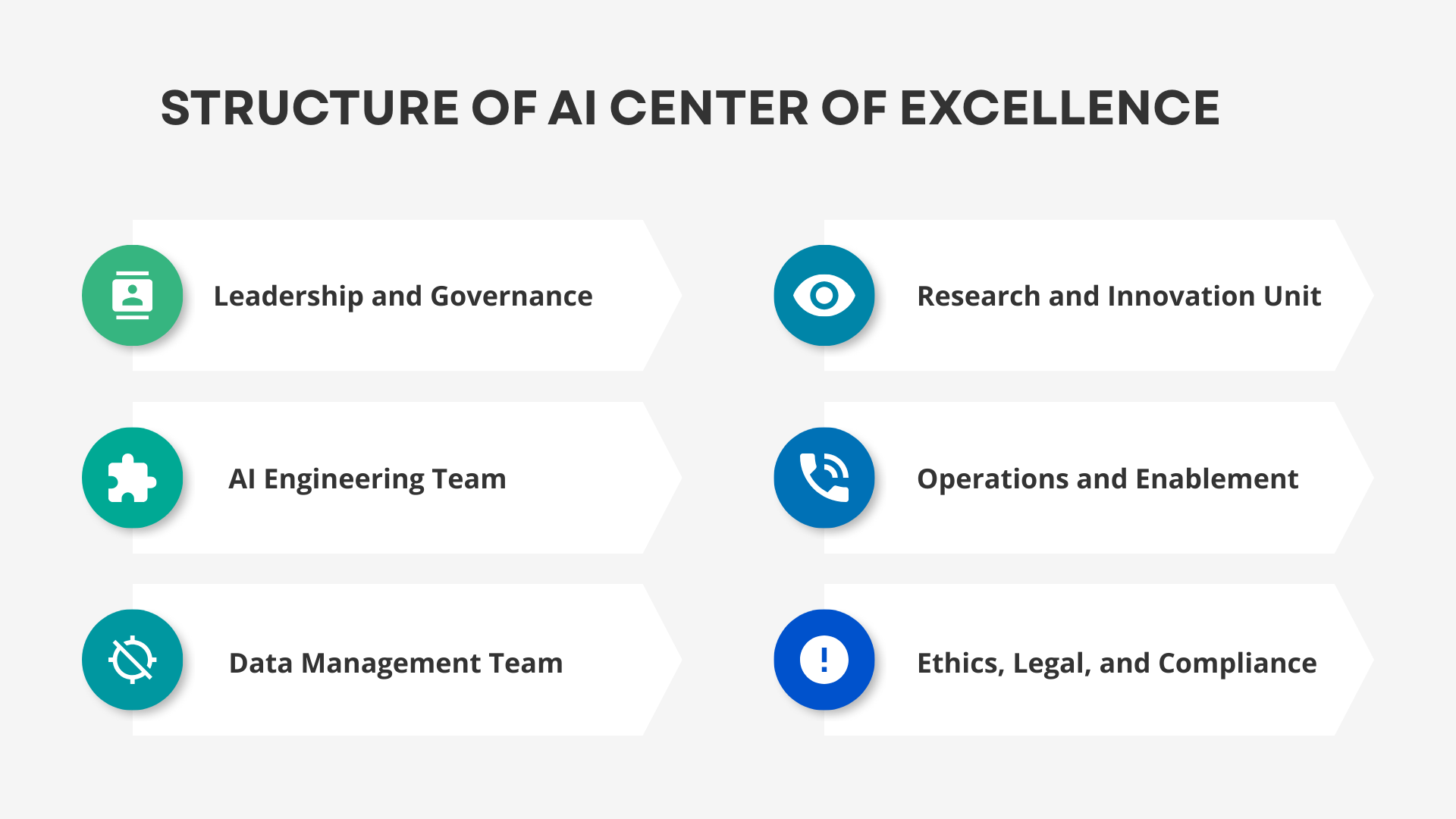
Leadership and Governance
The leadership and governance team is in charge of making sure that AI projects are in line with business goals and setting the strategic direction for AI. This group usually has:
- Chief AI Officer / AI Program Director: The AI CoE is led by the chief AI officer or an AI programme director who also sets the strategic direction. This position comes with the setting of a view for AI, prioritizing and ensuring that AI is realized consistently with other business objectives.
- AI Steering Committee: The AI Steering Committee is responsible for governance and decision-making. It consists of senior-level leaders from various teams and is responsible for approving AI projects, allocating resources, and tracking progress.
AI Engineering Team
The AI engineering team is in charge of making and using AI solutions. This group usually has:
- Data Scientists: They create algorithms and models to analyze data. They partner closely with business units to uncover use cases and create solutions that respond directly to a specific line of business need.
- Machine Learning Engineers: They are those who prepare and deploy machine learning models. They collaborate with data scientists to find solutions that scale.
- AI Architects: They design the structure and architecture of systems. They also validate AI solutions to make them scalable, secure, and compliant with regulations.
Read: Must-Have AI Tools for Engineers.
Data Management Team
The data management team is in charge of taking care of data assets and making sure that the data is correct, reliable, and easy to access. Usually, this team has:
- Data Engineers: They are tasked with developing and maintaining databases, data pipelines, and data warehouses. They make sure that AI projects have access to data.
- Data Stewards: They are responsible for data governance and quality. They make sure data is accurate, consistent, and regulatory compliant.
Research and Innovation Unit
The research and innovation unit is in charge of looking into new AI technologies and how they can be used. This unit usually has:
- AI Researchers: They are in charge of looking into new ideas and ways of doing things in the field of AI. They work with third-party groups like universities and startups to stay ahead of the curve in AI research and development.
- Innovation Evangelists: These people are in charge of spreading the word about AI innovation within the company. They put together hackathons, workshops, and other events to get people to work together and try new things.
Operations and Enablement
The operations and enablement team is in charge of helping AI projects and making sure that AI solutions are set up and kept up to date correctly. This group usually has:
- MLOps Specialists: They are in charge of setting up and running machine learning models. They make sure that models are deployed quickly and checked for performance and reliability. Read more about it in this MLOps Guide: Tools, Best Practices & Key Concepts.
- AI Trainers / Educators: They are in charge of giving employees training and help. They make training programs and materials to help workers learn how to use AI technologies.
Ethics, Legal, and Compliance
The ethics, legal, and compliance team makes sure that AI projects are legal, ethical, and follow the rules. This group usually has:
- AI Policy Managers: AI policy managers craft and enforce AI policies and guidelines. They maintain that the AI projects keep pace with moral guidelines and legal norms.
- Risk Officers: Risk officers have responsibility for carrying out risk assessments and checking that things are all shipshape with AI systems. They collaborate with the organization’s AI steering committee to identify and manage risks.
Pillars of AI Center of Excellence
The AI Center of Excellence (CoE) needs sound foundations to help the entire organization decide on things to do, set targets around those activities, and get them done. They ensure that AI projects are scalable, ethical, and aligned with business objectives. They also leave room for teams to develop original ideas.
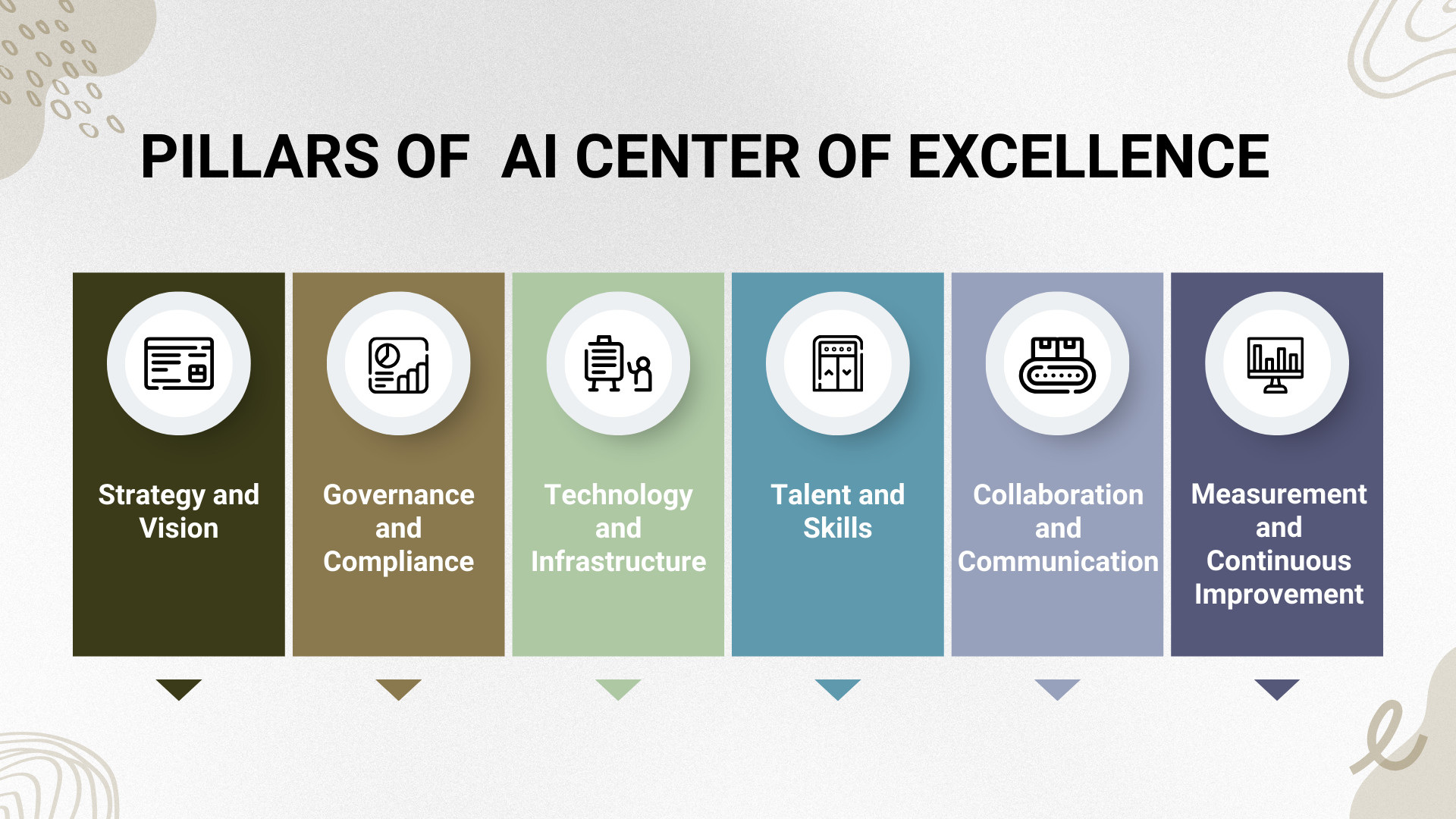
- Strategy and Vision: The AI CoE needs to have a clear strategy and vision that is aligned with the company’s objectives. This includes setting priorities, objectives, and a strategy for AI adoption.
- Governance and Compliance: The AI CoE will also build governance structures to ensure AI initiatives are ethical, transparent, and comply with regulations. This includes the setup of ethics committees, carrying out risk assessments, and monitoring AI systems for bias and other problems.
- Technology and Infrastructure: The AI CoE will have to create and operate the infrastructure required for other AI efforts. This ranges from storage and processing of data to machine learning platforms to build our models to deployment pipelines.
- Talent and Skills: The AI CoE will have to uncover talent gaps and then train personnel. It also collaborates with HR to hire and retain top AI talent.
- Collaboration and Communication: The AI CoE should enable collaboration and communication between departments. This involves dismantling silos, promoting the flow of ideas and best practices, and creating an environment for teams to share resources and knowledge.
- Measurement and Continuous Improvement: The AI CoE should set KPIs, update progress, and share results with stakeholders. It will also do a regular review and audit to find areas for improvement and make sure AI projects are adding value that the company expects.
How to Set Up an AI Center of Excellence
Setting up an AI CoE is a difficult task that needs careful planning and execution. Here are the steps to follow to set up an AI CoE:
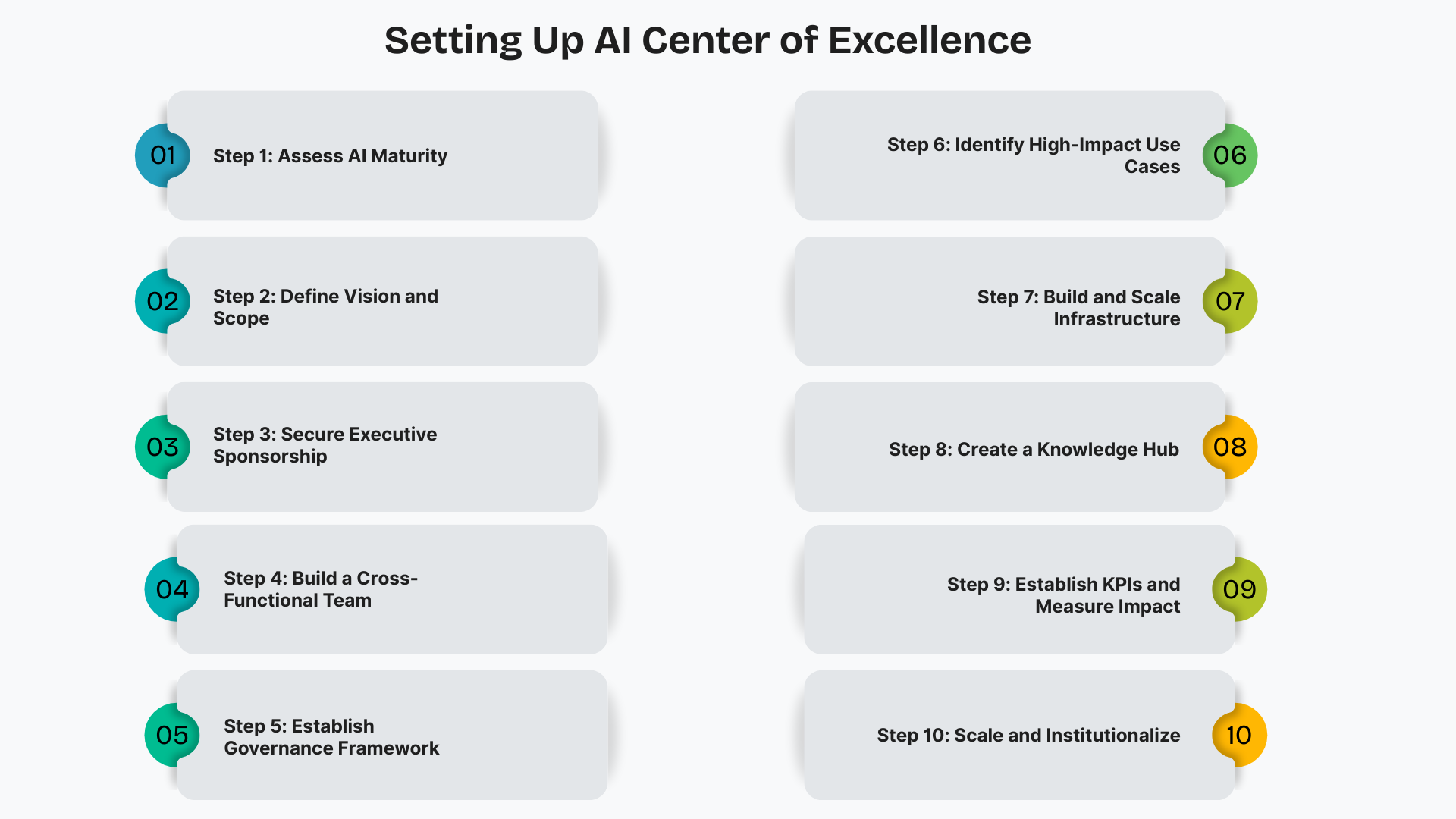
- Step 1: Assess AI Maturity: The first step is to evaluate the existing state of AI maturity in your organisation. It involves assessing your current AI capabilities, finding out what’s missing, and understanding how ready the organization is for AI implementation.
- Step 2: Define Vision and Scope: The second step is to define the vision and scope of the AI CoE. That involves clarifying priorities, articulating goals, and creating a path to adopting AI.
- Step 3: Secure Executive Sponsorship: AI projects need a sponsor from top management for the necessary resources and support. The AI CoE should have support from executive leaders and create a steering committee to guide the work on artificial intelligence.
- Step 4: Build a Cross-Functional Team: As cross-functional teams are the key to organizational success, the AI CoE should set up a diverse team with all expertise from data science, machine learning, software engineering, data management, research, operations, and ethics.
- Step 5: Establish Governance Framework: The AI CoE should develop governance frameworks that specify the roles, responsibilities, and decision-making criteria for AI initiatives. Those include the establishment of ethics panels, assessments of risk, and monitors on AI systems to check for bias and other problems.
- Step 6: Identify High-Impact Use Cases: AI CoE must identify high-impact use cases that correspond to business objectives. This means focusing on the projects that provide the most benefit and have the highest chances of success.
- Step 7: Build and Scale Infrastructure: Develop the infrastructure that will enable and be capable of supporting AI. This ranges from storage and processing systems to machine learning platforms to deployment pipelines.
- Step 8: Create a Knowledge Hub: The AI CoE must establish a knowledge hub that trains, supports, and shares resources with employees. This will involve planning workshops, webinars, and other learning events to disseminate best practice to promote ongoing learning.
- Step 9: Establish KPIs and Measure Impact: The AI CoE must set and measure the impact of AI initiatives. This means tracking progress, sharing results with stakeholders, and partnering to do cost-benefit analyses to ensure AI programs provide a positive return on investment.
- Step 10: Scale and Institutionalize: The last step is to scale and institutionalize AI efforts organization-wide. That includes building AI solutions into pre-existing systems, fostering a culture of innovation, and ensuring that AI initiatives are sustainable and aligned with the business.
AI CoE and Responsible AI
The AI CoE is a cornerstone to drive responsible adoption of AI. This involves setting clarity in terms of ethics, transparency, and oversight to model behavior. It also encourages teams to prioritize fairness, accountability, and privacy by preventing unintended bias in AI systems. By being involved in both ongoing education and governance, the CoE ensures that responsible AI is not an add-on but becomes something integrated as a fundamental principle.
Ethics Committees
The AI CoE should create ethics boards to monitor the use of AI to make sure it is ethical, fair, and compliant. Ethics committees are meant to perform risk assessments, monitor AI systems for bias and other problems, and make recommendations on ethical use.
Bias Detection Frameworks
The AI CoE needs to develop bias detection frameworks that can be used to identify and rectify biases present within AI solutions. This is addressed by auditing both training (with respect to different datasets) and fairness metrics.
Transparency & Explainability Practices
The AI CoE will promote principles of transparency and explainability to ensure AI systems are both understandable and accountable. You can do this by writing down your success stories and using basic models that stakeholders find easy to understand.
Conclusion
An AI Center of Excellence is a cornerstone in any organization’s AI strategy. It leads, guides, and supports AI initiatives aligned with business goals, ethical principles, and regulatory requirements. AI CoE helps companies to maximize the potential of AI while minimizing risks and inefficiencies by fostering collaboration, standardization, and continuous learning. The AI CoE becomes increasingly critical as AI matures to help the business innovate with and responsibly use AI at scale.
| Achieve More Than 90% Test Automation | |
| Step by Step Walkthroughs and Help | |
| 14 Day Free Trial, Cancel Anytime |