
The Role of AI in Root Cause Analysis (RCA): How AI Accelerates Problem Detection
 |
Software today is much more complicated than it was a decade ago: instead of simple, deterministic applications, we’re now dealing with distributed systems of microservices, APIs, containers, cloud infrastructure, event-driven integrations, and third-party platforms. Artificial Intelligence makes Root Cause Analysis more challenging but interesting. Old methods of reading logs and code become infeasible with the scale at which logs, metrics,, and traces are generated.
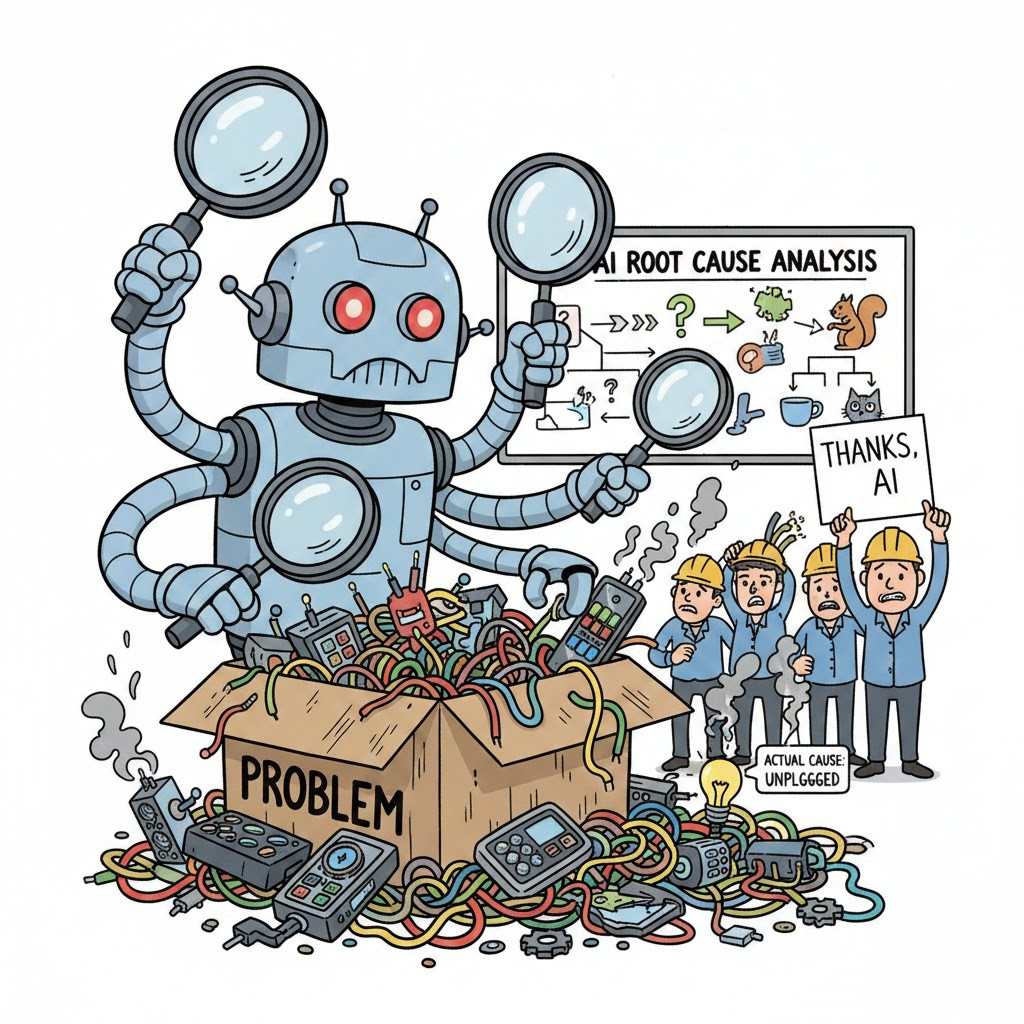
In this perspective, AI is a diagnostic colleague for engineers rather than a replacement. AI can quickly process millions of signals, recognize abnormal behavior,, and track the trouble down to its actual root source, not just where you see symptoms. This makes RCA evolve from a painstaking guessing game to a more solid, holistic knowledge of complex systems.
| Key Takeaways: |
|---|
|
Why AI has Become Essential for RCA
This is not an optional thing anymore, AI is now mandatory for RCA, because the architecture of system failures is different. As companies moved to microservices, serverless computing, cloud native APIs, and continuous deployment pipelines, the complexity of each digital journey multiplied the number of components involved. More complexity made it harder to discern where things go wrong.
Traditional RCA breaks down when:
- Failures occur across multiple services
- Logs contradict each other or appear in different formats
- Incidents involve multiple asynchronous events
- The same failure has many potential origins
- Symptoms appear far from the actual root cause
AI overcomes these limitations by studying the behavior of systems over time. It is able to reveal anomalies, even if they are only slightly abnormal or depending on context. It draws links between components that even engineers might not consider related. It analyzes historical data for patterns that could be used as references in detecting outliers.
AI-driven RCA makes sure that teams don’t get stuck in an endless cycle of reactive troubleshooting in a world where releases happen every day and services run on unpredictable traffic patterns.
For QA teams specifically, this is where platforms like testRigor become critical. As releases speed up and UI changes happen daily, testRigor’s AI analyzes historical test runs and patterns of failure to quickly distinguish between genuine product defects and noise caused by flaky tests, environment instability, or minor UI shifts.
Read: What are AI Hallucinations? How to Test?
How AI in RCA Actually Works
AI-based Root Cause Analysis goes beyond simple log inspection to create an intelligent model of your system’s behavior as a whole. By continuously learning patterns, relationships, and signals across the distributed nature of environments, AI is able to identify not just what went wrong, but why it went wrong and how the failure occurred.
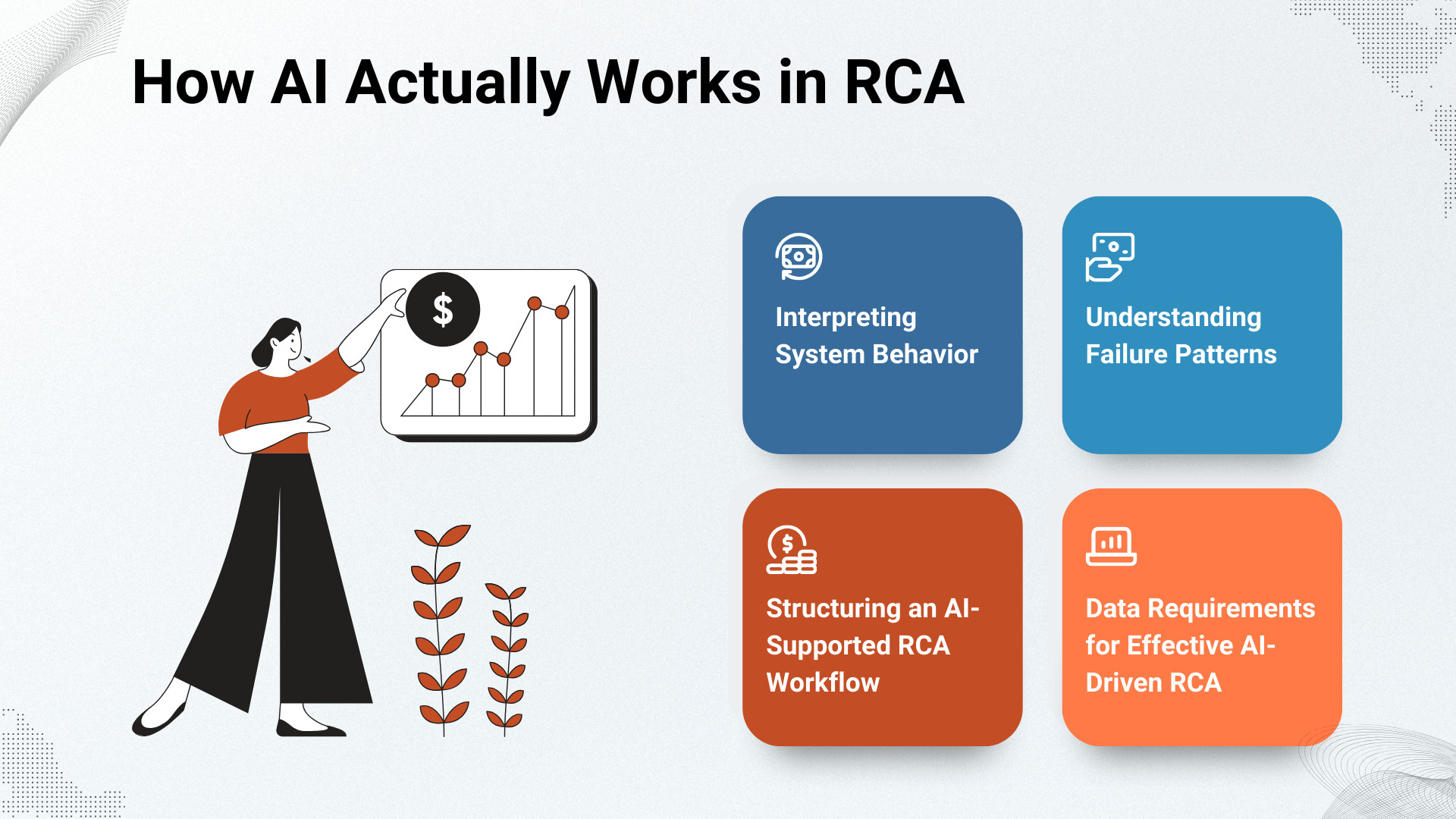
Interpreting System Behavior
AI doesn’t just “look at logs.” It constructs a holistic mental model of what the system does. It analyzes streams of data, recognizes normal working levels, interprets statistical deviations, and comprehends performance baselines. AI develops a view of the system through several layers:
- Learning Normal Behavior: AI sees how services work under normal circumstances and applies this knowledge to recognize deviations.
- Understanding Service Relationships: It explores dependencies, communication relationships,, and resource sharing across the architecture.
- Mapping Data Flow: AI understands the paths that requests take through microservices, queues, APIs, and databases.
- Recognizing Anomaly Patterns: It detects recurring patterns that have historically havebeen associated with certain types of failures.
Read: What is Responsible AI?
Understanding Failure Patterns
Failures today are seldom the fault of a single source anymore. Instead, they come out of a set of circumstances that only make sense when we put them together. One service issuing a slow query can lead to timeouts in another. This type of trade-off can increase the memory footprint in certain traffic patterns. A downstream might occasionally refuse a request, and this should only appear at high load. AI is better in this area because it doesn’t just rely on human intuition. Instead, it looks at patterns in millions of data points to figure out how problems happen.
- Cross-service Propagation: Failures propagate across services and systems, causing symptoms to emerge in a distant downstream place from the source cause.
- Hidden Latency Trends: Deteriorations develop gradually, frequently not being obviously detected until they accumulate and reach a threshold.
- Conflicting Signals: There can be discrepancies between logs and metrics, with manual interpretation hard to understand.
- Environment-specific Behavior: Problems may be experienced only in certain areas, environments or on specific device types.
Read: Effective Error Handling Strategies in Automated Tests.
Structuring an AI-Supported RCA Workflow
AI-enhanced RCA workflows don’t feel like a bunch of separate tools. It feels more like a smooth and smart flow.
It starts with streaming data in real-time from logs, traces, and metrics. AI observes all of this and looks for the early signs that something unusual is occurring. Once any anomalies are detected, AI automatically gathers contextual evidence, groups symptoms together,, and attributes which services are affected. It then backtraces the event stream and emphasizes which part of that sequence is out of the norm.
AI then checks the event signature against failure patterns to determine if the problem looks similar to an issue in the past. And if it does, AI brings up previous resolutions or known preventive strategies. Finally, AI provides a clear explanation of the root cause and displays proof points showing why it reached that conclusion.
Read: Root Cause Analysis Explained.
Data Requirements for Effective AI-Driven RCA
To give reliable results, AI-driven RCA needs to have enough data coverage. Here are the most important types of diagnostic data that AI needs:
- Operational Telemetry: This comprises logs, metrics, tracing data, and alerts that originate from each microservice and its corresponding component.
- Traffic Patterns: AI requires request timing, load distribution,, and user behaviour to figure out what is normal.
- Infrastructure Signals: CPU utilization, memory usage, autoscaling, and restarting of containers indicate far more serious problems.
- Application State Data: AI analyzes variables such as queue lengths, database query times, and session activity.
- Deployment History: Changes in configuration, code, or environment help AI pinpoint which update introduced the issue.
Read: Anomaly Reports: How to use AI for Defect Detection?
How AI Analyzes and Learns from Distributed Systems
AI provides a genuinely new level of insight to Root Cause Analysis as it can analyze system behaviour in ways that are impossible for humans. Particularly true for the scale and speed that far exceed human capability. Through identifying the trends that usually occur, correlating the signals and learning from past cases it has seen, AI is changing RCA from something being done reactively to a system of proactive knowledge.
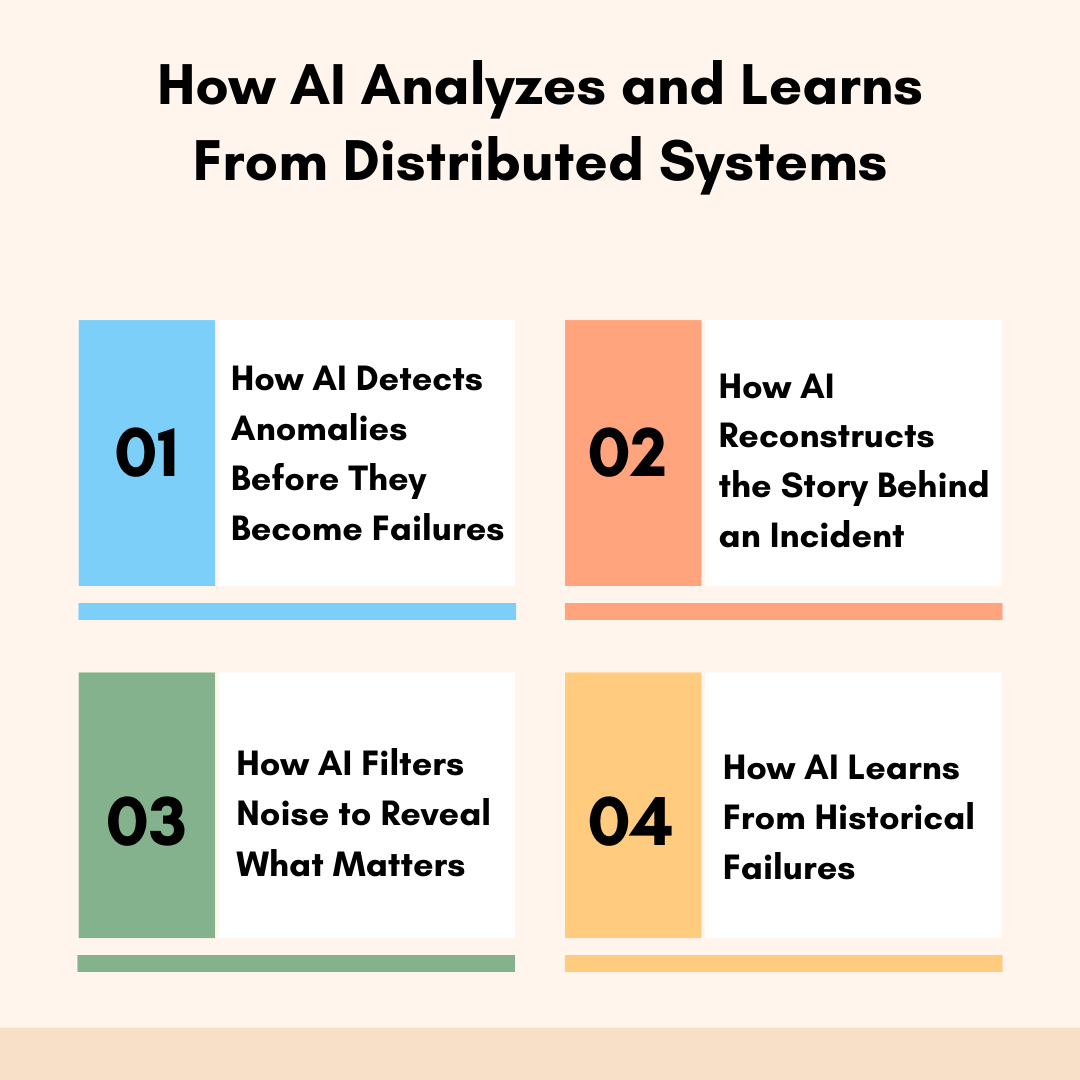
How AI Detects Anomalies Before They Become Failures
AI radically changes Root Cause Analysis by getting to know the normal behavior of a system and finding minor deviations from that baseline much earlier than legacy threshold-based monitoring. Rather than depending on predetermined rules, it spots anomalous patterns as they unfold, often hours in advance of an attack, so teams can act in a preventative way. This move is a game-changer for engineering organizations to catch failures before they impact users.
- Behavioral Shifts: AI recognizes differences in service response times, transaction throughput or user interactions from normal behavior.
- Load-sensitive Fluctuations: Artificial intelligence can determine if performance dips are related to times of heavy usage or traffic anomalies.
- Resource Imbalances: AI can alert to CPU, memory,, and I/O usage that has diverged from normal patterns.
- Rare Event Detection: AI identifies unusual spikes or drops that happen in extremely low frequency, but still are a source of major failures.
Read: What is Model Context Protocol (MCP)?
How AI Reconstructs the Story Behind an Incident
When a system breaks down, the obvious signs don’t usually show the full chain of events that led to the failure. AI puts together this hidden story by connecting raw signals from different services and turning them into clear, ordered sequences. Instead of thousands of unrelated data points, engineers get a clear timeline that shows what happened, when it happened, and why.
- Signal Alignment: AI correlates different logs and traces coming from multiple systems, even if their time stamps or clocks are not perfectly synchronized.
- Cause-and-Effect Grouping: AI picks out which anomalies were the ones that caused downstream events, and which just occurred as a result.
- Path Reconstruction: AI reconstructs the precise path an event traveled through microservices, infrastructure layers,, and third-party integrations.
- Service Interaction Mapping: It identifies how failures in one service influenced behavior in others.
How AI Filters Noise to Reveal What Matters
Modern monitoring systems generate a massive amount of data. Alerts trigger from dozens of dashboards. Log files containing warnings, exceptions, and debug information grow constantly. Metrics fluctuate constantly. Amidst this ocean of signals, only a few, a small fraction, are indications of the actual root cause.
Noise is one of the major barriers to successful RCA, and AI is significantly helping to overcome such noise. Rather than overwhelming engineers with every anomaly, AI identifies the signals that veer meaningfully from the typical.
- Irrelevant Event Removal: AI eliminates logs, alerts, or metrics that are frequently observed during regular operations.
- Duplicate Symptom Consolidation: Identifies and groups warnings that share a common root cause.
- False Positive Reduction: AI learns patterns that do not result in failure and prunes them from the investigation trail.
- Event Prioritization: It scores the anomalies on severity, confidence of impact, and strength of correlation.
Read: What is an AI Center of Excellence?
How AI Learns From Historical Failures
AI learns from every moment it witnesses. Every single failure has given a wealth of information to better model and predict the future. This results in a progressive feedback loop where RCA becomes more accurate with time.
- Recurring Pattern Recognition: AI recognizes when an existing problem closely matches a previous incident and remembers how that was resolved before.
- Signature Matching: It identifies the logs that share similar patterns, stances or behaviors that might have arisen from a common cause.
- Preventive Insight Building: AI predicts where the system is most likely to break and identifies which of its components are more susceptible to future failures.
- Root Cause Clustering: It clusters like root causes over months or years to demonstrate systemic gaps.
AI Applied to Specific RCA Scenarios
Like all modern systems, which are getting more complex and larger in scale, Root Cause Analysis also needs to evolve to handle different failure patterns across deployments, testing pipelines,, and production. AI speeds up, deepens, and makes RCA more accurate by solving for known contexts where common sense methods fail.
How AI Handles Deployment-Related RCA Scenarios
Deployments involve modification at multiple levels of the system’s application code, configuration values, container images, environment variables, and dependencies, among others. All its working parts mean failures often get introduced while they are being deployed, and sometimes aren’t immediately obvious.
AI is able to cut down troubleshooting time significantly in the release cycles because it analyzes deployment metadata and correlates that with the behavior of the systems soon after a release.
- Version Comparison: AI accurately detects which changes in the new release distinguish it from previous stable versions.
- Behavioral Differences: It identifies the manner in which the system behavior changes post-deployment, leading to anomaly areas.
- Behavior Fingerprinting: AI develops a “behavior fingerprint” for each deployment and highlights discrepancies when anomalies are detected.
- Rollback Indicators: Decide if the release is to roll back based on failure severity and frequency.
Read: What Is “Vibe Slopping”? The Hidden Risk Behind AI-Powered Coding.
How AI Supports RCA in Automated Testing Scenarios
Today’s test automation generates a huge amount of data, including logs, screenshots, DOM snapshots, performance traces,, and recorded interactions. Platforms like testRigor centralize this information and apply AI to interpret it. Interpreting the test failures is often challenging because not all of them correspond to true bugs. Some of these failures are caused by unstable or inconsistent environments, test data, and eventual consistency lags in distributed systems.
AI enhances RCA in a testing environment by studying the execution patterns and determining if certain things are more likely causes of false or flaky failures.
- Failure Categorization: AI differentiates true failures from environmental issues and flakiness. For example, testRigor can mark a test as flaky when it sees inconsistent behavior across runs, even though the underlying application logic hasn’t changed.
- Test Pattern Analysis: It identifies tests that repeatedly fail under specific conditions. testRigor’s analytics highlight which test cases or suites are the most unstable, giving teams a prioritized RCA backlog.
- Visual State Recognition: AI examines screenshots to detect misplaced UI elements, rendering delays, or missing components. Using visual and structural analysis, testRigor can show exactly which UI element moved, changed text, or disappeared between a passing and failing run.
- Comparative Trace Analysis: It compares failing execution traces with previous successful ones to identify deviations.
Why AI Resolves RCA Scenarios Through Accelerated Analysis
One of AI’s greatest benefits in Root Cause Analysis is speed, and it can bring down the extended timelines created by manual log reviews, re-investigations,, and issue reproduction. AI does the heavy lifting on analytics, rapidly scanning through petabytes of logs, metrics,, and traces to detect meaningful patterns. And engineers get targeted insights that focus on anomalies, event correlations,, and probable root causes rather than having to sift manually through the data.
- Automated Event Reduction: AI reduces the data set from thousands of logs to just those few lines that are relevant.
- Direct Cause Highlighting: Instead of showing symptoms, AI also shows the specific anomalous event that is a direct cause of failure.
- Faster Pattern Recognition: In seconds, AI will be able to compare the similarities between past occurrences, saving hundreds of hours searching per incident by hand.
- Time-Aware Prioritization: AI classifies anomalies on the basis of when they happen and how much importance they carry.
How AI Helps Teams Avoid Recurring Failures
The next highest pain point for engineering and SRE teams is recurring issues. But without a clear RCA, failure can come back again and again, particularly in systems with band-aids covering the root of the issue. Artificial intelligence (AI) cuts down recurrence by pinpointing underlying structural causes, not just temporary warning signals.
- Systemic Weakness Detection: AI spots patterns of instability that appear across different incidents.
- Recurring Behavior Identification: It flags failures with similar signatures, even when they appear in unrelated parts of the application.
- Hidden Trigger Discovery: AI uncovers rare or subtle triggers that set off repeated failures.
Handling Multi-Layer Failures and Complex Environments
Modern software environments are increasingly complex, with failures rarely confined to a single layer or component. To manage this complexity effectively, teams need approaches that can correlate signals across systems and anticipate issues before they escalate, which is where AI-driven analysis becomes essential.
Resolving Multi-Layer Failures With AI
Multi-tier failures are particularly difficult to work with because there is an extra level of confusion as symptoms manifest in different areas, including apps, infrastructure, networking, integrations,, and user experiences, often where no single team owns the entire stack.
AI breaks down Root Cause Analysis, by alerting independently in every tier, whether it is detecting a wrong application logic, infrastructure resources problematicity, network downtimes or third-party service failures and/or user impact signals. It then aggregates these results into a single diagnosis that illustrates how failures are propagated up layers.
Building Predictive Reliability With AI
A good RCA is not just telling the story of previous failures, but also about predicting future system behavior. AI makes this possible through the creation of predictive data models that serve as indicators against load stress, provide insights into early resource fatigue, and monitor patterns when traffic starts to deviate from stability.
It can even assign probabilistic risk scores to candidate failure points and expose gradual performance deterioration that is often invisible to humans, helping teams to proactively build stronger systems before an issue develops into an incident.
AI-Powered RCA Recommendations and Challenges
Root Cause Analysis powered by AI not only has the ability to explain failures, but also to assist teams in preventing future incidents and driving up system reliability. But for these benefits to be fully realized, organizations must weigh what’s offered by AI-powered suggestions against the realities of how AI is put into practice in complex production environments.
Strengthening Incident Prevention Through AI Recommendations
After learning the patterns of failures and system behavior, AI can also provide proactive recommendations instead of only being used to explain incidents. This reliance on such methods also includes reinforcement of configurations, architecture design, and strategy, tuning thresholds of alerts, capacity planning for data flow bottlenecks,, and guidance for testing priorities to lower future risk. Organizations apply these lessons learned and ongoing improvements to the reliability and save their skin by doing so.
Challenges and Considerations When Using AI for RCA
AI is beneficial to RCA when properly leveraged. However, it also introduces challenges that need to be addressed carefully to ensure responsible adoption. Problems like poor data quality, spurious correlations, model drift, incomplete telemetry, and interpretability of insights can prevent the impact if not solved. AI is not a substitute for engineering judgment; rather, when used responsibly and trained/validated appropriately, it becomes a very robust, trusted tool in incident analysis.
Final Thoughts
Root Cause Analysis is now an advanced, automated, and proactive solution that can analyze environments so thoroughly that it uncovers the deepest issues that no human could identify by hand. By learning from past failures and leveraging real-time telemetry, teams can more effectively detect problems early, diagnose them quickly, and prevent them from recurring. AI, a rock star resource that it is, ultimately pushes RCA from mundane tasks and into a strategic capability, enhancing reliability and product quality, giving engineers more time to focus on building rather than breaking things.
| Achieve More Than 90% Test Automation | |
| Step by Step Walkthroughs and Help | |
| 14 Day Free Trial, Cancel Anytime |