Understanding Pair Prompting in AI
 |
Generative AI is typically framed as an interaction between a user and a model where the user submits a prompt, the model generates a response, and the user evaluates the output. But, in general, important work like business proposals, software development, policymaking, and writing content is all better with multiple perspectives and review.
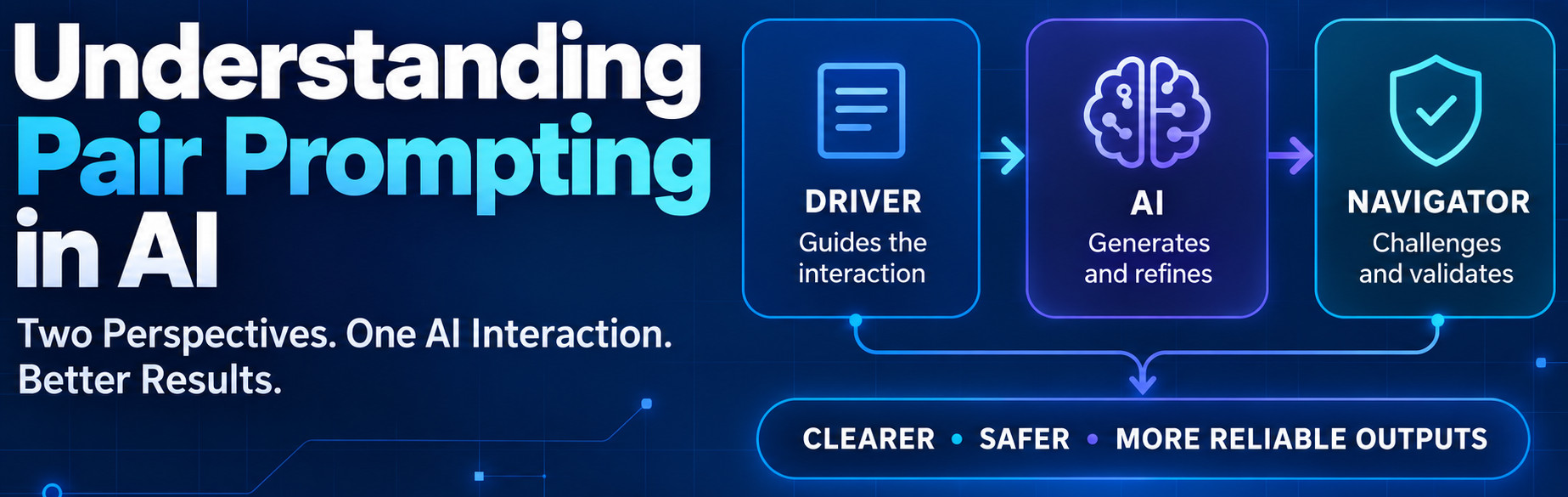
Pair prompting takes this collaborative approach to AI further by having two people collaboratively design, refine, and evaluate prompts using the same system. Similar to pair programming, one person drives the interaction, while the other reviews assumptions, finds gaps, questions inaccuracies, and makes sure the output is aligned to the intended goal.
| Key Takeaways: |
|---|
|
What is Pair Prompting?
Pair prompting is a collaborative practice in which two people jointly guide an AI system to complete a task. Both participants share responsibility for defining the objective, providing context, developing prompts, interpreting the AI’s responses, and validating the final result.
The most common roles are the driver and the navigator.
The driver directly interacts with the AI. This person enters the prompts, provides additional context, asks follow-up questions, and keeps the task progressing.
The navigator observes the interaction from a broader perspective. This person identifies missing information, questions assumptions, detects inconsistencies, considers alternative approaches, and checks whether the AI’s response meets the intended objective.
- What happens if two users select the same appointment simultaneously?
- How should the system handle an expired session?
- What happens if the appointment is created but the confirmation message fails?
- Has accessibility been considered?
- How are time-zone differences managed?
The resulting prompt becomes much more comprehensive than one written by either participant independently. The participants can switch roles during the session. This prevents one person from becoming a passive observer and helps both participants understand the complete problem. In some cases, the roles may be based on expertise rather than who operates the interface. A security specialist may continuously review risks, while a developer focuses on technical feasibility.
Pair Prompting vs. Prompt Engineering
Prompt engineering focuses on how an individual structures instructions, context, constraints, and examples to get better results from AI. Pair prompting takes this a step further by having two people collaborate while interacting with the AI.
For example, a QA engineer and developer might work together to generate test scenarios. The QA engineer focuses on user behavior, edge cases, and expected outcomes, while the developer contributes technical constraints, API behavior, and possible failure conditions. Together, they review the AI’s response and refine the prompts.
In simple terms, prompt engineering improves how we communicate with AI, while pair prompting improves how people collaborate around that AI interaction.
Pair Prompting Workflow
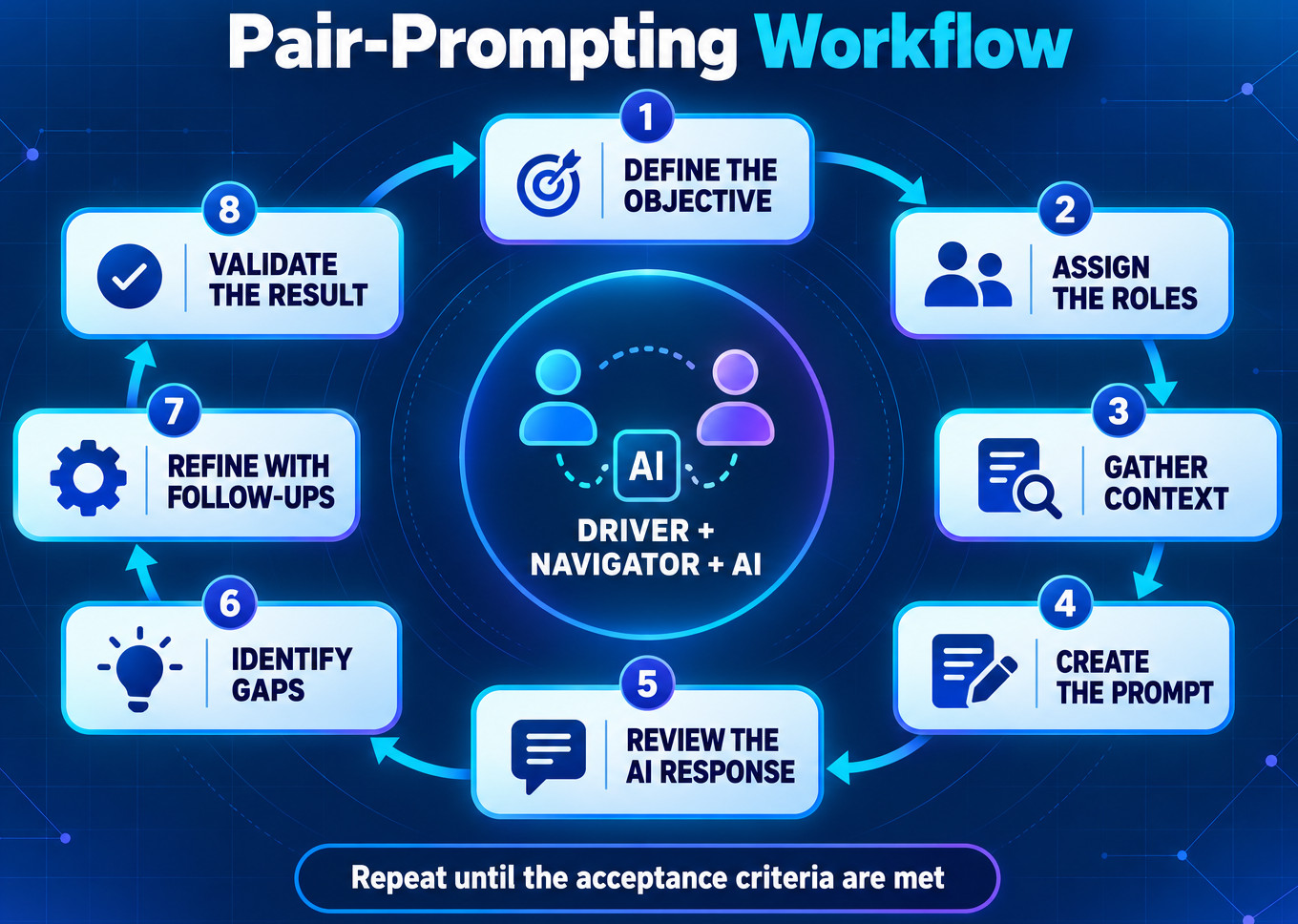
- Define the objective.
- Establish the participants’ roles.
- Collect the relevant context.
- Create the initial prompt.
- Review the AI-generated response.
- Identify gaps, errors, and assumptions.
- Submit targeted follow-up prompts.
- Validate the final result.
The process begins before anyone enters a prompt. Both participants first need to agree on the intended outcome. For example, “Generate test cases for a login page” is too broad to produce a focused result. A better objective would be:
"Generate 15 test cases for the login functionality of an e-commerce application. Cover valid and invalid credentials, empty fields, password rules, account lockout, forgot-password flow, session behavior, and relevant security scenarios. For each test case, provide the test scenario, preconditions, test steps, test data, and expected result in a table. Include positive, negative, boundary, and edge cases."
This definition clarifies the audience, scope, format, expected content, and important restrictions. The pair then decides who will act as the driver and navigator. The driver converts the objective into an AI prompt, while the navigator reviews whether the prompt contains sufficient context and clear acceptance criteria.
- Factual accuracy
- Requirement coverage
- Logical consistency
- Relevance to the intended audience
- Missing scenarios or perspectives
- Unsupported assumptions
- Security or privacy concerns
- Clarity and readability
- Practical feasibility
Why Pair Prompting Produces Better Results
- Account-enumeration attacks
- Token expiration
- Single-use tokens
- Rate limiting
- Replay protection
- Session invalidation
- Audit events
- Sensitive information appearing in logs
- Concurrent password-reset requests
The improvement comes from combining expertise, not merely adding more words. An independent reviewer can challenge AI-generated answers that sound convincing but may be inaccurate, insecure, or impractical.
Complementary Roles in Pair Prompting
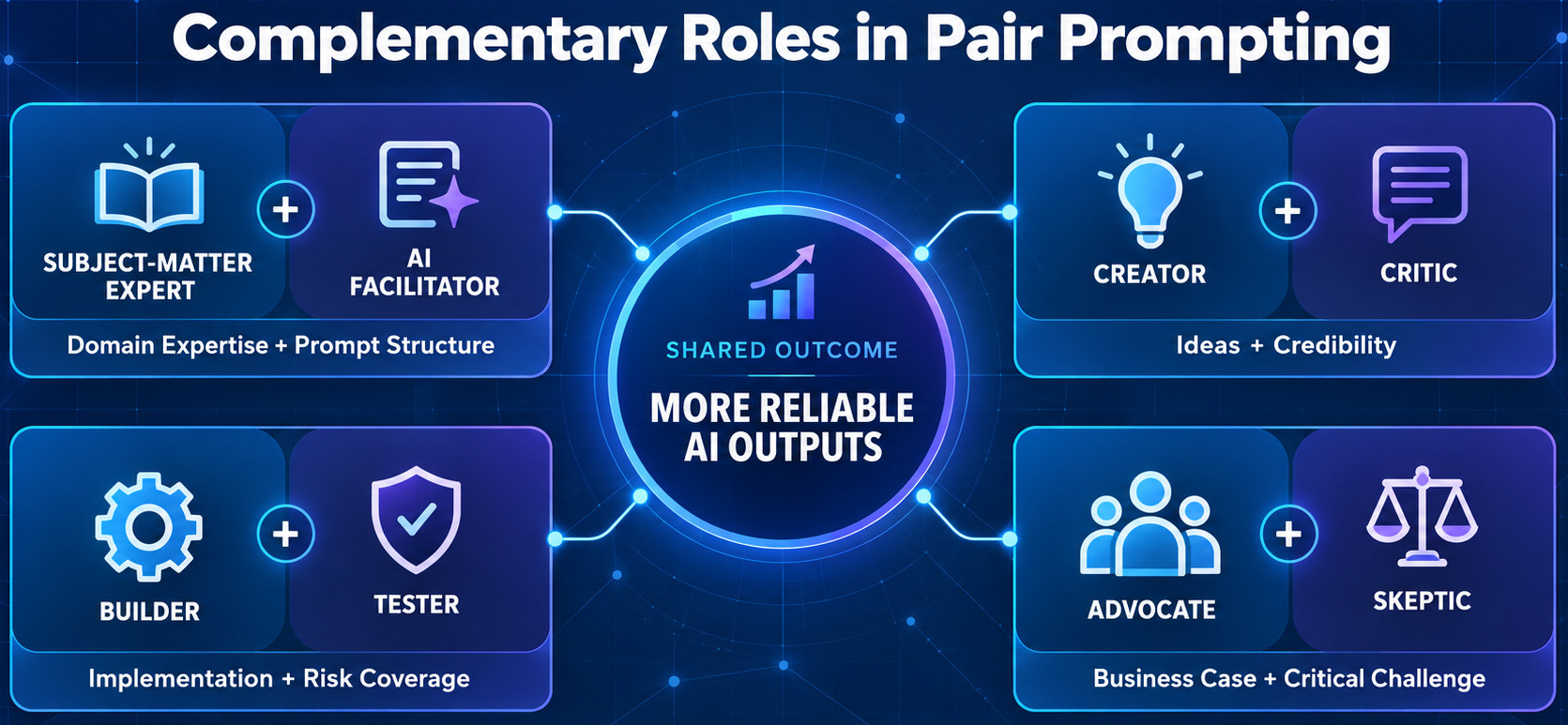
- Subject-Matter Expert and AI Facilitator: The subject-matter expert gives the domain knowledge, and the AI facilitator transforms the requirement into a well-formed prompt with the right audience, format, constraints, and verification criteria. Then the expert checks the AI-generated output for accuracy, safety, and misleading information.
- Creator and Critic: The creator comes up with interesting ideas and stories; the critic judges them for clarity, originality, credibility, and technical accuracy. Together, they create content that is both compelling and realistic, without unsubstantiated claims or oversimplification.
- Builder and Tester: The builder is worried about coming up with a working solution, while the tester is trying to break it with edge cases, failure scenarios, and expected behaviors. This collaboration enables the AI to generate more dependable implementations and more robust test coverage.
- Advocate and Skeptic: The advocate makes the strongest case for a proposed approach; the skeptic challenges its assumptions, costs, risks, alternatives, and failure conditions. This balanced evaluation helps prevent confirmation bias and leads to more informed decisions.
Example: Pair Prompting
A good paired prompt should communicate the objective, context, audience, constraints, output format, and evaluation criteria.
A reusable structure is:
You are assisting two collaborators: [Role A] and [Role B].
Our objective is [desired outcome].
The result will be used by [audience or stakeholder].
Use the following context: [approved information].
Respect these constraints: [limitations and exclusions].
Produce the response in [required format].
Evaluate the result against [quality criteria].
Clearly identify assumptions, uncertainties, and information requiring verification.
Do not invent missing facts.
The reference to two collaborators helps communicate the perspectives involved, but the prompt should still remain focused. Attempting to place every instruction into one enormous prompt can make the task harder for both the AI and the users.
- Ask the AI to summarize the business problem.
- Validate the summary against the available information.
- Generate multiple solution approaches.
- Compare the approaches using agreed criteria.
- Select one approach.
- Develop the proposal.
- Critique the proposal from the customer’s perspective.
- Verify all claims and supporting data.
- Rewrite the final version for the intended audience.
This is sometimes called prompt chaining. Prompt chaining and pair prompting can work together: prompt chaining structures the AI interaction, while pair prompting structures the human collaboration around it.
Steps to Adopt Pair Prompting
- Reviewing a major client proposal
- Designing tests for a critical feature
- Analyzing a production incident
- Preparing an architecture recommendation
- Writing a technical article
- Developing an AI-governance guideline
- Approved AI tools
- Acceptable data usage
- Confidentiality
- Source verification
- Human accountability
- Documentation requirements
- Security and privacy review
- Final approval responsibilities
As teams gain experience, they can create reusable pair-prompting patterns. A content team may develop a creator-and-critic workflow. A software team may use builder-and-tester prompting. A leadership team may use advocate-and-skeptic prompting for strategic decisions.
Pair Prompting in Quality Engineering
Pair prompting has considerable potential in quality engineering because software quality involves multiple perspectives. Requirements, architecture, user behavior, risk, data, security, performance, and operational recovery all influence what should be tested.
- Click ‘Book Appointment’.
- Select ‘Monday’ from the available days.
- Choose ’10:30 AM’.
- Click ‘Confirm Booking’.
- Verify that the page displays ‘Appointment Confirmed’.
A simple AI prompt may generate only variations of this successful journey. A business analyst and a QA engineer working together can create a more robust prompt:
Create test scenarios for an appointment-booking journey in which the user selects a day, chooses an available time, confirms the booking, and receives an “Appointment Confirmed” message. Cover the normal flow and failures involving stale availability, simultaneous booking, time-zone conversion, double submission, session expiry, payment timeout, notification failure, accessibility, mobile layouts, and recovery after a partial backend error. For each scenario, provide preconditions, test data, steps, expected results, priority, and automation suitability. Separate stated requirements from inferred requirements.
The business analyst verifies whether the expected outcomes align with business policy. The QA engineer evaluates risk coverage, observability, data requirements, and testability.
The pair can then ask the AI to classify the scenarios into smoke, regression, integration, performance, security, accessibility, and exploratory testing. The AI accelerates the process, but the humans still determine whether the scenarios are correct and valuable.
Pair Prompting in Software Testing
- Reviewing requirements for ambiguity
- Creating acceptance criteria
- Generating risk-based test scenarios
- Identifying boundary conditions
- Designing performance workloads
- Producing synthetic test-data requirements
- Analyzing defects and production incidents
- Reviewing automation code
- Identifying regression impact
- Summarizing test results for stakeholders
Pair Prompting for Research and Analysis
Generative AI can quickly create explanations, summaries, and hypotheses. However, it can also produce confident narratives without sufficient evidence. Pair prompting is valuable when the output will influence analysis or decision-making.
Suppose a domain researcher and data analyst are investigating an increase in customer churn. Asking the AI, “Why did churn increase?” encourages speculation. The model may generate plausible reasons even when no data support them.
A better paired prompt would be:
Develop competing hypotheses for the increase in customer churn. For each hypothesis, identify supporting indicators, contradictory indicators, required data, possible confounding factors, and an appropriate analysis method. Separate evidence from speculation. Do not rank the hypotheses until the relevant data is assessed.
The researcher identifies meaningful business events, such as pricing changes, service issues, customer-segment shifts, or competitor promotions. The data analyst checks cohort definitions, sampling bias, seasonality, measurement changes, and correlation versus causation issues.
Pair Prompting for Business Decisions
- Continue the existing manual process
- Purchase an off-the-shelf automation platform
- Develop a custom AI-assisted solution
The operations leader understands workflow complexity, employee effort, service quality, and customer impact. The finance partner understands total cost, investment assumptions, cash flow, risk, and return.
They might prompt the AI as follows:
Compare the three options using implementation time, three-year total cost, operational risk, scalability, explainability, vendor dependency, integration complexity, and expected service improvement. Show the scoring logic. Use best-case, base-case, and worst-case assumptions. Do not invent costs; label unavailable values as requiring input.
The AI can create a decision framework, but the pair must supply and verify the actual values. If the model assigns numerical scores without evidence, the pair should not accept them merely because they appear in a professional-looking table.
Unknown information should remain clearly identified as unknown. Numerical formatting must not be allowed to create false certainty.
Common Pair Prompting Mistakes
- Verify factual claims
- Check authoritative sources
- Execute and test the generated code
- Validate calculations
- Review legal and regulatory interpretations
- Protect sensitive information
- Obtain formal approval where required
- Avoid entering confidential data, proprietary code, credentials
When to Use Pair Prompting
- Customer-facing proposals
- High-risk software features
- Security-sensitive designs
- Important architectural decisions
- Regulated or compliance-related content
- Research and data interpretation
- Strategic recommendations
- Incident analysis
- Policy creation
- Training less experienced employees
- Deliverables requiring technical and business alignment
It may not be necessary for low-risk and routine tasks. Correcting grammar, summarizing a simple internal note, formatting a table, or generating preliminary ideas may not justify involving two people. The effort should be proportional to the consequence of the output.
How to Measure Effectiveness of Pair Prompting
Organizations should evaluate pair prompting based on outcomes rather than assuming it is useful.
- Requirement coverage
- Factual error rate
- Number of review defects
- Percentage of outputs accepted during the first formal review
- Rework after stakeholder feedback
- Number of missing risks or scenarios
- Accuracy of decisions or recommendations
- Time required to produce an accepted output
- Number of prompt iterations
- Total review time
- Downstream effort saved
- Defects prevented before implementation
Pair prompting may take longer during the initial AI interaction but reduce later review and rework. For example, two people may spend an additional 20 minutes refining a test-design prompt, but the resulting scenarios may prevent hours of requirement clarification and test-case rewriting.
Pair Prompting Checklist
- Define the expected outcome and intended audience.
- Choose participants with complementary expertise.
- Assign the driver and navigator roles.
- Gather relevant, reliable, and approved context.
- Identify confidential or sensitive information that must not be shared.
- Agree on quality criteria and the final decision owner.
- Set a clear time limit for the session.
- State assumptions, constraints, and uncertainties explicitly.
- Ask the AI to identify missing information and unresolved questions.
- Review each response before requesting revisions.
- Use focused follow-up prompts instead of repeatedly expanding one prompt.
- Request alternatives, counterarguments, and supporting evidence.
- Examine edge cases, risks, and failure scenarios.
- Separate verified facts from assumptions and AI-generated suggestions.
- Switch roles when a fresh perspective would help.
- Verify important claims using authoritative sources.
- Test generated code, calculations, and technical recommendations.
- Confirm that all requirements and acceptance criteria are covered.
- Review privacy, security, accessibility, fairness, and compliance risks.
- Remove unsupported, exaggerated, or absolute claims.
- Document unresolved questions, assumptions, and limitations.
- Obtain approval from the person responsible for the final decision.
Conclusion
Pair prompting transforms AI interaction into a collaborative discipline by combining different perspectives to frame problems, challenge assumptions, review responses, and validate results. As generative AI produces information rapidly, the driver keeps the interaction moving while the navigator protects its direction and quality, with both remaining accountable for the outcome.
Used thoughtfully, this approach helps teams ask better questions, uncover hidden risks, improve decisions, and produce more complete, reliable, and trustworthy results.
Frequently Asked Questions (FAQs)
- Can pair prompting be used when participants work remotely?
Yes. Participants can collaborate through screen sharing, shared documents, or an approved AI workspace, provided they can review the interaction and challenge decisions in real time.
- Can more than two people participate in pair prompting?
Yes, but additional participants should have clearly defined responsibilities because too many reviewers can slow down decisions and create conflicting instructions.
- How should disagreements between the driver and navigator be resolved?
The pair should refer to the agreed acceptance criteria, available evidence, and the designated decision owner instead of asking the AI to settle a human disagreement.
| Achieve More Than 90% Test Automation | |
| Step by Step Walkthroughs and Help | |
| 14 Day Free Trial, Cancel Anytime |