
testRigor vs Playwright + Claude Code
 |
Limitations Of Playwright + Claude Code
- You can’t write tests until the code is written – meaning it’s not ATDD-compatible.
- It is very verbose – meaning a lot of tokens.
- Reliance on implementation details means more maintenance, i.e. more time and tokens. Tests are also unstable and require constant maintenance.
- Nobody can easily read the generated Playwright code except test automation engineers, and even that requires a lot of effort. That means nobody else knows what is being tested, and no one can participate in fixing it except automation engineers, with a lot of effort.
- You can’t write true end-to-end tests spanning web, mobile, native desktop, mainframes, emails, APIs, 2FA, SMS, and many more in one test.
- No AI actions to validate AI-based features and images/diagrams.
- AI is expensive to use, and you’re charged every time you use it.
- No automatic scaling of the infrastructure.
- See proof that something works and details of failures if something doesn’t.
testRigor vs Playwright + Claude Code: Feature Comparison
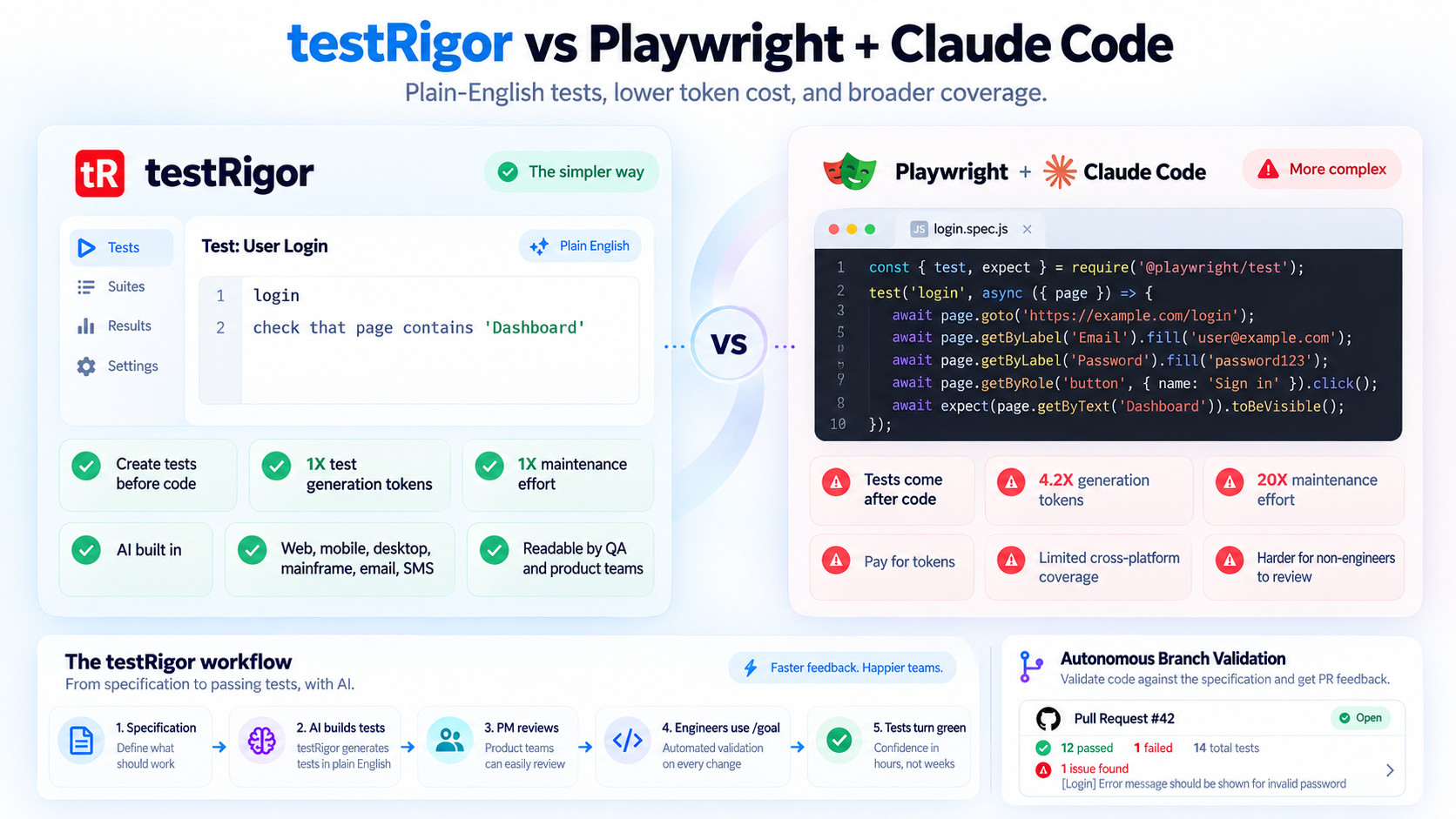
| testRigor | Playwright + Claude Code | |
|---|---|---|
| Can you run it locally with MCP? | Yes | Yes |
| Can you create tests BEFORE generating code? | Yes | No |
| Number of tokens required to generate tests | 1X | 4.2X |
| Number of tokens required to maintain code | 1X | 20X |
| Can product managers review generated tests to confirm they test what they’re supposed to? | Yes | No |
| Can manual QA testers participate in building and maintaining automated tests? | Yes | No |
| Do you need to pay Anthropic for tokens? | No, unless you choose to. AI is built in. | Yes |
| Test mobile, native desktop, mainframe, email, SMS, etc. | Yes | No |
| Test AI features | Yes | No |
| Automatic infrastructure scaling | Yes, run tests in parallel | No |
| Can non-technical people understand test failures? | Yes | No |
| Is it easy to understand what went wrong when a test fails? | Yes | No |
Plain English Tests vs Playwright Code
login
check that page contains "Dashboard"
const { test, expect } = require('@playwright/test');

test('login', async ({ page }) => {
  await page.goto('https://example.com/login');
  await page.locator('input').nth(0).fill('[email protected]');
  await page.locator('input').nth(1).fill('myPassword123');
  await page.locator('button').filter({ hasText: 'Log in' }).click();

  await expect(page.getByText('Dashboard')).toBeVisible();
});
You can see it for yourself: an order of magnitude more text that is much harder to read.
The Ideal AI-Assisted Development Workflow
- A product manager writes a specification
- QA can ask AI to build tests for a ticket covering the requested functionality. They then review the tests
- The product manager reviews the tests and approves them (or corrects them)
- Engineers can then use the /goal feature from Claude Code/Codex to generate code until the tests turn green
Result: effective AI code generation, with code that works and is 100% covered by regression tests from the start.
Autonomous Branch Validation With testRigor
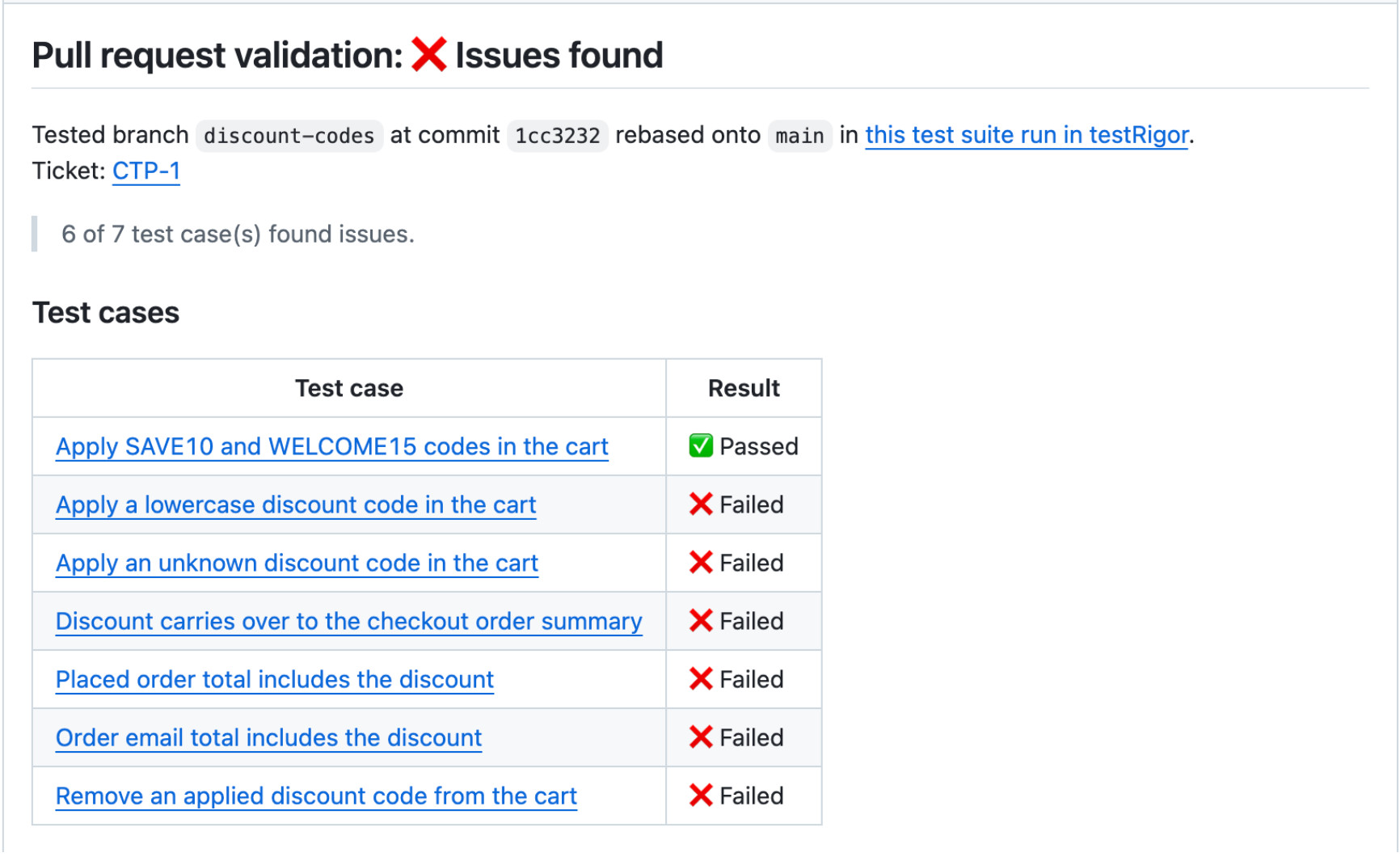
On top of that, testRigor has Autonomous Branch Validation, which allows you to validate that the code developed by engineers and AI works according to the specification in the ticket, with proof of any discrepancies, including screenshots.
Why Choose testRigor Over Playwright + Claude Code?
Do you want to understand what is being tested and make sure that your functionality is covered and it is not a hallucination?
Do you want to make your code generation work effectively instead of just burning tokens?
Do you want to be able to automate tests for your AI-based features?
Do you want to scale your tests instead of slowing down your pipeline or not being able to run enough?
If any of those answers is yes – request a demo .
Thank you for your request. Please select date and time for a demo.