
DevProJournal.com Mentions the Next Phase of Gen AI in Software Testing: Quality at Scale
 |
“The single greatest challenge in AI is scaling the capacity”— Jensen Huang.
Today, we see that Gen AI’s role in software testing has entered an entirely new phase. Now, it is not just about experimental test case generation. It is an operational necessity for teams to deliver quality software at speed.
Recently, DevProJournal.com reinforced this shift in its article “Quality at scale: The next phase of GenAI in software testing” by Hélder Ferreira, Director of Product Management at Sembi, and Bruno Mazzotta, Solution Engineer Manager at testRigor. The article captures a reality that many engineering leaders are already feeling and working towards finding a solution. Today, the delivery cycles are compressing, and systems are becoming more interconnected. On top of this, new AI-powered features introduce an unpredictability that traditional testing tools struggle to handle.
At testRigor, we strongly align with this message. The future of QA will not be shaped by who can generate the most test cases. It will be shaped by who can build confidence at scale, keeping the product quality intact.
| Key Takeaways: |
|---|
|
Gen AI is NOT Just Test Generation
No. Writing automated test scripts takes considerable time, and then add test maintenance to that. Also, test coverage backlogs are an actual problem. In such a scenario, when we got access to Gen AI-powered test generation, it changed the whole narrative for everyone. The promise it made was very clear. Faster test creation, faster releases, and less manual effort.
However, as DevProJournal.com correctly points out, speed does not equal quality and confidence. AI-generated tests that fail to accurately reflect product features, real workflows, or business-critical risks simply shift effort somewhere else. QA teams are still left with the same responsibility, i.e., rewriting, validating, and maintaining tests that were never aligned in the first place.
That is why AI must evolve beyond “test factories”. AI should be integrated across the whole software lifecycle to support quality.
Follow Review-First and HITL (Human-In-The-Loop)
One of the strongest insights we receive in the DevProJournal.com article is about “one-shot” AI testing. When AI generates full test cases instantly, and these tests are made official before review, teams face two issues. Teams either accept low-quality tests due to time pressure or spend significant effort cleaning up the output. Neither is ideal.
The better approach is review-first governance and having HITL (Human-In-The-Loop). AI can be used for suggesting coverage, edge cases, and acceptance criteria. But then humans must remain accountable for what becomes part of the final regression suite.
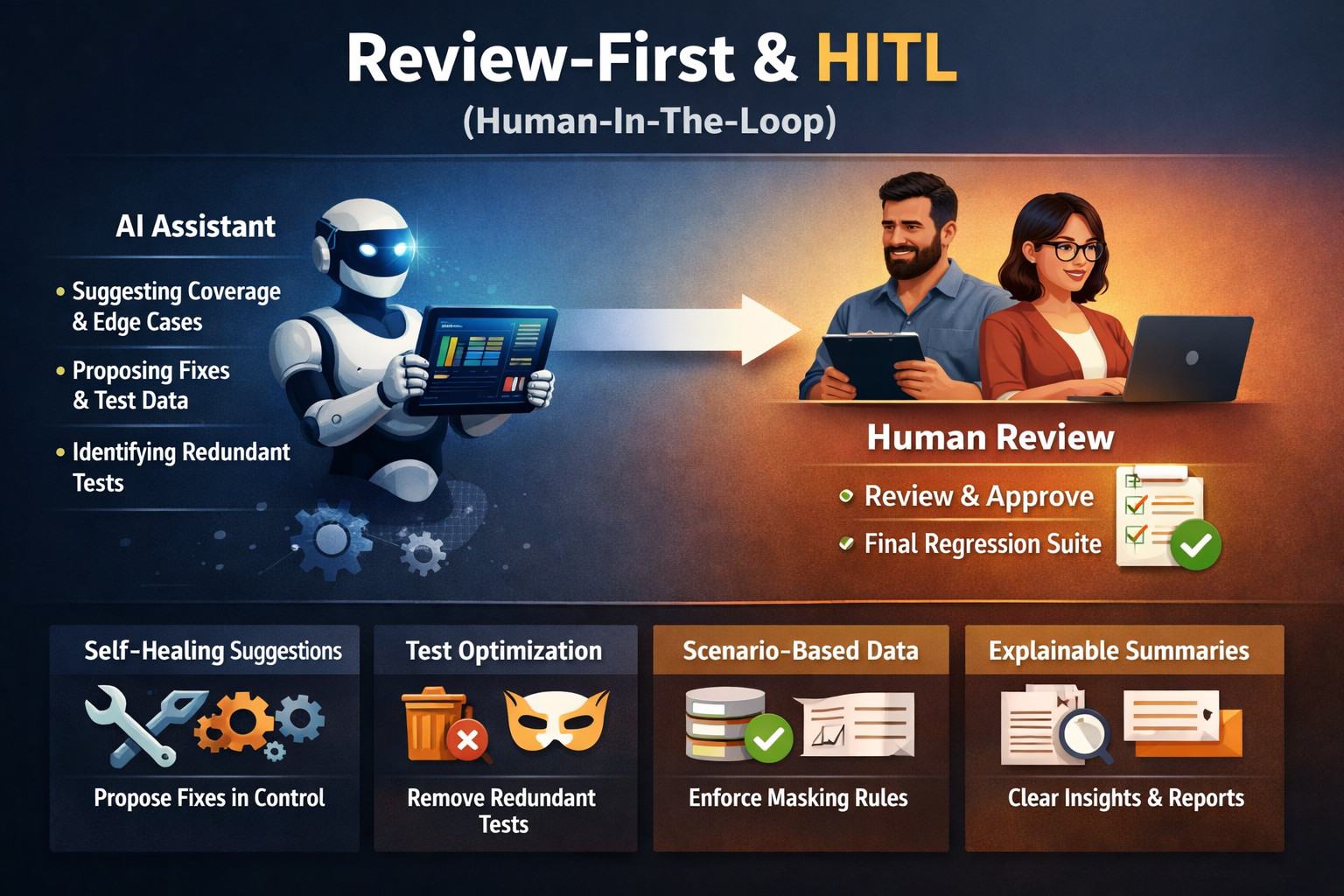
In real projects, Gen AI can help teams:
- Propose self-healing fixes while keeping humans in control
- Detect redundant or low-value tests in test suites
- Suggest realistic scenario-based test data while maintaining compliance
- Provide explainable summaries instead of black-box automation behavior
The key is keeping human-in-the-loop (HITL). AI suggests. Humans approve. Trust remains intact. This is how AI delivers real value in software testing. It is certainly not achieved by replacing expertise, but by helping the experts in decision-making and keeping QA ownership intact.
Intelligent Automation in Every Testing Stage
We see in the article that intelligent automation is not about testing only AI features. Basically, it is about AI support across planning, execution, triage, and maintenance.
Test automation fails because systems constantly change and get new features. For example, UI locators shift, APIs update, test environments become outdated, and new services are added continuously. In such scenarios, traditional test scripts become brittle and really expensive to maintain.
That is why now Gen AI testing should not just generate tests. It should help teams keep automation stable, relevant, and aligned as the product evolves.
testRigor builds intelligent test automation and connects intent, execution, and outcomes in a single operational loop. Read: All-Inclusive Guide to Test Case Creation in testRigor.
Real Projects: Where AI Helps QA Teams
In the article, we see three important areas where AI delivers immediate, practical value. They are:
- Test Data Creation and Management: Many defects are missed because the data is unrealistic or incomplete. AI can help propose scenario-based data sets, but governance is essential to ensure masking, compliance, and repeatability. Read: Test Data Generation Automation.
- Failure Triage: It is where teams lose time. When pipelines fail, developers and QA engineers spend hours separating false noise from real defects. AI can reduce this time and effort by grouping failures and attributing likely causes. Read: Defect-based Testing: A Complete Overview.
- Test Automation Maintenance: It is where trust is often lost. Intelligent self-healing can reduce effort significantly, but it must still remain reviewable. AI-assisted changes should be explainable and approved by humans. Read: Decrease Test Maintenance Time by 99.5% with testRigor.
This is exactly how AI becomes a force multiplier instead of a risk multiplier. We can see that Gen AI is helping solve issues not by bypassing expertise, but by amplifying it.
AI-Based Software Needs a Different QA Strategy
Gen AI-powered copilots, assistants, summarizers, and conversational bots introduce a new testing challenge. Expected results are no longer deterministic. The same prompt can generate different outputs. Also, the behavior and output can shift after model updates or retrieval changes.
As DevProJournal.com highlights, testing must evolve beyond deterministic output matching. QA teams must validate intent-based outcomes, enforce safety and compliance guardrails, verify retrieval correctness, detect drift over time, and monitor hallucinations and bias.
AI can help generate test data variations and test suites through prompts. But QA must define the “mandatory” behaviors tied to business risk and validate them continuously.
Example: Testing Non-Deterministic Outputs
- Problem: A finance company added an AI assistant for ticket summarization to their platform. Traditional testing methods failed because the responses and outputs varied every time, though they were correct. QA struggled to define “expected results.”
- Solution: They shifted testing to intent-based assertions and guardrail validation. AI-assisted testing validated whether required fields were captured, whether prohibited requests were rejected, whether responses adhered to policy, and whether hallucinations were present. Drift detection checks were added after model updates to monitor behavioral changes over time.
- Result: Instead of testing the exact phrasing/words, teams validated intent, compliance, safety, and task completion. This testing is a must for probabilistic software.
So, What is the Litmus Test for AI?
Now we know that the value of AI in QA is measured by release confidence, not test case volume. So, the question is, what is the right AI testing approach?
Gen AI in software testing should maintain a smooth flow between test intent, execution, and results. And when that connectivity exists, teams can trace what was tested, why it mattered, what changed between test runs, and whether release readiness is better.
And without traceability and metrics, AI only creates more output, which might not be useful. With these, AI becomes a practical guiding light for scaling quality.
The litmus test for AI in QA is not how many test cases it can produce. It is whether teams can confidently answer these questions:
- What was tested?
- Why does it matter to business and users?
- What features changed since the last release?
- Are we safe to ship the product?
Conclusion
AI is most powerful when it uses human expertise. The true measure of AI in QA is simple. Can teams release faster and feel safer doing so?
To make AI the foundation for scalable QA, we need to connect user intent, execution, and outcomes into one continuous feedback loop. That is what DevProJournal.com’s article mentions: quality at scale requires both Gen AI and human expertise.
| Achieve More Than 90% Test Automation | |
| Step by Step Walkthroughs and Help | |
| 14 Day Free Trial, Cancel Anytime |