Understanding Pair Prompting in AI
 |
AI is fast changing how we write, build apps, verify bugs, suggest new ideas, or handle teams. Yet despite its power, these AI-powered tools often underperform. That is, if you limit yourself to staring at a screen, only dropping prompts in a box. Truth be told, more teams are discovering something quite human. AI works better when people work together.
This is the very idea behind the concept of pair prompting.
Don’t be stressed if you are new to this world. The concept is still evolving. In easy terms, pair prompting is when two humans collaborate to direct AI, instead of one going solo and rogue.
| Key Takeaways: |
|---|
|
This article works to decipher what pair prompting is, explaining its efficiency. It also compares it to traditional prompt methods and walking through examples.
What is Pair Prompting?
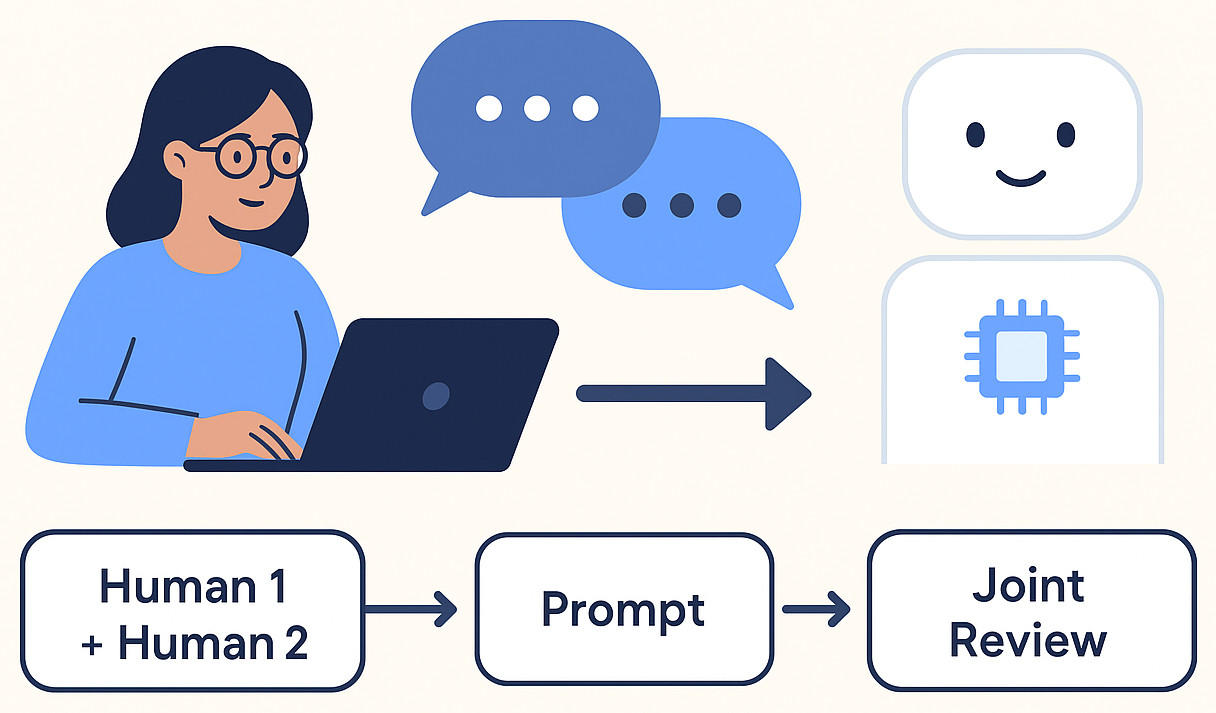
Two people working together can create questions for an AI. Talking through ideas while building them. One doesn’t go solo hunting for inputs or judging replies; they share the task at each step.
Consider it is like a type of team coding. Just replace lines of code for chats with a device. One person manages flow and clear wording. The other handles big picture thinking or precision details. Meanwhile, the bot comes in and acts as a quick-talking helper that produces thoughts on demand.
It is simple, even fun, and definitely gets the job done.
The concept uses common phrases like collaborative prompting, co-prompting, or even multi-human prompting. Each displays how people collaborate to guide AI results more efficiently. While these labels differ slightly, they share a common goal. Improving results through combined human effort instead of working in silos.
Why does Pair Prompting Work so Well?
AI tools can manage words and build stuff very well. Yet it all depends on how good the guidance is. When people team up and share views, things start getting interesting:
- They fill in each other’s blind spots.
- They naturally create richer context.
- They correct vague or confusing parts of the prompt.
- They evaluate the output more critically.
- They prevent the AI from drifting off-topic or accepting flawed assumptions.
One person can find a prompt to be clear, but another could feel it is vague. Artificial intelligence often uses the information it gets, and when directions are vague, outcomes show the consequence.
Pair prompting reduces the chance of mistakes. Imagine it as two people working on a puzzle at once; at least one will spot the missing details.
Pair Prompting vs. Traditional Prompt Engineering
Prompt engineering once entailed creating clear instructions for AI. You had to pick the target, decide how it should appear, and also establish the restrictions around what it should be capable of. In this method, your role was shaping the task, while AI did the heavy lifting.
Pair prompting changes things slightly. It is not setting objectives, but helping to work together. Instead of planning tasks, it is more related to teaming up and exchanging ideas.
Here is how it is explained in simpler terms:
Prompt Engineering
- One person.
- A structured, almost technical approach.
- The goal is to “engineer” the best possible instruction.
Related reads:
- Prompt Design vs Prompt Engineering: Key Differences, Use Cases & Best Practices
- Talk to Chatbots: How to Become a Prompt Engineer
Pair Prompting
- Two (or more) humans.
- Conversational, flexible, iterative.
- More emphasis on exploring ideas, refining together, and using human diversity as part of the process.
Here’s an interesting analogy to differentiate the two.
Prompt engineering is like building a recipe on the spot with the ingredients in hand.
Pair prompting, however, is like making dinner in the company of someone. Chatting with changing steps, tasting now, then tweaking the recipe.
Yes, they both do the job; no need to pick one. But combining prompts just works better. Specifically, the goal is vague or creative.
How to Practice Pair Prompting
The cool thing about pair prompting? No special or fancy tools needed. Just grab two people plus a chatbot such as Gemini, Claude, or ChatGPT.
Pair Prompting Workflow
- Pick a partner: A friend might work, maybe a teammate, or an expert in the field. Or, even someone completely unrelated. Remix things; it makes a difference.
-
Define the goal: Initiate the discussion, even before you jot it down.
- What do we want?
- What is the result supposed to actually do?
- Who is the target?
It doesn’t need to be formal. A rough, messy discussion is fine. - Draft the first prompt together: Understand what background info the AI should have. Maybe you will identify someone who knows something. Maybe the other person didn’t have the context.
- Send it to the AI: Be patient for its response. Don’t be judgmental.
- Review the AI’s result: This is where pair prompting helps.
- One person can catch small errors.
- The other might catch holes in the logic.
- One person can recall needing to include a certain constraint.
- Iterate: Minor tweaks. Big shifts. Either way, just shape the next prompt together.
- Repeat until the result feels useful: Sometimes you get the right answer fast. But then again, it may take multiple rounds.
Examples of Pair Prompting in Action
Take a short peek at some typical cases.
Example 1: Brainstorming a Product Feature
One person tosses out thoughts while another verifies what the AI suggests. Different possibilities, benefits, cons, potential issues, and how things connect.
The AI works as a thinking buddy, structured and ready to help discuss ideas.
Example 2: Writing or Editing Content
One could care about how it sounds, whereas another might worry more about collating facts correctly. Or keeping the story smooth.
They work as one. Hitting each goal is easy.
Example 3: Debugging or Coding with an AI tool
This is like coding together with AI.
One person reviews the code. The other ensures AI gets the clear details. Or reviews each segment slowly. Read: What is Vibe Coding?
Example 4: Software Testing and Test Case Generation
This is when pair prompting produces work way better than intended. This is especially true with tools like testRigor.
The Benefits of Pair Prompting
Let us take a breath and understand what real benefits are. Of course, people claim pair prompting works better. But how? What is going on underneath the top?
- Better Context and Better Outputs: AI needs hordes of background info. With extra details, answers are usually improved and more realistic. One person alone gives less; two bring bigger perspectives.
- Human Diversity: Everyone has their own perspectives. While one focuses on small bits, the other looks at the bigger picture. As it thrives on such differences, AI finds this combination exciting.
- Built-in Quality Assurance: Two people are better at detecting issues than one. Lesser mistakes are neglected this way.
- Faster Iteration: One person modifies while the other verifies progress. This is like both hands on the steering wheel rather than only one.
- Reduced Cognitive Load: Going bonkers overthinking by yourself? Team prompts divide the load. Two minds, less stress.
- More Creativity: One person initiates, and the other steps in with AI ideas that spark something better. Thoughts bounce around, leading somewhere new or even surprising at times. It is like a chat that twists and turns when everyone adds their sprinkling.
Pair Prompting Techniques for AI
Pair prompting is not set in stone. Yes, plenty of teams implement certain tricks without even knowing: one moment it is trial and error, next it is about looping feedback. Instead of forcing steps, they allow bouncing back and forth of ideas. People lead by turns, or at times everyone jumps in at once.
Role Splitting
Each person has a different role:
- One takes charge of the setup.
- One comes up with new ideas.
- One looks at boundaries, the other takes care of targets.
Prompt Layering
You start with the background. Once that’s defined, add restrictions; after that comes the real query.
Dual Review
One person verifies the AI result alone. Then the other does the same before they discuss it.
Perspective Switching
Ask the AI:
- Rewrite this for a testing team.
- Rewrite this for a product manager.
- Explain this in simpler terms.
- Every change surfaces problems.
Challenges and Defend
One person highlights the defects in the AI’s response. While another defends its strength, this fight intensifies the outcome.
Where Pair Prompting Really Shines: Software Testing & AI Automation
Here is how it connects to real-life stuff. This includes verifying software.
Testing relies a lot on teamwork:
- QA engineers and developers talk about scenarios.
- Testers challenge assumptions.
- Requirements get clarified.
- Edge cases get pulled out of people’s heads.
Pair prompts accelerate things. Using them together works better.
Imagine two testers collaborating, tossing test cases into an AI app. One suggests a case while the other changes it on the fly.
- Brainstorm edge cases.
- Generate test data variations.
- Draft test scripts.
- Explore user flows.
- Analyze risks.
- Ask “what if?” questions.
The AI works like a quick helper that:
- Suggests missing tests.
- Uncovers logic branches.
- Simulates user paths.
- Proposes improvements.
How testRigor Fits Perfectly into Pair Prompting
testRigor uses artificial intelligence to allow people to write tests as they talk. Rather than coding, users type commands in plain English. The system understands human-like instructions without needing users to know complicated programming steps.
Thus, testRigor works well for pair prompting, mainly through three solid reasons.
Pair Prompting Helps Create Better English-Language Test Cases
Besides using plain English, testRigor allows testers to collaborate. They can work side by side, shaping prompts together.
- “Let’s describe how a user logs in.”
- “Okay, add the part where the password is reset.”
- “Should we mention the timeout scenario?”
One person plus another means better clarity when creating commands in plain English. testRigor grabs those, turning them into automated test cases.
AI + Two Humans = More Reliable Test Coverage
Checking things out means catching what is missing. As holes show up whenever:
- Testers forget edge cases
- Developers miss side effects
- Or the requirements aren’t clear
Pair prompting closes these gaps. Two people with AI verify scenarios simultaneously.
With testRigor, teamwork turns straight into executable automated tests.
It Makes Test Automation Accessible to Non-Technical Staff
This is big. Other than not needing any code, testRigor allows everyone to join in on pair prompting:
- Product managers
- Business analysts
- Customer support folks
- Manual testers
- Even domain experts
A tester collaborating with a business analyst might build simple commands. These are done in plain English, which makes sense immediately. testRigor changes these automated test cases swiftly. Uses smart steps that save time.
It basically turns a “pair prompting session” into a working test case.
Why Pair Prompting Works Especially Well in AI Testing Tools
AI in testing goes beyond building tests automatically. It ties into real usage scenarios.
- What the user wants.
- What the product does.
- What edge cases matter?
- What business rules must hold?
You need people to reason about all this stuff.
Pair prompting lets teams explain context better. While testRigor takes it in using simple language tests. It flows easily, this cycle is super-efficient, keeps moving without hiccups.
- Humans collaborate.
- They prompt an AI testing tool.
- The tool generates or executes test cases.
- Humans adjust.
- The AI refines testing behavior.
This is how AI-powered testing tools shape up. It’s less about replacing humans, more about boosting their skills.
Related reads:
The Future of Collaborative Prompting and AI in Teams
Pair prompting is changing swiftly. Yet it hints at a bigger change in how teams work with AI.
- AI becomes part of group conversation, not just solo chats: We will consider AI as a partner, quick on its feet, rather than a PA.
- Meetings will include live AI collaboration: One person could suggest tweaking the layout. At the same time, another nods and asks AI to create versions of it.
- Testing will become more conversational: Instead of building test scripts, the team can communicate through scenarios. System turns these conversations into automated checks.
- Multi-human prompting will become normal: Some teams use 3-person setups. Others may need four. Common during planning phases. These groupings pop up during risk analysis and testing.
Pair Prompting Makes AI More Human
Pair prompting is simple, not a big deal technically. It is simply a reminder that working together improves most things, and AI does not disagree.
When two humans combine their:
- Perspectives
- Understanding of context
- Ability to spot mistakes
- Natural back-and-forth thinking…
… the AI produces smarter, more reliable, more aligned results.
When you bring that collaborative spirit to software testing, with a tool like testRigor, it creates strong results because teamwork increases effectiveness.
- Tests are created faster.
- Scenarios captured more accurately.
- AI stays connected to human intent.
Pair prompting goes beyond being merely a method.
It’s one move closer to having AI work alongside people instead of taking their place.
| Achieve More Than 90% Test Automation | |
| Step by Step Walkthroughs and Help | |
| 14 Day Free Trial, Cancel Anytime |