
Test Cases for SaaS Subscription Lifecycle: Signup to Renewal
 |
The subscription lifecycle of SaaS applications is more diverse than just a signup and payment flow. While initial onboarding often gets the most testing focus, where the real risk comes in is afterwards, recurring billing, renewals, upgrades, downgrades, cancellations, and access management. These processes need to be closely synchronized over time so that what a user is actually being billed for always matches the features they can access.
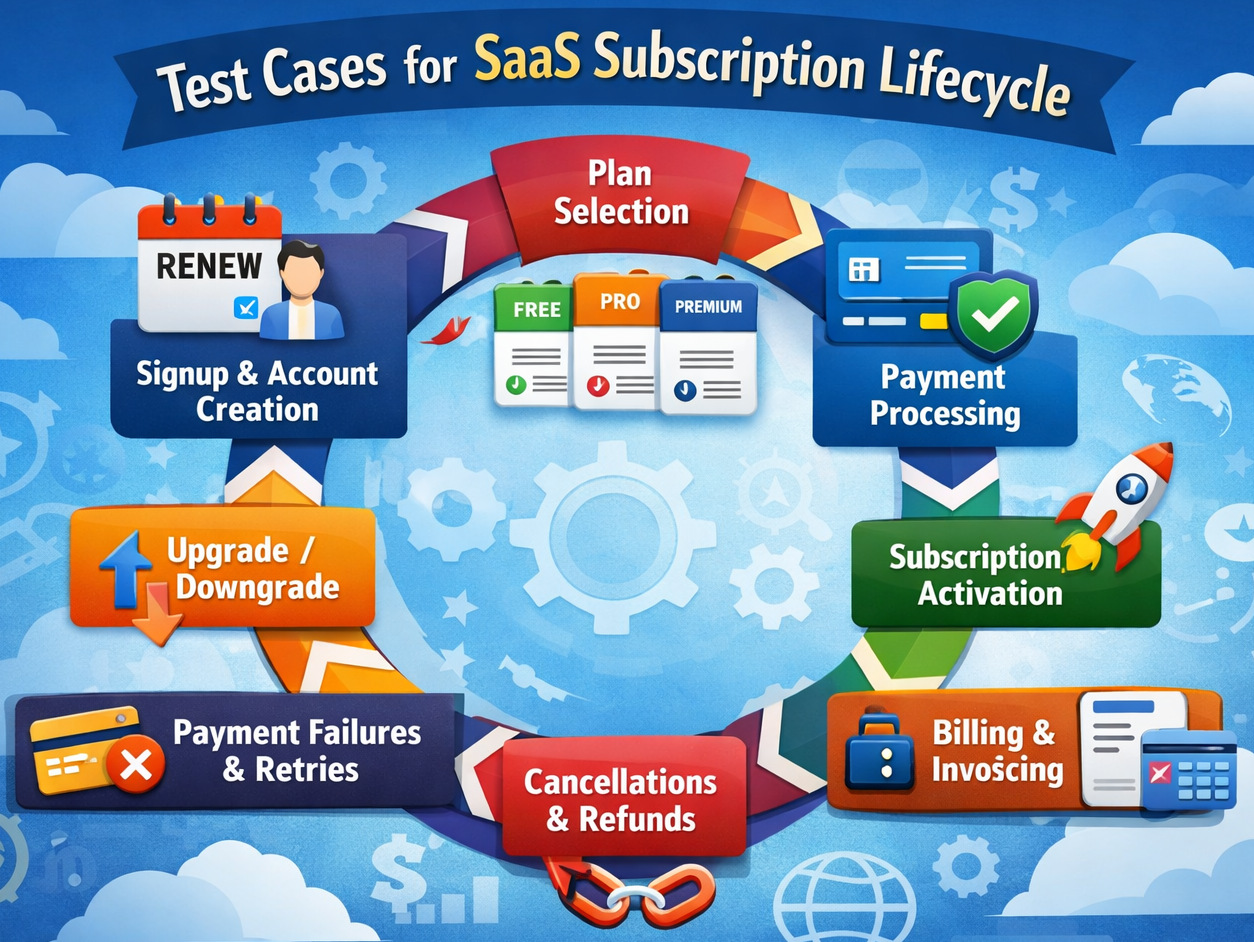
The problem is that these failures often do not show up right away. They arise during transitions, when a subscription renews, when a payment doesn’t go through or when a user switches plans mid-cycle. These are not rare edge cases, but common real-world scenarios that happen because of asynchronous systems, third-party integrations, and time-based triggers, which can be hard to simulate without careful test coverage.
This is why QA teams need to move away from testing individual test cases and move towards lifecycle-driven testing strategies. Teams should aim to validate the entire journey over normal billing cycles, state transitions, and edge conditions rather than just the signup flow. The thing that SaaS does not prove in the beginning, it proves in continuity.
| Key Takeaways: |
|---|
|
SaaS Subscription Testing
Testing a SaaS subscription is fundamentally a test of how that system manages user states over time and not merely access. The actual complexity arrives when plans change, renewals happen, or payments fail, where a few systems need to remain in sync. Without rigorous testing of these scenarios, even small discrepancies can result in billing errors, incorrect access, and broken user experiences.
- A user upgrades their plan, but the billing system does not reflect the updated subscription.
- A subscription expires, yet the user continues to have active access to premium features.
- A renewal is processed successfully, but the corresponding features are not unlocked for the user.
- A payment fails, but the system does not trigger the expected retry logic.
- Recurring billing cycles (monthly, yearly)
- Plan upgrades/downgrades (proration logic)
- Free trials and conversions
- Payment failures and retries
- Subscription pauses and cancellations
- Multi-currency and regional taxation
Test Cases for SaaS Subscription Systems
SaaS subscription systems require a new way of looking at testing: moving from feature-based to lifecycle testing. While static applications are built around the concept of a world-generating state, SaaS applications are designed to be always on. They employ continuous transitions that should remain valid no matter if they happen at different points in time, through different systems, or by different users. This means QA teams need to consider end-to-end journeys over one-off events.
- User signup and account creation
- Plan selection (free, trial, paid tiers)
- Payment method entry
- Subscription activation
- Feature access provisioning
- Billing cycle initiation
- Invoice generation
- Plan upgrade/downgrade
- Renewal or expiration
- Payment failure handling
- Cancellation and refunds
The biggest mistake teams make is testing each step independently instead of validating the transitions between them. This approach overlooks how different stages of the subscription lifecycle interact with each other. As a result, most critical failures occur between steps rather than within individual steps themselves.
SaaS Subscription Lifecycle: Functional Test Cases
The functional test scenarios for this SaaS subscription lifecycle adhere to the specific needs of verifying that each component within the system behaves as anticipated during normal user engagement. This covers verifying flows like signup, plan selection, billing, renewals, and cancellations under normal conditions. The aim is to see that every part functions as it should and stays uniform during the entire experience of the user’s subscription.
Test Cases for Signup and Account Creation
Signup is the gate to the SaaS lifecycle, and mistakes here can have a direct impact on conversion and onboarding. Users must be able to create accounts, and it is crucial to verify their ability with various input scenarios, such as valid, invalid, and edge-case data. The system should also handle duplicate accounts, email verification and authentication flows. The signup must also fail in a manner that does not destroy the overall experience and offers some pretty strong feedback to the user.
- User signs up with a valid email and password
- Verify email verification workflow
- Signup using social login (Google, GitHub, etc.)
- Prevent duplicate account creation
- Validate password rules and security policies
- Verify account creation without selecting a plan
- Validate error handling for invalid inputs
Test Cases for Plan Selection and Pricing
Plan selection and pricing test cases make sure users know what they’re subscribing to. It should show you accurate information about plan details, pricing features, and any available discounts or trial periods. You should also ensure that the targeted plan is passed on correctly into the billing and subscription configuration. Subscribing edge cases, like change plans before checkout or region-based pricing have to be checked too.
- Select free, trial, and paid plans
- Verify correct pricing display across currencies
- Validate tax calculation (GST, VAT, etc.)
- Verify plan feature comparison display
- Validate trial period duration
- Verify discount/coupon application
Test Cases for Payment Processing
These test cases cover the scenarios to ensure that the payment processing is happening accurately and securely under all circumstances. Payment is the start of revenue, so precision is essential. It should properly validate the various payment types, process items in the shopping cart, handle successful and unsuccessful transactions, and update user (subscription) status where necessary. Additionally, retry mechanisms and error handling must be validated alongside integration with third-party payment gateways.
- Successful payment via credit/debit card
- Payment via digital wallets (Stripe, PayPal, etc.)
- Validate saved payment methods
- Verify payment confirmation messages
- Validate invoice generation
- Verify payment failure scenarios
- Ensure no duplicate charges
Test Cases for Subscription Activation
Test cases for subscription activation guarantee that users are granted the appropriate access as soon as a payment is processed successfully. Someone has to grant access after payment, immediately, and correctly. The list of features and permissions should be present as per the plan. We verify that there is no lag or mismatch between when payment confirmation and feature availability happen.
- Subscription activates after successful payment
- Features unlock according to the selected plan
- Verify access restrictions for lower-tier plans
- Validate trial activation without payment
- Verify backend subscription status updates
Test Cases for Feature Access and Entitlements
The test cases for feature access and entitlements help ensure that users will only have access to features consistent with their subscription plan. Access control must always be consistent with the subscription state. In a multitenant system, we should be able to change the permissions of a user when he/she upgrades, downgrades or renews. You should also ensure that the restricted features are indeed not accessible when your subscription is either inactive or expired.
- User accesses premium features after subscription
- Restricted features remain locked for free users
- Feature access updates after plan change
- Verify role-based access control
- Validate API access limits per plan
Test Cases for Billing and Invoicing
These test cases verify the correctness of all the charges with respect to the billing and invoicing. Billing should be transparent and accurate. Depending on the plan chosen, the system needs to create invoices with actual amounts, taxes, and billing periods. Furthermore, it is essential to ensure that the users can view and download invoices consistently.
- Invoice generated after successful payment
- The invoice includes the correct plan, amount, and taxes
- Verify downloadable invoice (PDF/email)
- Validate billing history visibility
- Verify recurring billing schedule
Test Cases for Plan Upgrade and Downgrade
This also includes negative scenarios, such as not being able to upgrade or downgrade a subscription based on the validity of credit for coupons and redemptions. Transitions between plans are among the most error-prone areas. It must make sure billing, prorations, and feature access are adjusted in accordance with the new plan. You should also ensure that changes become effective at the right time and do not interfere with user experience.
- Upgrade plan mid-cycle
- Verify prorated billing calculation
- Immediate feature upgrade after plan change
- Downgrade plan and verify delayed effect (next cycle)
- Validate downgrade restrictions
- Verify billing adjustments
Test Cases for Renewal and Subscription Continuity
The continuity of the subscriptions is ensured through comprehensive test cases for renewal. Renewals are the lifeblood of SaaS revenue. It results in a number of automatic renewals being properly processed, billing cycles being updated, and feature access remaining uniform. It is equally critical to ensure users are informed appropriately, and renewal failures are handled gracefully.
- Automatic renewal at billing cycle end
- Verify the correct amount charged
- Validate renewal notification emails
- Verify uninterrupted access after renewal
- Validate renewal failure handling
Test Cases for Cancellation and Refunds
These test cases guarantee that the use of cancel is without hassle. Users must have a clean way to exit. The system must therefore cease future billing, terminate access at the correct time, and manage refunds in accordance with policy. Also, check that confirmation messages and logs are properly recorded.
- Cancel subscription before renewal
- Verify access until the end of the billing cycle
- Immediate cancellation option (if supported)
- Refund processing (full/partial)
- Verify subscription status updates
- Validate cancellation confirmation
Negative Test Cases for SaaS Platforms
For SaaS platforms, negative test cases verify that the system gracefully handles unexpected or invalid information without crashing. This is known as negative testing, which ensures that the system handles unexpected or invalid scenarios properly. Across the entire subscription lifecycle, the system must not allow invalid inputs, such as through forms or API calls, unauthorized access to features, or inconsistent state transitions. Similarly, it is necessary to authenticate the way the system behaves when payment fails, the session expires, and integration crashes.
- Payment failure due to insufficient funds
- Expired or invalid card details
- Duplicate payment attempts
- Network interruption during payment
- Invalid coupon codes
- Attempt to access premium features without a subscription
- Upgrade failure due to payment error
- Renewal failure due to payment gateway timeout
SaaS Subscription Systems: Non-Functional Test Cases
Beyond simply working, the SaaS subscription system must perform reliably across the entire lifecycle from signup to renewal. These systems operate continuously, handling recurring billing, user access, and plan changes in real time, often at scale. Test cases should validate how the system behaves under peak usage, multiple concurrent subscriptions, and high transaction volumes. They must also ensure the platform remains stable, secure, and consistent across different user scenarios, devices, and network conditions throughout the subscription journey.
Performance Test Cases
- Handles thousands of concurrent signups
- Processes billing cycles for large user bases
- Maintains performance during renewal spikes
- Handles peak traffic during promotions
Security Test Cases
For SaaS platforms, security test cases guarantee that sensitive financial and user data is secured during the entire subscription lifecycle. SaaS platforms handle sensitive financial and user data. You need to test the system for secure payment handling or data encryption, authentication and authorization controls. You must also verify shielding against access to unauthorized data, exposure of sensitive information and other standard security threats.
- Secure authentication and session handling
- Encryption of payment data
- PCI-DSS compliance validation
- Protection against unauthorized access
- Secure API communication with payment gateways
- Prevention of subscription fraud
Usability and Compatibility Test Cases
These test cases ensure that the SaaS subscription system provides a seamless and consistent experience across diverse platforms. Good UX is important to conversions and retention. Make sure you have a valid plan signup flow as well as clear instructions on how to sign up, choose a payment method, and manage your account. The platform’s functional correctness is also necessary to ensure it remains visible, responsive, and consistent across different network speeds and screen sizes.
- Smooth signup flow across devices
- Clear pricing and billing information
- Easy plan upgrades/downgrades
- Mobile-friendly billing interface
- Clear error messages
- Dashboard clarity for subscription status
Read: Automating Usability Testing: Approaches and Tools.
Critical Risk Areas in SaaS Subscription Systems
SaaS subscription systems are multi-component applications (mashups). This means that some topics will be more prone to critical failures than others. Recognizing and testing for these high-risk areas is crucial to avoid losing revenue or having a jittery user experience.
- Billing Accuracy: Incorrect charges can instantly chip away at customer trust and eventually churn. All calculations, taxes, and invoices must be done accurately and based on the chosen plan.
- Access Synchronization: Always provide exactly what a user paid for, neither more nor less. If billing status does not match available features, that can lead to major usability and compliance problems.
- Renewal Logic: Failures in renewal processing directly impact recurring revenue and user retention. It is important to validate timing, retries, and status updates during renewal cycles.
- Payment Gateway Integration: External payment systems must be reliable and resilient to failures. Test cases should verify how the system handles timeouts, declined transactions, and partial failures.
- Proration Calculations: Incorrect proration of fees during upgrades or downgrades is another data-related billing problem that stirs up disputes. Everything that is happening, the system needs to be able to automatically calculate and show revised charges depending on timing and plans.
Read: Transitioning from Manual to Automated Testing using testRigor: A Step-by-Step Guide.
Why SaaS Platforms Need Automated Testing
Manual testing continues to play an important role, especially for exploratory testing and validating user experience. It helps uncover usability issues and identify unexpected scenarios early in the testing process. However, it does not scale effectively for complex SaaS subscription systems.
In SaaS environments, there are numerous plans, billing scenarios, user states, and lifecycle transitions to consider. Testing every possible combination manually quickly becomes inefficient and error-prone. This is why automation is essential to achieve broad coverage, ensure consistency, and maintain reliability across the entire subscription lifecycle.
How testRigor Simplifies SaaS Subscription Testing
SaaS platforms tend to be highly dynamic, making traditional automation tools more likely to fail. Updates are frequent, UI elements change more often, and locator-based scripts break like a straw. As a consequence, teams spend more time maintaining the test scripts than verifying the system. testRigor solves this problem by letting testers write tests in plain English based on the interactions real users have instead of relying on fragile locators.
Using Gen AI, AI context, and Visual AI, testRigor auto-adapts to UI changes with minimal manual intervention, allowing teams to easily work with long end-to-end workflows that previously demanded high maintenance costs. It works on both web and mobile platforms, which allows even non-technical testers to add automation. This allows teams to validate complex scenarios like multi-factor authentication, dynamic charts, utilization of API integrations and financial transactions easily. testRigor also integrates with CI/CD pipelines, allowing for ongoing testing of SaaS platforms.
- testRigor supports reading images from text using OCR features, and it supports 2FA login, including login via email, text messages, and Google Authenticator.
- With Generative AI, testRigor helps create unique test data and test cases based on the description we provide.
- You can easily create functions for the test steps you use repeatedly. You can use the Reusable Rules to create such functions and call them in test cases by simply writing their names.
- Perform test steps involving file uploads or downloads without any third-party software and then validate the contents of the files. Read: How to do file testing using testRigor?
- testRigor enables you to test web, mobile (hybrid, native), API, AI features, and desktop apps with minimum effort and maintenance.
Now, let’s see a scenario for subscription signup using testRigor.
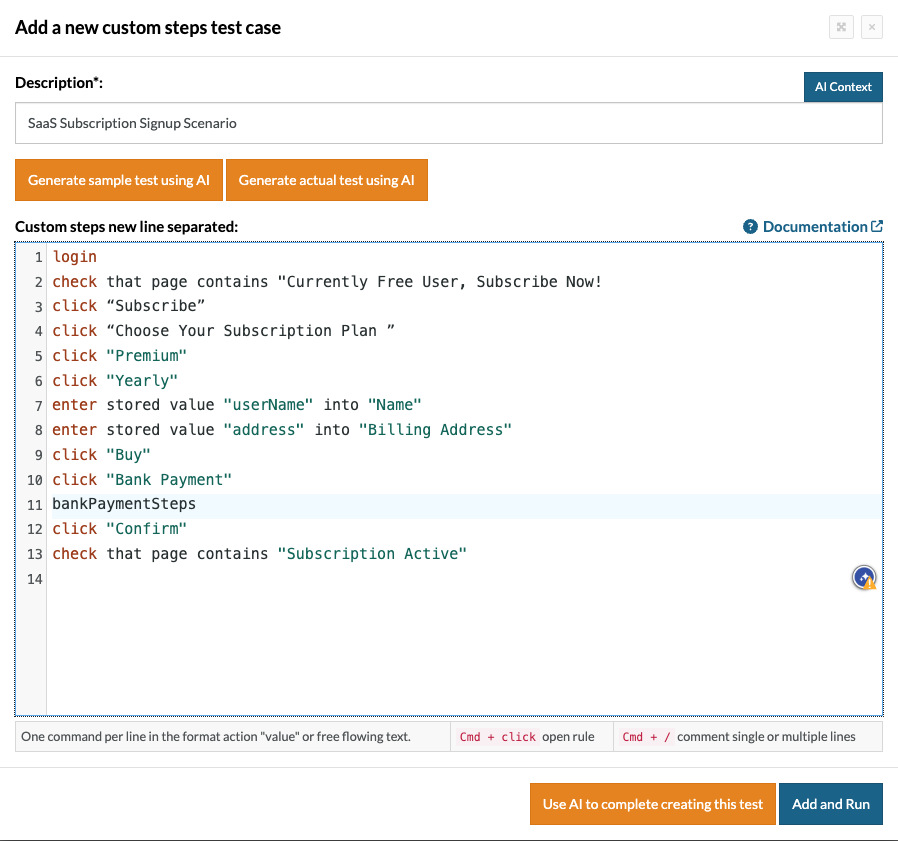
login // Reusable Rules
check that page contains "Currently Free User, Subscribe Now!"
click "Subscribe"
click "Choose Your Subscription Plan"
click "Premium"
click "Yearly"
enter stored value "userName" into "Name"
enter stored value "address" into "Billing Address"
click "Buy"
click "Bank Payment"
bankPaymentSteps // Reusable Rules
click "Confirm"
check that page contains "Subscription Active"
You can see how simple it is to create test scripts using testRigor. It is more like writing manual test cases. This helps even non-technical stakeholders to understand the test script easily and update it.
Why Trust Depends on Subscription Accuracy
SaaS is not like signing up for any promo. It is relationship-building and trust-building over time. Throughout all stages, users expect correct billing, uninterrupted access, straightforward renewals, and predictable system behavior. Even a single slip, like an erroneous charge or loss of access, can obliterate that trust in an instant. Thus, it can be concluded that a well laid out test case supports maintaining the financial health of an organization, product stability, and is critical to retain customers for a longer time.
Frequently Asked Questions (FAQs)
- What makes SaaS subscription testing different from traditional application testing?
SaaS subscription testing focuses on validating user states over time rather than isolated features. It involves continuous transitions like renewals, upgrades, and billing cycles, where multiple systems must stay synchronized, making it far more complex than static application testing.
- Why do most SaaS subscription failures occur after signup?
Most failures occur during lifecycle transitions such as renewals, payment retries, or plan changes. These involve asynchronous processes, third-party integrations, and time-based triggers, which are harder to test and often overlooked in early-stage testing.
- What are the most critical risks in SaaS subscription systems?
The most critical risks include billing inaccuracies, mismatched user access, failed renewals, incorrect proration during plan changes, and unreliable payment gateway integrations. Any of these can directly impact revenue and customer trust.
| Achieve More Than 90% Test Automation | |
| Step by Step Walkthroughs and Help | |
| 14 Day Free Trial, Cancel Anytime |