
What Is a Heisenbug?
 |
Everything works fine.
Out of nowhere, things go wrong.
You poke at the bug, and suddenly, it vanishes. One moment it’s there, next it’s nowhere. Like smoke when you reach for it.
A single line of logging goes in. After another run, the tests show green.
Meet the strange case of Heisenbugs.
This blog explores Heisenbugs – what they are, why they show up, and how they’re unlike more predictable bugs such as Bohrbugs. Testing runs into trouble too – sometimes the bug vanishes during checks, making results shaky. Flaky tests often point to one of these lurking issues. Teams face real hurdles catching them early. Tools that learn patterns might cut through the noise better than rigid scripts. AI-driven approaches offer a way to spot oddities without rewriting everything from scratch.
| Key Takeaways: |
|---|
|

What Is a Heisenbug?
Something strange happens when you look closely – a Heisenbug shifts or vanishes entirely during testing. Watching it changes how it acts, making it hard to pin down.
The name is inspired by Heisenberg’s Uncertainty Principle in physics, where watching a thing changes how it behaves. That thought jumps into coding, and the act of debugging alters the program enough that the bug no longer shows up.
Now here’s how it works – ask someone what a Heisenbug is, give them a moment, then say the easiest explanation goes like this:
“A bug that hides when you look directly at it.”
This could mean:
- The bug disappears when you attach a debugger
- Surprisingly, when logs are included, the issue stops happening
- Running the same test twice gives different results
Frustration creeps in because these bugs refuse to act the same way twice.
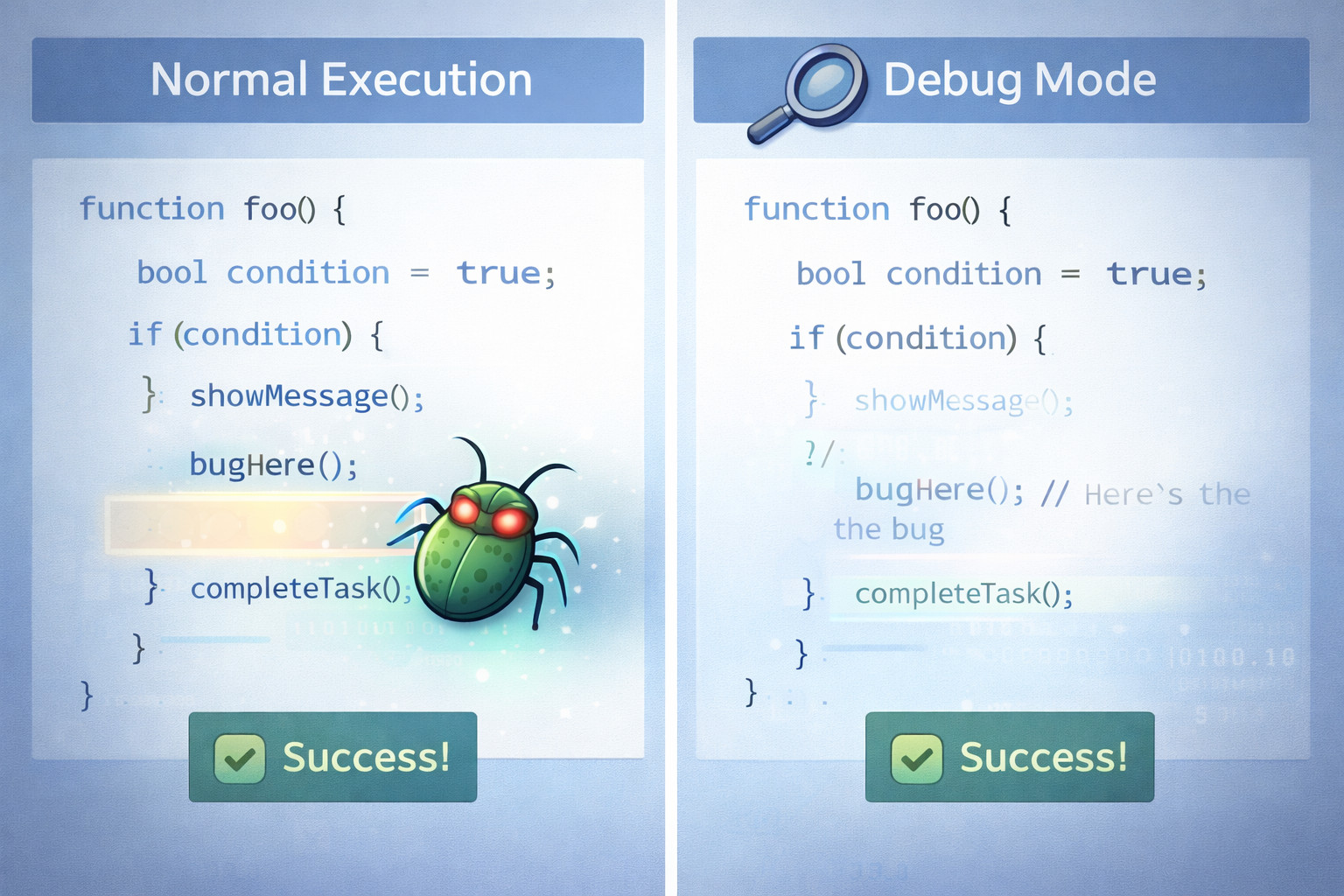
Heisenbug in Software Testing: Why Testers Hate Them
Heisenbugs confuse testers most of all. Most people take it for granted. But testing runs on a single quiet belief: “A single defect means there’s a way back to find it again.”
Heisenbugs make that idea fall apart.
Test fails happen – sometimes just once, then nothing more.
Something goes wrong when running tests in the pipeline. Yet it works just fine on your own machine. The issue shows up only during automated checks. Not seen anywhere else. Pops up unexpectedly each time the system builds remotely.
A bug appears only in CI but not locally.
People often mix up Heisenbugs with flaky tests, but they’re not exactly the same thing.
Intermittent and Non-Deterministic Bugs
Defects that vanish when observed live are part of something wider known as:
- Intermittent bugs
- Non-deterministic bugs
Here come bugs that:
- Might skip a beat now and then
- Depend on timing, order, or environment
- Some attempts fail when trying again. Results show up only by chance
A glitch that shifts when watched – that’s what makes it a Heisenbug. Its actions twist under scrutiny, never quite repeating the same way twice.
That’s an important distinction.
Heisenbug Examples You’ve Probably Seen Before
Here is something true. This feels closer now.
Example 1: Logging Changes Behavior Bug
A quick line of text shows the value inside. It just appears on screen when the code runs.
A moment ago, it was there – now gone without a trace.
Why?
Because logging:
- Slows execution slightly
- Changes thread timing
- Alters memory usage
A shift that small stops the glitch – for now.
Example 2: Debugger Makes the Bug Vanish
A production crash happens once a week.
A small tool hooks into the system during tests. It watches what happens without changing anything.
Nothing breaks.
Debuggers often:
- Pause threads
- Change execution order
- Memory access patterns shift based on it
A glitch still lives beneath the surface. Not gone – only out of sight.
Example 3: Test Passes When Run Alone
A test fails when the full suite runs.
Run it by itself? It passes every time.
This is a classic sign of parallel execution issues or shared state problems.
Race Condition Bugs and Concurrency Bugs
Many Heisenbugs are rooted in race conditions.
What are Race Condition Bugs?
A race condition happens when:
Something runs alongside something else. At once, tasks overlap. While one acts, another moves. Together, they operate without waiting. Timing decides what happens next.
There’s no guaranteed execution order.
- Should thread A go first, the system behaves as expected
- Should thread B go first, problems show up
Slip in a debugger or some logs, then watch how everything shifts. Timing bends when you peek under the hood.
Boom – Heisenbug.
Multithreading Bugs and Timing-Related Defects
Today’s software intensifies the bug instead.
Most tools we use now work like this:
- Multithreading
- Asynchronous processing
- Event-driven architectures
This brings in defects tied to timing, which show up when delays stack unexpectedly.
Distributed Systems Bugs: Heisenbugs at Scale
Faults grow stranger in shared setups.
Now you’re dealing with:
- Network delays
- Clock drift
- Partial failures
- Message ordering issues
A bug may appear only when:
- Some time slips by before the reply arrives
- Mistakes pile up when timing turns cruel
- Two systems disagree on the state
Fiddling with these bugs can shift how things unfold, so the issue vanishes. This makes root cause analysis annoyingly slow.
Heisenbug vs Bohrbug: What’s the Difference?
This comparison comes up a lot, so let’s clarify it.
Heisenbug vs Bohrbug
| Bohrbug | Heisenbug |
|---|---|
| Easy to reproduce | Hard or impossible to reproduce |
| Happens consistently | Happens inconsistently |
| Debugging helps | Debugging hides it |
| Predictable | Non-deterministic |
A Bohrbug is your classic bug.
Click this button → app crashes → every time.
A Heisenbug is the opposite.
It feels alive and slightly malicious!
Observer Effect in Software: Why Watching Changes Behavior
At the core of each Heisenbug is the observer effect in software.
Observing a system usually means:
- Adding logs
- Attaching debuggers
- Running in debug mode
- Changing test execution order
All of these actions:
- Affect timing
- Change memory layout
- Alter thread scheduling
A single tweak might shift how things run. Systems react in ways you wouldn’t expect. Tiny adjustments lead somewhere new.
Flaky Tests vs Heisenbugs: Are They the Same?
Here’s a fresh take on that thought: It isn’t quite the same thing – yet they do cross paths now and then.
Flaky Tests
- Tests that sometimes pass, sometimes fail
- Shaky setups tend to trigger it. Faulty logic in checks plays a part too
Heisenbugs
- Bugs that disappear when observed
- Often caused by concurrency, timing, or state issues
A flaky test may be exposing a Heisenbug. It might also stem from poor test writing instead.
What makes it tough? Spotting the gap between them.
Here are some articles that delve more into flaky tests:
- What are Flaky Tests in Software Testing? Causes, Impacts, and Solutions
- Flaky Tests – How to Get Rid of Them
Debugging Heisenbugs: Why Traditional Methods Fail
Traditional debugging assumes:
- You can pause execution
- Take a look at the current status
- Move line by line through the code
But faulty guesses fail when Heisenbugs show up. When the issue shows up, it has vanished long before.
This leads to:
- Guess-based fixes
- Overengineering
- “Let’s just add retries”
- “It hasn’t failed again, so we’re fine”
Not one stands out as truly good.
Read: What is Error Guessing Technique?
Best Practices to Catch Heisenbugs
Heisenbugs are tough to wipe out completely – still, their numbers can shrink. What remains often hides in plain sight.
1. Reduce Shared State
Faults creep in when multiple parts share the same data at once.
2. Avoid Over-Instrumentation
When logs track every detail, how systems act might shift.
3. Test Under Real World Scenarios
Production-like environments matter more than perfect mocks.
4. Observe How People Act
When you test how something is built, those checks break easily.
Here’s when picking tools begins shaping things. Not every option bends the same way under pressure.
Heisenbug in Software Testing: Why Tooling Matters
Some bugs persist due to unpredictable behavior.
- Tests are tightly coupled to code
- Test scripts rely on timing
- Test maintenance causes constant changes
Making adjustments to a test can shift how it runs. What happens during execution might not stay the same afterward.
Especially when it comes to UI, along with full workflow checks.
Read: How to Write Effective Test Scripts for Automation?
AI-Powered Testing Automation and Heisenbugs
Here’s when machines that learn start to matter in checking software.
Instead of:
- Hardcoded waits
- Fragile selectors
- Timing-dependent scripts
Today’s gadgets try to:
- What someone does matters more than how they do it
- Reduce test-side interference
- Adapt on its own when the interface shifts
Fixing Heisenbugs won’t happen overnight like some miracle. Still, fewer test-driven changes mean less chaos along the way.
testRigor and Heisenbugs
Well, now, can testRigor actually handle Heisenbugs in practice? Here’s why testRigor helps you deal with Heisenbugs effectively:
1. No Code for Test Scripts
With testRigor, anyone can write tests using everyday words. That looks like typing instructions just as you would explain them to a person. This means:
- Less brittle logic
- Fewer timing dependencies
- Reduced observer effect from the test code itself
These tests, written in English, can verify numerous scenarios like emails, 2FA logins, form validations, and even AI features like LLMs and chatbots that are being extensively incorporated into modern applications.
2. Stable Tests Mean Less Noise
Stability in testing lets teams tackle actual problems instead of wrestling with unpredictable results from their checks. The AI-based engine ensures that you get the most reliable test results and reduced test maintenance.
3. Behavior-Driven Focus
testRigor validates what users actually see and do, not internal implementation details that tend to trigger Heisenbugs. This works in favor of implementing a holistic QA approach since everyone on the team, irrespective of their technical expertise, can contribute to automated testing.
4. Performs Efficiently Under Parallel Workloads
Fewer hiccups show up during parallel runs because testRigor’s tests handle delays better.
Simply put, testRigor cuts down on wasted hours hunting for false alarms. Rather, teams focus on actual issues. What happens? Fewer distractions. The result? Real progress without the noise.
Heisenbugs Aren’t Going Away…
Heisenbugs are a natural side effect of:
- Concurrency
- Speed
- Complexity
- Scale
When setups get bigger and spread out, such errors show up more often instead of fading away. It is impossible to remove them entirely. Still, here’s what works instead:
- Lessen their frequency
- Detect them earlier
- Fragile testing habits tend to spark fresh problems instead of solving them
A sudden change in code might hide a Heisenbug – unlike most glitches, it shifts when observed. Your testing method can change how systems respond, sometimes making issues vanish. Spotting this early sets you on firmer ground.
Finding better testing tools – ones that adapt easily – keeps your checks from slowing things down. Tools such as testRigor simply work when you need them to.
| Achieve More Than 90% Test Automation | |
| Step by Step Walkthroughs and Help | |
| 14 Day Free Trial, Cancel Anytime |