
What is Gamma Testing?
 |
At some point in every software development process, the product seems almost finished. The features are in place, the bugs have been fixed, the documentation is there, and the internal teams have tested the app in a lot of different ways. But there is an unspoken understanding in every engineering company, big or small, that internal validity is never enough.
At this point, the team asks, “Are we absolutely sure the product is ready for the real world?”
The purpose of Gamma testing is to answer that question.

Gamma testing is the quiet, often overlooked, but very important step where the product leaves the perfect, controlled world of internal testing and enters something more like the unpredictable world of real customers, but in a safe, pre-release cocoon.
Alpha testing isn’t very organized or repetitive, and Beta Testing isn’t a big marketing test. Gamma testing is the last, small test that builds trust by making sure the product works with real users, meets their expectations, and doesn’t filter out interactions before it is officially released.
| Key Takeaways: |
|---|
|
Understanding Gamma Testing
Before the software is officially released to the public, Gamma testing is the last step in making sure it is of high quality. It is not about showing the product to a lot of people, getting feedback on features, checking if the product fits the market, finding major design flaws, or redesigning workflows. Instead, it focuses on the last layer of assurance, which is making sure that the product works as expected in real life for real users. During Gamma testing:
- No major code changes occur.
- Only critical fixes are allowed.
- The focus shifts from defect discovery to release readiness.
- It assesses the true usability, performance, consistency, and market-fit of the software.
Gamma testing checks three important areas:
- The user experience and usability in real-world situations.
- Business readiness, which includes documentation, help content, onboarding guides, and support workflows.
- Technical strength, which includes checks for configuration, installation, migration, and compatibility.
It answers the most important question that every engineering and product team should ask:
“Is this build really ready to go to customers without hurting the business?”
Gamma testing is what connects internal testing assurance to public trust. It’s the safety valve that gives businesses confidence that the deployment won’t break things in the real world.
Why Gamma Testing Matters More Than Ever
In the past, products went through long QA cycles in traditional waterfall cycles. After that, they went through Alpha and Beta testing, which often looked at functional, usability, and compatibility issues. Gamma testing was not required, but it was mostly used for products that needed to be very reliable, like medical devices, industrial systems, or financial products.
But these days, when continuous deployment, quick release cycles, and technologies that change all the time are the norm, Gamma testing is more important than ever.
- Releases Are Faster, Meaning More Risk: Modern SaaS teams send out updates quickly, which shortens regression cycles and makes it more likely that problems will go unnoticed. Gamma testing lowers this risk by checking the final build in settings that are very similar to how it will be used in the real world.
- Users Have Zero Tolerance for Bugs: There are a lot of options, and switching costs are low, so even one bad release can hurt conversions, cause people to leave, and hurt the brand’s reputation. Gamma testing makes sure that the product feels stable, purposeful, and ready for customers.
- Complex Integrations Require Real-World Validation: Today’s applications are built on many integrations, from APIs to cloud services, yet these integrations do not always behave the same way in the real world as they do in dry runs. Gamma testing verifies these integrations in environments that are similar to production, so it can be used to uncover problems that other tests may have missed.
- User Experience Validation Is Now a Competitive Priority: Features no longer alone drive the success of a product. Consumers are looking for seamless flows, effortless interactions, and coherent micro-experiences. Gamma testing reveals relatively minor issues that real users pick up on immediately, but in-house teams may miss.
The Goals of Gamma Testing
While most testing phases aim to find defects, Gamma testing has a broader, more strategic vision. Its goals cover technical validation, business alignment, user confidence, and market readiness.
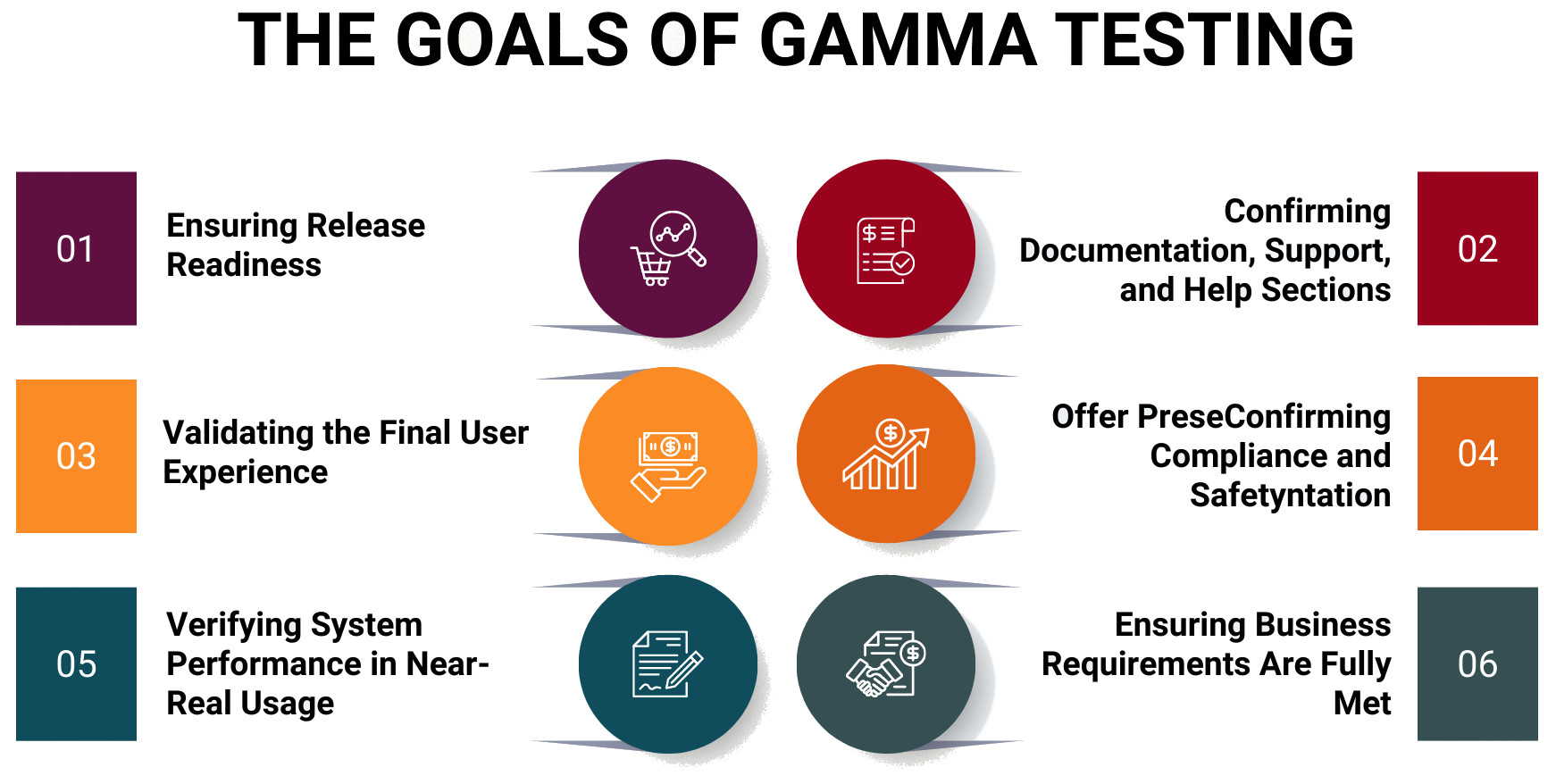
- Ensuring Release Readiness: Gamma testing is the last step to make sure that all the important features work and that there are no more major problems. It makes sure that the whole system works well so that the product is ready for a general release.
- Validating the Final User Experience: Controlled environments can hide small problems with usability that only show up when people use the product normally. Gamma testing finds problems with navigation, steps that are hard to understand, or gaps in responsiveness that help make the product better.
- Verifying System Performance in Near-Real Usage: Results from earlier stages of performance testing may not be a good indicator of how things will work in the real world. Gamma testing checks for responsiveness, load handling, and stability in conditions that are close to production to cut down on performance problems after release.
- Confirming Documentation, Support, and Help Sections: Changes to products often happen before the documentation is updated, and people don’t always notice when it becomes out of date. Gamma testers make sure that manuals, onboarding guides, help content, and FAQs are all easy to understand and follow.
- Confirming Compliance and Safety: Industries that are regulated must follow compliance standards very closely, especially as the release date gets closer. Gamma testing ensures that no last-minute changes introduce risks or violate the rules.
- Ensuring Business Requirements Are Fully Met: Industries that are regulated must follow compliance standards very closely, especially as the release date gets closer. Gamma testing makes sure that no last-minute changes add risks or break the rules.
Gamma Testing vs Alpha Testing vs Beta Testing
People often mix up gamma testing with beta testing. They are similar in some ways, but their goals, timing, and audience are very different. Let’s have a comparison.
| Criteria | Alpha Testing | Beta Testing | Gamma testing |
|---|---|---|---|
| Conducted By | Internal team | External users | Selected real-world users or internal QA |
| Environment | In-house, controlled | External or customer environments | Near-production or production-adjacent |
| Bugs Expected | Many | Some | Minimal |
| Focus | Detect defects early | Evaluate usability & gather feedback | Validate readiness and stability |
| Type of Feedback | Technical | User experience | Business, performance, and final usability |
| Code Changes Allowed | High | Medium | Low to none (only major fixes) |
| Timing | Before Beta | After Alpha | After Beta, before launch |
| Goal | Improve product quality | Validate market acceptance | Confirm final production readiness |
A lot of organizations wrongly believe that Gamma testing is not necessary. Not all businesses use it, but most teams that care about high reliability do. Gamma testing is especially vital for:
- Mission-critical software.
- Enterprise applications.
- Systems with real-time data.
- Consumer-facing apps with complex UI flows.
Read Verification and Validation in Software Testing: Key Differences
When Should Gamma Testing Be Used?
Gamma testing is not necessary for every type of product. However, it becomes extremely important when:
You Are Releasing a Highly Visible Feature
When a feature affects a lot of users or takes the place of an existing workflow, defects have a much bigger effect. Gamma testing makes sure that the transition goes smoothly and that users can use the update without any problems.
Product Stability Is Crucial to Business Reputation
Industries like banking, medicine, aviation, human resources, and e-commerce can’t afford to fail after a release. Gamma testing is the last line of defense for brand trust and reliability.
Your Product Integrates With Many External Systems
When not in a controlled environment, complex integrations can act in ways that are hard to predict. Before users do, gamma testing finds configuration gaps or dependency problems.
The Product Supports Different Devices, Platforms, or Browsers
Problems with compatibility usually only show up when software runs in different settings. Gamma testing makes sure that the product works well on a wide range of devices, operating systems, browsers, and settings that are specific to a region.
Your Team Is Using Continuous Delivery
Releases that happen too quickly can skip over thorough human validation and let regressions slip through. Gamma testing is the last step in manual quality control that keeps quality high at high speeds.
Gamma Testing Lifecycle
Gamma testing follows a strict, organized process that is meant to check the final build in real-world situations. Before the product is made public, each step makes sure that it is stable, ready for use, and in line with business expectations.
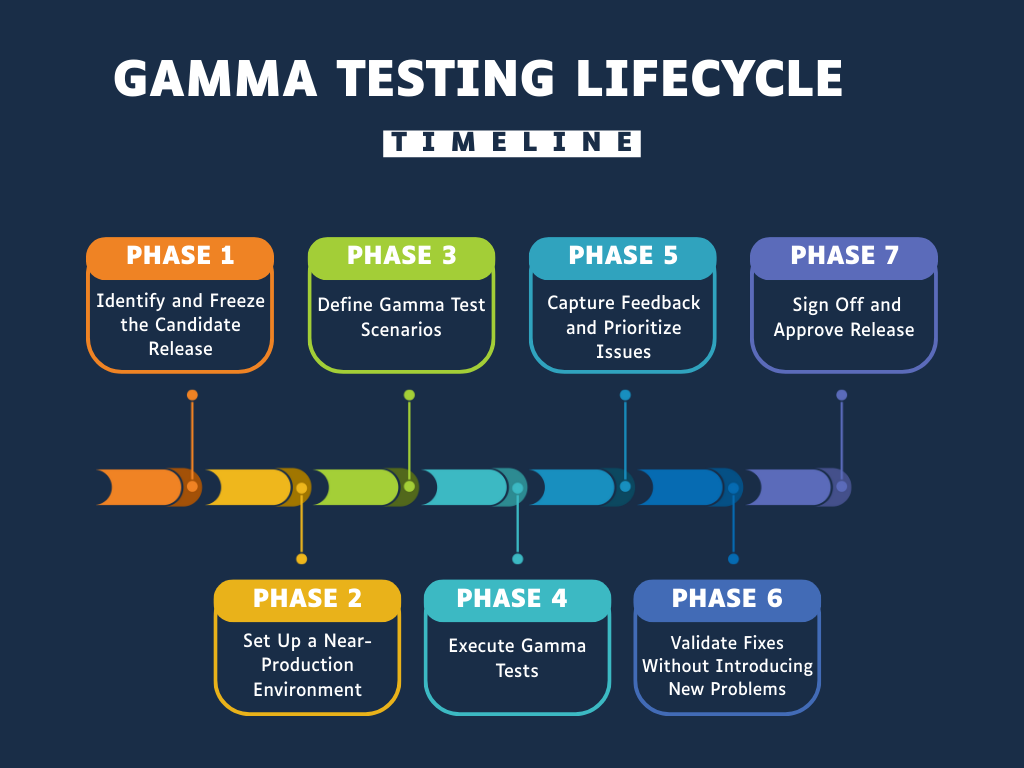
Step 1: Identify and Freeze the Candidate Release
Gamma testing doesn’t start until the team picks a stable “release candidate” build that they think is almost ready for deployment. To keep things stable during testing, all major development must be done, all critical issues must be fixed, and the code must be frozen.
Step 2: Set Up a Near-Production Environment
Testing must take place in an environment that is very similar to production, including the settings for the servers, the amount of data, the roles of the users, and the state of the network. This makes sure that the results show how people really act, not how they would act in an ideal situation.
Step 3: Define Gamma Test Scenarios
Gamma scenarios are all about making sure that end-to-end flows work, that everything is compatible, that performance is good, and that the final product is easy to use. These scenarios include user-centered journeys, operations that are specific to the environment, integration checks, and documentation validation to make sure that everything is covered.
Step 4: Execute Gamma Tests
Gamma testers do exploratory testing to make sure that all important flows are working and that there are no hidden bugs. They look at the product with fresh eyes, which shows small problems like UI inconsistencies or slow performance.
Step 5: Capture Feedback and Prioritize Issues
Feedback usually includes problems with usability, UI inconsistencies, missing content, or slow performance. The focus right now is on stability, not making new changes, so only serious problems that affect customers are being fixed.
Step 6: Validate Fixes Without Introducing New Problems
Changes and improvements that could make things less stable should be kept to a minimum during Gamma testing. We do targeted checks and a quick regression sanity check on each fix to make sure no new problems come up.
Step 7: Sign Off and Approve Release
When all of the Gamma criteria are met, QA formally approves the release, and the people who are interested in the product and the business confirm that they are ready. This last sign-off means that the product is really ready to be used by the public.
Gamma Testing Entry and Exit Criteria
Clear entry and exit criteria make sure that Gamma testing starts with a stable build and ends with a product that is ready to be released. These standards help teams stay on the same page, avoid unnecessary risks, and keep the same level of quality for final validation.
| Entry Criteria | Exit Criteria |
|---|---|
|
|
Read Entry and Exit Criteria: The Gatekeepers of Successful Regression Testing
Gamma Testing Techniques
Gamma testing uses specific manual methods to check that things work as they should and that users have a good experience. These methods help find small problems that earlier tests often miss.
- Exploratory Testing: Testers use their instincts to find workflow gaps, UX friction, and navigation problems in the application. This method shows problems that scripted tests usually miss. Read Exploratory Testing: How Do You Approach it as a QA Engineer?
- Experience-Based Testing: Testers use their knowledge of the field and how real users behave to make sure the product works the way customers expect it to. This makes sure that the testing is like how things work in the real world.
- Usability and UI Consistency Checks: Gamma testing checks things like visual consistency, spacing, alignment, labels, and responsiveness. These tests make sure that the interface looks and feels good on all screens. Read GUI Testing – A Complete Guide
- Documentation Testing: Gamma testers check that user manuals, API references, installation guides, and help articles are all correct. This makes sure that the documentation matches the real thing and helps users in the best way possible.
- Smoke and Sanity Testing: To keep the system stable, key flows and main features are checked quickly. After each accepted fix, these quick checks are done again to make sure that no regressions are introduced. Read Smoke Testing vs. Sanity Testing
- Performance and Load Checks: Testers confirm that the screens load quickly, the transitions are smooth, and the system can handle a moderate load with ease. These tests help find performance problems before the release. Read What is Performance Testing: Types and Examples
Gamma Testing vs. Production Testing
Gamma testing and Production testing may look the same at first because they both use real users and real-world situations, but they have very different goals. Before a product is released, Gamma testing checks to see if it is ready. After a product is released, Production testing checks to see if the live system works correctly when customers use it.
| Factor | Gamma Testing | Production Testing |
|---|---|---|
| Environment | Pre-production or near-production | Live production |
| Risk Level | Low | High |
| User Impact | None | Real users |
| Goal | Validate release readiness | Validate real-world behavior |
| Fix Scope | Minimal | Emergency fixes only |
Automating Gamma Testing
Gamma testing has always relied heavily on manual validation, human intuition, and real-world exploratory checks. This human perspective is still important, but modern QA teams are using automation more and more to speed up the final readiness assessment without lowering quality.
Gamma testing needs to be performed fast, as the testing window will be short before releasing. So, relying on traditional test automation tools won’t be recommended as it creates more maintenance and script complications. That’s why, currently, most organizations have opted for AI-based next-generation test automation tools like testRigor. testRigor provides many advantages for supporting gamma testing:
- With its Natural Language Processing (NLP) algorithms, users can create test scripts on the fly and run them on cross-browser or cross-platform environments. There is no dependency on any programming language, which means no script-level maintenance headaches.
- Another major advantage is that testRigor is a one-purpose solution for all automation; you can do web, mobile, API, desktop, etc. That means no need to use multiple frameworks. So framework maintenance is also not required.
- testRigor provides many superior features like reading text from images (OCR), supporting different authentications like Google or MFA, and can even test AI features like LLMs and Chatbots. It also supports call or SMS validations.
There are many additional features that testRigor supports; you can view them here.
Conclusion
Gamma testing is the last line of defense between a product and its real users. It makes sure that every important workflow, experience, and integration works as it should in the real world. This last layer of validation is very important for keeping stability, trust, and customer satisfaction as release cycles speed up and software gets more complicated.
With new AI-powered tools like testRigor, teams can do Gamma testing faster and more accurately, which means less work for people and more confidence in the release. Companies can make high-quality products that are really ready for the real world by using both human insight and smart automation.
| Achieve More Than 90% Test Automation | |
| Step by Step Walkthroughs and Help | |
| 14 Day Free Trial, Cancel Anytime |