
What is Mock Testing?
 |
Ever tried testing a software that relies on many third-party services? If yes, then you must have experienced that frustration that arises when each of these external services doesn’t work at a given time – one may fail, another may spew weird errors. The result of all this – your perfectly crafted test suite is riddled with errors because tests aren’t able to run successfully due to these misfires.
While you’re struggling to get your test suite up and running, you might see developers easily making their unit and integration tests run, despite all these third-party dependencies. How do they manage this? It is through mock testing. It might appear confusing at first, but once it clicks, things become clear. Truth is, it saves loads of time.
In this blog, we will look at what mock testing is all about, why it counts, how it functions within software testing, and also how AI-powered tools simplify the process.
| Key Takeaways: |
|---|
|
What Is Mock Testing? (And Why Is Everyone Talking About It?)
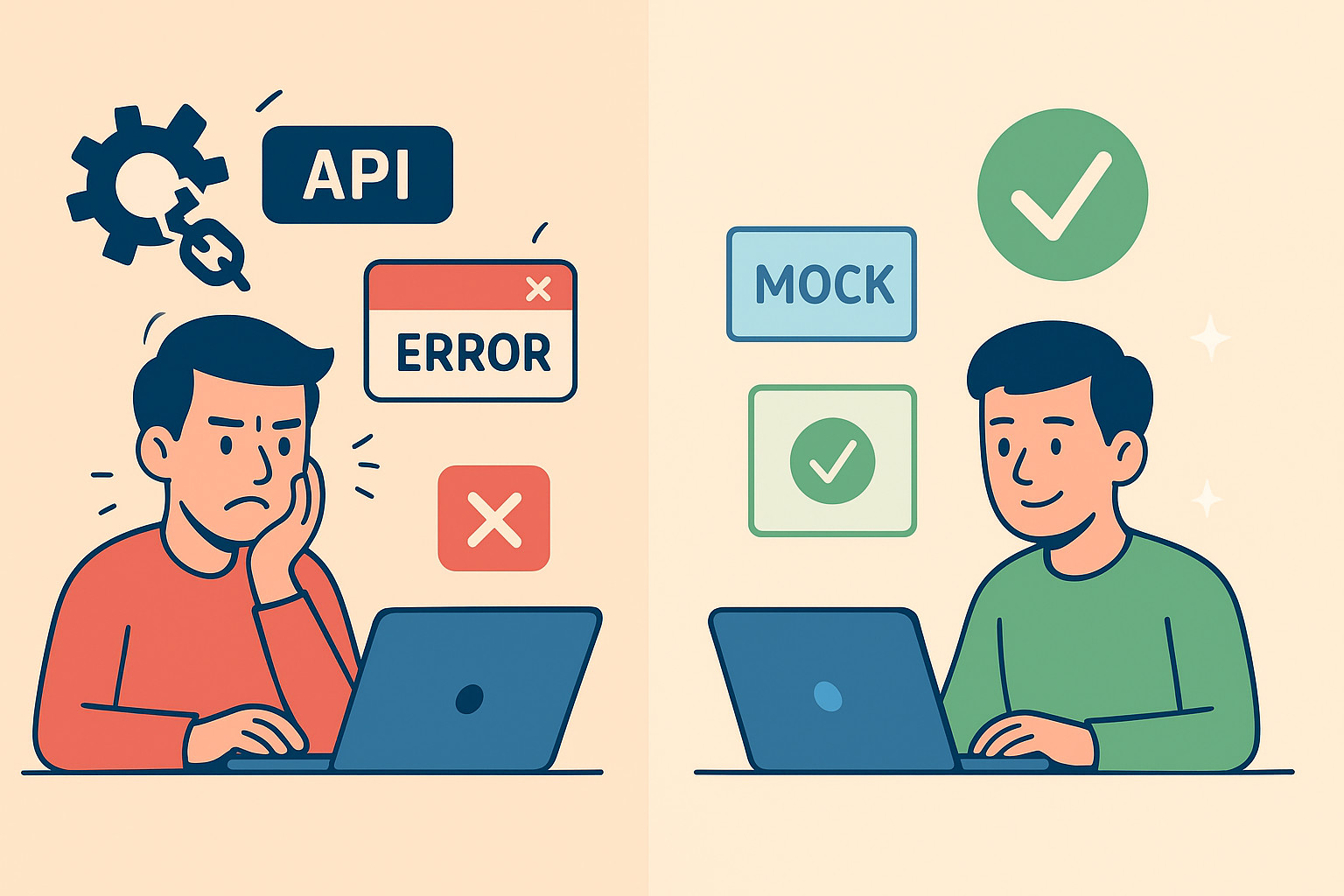
To keep it simple, mock testing means swapping real bits of a system with fake ones. Though not with random stand-ins. They are planned copies called mocks that are created to act like the real piece of code you need. Think of checking a car motor without connecting to a real fuel system. Instead, you plug it into a simulated fuel feed.
Why Should You Consider Mocks?
Because services crash now and then. Your database gets slow. External tools change how they respond suddenly. What if what you require is not ready? Another group could still be coding it. Testing with mocks lets coders avoid these headaches. Attention is shifted to where it counts, on the actual piece they are working on.
Mock testing lets you check one piece of code alone, neglecting anything else that might mess things up. Instead of depending on real parts, it uses fake ones to keep things under control. This means errors from outside won’t affect what you are trying to validate. By doing this, you focus only on how that small part acts when isolated.
Mock Testing vs Traditional Unit Testing: A Quick Contrast
Many people confuse unit testing with mock testing. Truth is, there are overlaps. Yet, there is an easy way to distinguish them:
- Unit testing: Test the smallest piece of your code in isolation.
- Mock testing: Replace the dependencies of that unit with fake versions so your test stays focused.
Traditional tests might rely on real components, say, a live database or reading an existing file. But mock testing skips right through the mess. You can swap in a fake version of the database, one that you control fully. It gives back just what you need, right when you ask. Zero network calls. Nothing unpredictable shows up. Time is not wasted.
Mock testing focuses on how parts of your code talk to each other. Meaning you’re checking how your code behaves when it thinks it’s communicating with another module.
Think: messages sent, functions called, paths taken. You simulate a piece working with another. Watch how they react. Though not the real integration, it still manages to catch hiccups early.
The goal? See if things move right when one component believes it is chatting with its neighbor.
Read more on unit testing:
- Unit Testing: Best Practices for Efficient Code Validation
- Are Unit Tests a Waste?
- Integration Tests vs Unit Tests: What Are They And Which One to Use?
Why Mock Testing Matters in Software Testing
Here’s what makes mock testing useful:
- It isolates the code you are testing: Mock tests keep things focused on just what you want verified. So, no surprise problems from other components impacting the outcome.
- It speeds up the entire testing cycle: Mock replies mean you get answers immediately. No need to wait for a response from real systems.
- It’s cheaper: Some APIs cost money every time you use them. Meanwhile, others delay your access. Some just don’t like being poked 10,000 times during a CI/CD run. That’s where mocks come in handy.
- It helps catch issues early: Dev teams can begin checking things early. No need to hold off till everything’s linked up. Mock testing can be brought in at the beginning of the development cycle.
- It enables parallel development: One team works on the real product while the other checks their part with mock setups. Meanwhile, teams keep pushing forward. Progress never stops despite differences.
Mock testing won’t take the place of integration or end-to-end testing. Instead, think of it as a solid partner who gets your code in shape before the heavy-duty runs.
How Mock Testing Actually Works (Without Overcomplicating It)
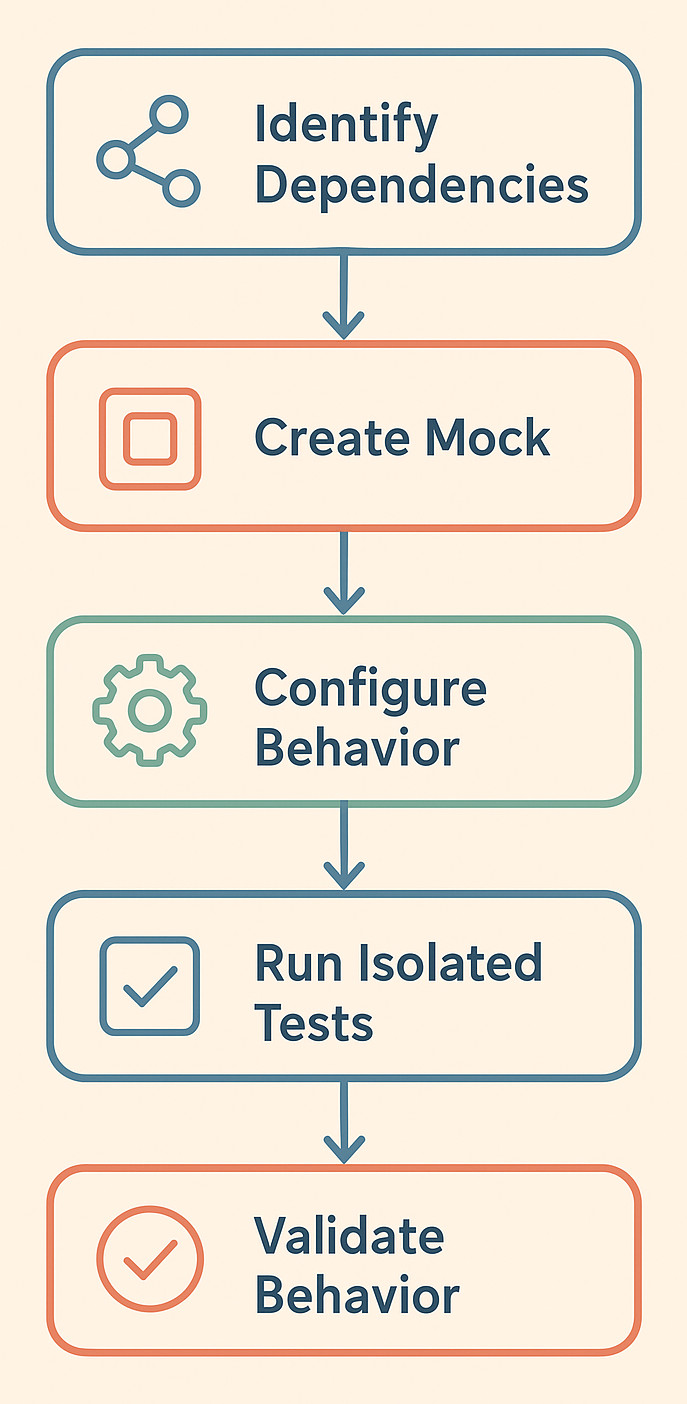
1. Figure Out What You Depend On
Your code might hit an API. Besides, it could store information in a database. Otherwise, it catches details from a tool handling money conversion.
Every one of those is a dependency.
2. Create Mock Projects
You build fake copies of those dependencies. These mocks:
- Follow the same interface or structure.
- Return the same type of data.
- Behave predictably and instantly.
The keyword here is predictably. With these mocks, you are now able to reliably test if your code is properly interacting with all these modules.
Read: Mocks, Spies, and Stubs: How to Use?
3. Control the Behavior
You can make the mock:
- Return success
- Return an error
- Return partial data
- Time out
- Behave strangely (because real services sometimes do)
This lets you build scenarios that are tough to simulate outside a controlled setup.
4. Run Tests That Use the Mock
Now your code interacts with the mock service rather than the real one. This way, your test cases can get reliable results without you having to manually fix failing dependencies. It allows you to focus on the actual thing – the behavior of the code, rather than on “why the dependencies that you didn’t build aren’t working?”
5. Verify Behavior
This is when mock testing really works well. You are not only looking at what your unit produces, but also:
- Did your function call the dependency?
- How many times did it call it?
- With what parameters?
- Did it handle errors gracefully?
- Did it retry when expected?
Mock testing focuses mostly on how things act. That’s the core of it.
Common Mock Testing Tools and Frameworks
Different coding languages have their own favorite mocking libraries. These include:
- Java: Mockito, JMock, EasyMock
- Python: unittest.mock, pytest-mock
- JavaScript: Jest mocks, Sinon.js
- C#: Moq, NSubstitute
You could manually write mocks if you wanted. Yet plenty skip it since tools handle things way seamlessly.
Read: How to Choose the Best Unit Testing Framework for JavaScript
When Should You Use Mock Testing?
Mock testing is ideal when:
- A dependency might break easily, work poorly, or cost too much.
- The actual setup still isn’t done.
- You’re looking for quick replies.
- You test how it acts instead of checking the full end result.
- You’re creating a tool that connects to many outside services.
- You’re dealing with microservices or a modular setup.
- Mostly, when your checks rely heavily on setups you can’t manage.
Where Mock Testing Fits Into Modern Software Testing
Nowadays, software setups aren’t basic at all. We deal with microservices, cloud infrastructure, distributed systems, and APIs everywhere. At the pace that teams move, it’s pretty much impossible to test everything at once “for real”.
Mock testing helps keep things manageable. It fits nicely into:
- Unit testing
- Component testing
- Continuous integration pipelines
- Development workflows before APIs are ready
- Simulation of error states that are hard to reproduce
It’s like training wheels before you go ride on a busy highway.
Mock Testing in Software Testing Automation
Mock testing definitely simplifies the process of verifying if the implementation or integration works as expected. But here’s the thing – we also need to verify the real deal. It means that we still need higher levels of testing for this, not just unit or integration tests where mocks are applied. You might need to do:
- Automated UI tests
- API tests
- integration tests
- regression suites
- performance tests
- and more
How testRigor Fits Into Modern Software Testing (And Why It Matters When Doing Mock Testing)
Test automation works well, yet traditional methods mean coding by hand, ongoing fixes, and regular tweaks. That’s when AI-powered test tools step in. They reduce manual coding and adjust test scripts automatically when things evolve.
Mock testing also works well with AI-based test automation. A tool like testRigor can help you with both managing high-level testing and mocking APIs wherever needed.
1. testRigor Lets You Mock APIs
Similar to how mock testing supports initial checks, testRigor handles complete workflows – without needing a finished interface or server setup. If your app calls an external service that charges per request (like a map API or a credit check), you can mock the response to save costs and avoid hitting rate limits during your test suites. Since most modern applications follow modular or microservices architectures, this is a great way to use a single tool to test integrations as well as user-level scenarios.
Here’s an example of how easily one can write a test case for mocking APIs in testRigor:
mock call api POST “https://httpbin.org/post” returning body from stored value “mocked-response”
2. Perform All Kinds of Testing in Plain English
With testRigor, you can write tests in plain English. This helps everyone on the team, not just specialized engineers, participate in the QA process. You can automate tests across platforms (web, mobile, desktop) that could be regression tests, functional tests, UI tests, AI features testing, database testing, API testing, and more.
3. Assured Test Stability and Reduced Test Maintenance Costs
Mock testing supports devs when working on small pieces. But when the real dependencies are brought in instead of the mocks, testRigor keeps the tests stable, provided the tests were working fine at the mocking stage. testRigor’s AI engine can adapt to breaking UI changes, like elements being moved or texts getting updated, and correct the test cases accordingly. This is possible since testRigor doesn’t rely on flaky element locators like XPaths or CSS selectors and instead, processes UI elements like a human emulator. All this brings down test maintenance to a bare minimum.
4. Continuous Testing with testRigor
Just like mock tests, you can integrate testRigor tests into your CI/CD pipeline. This will help ensure that quality is being maintained at all levels – unit, integration, and end-to-end.
Where Mock Testing Doesn’t Help Much
- When you’re testing UI behavior.
- While checking how actual users move through a system.
- For full coverage from start to finish.
- While sorting out problems that feel real-world.
So that’s the reason mock checks need to go hand-in-hand with system-wide tests, full-path validations to handle tangled setups.
Advantages of Mock Testing in a Real Development Workflow
- Flexibility: You could mimic just about any situation – like sluggish replies, system crashes, or strange data layouts.
- Less brittle tests: You don’t rely on actual setups that shift without warning.
- Better coverage: You can try out extreme situations that almost never happen by chance.
- Great for TDD (Test-Driven Development): Mock testing works well for devs that start with tests, since it fits their flow quite naturally. Read: How to Handle TDD with AI
- Perfect for microservices: Microservices rely heavily on one another. However, mocks help keep testing under control. Read: How to Do API Testing in Microservices Architecture: A Beginner’s Guide
But Mock Testing isn’t Perfect
Mock tests are great – though they come with drawbacks. While they help you practice with substitutes, they don’t always reflect the real world. If your fake versions act differently from the actual system, tests could still work, and yet, things break when they connect for real.
Dev teams might waste effort fixing fake systems when actual ones change. It won’t spot deeper problems; rather, it just checks integrations with a fake version of the dependency. Hence, mock testing isn’t meant to take over from regular checks. Instead, it covers missing spots while building a reliable foundation.
Mock Testing Makes Testing Faster, Safer, and More Predictable
In present times, when apps update nonstop, whatever adds smoothness while giving quick results deserves a shot. Much like a quick rehearsal, mock tests feel basic at first glance – yet they pack quite a punch. They cut down unpredictable errors because systems don’t rely on unstable parts. Development moves faster since devs aren’t stuck waiting around for dependencies to work. Team members can tackle tasks at the same time without tripping over each other. Outcomes become clearer, so debugging isn’t guesswork anymore. Pair this approach with smart automation tools, and suddenly, workflows get smoother while staying sharp.
| Achieve More Than 90% Test Automation | |
| Step by Step Walkthroughs and Help | |
| 14 Day Free Trial, Cancel Anytime |