
Top Banking Domain Software Testing Interview Questions for 2026
 |
For banking and financial services, the requirements are extremely robust in terms of quality, accuracy, and security, which makes software testing even more challenging for these verticals compared to other sectors.
Moreover, with the fast-paced developments in digital banking, UPI, mobile payments, and AI-based fraud detection, QA professionals are expected to possess advanced skills. The interview questions below will help you prepare for BFSI career scenarios, so that you can confidently give these interviews.
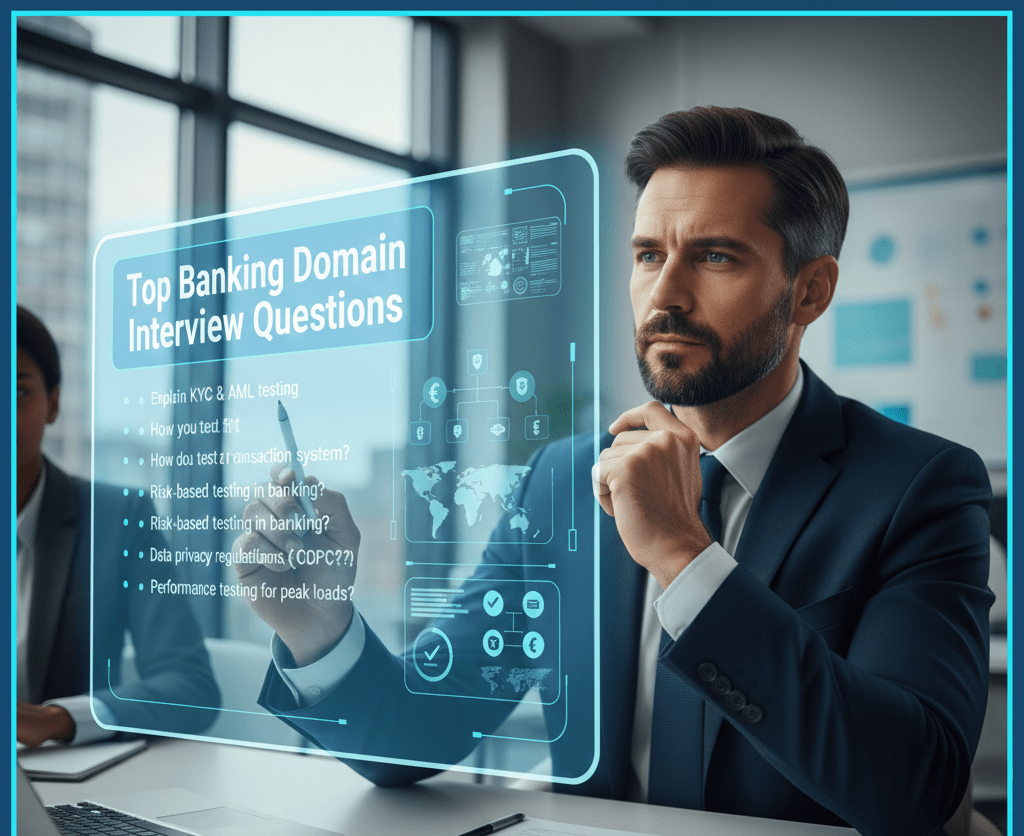
Banking Domain Software Testing Interview Questions
1. What makes banking domain testing more complex than other domains?
Suggested Approach: Highlight regulations, sensitivity of data, and multiple system integrations.
Sample Answer: Banking applications deal with extremely sensitive financial information, so precision and safety are crucial job requirements. These systems interface with payment networks, credit bureaus, ATMs, and regulatory systems, adding to the complexity of the test. One error can cause financial loss, a compliance breach, or customer mistrust. This has led QA to look for some in-depth domain and foolproof testing techniques. Thus, testing used in banking needs to be more extensive and heavily validated than in most other sectors.
2. How do you test a fund transfer in a banking application?
Suggested Approach: Mention authentication, limits, settlement, negative tests, and ledger validation.
Sample Answer: To test fund transfer, we would need to validate beneficiary addition, verification mechanism, limits for transfer, and charges that apply. Settlement times need to fall within NEFT, RTGS, IMPS, or UPI guidelines. There must also be comprehensive testing of negative situations, such as when there are no funds or the account number is invalid. Ledger entries must always be up to date (no financial reconciliation). The balances of both payer and payee should be updated to reflect the transaction.
3. What are the key test scenarios for login and authentication in banking apps?
Suggested Approach: Cover MFA, OTP, session management, device binding, and negative scenarios.
Sample Answer: Authentication testing begins with verifying strong password rules, OTP flows, biometrics, and multi-factor authentication. You must test session timeout, device registration, and account lockout mechanisms. Negative cases, such as invalid credentials or repeated login failures, are equally important. All login events should be captured in audit logs for compliance. The goal is to ensure access is secure and controlled at all times.
4. How do you ensure data integrity in banking systems?
Suggested Approach: Mention ACID compliance, consistency checks, and rollback validation.
Sample Answer: Ensuring data integrity involves validating ACID properties, referential integrity, and cross-module data consistency. Every transaction must reflect accurately across ledgers, statements, and dashboards. Rollback scenarios should be tested so partial updates never corrupt data. The system should prevent duplicate, missing, or mismatched records. Clear logging ensures auditors can trace any change or exception.
5. What is reconciliation testing, and why is it important?
Suggested Approach: Explain customer vs. ledger matching and financial accuracy.
Sample Answer: Reconciliation testing verifies that customer account transactions match exactly with backend ledger entries. Any mismatch may indicate processing failures or integration issues. Since banks depend on precise financial reporting, even the smallest difference can cause legal or financial impact. Reconciliation ensures the system remains accurate and trustworthy. It also prevents disputes and improves operational stability.
6. How do you test account statement generation?
Suggested Approach: Include transaction order, balance accuracy, formats, and edge cases.
Sample Answer: Account statement testing involves verifying the accuracy of amounts, timestamps, descriptions, and running balances. You must test downloadable formats such as PDF and Excel for consistency. Edge cases like backdated entries, reversals, or partial settlements must also be validated. Every record should align with backend ledger data. The final output should be readable, precise, and audit-compliant.
7. What is your approach to AML testing?
Suggested Approach: Mention rule validation, alerts, thresholds, and compliance behavior.
Sample Answer: AML testing involves evaluating rules that detect suspicious activities, threshold breaches, and unusual transaction patterns. Alerts must trigger correctly and escalate to compliance teams. False positives and false negatives must be measured carefully. Integration with sanction lists and regulatory data sources is critical. The goal is to ensure proactive fraud detection and full compliance.
8. What do you test in loan processing systems?
Suggested Approach: Include eligibility, credit checks, interest rules, and workflows.
Sample Answer: Loan system testing starts with validating application intake, eligibility checks, and credit score integrations. Interest calculations, EMI schedules, and amortization tables must be accurate. You also test prepayment, foreclosure, and penalty rules. Document workflows like approval and underwriting are equally important. The final loan details should flow correctly into statements and ledgers.
9. How do you test interest calculation logic?
Suggested Approach: Mention fixed/floating rates, compounding, rounding, and date adjustments.
Sample Answer: Testing interest involves validating fixed and floating rates, compounding frequency, and precise rounding rules. Holiday adjustments, partial payments, and changes in repayment dates need careful testing. You must compare system output against validated financial formulas. Even small errors can impact customer trust and regulatory compliance. Therefore, interest logic must be validated against multiple scenarios.
10. What are the key tests for digital banking applications?
Suggested Approach: Focus on features, usability, security, and performance.
Sample Answer: Digital banking testing includes validating fund transfers, account updates, bill payments, and notifications. You must ensure the app works consistently across devices and browsers. Security checks include encryption, authentication, and secure session handling. Performance testing is critical due to high user traffic. The overall experience must remain smooth, fast, and secure.
11. How do you test a payment gateway integration?
Suggested Approach: Mention authorization, settlement, callbacks, and error handling.
Sample Answer: Payment gateway testing validates authorization, capture, refund, and settlement flows. You must ensure callback responses update the transaction status correctly. Negative scenarios such as expired cards, insufficient funds, or 3D-Secure failures must be covered. Duplicate transactions should be avoided at all costs. Reconciliation ensures that merchant records and bank records match.
12. What scenarios are essential for credit card testing?
Suggested Approach: Include billing, interest, limits, rewards, and declines.
Sample Answer: Credit card testing covers billing cycle generation, interest calculations, minimum payment rules, and late fees. You also verify reward points, limit changes, and disputed transactions. Authorization, capture, and decline messages must reflect accurately. Statement accuracy is extremely important. The card’s available limit should update instantly after any transaction.
13. How do you test a mobile banking app?
Suggested Approach: Mention device coverage, biometrics, network variations, and security.
Sample Answer: Mobile banking testing includes validating navigation, biometrics, fingerprint or face ID login, and push notifications. You must simulate different networks, like 2G, 4G, Wi-Fi, and switch between them. Compatibility across devices and OS versions ensures a consistent experience. Offline and low-battery behavior must also be evaluated. Security validation protects sensitive data stored or transmitted via mobile.
14. How do you test UPI transactions?
Suggested Approach: Cover P2P/P2M flows, PIN validation, timeouts, and NPCI compliance.
Sample Answer: UPI testing includes validating send money, collect requests, and merchant payments. You must test UPI PIN flows, device binding, and transaction reference numbers. Negative scenarios like limit exceeded, wrong PIN, and network failures are essential. Balance updates must be instantaneous on both ends. Compliance with NPCI guidelines is mandatory.
15. What is your testing strategy for batch processing (BOD/EOD)?
Suggested Approach: Mention job sequencing, dependency, logs, and reconciliation.
Sample Answer: Batch testing validates whether sequence, timing, and job dependencies execute correctly. You must check completion status, retry logic, and error handling. Outputs such as interest postings and settlements should be accurate. Reconciliation ensures no mismatches occur after batches run. Logs must clearly document all steps for audit and debugging.
16. Why is maker-checker testing important?
Suggested Approach: Explain dual-authorization, approval routing, and security.
Sample Answer: Maker-checker workflows prevent unauthorized modifications by requiring two-person approval. Testing includes validating approval routing, rejection, escalation, and incomplete workflow handling. Unauthorized bypass attempts should be blocked. All actions must be logged to satisfy compliance. This ensures strong internal controls within the bank.
17. How do you test regulatory compliance in banking apps?
Suggested Approach: Mention KYC, AML, PCI DSS, GDPR, and data protection.
Sample Answer: Compliance testing includes validating KYC checks, AML rules, PCI DSS payment standards, and GDPR data protection policies. You must verify encryption, data masking, consent flows, and secure storage. Audit trails must be complete and tamper-proof. Regulatory reports should follow the required formatting. Non-compliance can lead to severe penalties.
18. What are critical security tests for banking apps?
Suggested Approach: Mention encryption, penetration testing, session security, and MFA.
Sample Answer: Security testing includes validating encryption for data at rest and in transit. Session hijacking, brute-force attacks, SQL injection, and CSRF vulnerabilities must be checked. MFA and OTP flows should work consistently. Logs must capture unauthorized attempts. Penetration testing helps uncover bigger risks.
19. What is important when testing the performance of banking systems?
Suggested Approach: Discuss throughput, concurrency, scalability, and failover.
Sample Answer: Performance testing evaluates response time, TPS, concurrency handling, and resource consumption. You must simulate peak loads and stress the system beyond normal levels. Failover tests check how quickly systems recover during outages. Scalability ensures smooth performance as users grow. Banking apps cannot afford slowdowns or crashes.
20. How do you test APIs in a banking environment?
Suggested Approach: Mention authentication, encryption, negative tests, and rate limits.
Sample Answer: API testing validates schema structure, encryption, authentication mechanisms, and response accuracy. You must test rate limiting, throttling, and timeout handling. Negative tests include invalid tokens and malformed payloads. APIs should behave consistently across channels. Security hardening is critical due to financial risks.
21. How do you handle testing during banking data migration?
Suggested Approach: Mention completeness, accuracy, parallel run, and integrity.
Sample Answer: Data migration testing verifies that all fields are migrated completely and accurately. Referential integrity checks ensure no broken relationships appear. Parallel run helps compare results between old and new systems. Transformation logic must be validated through samples and bulk data. The migration should not impact performance or compliance.
22. What do you test in an ATM transaction flow?
Suggested Approach: Mention withdrawal, PIN validation, switch network, and reconciliation.
Sample Answer: ATM testing validates withdrawals, mini statements, PIN change, and balance inquiries. Integration with the switch network must be tested for approvals and declines. Timeout handling and retry behavior must be verified. Cross-bank transactions require settlement checks. Reconciliation ensures ATM logs match bank records.
23. How do you test fraud detection systems?
Suggested Approach: Mention rule evaluation, anomalies, latency, and alert workflows.
Sample Answer: Fraud system testing includes validating detection rules using normal and suspicious patterns. Alerts should trigger instantly, with low latency. You evaluate false positives and false negatives to ensure model quality. Escalation and case management workflows must work correctly. Compliance requires retaining evidence and logs.
24. What are important scenarios for testing beneficiary management?
Suggested Approach: Include add/edit/delete, OTP, activation time, and limits.
Sample Answer: Beneficiary testing includes validating add, edit, and delete actions with proper OTP verification. Activation windows and daily limits must be enforced correctly. Negative cases like invalid account numbers should be handled smoothly. Changes should reflect instantly in the system. Proper audit logging ensures secure tracking.
25. How do you test transaction rollback scenarios?
Suggested Approach: Mention atomicity, reversals, logging, and consistency.
Sample Answer: Rollback testing ensures that partial failures revert all updates made during a transaction. No ghost or duplicate entries should remain in the system. Ledger and balance records must remain consistent. The system should remain stable even during high load or failures. Logs must capture the entire rollback sequence clearly.
26. What are the essential test scenarios for customer onboarding?
Suggested Approach: Mention KYC, document verification, mandatory fields, and risk scoring.
Sample Answer: Customer onboarding testing verifies KYC document upload, OCR accuracy, and identity verification. Mandatory fields should enforce strict validation rules. Integration with external verification systems must work correctly. Risk scoring and PEP/sanction checks must be validated. The final profile should be stored securely and compliantly.
27. How do you test audit logging in banking applications?
Suggested Approach: Mention completeness, tamper-proof storage, and traceability.
Sample Answer: Audit logging requires validating that every user and system action is logged properly. Logs must include timestamps, user IDs, event types, and metadata. Tamper-proof storage ensures logs cannot be altered. Review teams should be able to trace full transaction flows. This is essential for compliance and fraud detection.
28. What do you check when testing account closure?
Suggested Approach: Mention settlement, pending transactions, blocking access, and final state.
Sample Answer: Account closure testing includes verifying the settlement of dues, interest, pending transfers, and charges. Once closed, the account must not allow further transactions. Ledger entries and statements should reflect the closure accurately. Notifications should be sent to the customer. Archived data must remain accessible for audits.
29. How do you ensure multi-channel consistency across banking systems?
Suggested Approach: Mention sync, latency, conflict handling, and accuracy.
Sample Answer: Multi-channel testing validates whether transactions performed on one channel are reflected immediately across others. You must test synchronization delays and conflict scenarios. Inconsistent balances or records can cause customer distrust. Back-end APIs must ensure uniform processing. The goal is to offer a seamless banking experience.
30. What is end-to-end testing in banking, and why is it crucial?
Suggested Approach: Highlight full workflow validation across all integrated systems.
Sample Answer: End-to-end testing covers the entire customer journey across core banking, payments, compliance, statements, and ledgers. Since banking systems are highly integrated, a failure in one component can disrupt the entire process. E2E testing validates correctness, security, and compliance. It ensures all systems communicate properly under real conditions. This is one of the most crucial phases in BFSI testing.
Conclusion
Take the time to learn about some related topics around banking – what are their industry practices, what are the latest technologies added there, and so on. Remember to respond with confidence and show interest in learning and being part of a team to create a favorable impression in the interviewer’s mind!
Additional Resources
- Automated Testing in the Financial Sector: Challenges and Solutions
- How to do Digital Banking Testing?
- Wealth Management Testing: Ensuring Financial Systems and Client Data Integrity
- How to Do Payments Testing: Ensuring Secure and Seamless Transaction Processing
- How to Do AML (Anti Money Laundering) Testing: A Step-by-Step Guide for Compliance
- Test Automation for FinTech Applications: Best Practices
| Achieve More Than 90% Test Automation | |
| Step by Step Walkthroughs and Help | |
| 14 Day Free Trial, Cancel Anytime |