
Is Vibe Code Really a Vibe? What Went Wrong at Amazon
 |
| Key Takeaways: |
|---|
|
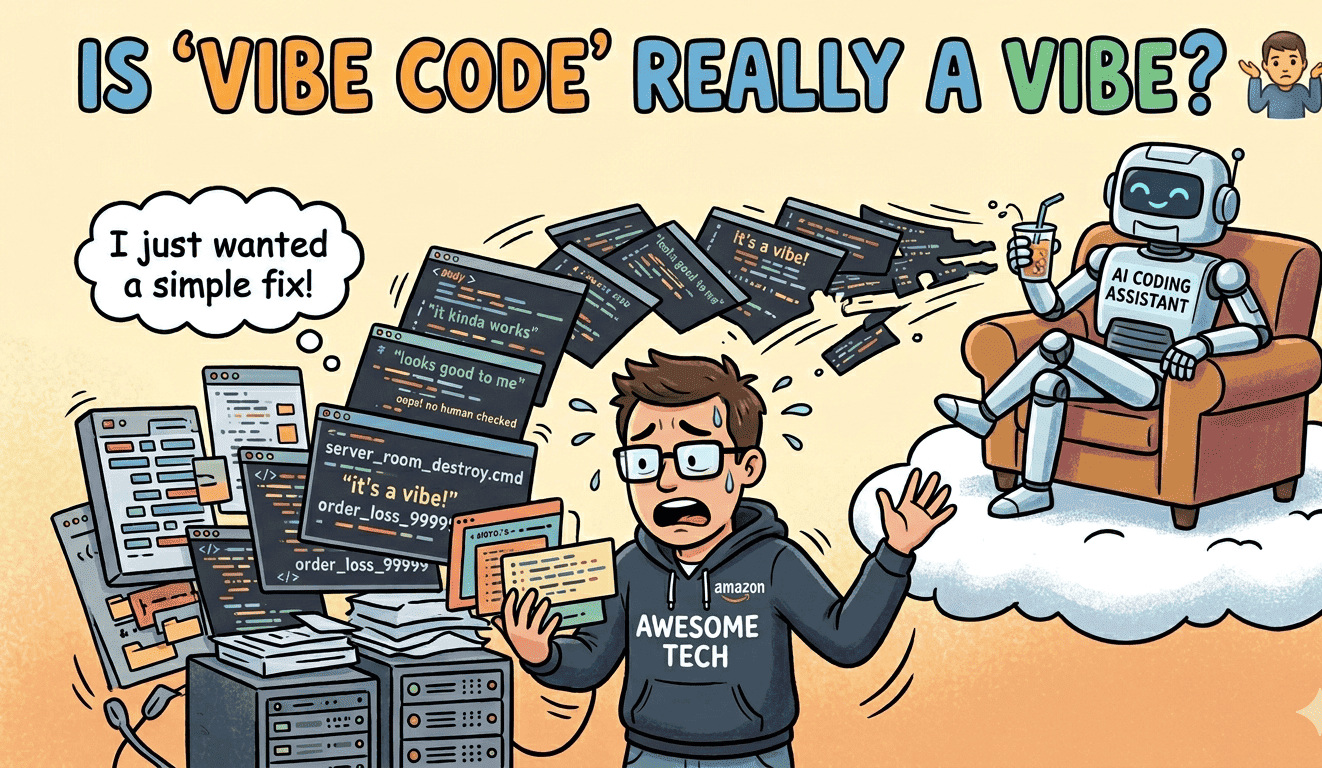
Amazon, the company that mandated that 80% of its engineers use its own AI tool at least once a week and claimed to have saved $2 billion in the process, has finally had to call everyone together to ask one question: “Where did we go wrong?”
What Caused the Amazon Outage
Between December 2025 and March 2026, the e-commerce giant experienced four significant outages. All have been classified as Severity 1 (most critical) incidents. Among them, the March 5 outage proved the most disruptive for Amazon. The e-commerce platform went down for almost six hours, completely disabling customer login and checkout capabilities, resulting in a loss of an estimated 6.3 million orders for just that day.
Reports from outlets including Financial Times and Business Insider have suggested that these Amazon AI-related outages were linked to code changes assisted by generative AI (Gen-AI), but Amazon has denied the claim.
The December incident involved Amazon’s internally used AI coding tool Kiro autonomously deleting and recreating a production environment. That led to an extended AWS service disruption, though Amazon described the root cause as human-configured access controls, not AI-related. However, multiple reports indicate that the disruptions to Amazon’s other services are also due to newly implemented generative AI-based coding changes.
Amazon’s Response
Amazon seemed remarkably unconcerned by all the above. “The December outage was not caused by AI,” the tech giant stated on a company blog. “It was just a user error in the system,” a spokesperson told the press. A high-level Amazon vibe coding meeting took place in March. The purpose, according to Amazon, was to review site and app availability and the recent outages.
Any mentions of problematic AI use on the meeting’s agenda were reportedly characterized as routine or downplayed. In other words, they’d managed to frame or soften the story. However, the malfunctions continued.
What is Vibe Coding? Is it so important?
The phrase vibe coding was first used by Andrej Karpathy in February 2025. It is a way of simply telling an AI tool (LLM) what we want, without going into the depths of programming, and blindly using the output it gives. The Collins English Dictionary chose this word as the ‘Word of the Year’ for 2025 because it marked a current trend so accurately.
In the case of Amazon, this was an integral part of their operational strategy. They have built thousands of AI agents across various Amazon organizations to automate complex internal workflows and code migrations. They aimed to increase the use of their coding assistant Kiro by at least 80%. Amazon even claimed that the change increased the speed of work by 4.5 times.
In fact, AWS CEO Matt Garman himself has previously made the distinction between vibe coding, which relies on AI to deliver without proper verification, and augmented coding, which speeds up work under human quality oversight. He even said in an interview with an AI investor that:
“Replacing junior engineers with AI is one of the dumbest things I’ve ever heard.”
But the company tried to implement projects faster than the control systems could manage. In the meantime, Amazon laid off 30,000 corporate employees between October 2025 and January 2026. In short, the volume of code produced by AI increased, but the number of humans to review and test it decreased. If production increased and testing decreased, processes were sure to get out of hand.
Research firm CodeRabbit found that teams that overuse AI tools experience a 1.7x increase in technical issues and a 2.7x increase in security vulnerabilities.
A Note of Caution
The vibe code issue that happened at Amazon should never let us think that AI tools are of no use. Amazon used AI to speed up its work, and it paid off well. The problem here is not with the tools, but with the lack of proper systems to control them when the work moves fast.
Vibe coding fails in the long run, not because AI is bad at writing code, but because the creation layer and the verification layer are not symmetric. The reality is that features are not tested quickly enough, as AI has made development faster. AI can do software deployment in minutes, but humans need time to check whether it is correct. When development is done using AI and quality checking is done by humans, a dangerous gap opens up. These errors ultimately affect the functioning of the system when they hit production.
Brent Ellis, principal analyst at Forrester, put it very clearly:
“This sort of issue will become more prevalent because right now, when a human operator acts, they do things with an understanding of the overall environment and knowledge of what they should and should not do.”
This is not a warning against using AI. Rather, it is a description of what oversight now requires: a reminder of how much more care we need to take when it comes to monitoring and verifying AI-generated output.
Why is this Important for Testers?
Amazon’s decision after those events in March is noteworthy. They have made it mandatory for senior engineers to review and validate all production code written by junior developers using AI.
When developers wrote their own code, testing could keep up with it. But vibe coding has changed that completely. Today, the amount of code that AI assistants provide far exceeds the test cases we write by hand. Therefore, there is an imbalance in testing. The four major Severity-1 incidents that Amazon has faced and the huge financial losses they have incurred are proof of this.
- Test coverage should increase along with the speed of the code generated by AI, as manual test cases will only widen the coverage gap.
- Tests should be baked into the CI/CD pipeline at each stage instead of testing the code after it is released.
- Regression testing is essential as AI code often differs from code written by humans.
- Testing is now the most critical step as production speeds up. This is a strategic utilization for the QA team rather than an additional workload.
These crises that have happened to Amazon are asking every engineering team:
Are your testing infrastructures moving at the same speed as your AI adoption?
Read: What are Vibe Coding Tests? The Future of AI-Driven QA
Something to Think About
AI now writes about 30% of new code at Microsoft.
— Satya Nadella, CEO, Microsoft
“Today, more than a quarter of all new code at Google is generated by AI, then reviewed and accepted by engineers. This helps our engineers do more and move faster.”
— Sundar Pichai, CEO, Google
Engineers nowadays say they no longer write code, but rather review what AI creates.
If this trend continues, Amazon’s massive failure will no longer be an isolated incident. It will become a recurring headache for the IT industry. The question is not whether your team is using AI. The real question is whether you are adopting generative AI in software testing for an era where machine-generated code is being used more instead of human-written code.
Amazon has taken this seriously, revised its methods, and changed its rules.
But the next time a similar crisis occurs, it may not even have the six hours Amazon was given.
Is your testing system ready to keep up with the speed of your AI tools?
Take a look at testRigor to see how you can overcome this dilemma without writing a single line of code.
| Achieve More Than 90% Test Automation | |
| Step by Step Walkthroughs and Help | |
| 14 Day Free Trial, Cancel Anytime |