
How Does Specification-Driven Development Work?
 |
Specification-Driven Development (SDD), or as it is also known, BDD 2.0, represents a significant advancement in how contemporary development teams conceive, validate, develop, and deliver feature-rich software. Well, unlike those previous approaches where requirements ambiguity results in wrongly interpreted requirements, duplicate work effort, test coverage that varies outcome to outcome, and rework (it’s all about the rework), SDD makes a pretty radical suggestion:
The specification itself becomes executable and serves as the single source of truth for the entire lifecycle.
The concept is simple, but its impact is game-changing. You no longer need to rely on manual test coding or monitor whether the test matches the requirements or implementations. You can verify correctness even before a line of code has been written, and it also brings the product owners, developers & QA into perfect sync.
| Key Takeaways: |
|---|
|
What is Specification-Driven Development (SDD)?
- Written in plain English
- Executable without additional coding
- Fail before development begins
- Pass before a feature is released
- Living artifacts that evolve with every change
SDD is not just a practice; it’s a mindset in which teams think differently about software development. Instead of separate code structures, teams build around observable behavior and user-facing results.
Read: What is Behavior Driven Development (BDD)? Everything You Should Know.
Why Specification-Driven Development Exists
Specification-Driven Development (SDD) was developed due to a long-existing imbalance between requirements, testing, and code. By bringing all these together in a single authoritative specification, SDD provides coherence across teams. Finally, it eliminates ambiguities and redundancies.
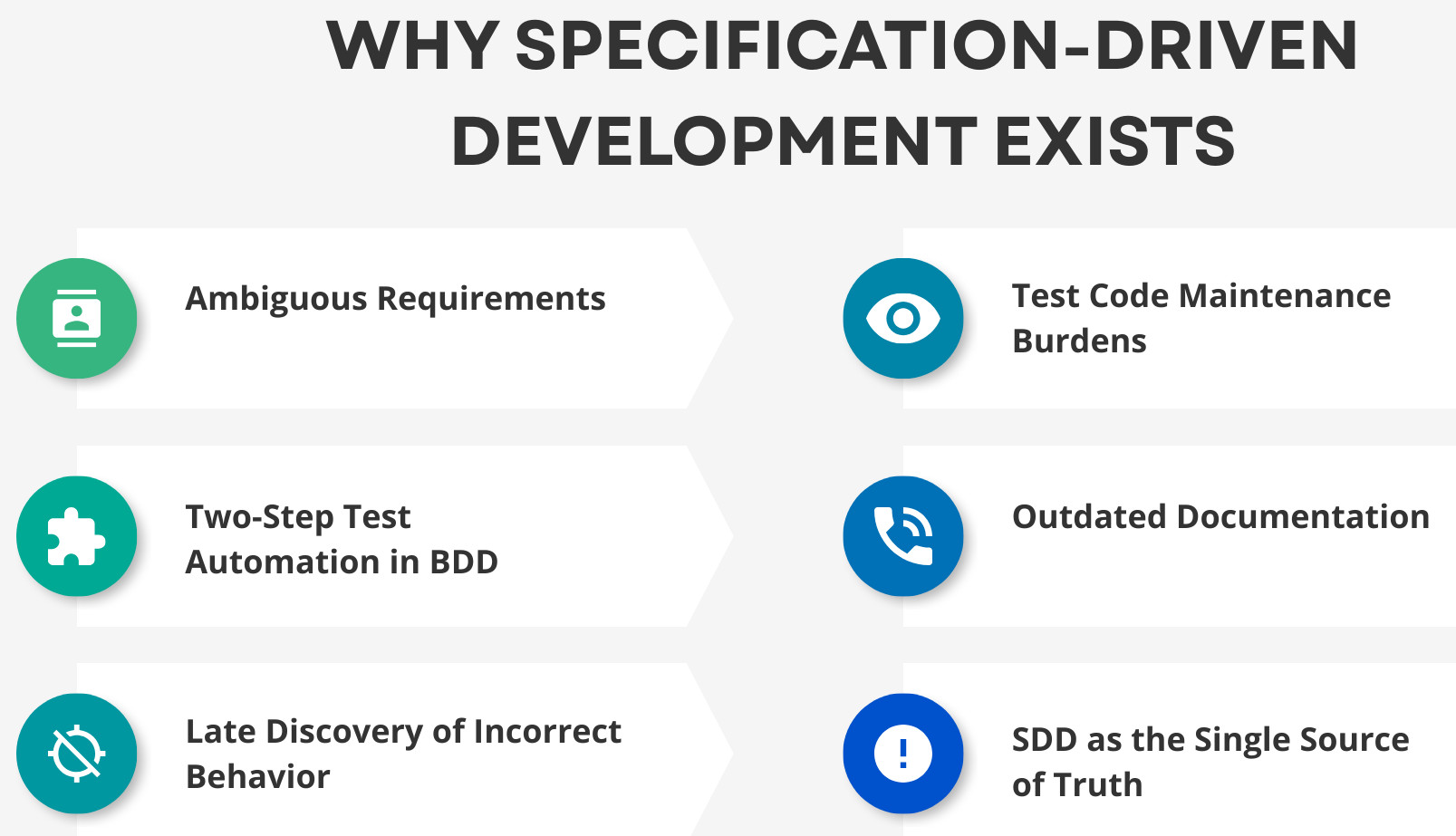
- Ambiguous Requirements: Traditional, written text requirements are typically vague and open to interpretation among developers, quality assurance teams, and stakeholders. This results in inconsistent behavior at every level, since each person might imagine the requirement differently. SDD replaces obscure descriptions with usable specifications devoid of ambiguity.
- Two-Step Test Automation in BDD: BDD 1.0 is driven by Gherkin files and step definitions independently, so you have a two-layered configuration that drifts over time. When step definitions are not in tandem updated with Gherkin, the team loses the integrity of the original vision BDD brings. SDD simplifies both of these into one executable spec, all while maintaining intent and correctness.
- Late Discovery of Incorrect Behavior: Lots of teams uncover misunderstandings only while testing or after they are done with development, leading to delays and expensive rework. This is because the requirements are not validated soon enough. SDD also forces you to test behavior at the beginning (as it does enable executable specifications from day one).
- Test Code Maintenance Burdens: Automation frameworks need to be maintained, and even minor UI/login changes can break a lot of test lines. You still have to manage your step definitions, locators, and the custom helper functions. That’s a bit of an overhead. SDD removes this burden by getting rid of the duplication in the automation layer and treating the spec itself as a test.
- Outdated Documentation: Often, documentation becomes obsolete because it is not connected to the system’s functionality and is rarely maintained. The result is that teams become increasingly less confident in their spec over time. Each time something is documented, it becomes a test that keeps documentation up to date. SDD does this by having the artifact of documentation also be a living, executable test.
- SDD as the Single Source of Truth: By consolidating requirements, tests, and validation in a single artifact, SDD eliminates the separation that leads to misalignment. Teams work from a single source of truth, so every step in your bustling workflow will have clarity. This model unites us and is all about working together and delivering more quickly.
Read: What is a BDD Framework? The Complete Introduction.
The Philosophical Pillars of SDD
Specification-Driven Development (SDD) is more than a process. It is also a change in thinking about how we develop software. Instead of breaking apart requirements, testing, and validation steps, SDD brings all these together in one executable source of truth. These six principles outline the guiding philosophy of the approach.
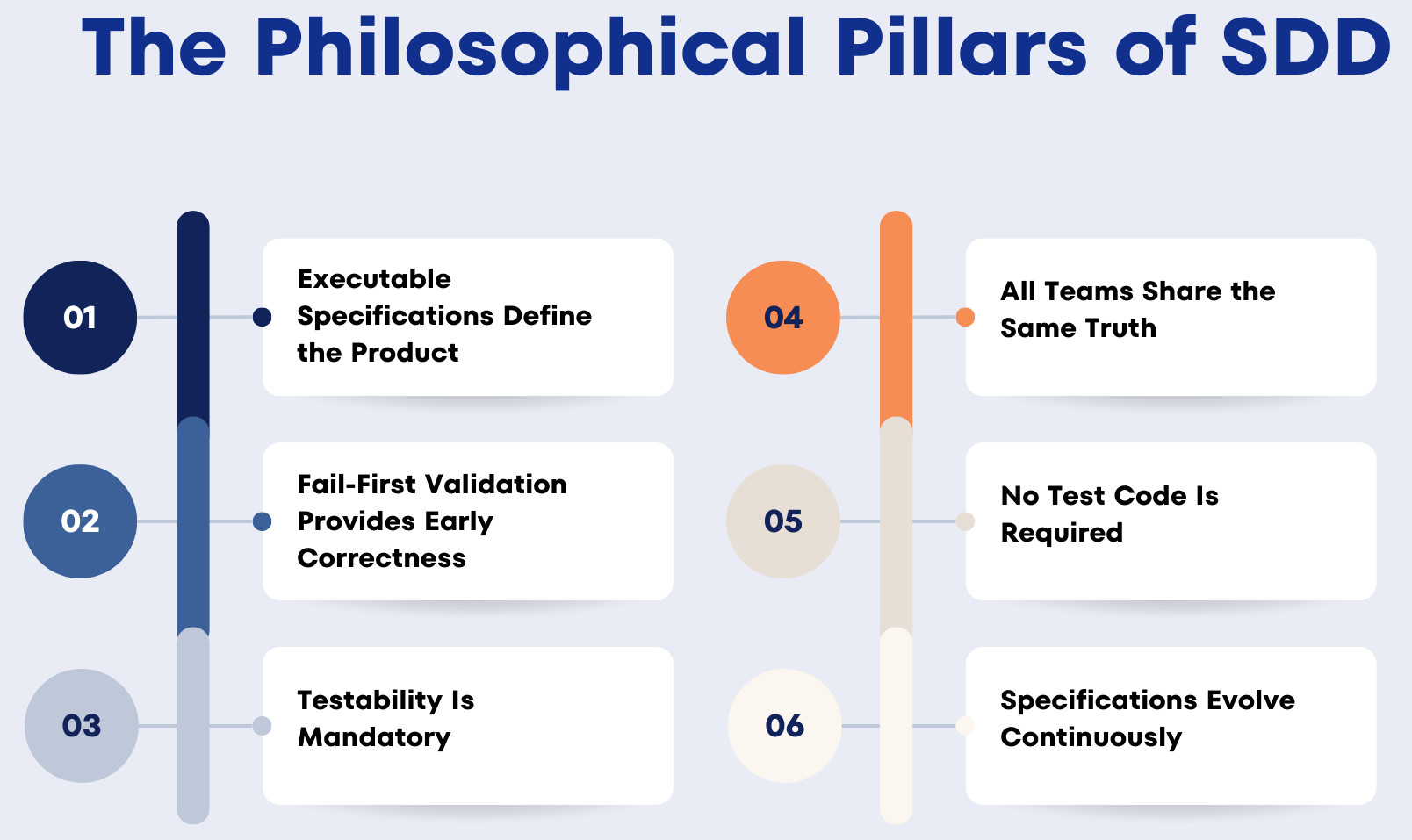
- Executable Specifications Define the Product: SDD is not only the documentation, but it is also the definition of the product. Because these specs are executable, they describe behavior in a very precise and unambiguous way. The specification will always give away what the intended outcome should be when run by a team.
- Fail-first Validation Provides Early Correctness: SDD promotes validation early on through the execution of specifications before an implementation is prepared. This fail-first strategy reveals misunderstandings as soon as they occur, not weeks later. It guarantees that teams are building the right thing from the get-go.
- Testability is Mandatory: All functionalities need to be described in a manner that can be automatically validated against the specification. This demands clarity. It won’t allow vague or non-falsifiable requirements. If something cannot be proven, it is not finished according to SDD.
- All Teams Share the Same Truth: SDD removes vague interpretations by providing one common artifact for developers, testers, and stakeholders. When everyone follows the same spec to synchronize their behavior, coherence is a natural consequence. Communication failures decrease when everyone has the same executable truth.
- No Test Code is Required: One does not need the layer of classic automation: step definitions, helper functions, and scenarios in SDD. The spec acts as both the requirement and test, effectively eliminating layers of maintenance. That’s a way to lessen fragility and get faster delivery.
- Specifications Evolve Continuously: SDD considers the specification as a living document synchronized with the product. While features change, so does the executable spec to sustain certainty. This ongoing evolution ensures that the product remains in sync with business requirements at all times.
The Workflow of SDD in Practice
SDD is based on a small group of fundamental concepts. Teams follow a structured process to convert these ideas into daily activities. This process guarantees clarity, early validation, and product continuity between intent and engineering. Each move just strengthens SDD’s ideology of a single trustworthy executable.
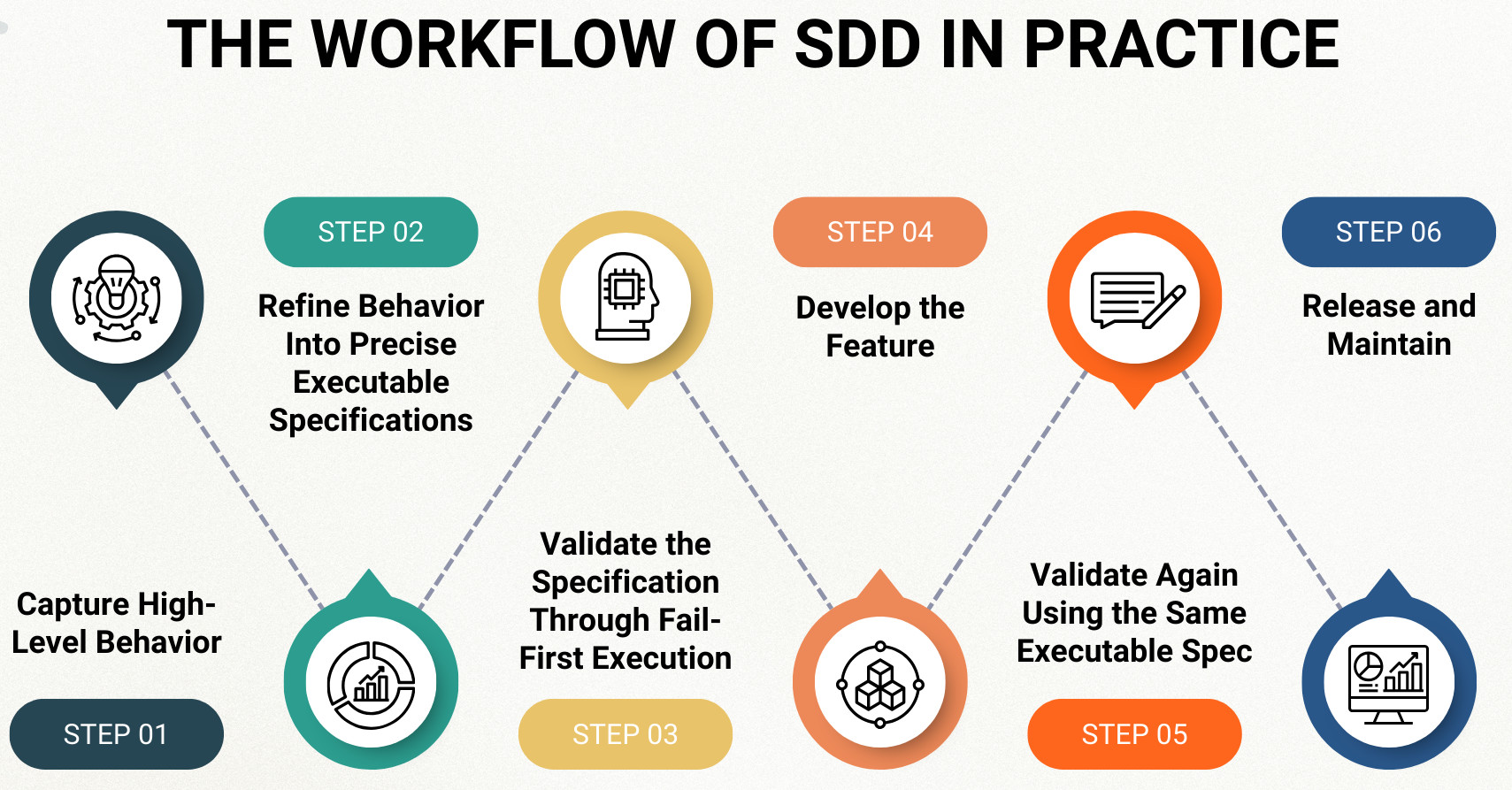
- Capture High-level Behavior: The product owners start with the detailing of business goals for the feature. These are all high-level descriptions of what the system is supposed to do without going into implementation details. This ensures a level playing field in terms of shared knowledge.
- Refine Behavior into Precise Executable Specifications: The abstract ideas are turned into formal specifications in natural language. Each spec has preconditions, actions, expected results, and significant edge cases. This instead provides clarity and makes the behaviour thoroughly testable.
- Validate the Specification Through Fail-first Execution: The executable spec must be executed and should fail before any actual implementation work starts. This first failure indicates that the specification understands an incorrect or absent behavior. It also serves as proof that the spec is well-organized and actually testable.
- Develop the Feature: Engineers write the feature with the specification acting as a rigid behavioral contract. Instead of hypothesizing or inferring intention, developers author code that models the intended behavior. This process reduces the likelihood of misinterpretation and rework.
- Validate Again Using the Same Executable Spec: The same specification is then run again, once implemented, to validate its correctness. A successful spec in this case indicates that the feature does precisely what is intended, whereas a failure may indicate that the code or spec requires further development. This makes objective, automatic release criteria.
- Release and Maintain: After the feature is proven to function correctly, it can be deployed with confidence. As the product goes through change, the specification can evolve to incorporate those, and therefore is a living thing that remains authentic. This ongoing maintenance also maintains continued alignment of the system with the business objectives.
Read: What is Test Driven Development? TDD vs. BDD vs. SDD.
The Structure of a Strong SDD Specification
- Precise and Deterministic: A system description and specification for an SDD must define its operation in clear and unequivocal language. Subjective terms like “should,” “perhaps” or “intuitive” are omitted altogether. Deterministic statements guarantee the same output and structure.
- Self-contained: The specification must contain everything that is necessary to be known about the behavior, including the preconditions, required stimuli, and expected responses. This keeps out the reliance on external knowledge or assumptions. Having a stand-alone spec makes it easier to onboard and reduces confusion.
- Testable: Each behavior that is included should be executable without human intervention. If something can’t be tested, it’s not in the spec. This eliminates ambiguous or non-actionable requirements and drives clarity.
- Modular: The best specifications are made up of small, focused units that define individual behaviors. This modular nature also makes it easier to edit each specification and reduces cascading changes. It also makes the code more readable and maintainable in the future.
- Stable Yet Adaptable: While the specification must remain consistent with the core business logic, it also needs to grow as the product evolves. Adjustments can be made as new features or edge cases emerge, without losing the foundational intent. This balance ensures longevity and flexibility.
Read: What is BDD 2.0 (SDD)?
How Teams Collaborate in SDD (Process)
- Product Owners Define the Behavior: Product owners write a precise description of what the feature should accomplish as viable criteria. They are the ground truth for all other downstream teams.
- Developers Implement the Behavior: Developers use the spec as a clear contract with no handwaving or ambiguity. They try to code it absolutely as per the behaviors.
- Testers Validate Behavior Using the Same Specification: Testers use the same executable specification to verify that the system behaves as intended. This is a way of making validation repeatable, objective, and in line with what the product owner intends.
- Designers and Architects Ensure the Behavior Aligns With System Capabilities: Designers and architects look at the specs to see if they fit into technical, UX, and architectural requirements. They serve as the intermediary between what is wanted and what the system can support in a sustainable way.
Everyone speaks the same language and uses the same source of truth. Read: Mastering Agile with BDD: Unleashing the Power of Behavior-Driven Development.
Differences with the BDD 1.0 specification
The philosophy of BDD 2.0 and BDD 1.0 is the same (write behaviour prior to implementation). However, they are very different in terms of execution, tool requirements, and practical effectiveness. Below is a clear comparison illustrating how SDD modernizes and significantly improves upon the original BDD model.
| Aspect | BDD 1.0 | SDD (BDD 2.0) |
|---|---|---|
| Executability of Specification | Not executable; requires automation code. | Fully executable on its own with no coding. |
| Test Code Requirement | Requires step definitions and glue code. | No test code needed — the specification is the test. |
| Fail-First Validation | Not possible; specs cannot run early. | Required — spec must run and fail before coding begins. |
| Risk of Spec/Test Drift | High — scenarios and automation often fall out of sync. | Zero — one artifact defines both spec and test. |
| Development Speed | Slower due to automation layer creation and maintenance. | Faster — testing is ready before development starts. |
| Stakeholder Alignment | Interpretation still required; alignment varies. | Strong alignment — everyone uses the same executable spec. |
| Release Confidence | Depends on the reliability of the automation code. | Very high — passing spec guarantees correct behavior. |
Why SDD is Considered BDD 2.0
Behavior-Driven Development (BDD) brought us the great idea of writing your specification in natural language, but its two-layer structure – Gherkin and then supporting test code – turned out to cause drift, maintenance overhead, and misunderstanding. Specification Driven Development (SDD) evolves this further by creating the specification itself as executable, with no step definitions or automation glue code required. This leads to a cleaner progression.
SDD takes BDD one step further by applying fail-first validation, bringing together validation and requirements, and reducing defects due to ambiguity significantly. Teams deliver faster and are more aligned, because they’re working from one source of truth. In essence, SDD retains BDD’s good properties but overcomes the structural weaknesses that made it suboptimal for solving problems.
Read: Top 5 BDD Tools: How to Choose Among Them?
How SDD Improves Quality, Speed, and Alignment
- Better Quality Through Precision: Executable specifications clarify expected behavior and uncover errors early. This leads to fewer defects and more predictable outcomes.
- Faster Delivery by Eliminating Redundant Test Code: Teams avoid writing or maintaining separate automation layers. This significantly shortens development and testing cycles.
- Perfect Alignment Between Business, Development, and QA: All teams work from the same specification, removing translation gaps and interpretation errors. This creates seamless communication and consistent understanding.
- Lower Long-Term Maintenance Costs: Because specifications and tests are one and the same, they cannot drift apart. This stability reduces regression failures and ongoing upkeep.
- Higher Confidence in Releases: A passing specification proves the feature behaves exactly as intended. This provides objective assurance at release time.
How testRigor Supports Specification-Driven Development
testRigor is one of the only tools that has been designed natively to support Specification-Driven Development, instead of forcing teams into a traditional BDD 1.0 flow where you write ‘Gherkin + code’ step definitions for it. testRigor executes plain English specifications, with no automation code necessary, which makes it a perfect fit for SDD’s philosophy.
click "Cherry Blossom Popup Bouquet"
click "Add to cart"
click "Cart"
enter "[email protected]" into "Email"
enter "4111111111111111" into "Card"
click "Place order"
validate if page contains "order placed successfully"
check that email to "[email protected]" was delivered
purchase Product
validate if page contains "order placed successfully"
check that email to "[email protected]" was delivered
purchase Product is defined as:click "Cherry Blossom Popup Bouquet" click "Add to cart" click "Cart" enter "[email protected]" into "Email" enter "4111111111111111" into "Card" click "Place order"
testRigor completes the SDD philosophy by enabling teams to write true executable specifications, something traditional BDD tools were never designed to do.
Conclusion
Specification-Driven Development changes the way teams define, validate, and deliver software. It combines requirements and tests into an executable source of truth. It removes ambiguity, decreases maintenance overhead, and fuels fail-first validation. That is why SDD accelerates delivery cycles and drastically aligns product, development, and QA. With tools like testRigor actually making executable specifications accessible, teams can now have the clarity, confidence, and cohesion that traditional approaches have long failed to deliver.
| Achieve More Than 90% Test Automation | |
| Step by Step Walkthroughs and Help | |
| 14 Day Free Trial, Cancel Anytime |