
Why a QA Mindset Is an Asset for Developers
 |
You might have heard someone say that coding is the art of making code that looks good and works well. Developers care about algorithms and architectures, and they like a product that has a nice structure. But if there is a screw loose in it somewhere, it isn’t done. This is where the QA (Quality Assurance) mindset can come in handy.

A quality assurance mindset doesn’t mean looking for mistakes to point out; it means being interested in how, when, and why things go wrong. It is meant to stop problems that aren’t obvious, bad user behavior, and the idea that quality is something that happens all the time instead of just once. Not only does a developer with this kind of attitude write better code, but they also make everything they make more durable, understanding, and dependable over time.
| Key Takeaways: |
|---|
|
Seeing Beyond the Happy Path
Most development teams naturally focus on the “happy path,” which is when everything works perfectly and every user does what they are supposed to do. But things don’t always go according to plan in the real world. To turn fragile software into strong, reliable products, you need to embrace failure-oriented thinking.
What “happy path” thinking costs developers
The majority of programmers first develop as though things were ideal: the input will be what is expected, the network will never go dead, and the user will struggle to read the manual. This optimism of linear form is dubbed as happy-path thinking. But all the production downtime, crashes, or problems with the support team are united by the fact that someone thought that things were going to be okay.
Happy-path analysis makes things harder for developers because it doesn’t take into account how chaotic things can be in the real world. When you don’t think about edge cases, you write code that looks perfect on paper but doesn’t work at all when you try it out.
Read Positive and Negative Testing: Key Scenarios, Differences, and Best Practices
The philosophy of QA is to investigate the unforeseen
QA professionals exist in a world beyond the happy path. They ask, What happens when the input is not correct? Or what happens when a system call returns no data? This constant interest makes them expect failure and not be afraid of it. When developers have the same goal, testing becomes a creative process. The unusual situations that were looked into before the release get rid of any real problems with production.
Developers create recovery measures not with the idea that things will stay the same, but with the idea that things will go wrong and other unexpected things will happen. This mindset helps with better exception handling, fault tolerance, and graceful degradation, which are all things that a mature system has that weak prototypes don’t.
Why Edge Cases Matter
Real users don’t always do what you expect them to do, and their unexpected actions often show developers edge cases they never thought of. Finding these hidden situations early turns unpredictable behavior into a powerful force that makes software stronger and more durable.

Why genuine users do not behave in predictable ways
No two users behave the same way. You can type in names in small letters, or you can copy and paste the text of a document that has invisible characters. There are different kinds of tech gadgets, different languages, and strange relationships because of time zones. These are the places where the production systems are found.
- Limitations on boundaries, like integer overflows and the maximum length of strings.
- Parallelism challenges between parallel transactions.
- Date rollovers and time zone rollovers introduce the risk of unexpected data conflicts.
- Breaking network requests or incomplete payloads.
- Localization idiosyncrasies, such as characters of non-Latin alphabets.
All of them can cause small bugs that don’t show up in a normal test run but can be very harmful in real life.
Read What Are Edge Test Cases & How AI Helps
Converting edge-case thinking into a preventive practice
Developers can also get into the QA mindset by making “mess tests” that purposefully break the interface, drop the network, and create fake concurrency race conditions. This isn’t chaos; it’s the disciplined study of how a system works in chaos, which builds the muscle memory that keeps software strong even when things go wrong.
Observability and Logging
Not only can logging help you fix problems, but it can also help you figure out what’s really going on with an app. QA engineers look at logs to figure out what happened before a problem happened. Useful logs can help developers go from guessing how to fix a problem to really understanding it.
A good log tells a story. It shouldn’t show cryptic error messages; instead, it should say what the system tried to do, what the inputs are, and what checkpoint it has passed. People can read narrative-style logs that leave behind breadcrumbs. This makes it easy to find out what went wrong right away.
Self-testing in the form of instrumentation
Instrumentation is proactive testing that involves putting observability hooks into applications. Latency, error rate, and memory usage are all examples of performance indicators that can be used as early warning signs. This happens when developers think of instrumentation as a coding task instead of a maintenance task, so they switch from reactive debugging to preventive assurance.
Read Test Log Tutorial: Boost Your Testing Skills with Industry Best Practices for Success
Debugging Like a QA Engineer
The QA professionals are good at reproducing things. They test variables in a systematic way, controlling the environment, input, and order until a defect becomes predictable. Developers can also use the same discipline: be more careful, look for patterns, and repeat mistakes in a planned way.
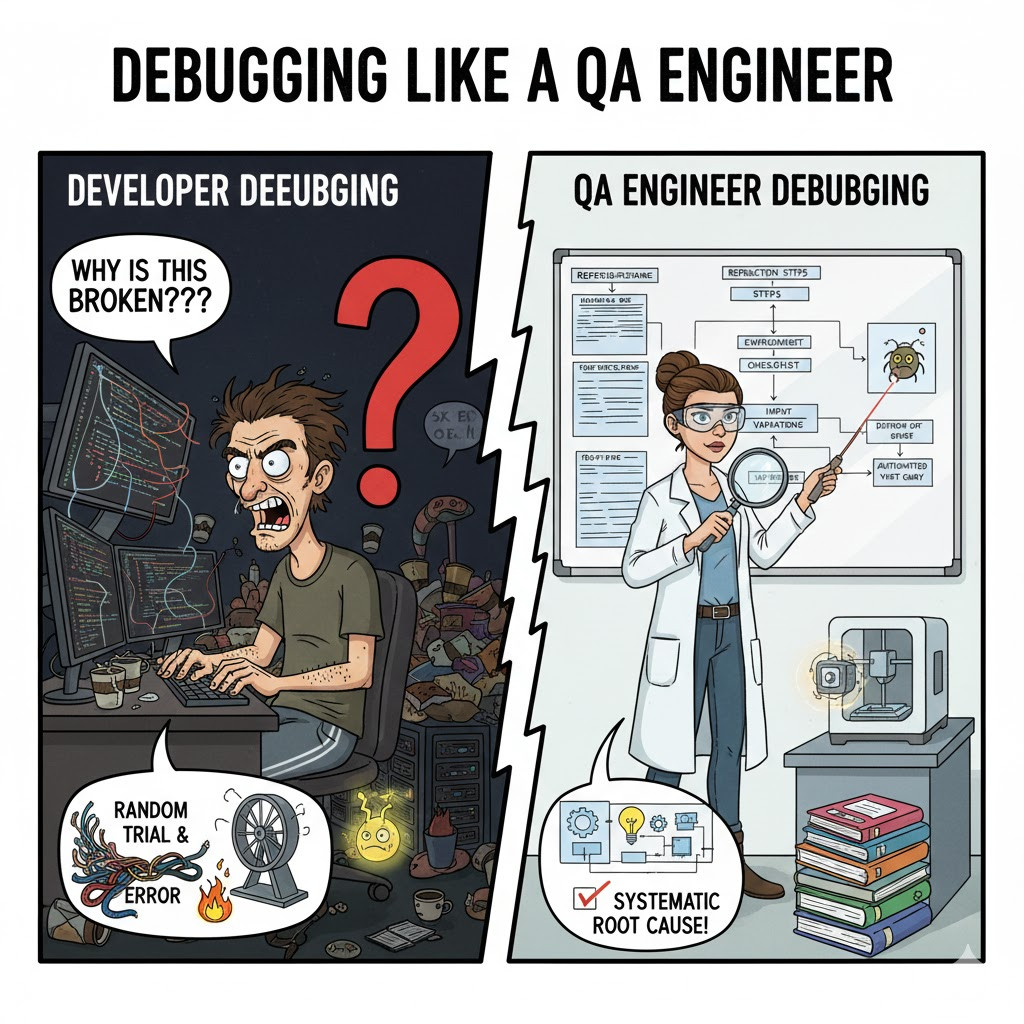
By noting the exact details of the crash, such as the setup, timing, and order, every time it happens, it can be used as a test case. By automating these conditions in test suites, you turn temporary chaos into something permanent.
Random trial-and-error debugging is exhausting. Writing down, narrowing down and checking things off in the QA-style way saves time. This approach to problems is more organized, and thus faster. And best of all, it teaches you how to not do the same things on your next project.
Read Testing vs Debugging
Teamwork and Quality Ownership
In the past, development and QA worked in two separate groups: development built things, and QA tore them down. But this separation is a source of conflict and delay. In today’s teams, teamwork has replaced conflict. Harmony reigns because of shared standups, merged test planning and reviews, and both roles learning about each other.
When developers are in charge of testing and QA is involved in the design, the quality is shared. The change turns conversations that are focused on blame into ones that are focused on solving problems, which cuts down on rework and finger-pointing.
The cross-functional working team makes it easier to get feedback. Developers get feedback faster because the stabilization happens faster than waiting for QA sign-offs. This synergy in agile companies shortens the time between releases and makes people more confident that each release will work.
Empathy: The Human Side of Code
QA is essentially advocacy for the user. Testers reflect the frustration and confusion, and expectations of the customer. Those developers who acquire such empathy will start to view code not only as code but as a human experience that has been presented by technology.
A developer who has been trained in QA is aware of all the problems. The button is too small, the error message is hard to understand, and the dashboard is slow. They put them in the user’s mind and think about how unhappy they will be before they even get to the helpdesk.
Empathetic design, like auto-saving progress, showing users the way to recover, or giving clear explanations, can turn anger into trust. In a market where users don’t have much patience, empathy is an important quality for engineers.
Preventive Thinking and Faster Feedback Loops
A developer who cares about quality will always ask, “How can this fail?” instead of waiting to find problems. This question makes people want to design things in a way that lowers future risk.
A design with points of observability and control lets teams test more quickly and fix things with more confidence. To make sure that tests cover a lot of ground, systems must have toggles, simulation modes, and fake dependencies.
Test automation and constant feedback help find bugs faster, sometimes just a few minutes after a change is made. The result is that remediation will happen faster, regressions will happen less often, and deployment schedules will be more predictable.
Bridging Dev and QA
Any bug that is reported and then retested should have its cost and morale assigned and reallocated. The more distance it has traveled, the more productive power it has lost.
A developer who includes QA-level tests, boundary validation, and useful error handling in their builds makes builds that don’t need much triage. Clean builds QA is done in a way that it doesn’t put out fires, but instead tests things out.
We can find usability problems before we harden the code by having everyone contribute to every sprint from the start. This first working partnership turns QA into a speed-up in agile processes.
Read A Tester’s Guide to Working Effectively with Developers
Architecture with a QA Lens
QA-based architecture expects failures to happen one after the other and keeps them separate. Every part needs to be able to fail without bringing down the whole app.
Modern reliability patterns, like circuit breakers, retry logic, and bulkheads, show how containment works. They accept failure and make sure they have a way out. The developers, who have worked in the QA department, make systems based on what-if questions. This enables the system to start healing itself. Resilience is no longer a haphazard reaction; it is now planned behavior that increases uptime and customer trust.
Learning from Defects: Continuous Improvement
Every defect shows more than just a failed attribute; it shows where there are holes in the process, the assumptions, or the validation. QA is great at keeping track of these root causes and making sure that every bug is a chance to learn.
Developers can use reusable patterns, like a template of code, a test utility, or a pre-commit hook, to fix bugs and avoid making the same mistakes again in the future. The systematic learning changes quality into cumulative.
Retrospective notes and improvement metrics close the loop. When developers write down every piece of feedback that QA gives them and then do something about it, they are instilling a culture of continuous improvement in the team’s DNA.
Read Anomaly Reports: How to use AI for Defect Detection?
Communication and Documentation Skills
Clear communication is a big part of QA culture. Each bug report includes the expected format, the actual results, the details of the environment, and the steps that can be repeated. This style makes it easier for developers to talk about technical things.
The documentation’s clarity has a direct impact on how easy it is to keep up with. Any developer who can write clear, accurate issue logs and documentation that is easy to use saves hours and days of onboarding.
A good product has clear commit messages, code that is easy to read, and documentation that is easy to find. Developers who care about quality know that things can go wrong with communication.
Risk Awareness and Priority
Experts in quality assurance know that not all bugs are the same. They don’t care what things look like; they care about how things will turn out and how likely it is that big payments will go through.
Developers who think this way put a lot of value on adding new features and refactoring code, depending on how risky they are for the business. This means that you should first make the modules that have the biggest effects stable, then add error handling to the core services, and finally make it easier to scale maintenance.
You can’t always have both quick shipping and stability. The way a QA thinks makes the balance tighter. They recommend using feature flags, incremental implementation, and rollback plans that give you freedom without being careless.
Read Risk-based Testing: A Strategic Approach to QA
Career Development and Differentiation
Technical anchors are common in cross-functional teams with developers who have a natural instinct for reliability. Their coworkers trust them to see problems coming and keep production safe.
This allows such developers to build a reputation for making clean builds that just work. They give the impression of reliability during code reviews or deployments, which is a very important personal brand in software engineering.
A coder is a product owner who is worried about what will happen after the product is released. An engineer who goes beyond the local machine to make code run is a holistic one, and this affects both user experience and business results!
How to Cultivate a QA Mindset
When developers follow QA testers around, they learn about real user problems. Watching QA question everything makes you more humble and aware. Never tell teams not to be challengers. What if there are no inputs?
These kinds of questions are defensive design. Start with logging, measurements, and switches. Code that explains itself is easier to trust, debug, and add to. Chaos testing or fuzzing tools should be part of local environments. It is not to break things but to see how well they can handle chaos.
Report defects as incidents. They all teach a small lesson about the system’s limits, and this needs to be written down and shared. When you communicate clearly, you change vagueness into clarity. By keeping accurate records of expected outcomes, developers save themselves a lot of work in the future.
Read A Day in the Life of a QA Engineer
Why Developers Need the QA Mindset More Than Ever
Companies can’t guess how microservices will work together anymore because distributed systems are becoming more common. They need to have a strong QA mindset. The more dependencies there are on things outside of the system, the more likely it is to fail. The people who made it need to be careful.
Automated pipelines and AI integrations amplify machine errors. Preventive thought is the only kind that can keep up with developing validation, verifying outputs and accounting for what’s going on. Today’s customers expect a seamless experience around the clock. Developers to achieve QA at this level must adopt observability, anticipation and accountability.
The Cultural Mass and Organizational Ripple Effect
When developers adopt a QA mentality, it is transmitted. Teams also start celebrating the preventive success weeks without incidents, reduced recovery time, and fewer regressions. Quality is not something to coerce but to create inspiration.
Testable and resilient code grows old gradually. It is not easily rotten and fewer emergency fixes are required, and because the cognitive load remains low for future maintainers. Good quality minimizes downtime, boosts user satisfaction and minimizes the costs of support. The leadership quickly becomes aware of the fact that investing in developer-oriented QA thinking gives back technical and monetary returns.
Addressing Common Misconceptions
The developers who use QA principles are not replacing QA; they are just making the first line of defense stronger. QA will still check for errors on its own, but it won’t have to deal with as many obvious ones.
Doing work up front is a way to avoid problems and cut down on unnecessary work. Taking the time to plan carefully pays off in the long run, as you will have to debug the same problem many times after the release. Pessimism is not the same as thinking about what could go wrong; it’s being ready. Systems that are perfectly designed have great uptime and stability.
Conclusion
Today’s software development needs developers who don’t just think about the next sprint or the code they’re writing right now. They should expect their systems to work even when they are under a lot of stress, in different time zones, or used by dishonest people.
QA thinking turns development into stewardship instead of craft. It makes people more caring, strong, and responsible. The developer of the future won’t just add new features; they’ll also build ecosystems that are open to the unexpected and stay strong.
When you code with a quality attitude, you don’t think of quality as a phase or a department. People generally think that every piece of code is a promise: to the user, to the team, and to the stability of everything built on it.
| Achieve More Than 90% Test Automation | |
| Step by Step Walkthroughs and Help | |
| 14 Day Free Trial, Cancel Anytime |