
What Are Regression Defects? Causes, Examples & How to Prevent Them
 |
Software systems are constantly being developed; new features are added, existing ones refined, bugs are fixed, performance improvements are made, and security holes are plugged. But each such change, no matter how small or well-meant, carries its own danger: It might cause something that used to work perfectly suddenly to break.
This phenomenon is known as a regression defect.
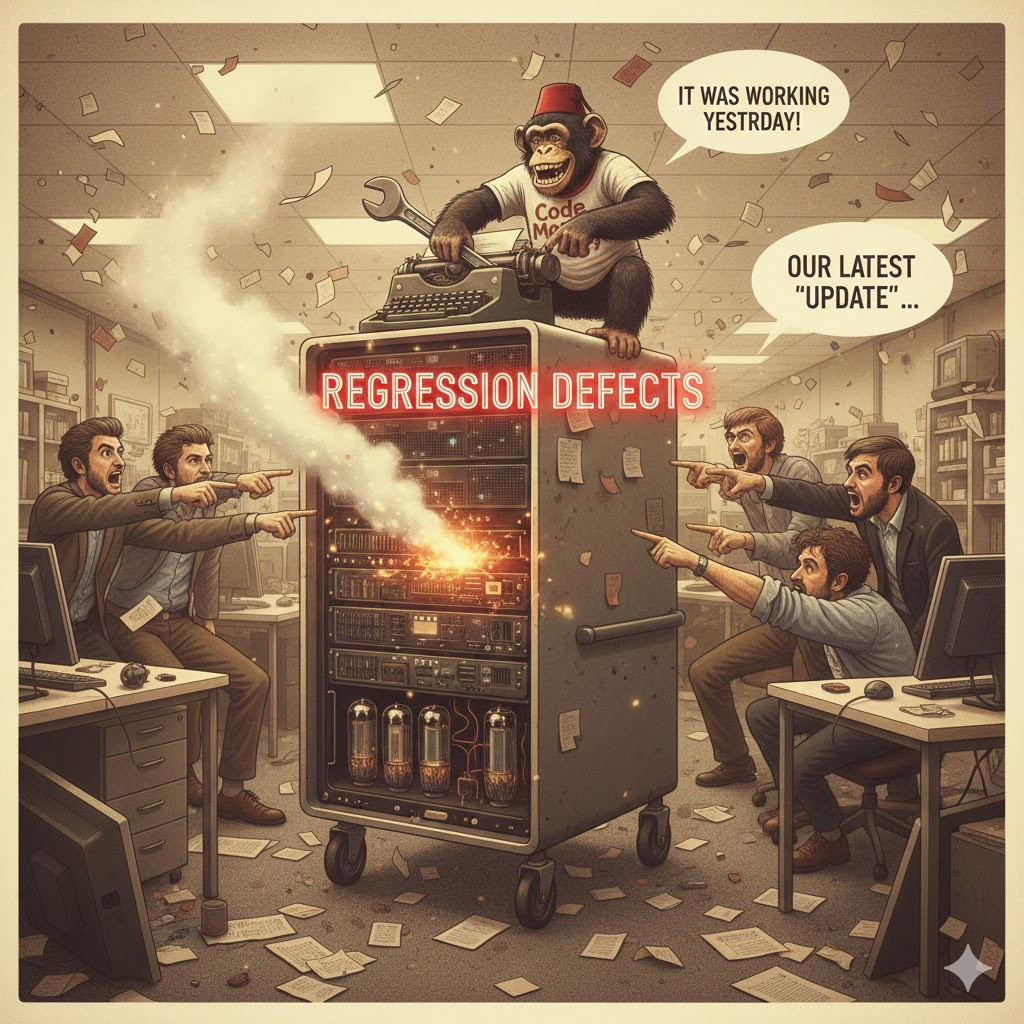
These sorts of regression bugs are especially harmful since they run contrary to a basic assumption from users and stakeholders, that what worked yesterday should continue working today, unless we want to change it. Confidence is shattered when this fails, even if the changes themselves are correct.
Regression defects are not only a testing issue. It is indicative of the quality of system design, engineering discipline, organizational maturity, and the effectiveness of teams reacting to change without introducing instability in the product.
| Key Takeaways: |
|---|
|
Understanding Regression Defects in Depth
A regression bug is when a previously existing feature that was working becomes non-functional due to changes made elsewhere in the application. These could be features or bug fixes, refactoring, configuration changes, library updates, and any change that is done in the code base. What distinguishes regression defects from other defects is not their severity, but their historical context:
- The behavior was previously correct and working as expected.
- It had already been thoroughly tested and formally accepted.
- No requirement or change request asked for this behavior to be modified.
Consider an app with users uploading files successfully for 4 months. We have a new addition for virus scanning when you upload. After upgrading, users notice that some valid types of files can’t be uploaded anymore. The upload feature itself wasn’t changed at all, but regressed by changing some validation logic. It’s regression at its best.
In practice, scenarios like this are difficult to catch with brittle scripted tests. Tools like testRigor, which validate behavior from a user’s perspective rather than relying on internal implementation details, are particularly effective at detecting such regressions early, even when the underlying code change appears unrelated.
Read: What is Regression Testing?
Types of Regression Defects and How They Manifest
Regression bugs come in many shapes and sizes, depending on the nature of the product or system, and they help teams to identify patterns instead of just reacting to each individual regression issue. They frequently appear after what appears to be a small change (refactoring, configuration modifications, or library upgrades) for which the impact is underestimated; knowing how such issues are manifested empowers teams to evolve their test coverage and prevent risk areas that will cause repeated failures across releases.
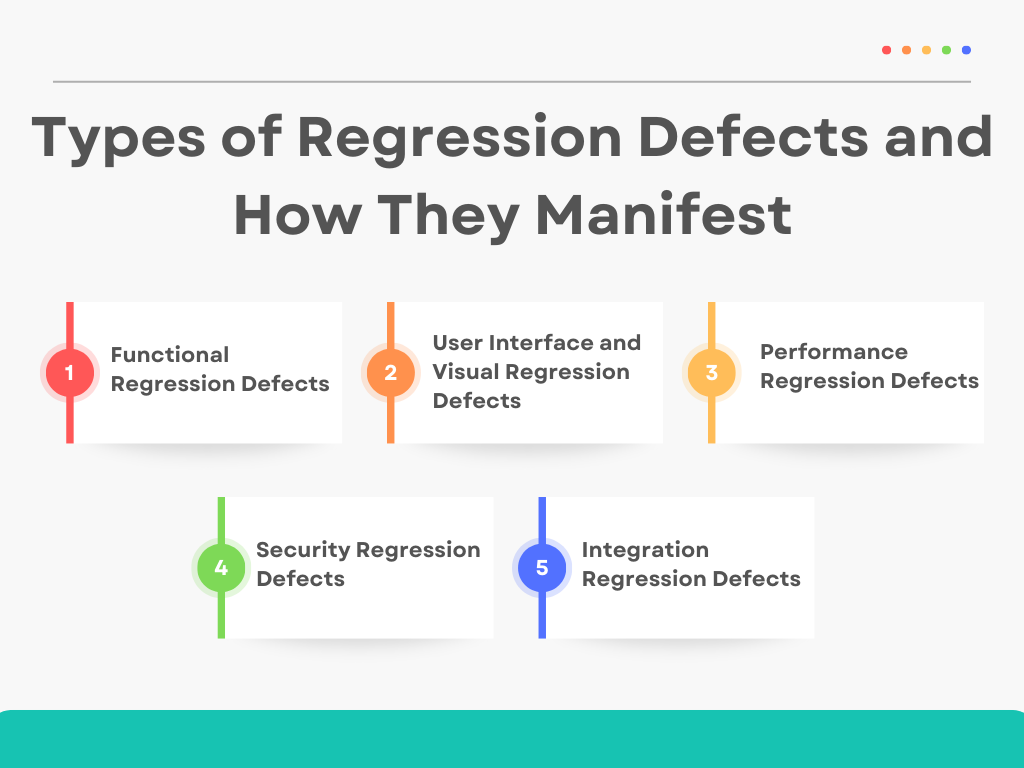
Functional Regression Defects
Functional regression bugs refer to when fundamental business logic no longer works the same after having been altered. These regressions are frequently the most visible and costly due to their direct effects on users’ ability to accomplish tasks.
For example, an e-commerce site might launch a discount engine for use during promotional events. Now, as the discount part works out okay by itself, when the user tries to pay (using gift cards for ex), he or she suddenly encounters issues. The checkout flow was perfect before, but the price logic shared had been modified and was inadvertently breaking a working route.
Functional regressions often arise from:
- Functional regressions often arise from shared business logic that is reused across multiple features, causing changes in one area to unintentionally affect others.
- They can also result from complex conditional rules where small logic modifications alter execution paths in unexpected ways.
- Another common cause is an inadequate understanding of dependencies between features, leading to overlooked side effects during development or testing.
Because functional flows tend to span multiple components, regressions in this category frequently go unnoticed until end-to-end scenarios are exercised.
Functional regressions often remain hidden until full user journeys are executed. AI-based regression platforms like testRigor help mitigate this risk by expressing functional flows in business-readable language, allowing teams to continuously validate shared logic across multiple paths without rewriting tests for every internal change.
Read: Functional Testing Types: An In-Depth Look
User Interface and Visual Regression Defects
UI regression bugs are the result of changes inadvertently modifying UI appearance, layout, or functionality.
A typical use case is to redesign the UI in order to make it more desktop-friendly. New fonts, spacing tweaked, reorganizing elements. Everything looks great on desktop, but then mobile users start filing bugs, buttons are stacked too close to each other, and forms are impossible to reach. It’s not like the functionality is gone, but it’s enough of a regression that you cannot use it in some scenarios. Visual regressions are particularly deceptive because:
- They may not trigger functional failures, even though they degrade the user experience or visual consistency.
- They often affect only specific devices or screen resolutions, making them harder to detect with limited test coverage.
- They are easy to overlook during fast-paced releases where visual validation is deprioritized in favor of functional checks.
Despite sometimes being labeled as cosmetic, UI regressions can block critical actions and significantly degrade user experience.
Traditional UI automation tends to amplify this problem, as tests fail due to minor layout changes rather than real regressions. testRigor’s Vision AI-based approach focuses on what the user actually sees and interacts with, making UI regression detection more resilient to cosmetic changes while still catching genuine usability breakages.
Read: How to do visual testing using testRigor?
Performance Regression Defects
Performance regression defects occur when existing functionality continues to work but becomes noticeably slower, less responsive, or more resource-intensive after a change.
For example, a development team may add detailed logging to an API for monitoring and diagnostics. Functionally, all endpoints continue to return correct responses. However, response times gradually increase under load, leading to timeouts during peak usage. From the user’s perspective, the system feels broken, even though no functional defect exists. Performance regressions are dangerous because:
- They are rarely caught by functional validation because the system continues to behave correctly from a feature standpoint.
- They often surface only in production-like conditions where real data, scale, or usage patterns are present.
- They degrade user and stakeholder trust by causing subtle issues without producing obvious or immediate failures.
Read: What is Performance Testing: Types and Examples
Security Regression Defects
Security regressions occur when existing security controls are weakened or removed unintentionally.
A common scenario involves refactoring authentication or authorization logic for maintainability. After deployment, users are still able to log in successfully, but session expiration or access control checks no longer function correctly. This creates silent vulnerabilities that may go unnoticed until exploited. Security regressions are especially risky because:
- They may not affect normal user flows, allowing the system to appear stable during routine usage.
- They can remain hidden for long periods, especially when edge cases or rare conditions are not exercised.
- Their impact is often catastrophic when discovered, as they can lead to data loss, compliance issues, or severe system failures.
Read: Security Testing
Integration Regression Defects
Integration regressions occur when interactions between systems or components break due to changes in contracts, formats, or assumptions.
For instance, a backend service may optimize its response payload by renaming fields or removing deprecated attributes. While the service itself functions correctly, downstream consumers relying on the old structure begin to fail. No explicit integration change was planned, yet the regression disrupts the ecosystem. Integration regressions are common in:
- In microservices architectures, integration regressions occur when independently deployed services introduce contract or behavior changes that break inter-service communication.
- In API-driven platforms, integration regressions arise when API responses, schemas, or versions change, and downstream consumers are not updated accordingly.
- In systems with third-party dependencies, integration regressions happen when external providers modify, deprecate, or optimize their interfaces without aligned coordination.
Read: Integration Testing: Definition, Types, Tools, and Best Practices
Root Causes of Regression Defects
Regression defects are rarely accidental and instead emerge from predictable technical and organizational conditions, often driven by rushed changes, incomplete impact analysis, or assumptions that existing behavior will remain unaffected. In many cases, gaps in communication, documentation, or test coverage allow these predictable issues to slip into production unnoticed.
One reason regression coverage degrades over time is the high cost of maintaining automated tests. Solutions like testRigor address this by reducing test fragility and maintenance effort, enabling teams to continuously expand regression coverage instead of pruning it under time pressure.
Read: Root Cause Analysis Explained
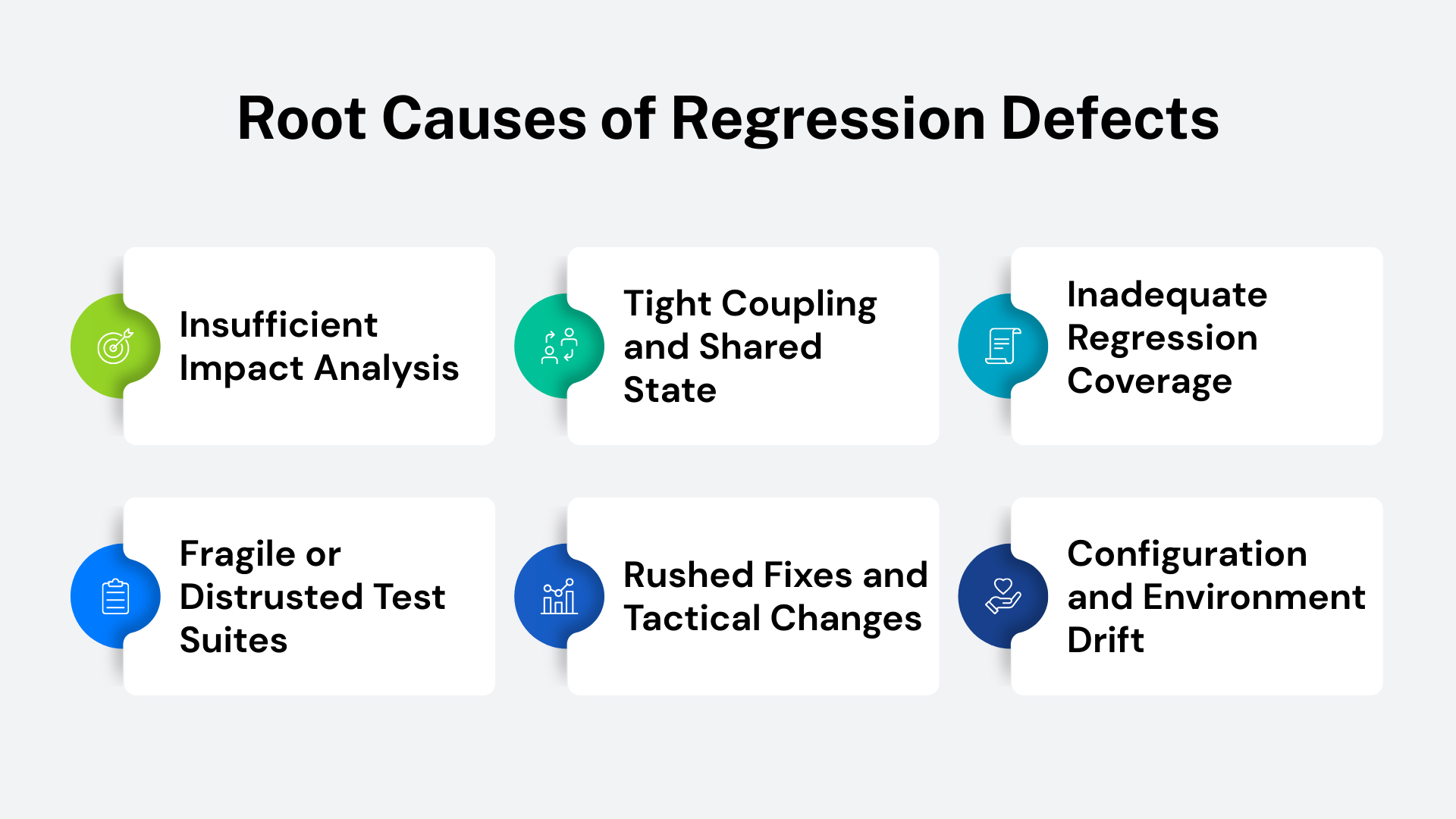
Insufficient Impact Analysis
One of the common reasons for regression defects is a partial understanding of how a change impacts the system. In complex systems, functionality is rarely isolated. A small change in a shared utility, validation rule, or configuration setting can ripple across multiple features. When teams focus only on the immediate change without considering dependent paths, regressions become inevitable.
For example, tightening input validation to prevent invalid data may inadvertently block legitimate use cases that rely on previously accepted formats.
Tight Coupling and Shared State
Regression defects thrive in tightly coupled systems where components share logic, data, or state. When a single function or variable is used across multiple features, changing it to support one scenario can easily break another.
This is especially common in legacy systems where modular boundaries are unclear and responsibilities are blurred. In such environments, even well-tested changes carry a high regression risk.
Inadequate Regression Coverage
Regression defects often occur because no test exists to detect them, especially when regression suites focus only on happy paths and ignore edge cases or historical defect scenarios. Over time, tests also become outdated as system behavior evolves, creating blind spots that give a false sense of confidence. When regression coverage fails to grow and adapt with the system, regressions inevitably slip through undetected. This results in repeated defects reappearing across releases despite previous fixes.
Fragile or Distrusted Test Suites
Ironically, regression defects can increase when teams lose confidence in their tests. If regression checks are flaky, slow, or difficult to maintain, failures may be ignored, or tests may be skipped altogether. Over time, this erodes the safety net that regression testing is meant to provide. A broken test suite is often worse than no test suite at all, because it creates a false sense of security.
AI-driven testing platforms such as testRigor are increasingly adopted to combat this issue by removing dependencies on locators, implementation details, and scripting complexity. When tests reflect user intent rather than technical structure, teams regain trust in their regression safety net.
Rushed Fixes and Tactical Changes
Bug fixes are among the most common sources of regression defects. When teams apply quick patches to meet deadlines or resolve production issues, they may bypass proper validation, design review, or impact analysis. While the immediate issue is resolved, new regressions emerge elsewhere, creating a cycle of reactive fixes.
Configuration and Environment Drift
Regression defects are not limited to code changes. Configuration updates, feature flag toggles, dependency upgrades, and infrastructure changes can all introduce regressions. For example, enabling a feature flag in production without validating backward compatibility may break existing workflows that were never designed for the new behavior.
Regression Prevention Strategies
Preventing regression defects requires a shift from reactive detection to proactive design and validation across the development lifecycle. Teams must anticipate change impact early by understanding dependencies, shared logic, and integration points before modifications are introduced. Regression prevention also depends on continuously evolving test coverage to reflect real system behavior and past defect patterns. When prevention is treated as a systematic practice rather than a testing phase, regression risk is significantly reduced.
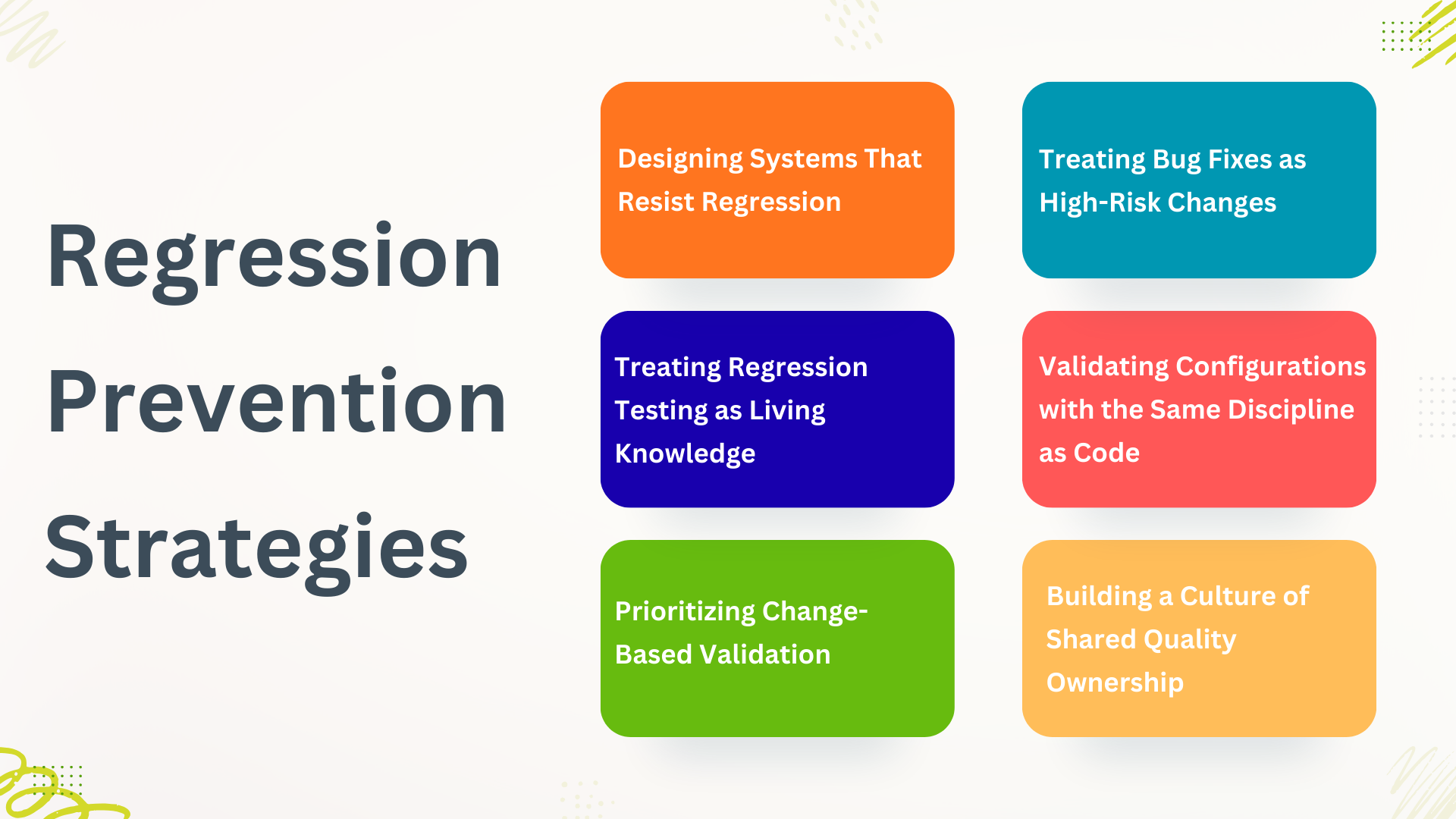
Designing Systems That Resist Regression
Systems built with loose coupling, clear interfaces, and strong encapsulation are naturally more resistant to regressions. When responsibilities are well-defined, changes remain localized, reducing the likelihood of unintended side effects. This architectural discipline is one of the most effective long-term strategies for minimizing regressions.
Treating Regression Testing as Living Knowledge
Regression testing should not be a static checklist. It should evolve alongside the system. Every regression defect discovered represents valuable knowledge about system behavior. When that knowledge is preserved through validation mechanisms, the same regression is far less likely to recur. For instance, if a checkout failure occurs due to a specific pricing combination, that scenario should permanently become part of regression validation.
Tools like testRigor support this mindset by allowing regression scenarios to be documented and executed in natural language, making historical defect knowledge accessible not only to testers but also to developers and product stakeholders.
Prioritizing Change-Based Validation
Not every change requires exhaustive validation, but every change requires thoughtful validation. Effective teams analyze:
- What changed should be clearly identified so the exact scope of the modification is understood.
- What depends on it must be analyzed to uncover direct and indirect consumers of the changed behavior.
- What could reasonably be affected should be evaluated to anticipate potential side effects beyond obvious dependencies.
This targeted approach allows teams to balance speed and safety without blindly expanding regression scope.
Treating Bug Fixes as High-Risk Changes
Bug fixes deserve the same level of scrutiny as new features. Since they often modify existing logic, they carry a high risk of unintended consequences. Validating surrounding functionality, not just the fixed behavior, is critical to preventing secondary regressions.
Validating Configurations with the Same Discipline as Code
Configuration changes should be version-controlled, reviewed, and validated. Many regressions occur because configuration changes bypass the rigor applied to code changes. Treating configuration as first-class system behavior significantly reduces regression risk.
Building a Culture of Shared Quality Ownership
Regression defects are not solely a testing problem. They are a systemic outcome of how teams design, implement, review, and release changes. When developers, testers, product managers, and leaders share responsibility for preserving existing behavior, regression prevention becomes part of everyday decision-making rather than a last-minute activity.
Regression Defects in Continuous Delivery Environments
Frequent releases increase the opportunity for regression defects, but they also shorten feedback loops. Teams that integrate validation early and continuously are able to detect regressions within minutes of a change, long before users are affected.
In such environments, regression prevention becomes an ongoing process rather than a phase at the end of development. This approach requires strong automation, clear ownership, and rapid response to signals from tests and monitoring systems. In continuous delivery pipelines, tools like testRigor integrate regression validation early in the workflow, providing fast feedback on behavioral regressions without slowing down release velocity.
Regression Defects as a Reflection of Engineering Maturity
The frequency and severity of regression defects tell a deeper story about an organization’s engineering practices. Systems plagued by regressions often suffer from:
- Weak architectural foundations make systems fragile, causing small changes to trigger widespread regressions.
- Inadequate validation strategies fail to detect unintended side effects introduced by new changes.
- A rushed delivery culture prioritizes speed over impact analysis, increasing the likelihood of regressions.
- Poor communication across teams leads to uncoordinated changes and missed dependencies.
Conversely, systems that evolve smoothly while preserving existing behavior demonstrate engineering maturity, disciplined change management, and a deep respect for user trust.
Conclusion
Regression failures are not just a symptom of random bugs; they are an indication of how well (or poorly) a system, a team, and an organization are dealing with change. As software continues to grow at a rapid pace, keeping things as they are becomes just as important as delivering new features. By building resilient systems, treating regression testing as a long-term asset, and slipping change-aware validation into standard workflows, teams can mitigate the risk of regression and make themselves orders of magnitude more efficient. In the end, reducing regressive bugs is about protecting user trust as we innovate.
| Achieve More Than 90% Test Automation | |
| Step by Step Walkthroughs and Help | |
| 14 Day Free Trial, Cancel Anytime |