
Quality as Code: Defining Quality in Infrastructure & Automation for Modern QE
 |
Software quality has historically been considered as a phase, checkpoint or duty of one particular team. For a long time, there were known trends in quality assurance, such as the manual test cycles, late stage validation, and sign-off driven release patterns. Quality practices generally fell behind, even as software development has evolved with practices like Agile, DevOps, and continuous delivery.
Software systems today are faster than ever. Releases happen continuously. Infrastructure is dynamic. Teams are remote and spread out across regions and time zones. Traditional quality methodologies often find it difficult to keep pace in this environment.
This is where Quality as Code becomes essential.
Quality as Code is not a tool, a framework or an automation trend. It is a contemporary solution when quality engineering applies software engineering principles to the QA infrastructure itself. Rather than try to manage quality through the crutch of documents, manual tasks, and tribal knowledge, Quality as Code integrates it into the engineer’s work systems.
| Key Takeaways: |
|---|
|
What is Quality as Code?
Quality as Code is the concept of treating all assets of quality as a first-class engineering artifact. We are talking about test environments, test data, configurations and even validation rules, quality gates or observability. Quality in this context goes from a reactive function to an embedded engineering capability that matures along with the product. Rather than being managed manually or informally, these assets are:
- Explicitly defined
- Version controlled
- Peer reviewed
- Automatically executed
- Continuously measured
Quality as Code makes quality behave predictably, consistently, and transparently through the Software Life Cycle. It is about way more than just test automation. Although automation is a contributor, the idea extends beyond automated test scripts. It is more about crafting the systems that make quality possible, and less about testing to see if things work.
In doing this, teams diminish reliance on manual processes in favor of repeatable and reviewable quality footings. This is how quality continues to be scalable and maintainable as systems, teams, and release velocity continue to scale.
Read: What Is the Software Testing Life Cycle? A Complete Guide.
Why Traditional Quality Practices Fall Short
A lot of organizations think that they already have good processes for quality. In reality, those flows generally stand on fragile feet that do not adapt well to the pace of today’s development and system complexity. What was once a valuable tool for more sluggish delivery cadences soon becomes friction for team growth and fast-paced delivery.
Typical issues are varying test environments, undocumented differences in configuration, shared and decaying data for testing, and manual setup steps that everyone does differently. Over time, those problems accumulate, and these normalized incidences of instability add up, where at a certain point, instability becomes how things are rather than something to be fixed.
The consequences are significant:
- Tests fail due to environment instability rather than real defects
- Debugging infrastructure consumes more time than testing product behavior
- New team members struggle to onboard
- Teams lose confidence in test results
With unreliable quality systems, teams will stop trusting them, and quality becomes a bottleneck instead of an enabler. This undermines the whole point of quality assurance, and it increases long-term delivery risk. Quality as Code solves these challenges by replacing our informal ways of working with an engineered, repeatable, and transparent process that returns trust and predictability.
Read: Quality Assurance vs. Quality Control: Know The Difference.
Quality as Code vs. Traditional Test Automation
One of the most popular misconceptions about Quality as Code is that it is just test automation on steroids. Although automation is a key factor, the two ideas are fundamentally at variance in terms of scope and purpose. Test automation is scoped around what we check; QaC explicitly looks at how we are building and maintaining the whole quality system.
Conventional test automation focuses on verifying the application’s behavior via scripted testing. Such scripts often depend on an unstable test environment, the same or outdated test data and hand-managed configurations. That means automation could be there, but it’s not trustworthy or reliable. Quality as Code shifts the focus entirely. Instead of asking whether tests are automated, it asks deeper and more strategic questions:
- How are test environments defined, created, and destroyed consistently?
- How is test data generated, isolated, and owned by individual tests?
- How are configuration differences controlled, reviewed, and tracked?
- How can quality systems evolve safely without introducing instability?
Automation tests behavior. Quality as Code engineers the entire quality ecosystem that makes those tests reliable, repeatable, and meaningful.
Read: What is QE or Quality Engineering Score?
Quality as Code vs. Traditional Test Automation: A Comparison
| Aspect | Traditional Test Automation | Quality as Code |
|---|---|---|
| Primary Focus | Automating test execution | Engineering quality infrastructure |
| Scope | Test scripts and assertions | Environments, data, configuration, validation, observability |
| Environment Management | Often manual or loosely defined | Explicit, consistent, and engineered |
| Test Data Handling | Shared, manually maintained data | Isolated, intentional, and reproducible data |
| Configuration Control | Manual updates and hidden differences | Versioned, reviewable, and intentional |
| Reliability | Prone to flakiness and false failures | Predictable and stable outcomes |
| Scalability | Difficult to scale with team growth | Designed to scale with system complexity |
| Trust in Results | Often low due to instability | High due to deterministic quality systems |
This distinction is critical. Without Quality as Code, test automation may exist but fail to deliver confidence. With it, automation becomes a trusted signal rather than a source of noise.
Core Principles of Quality as Code
Quality as Code implementations that succeed are based on a small number of core principles that can introduce engineering rigour into quality systems. These principles make quality predictable, scalable, and robust as software systems change. Instead of just wings and prayers, they set up a formal and repeatable approach for quality infrastructure.
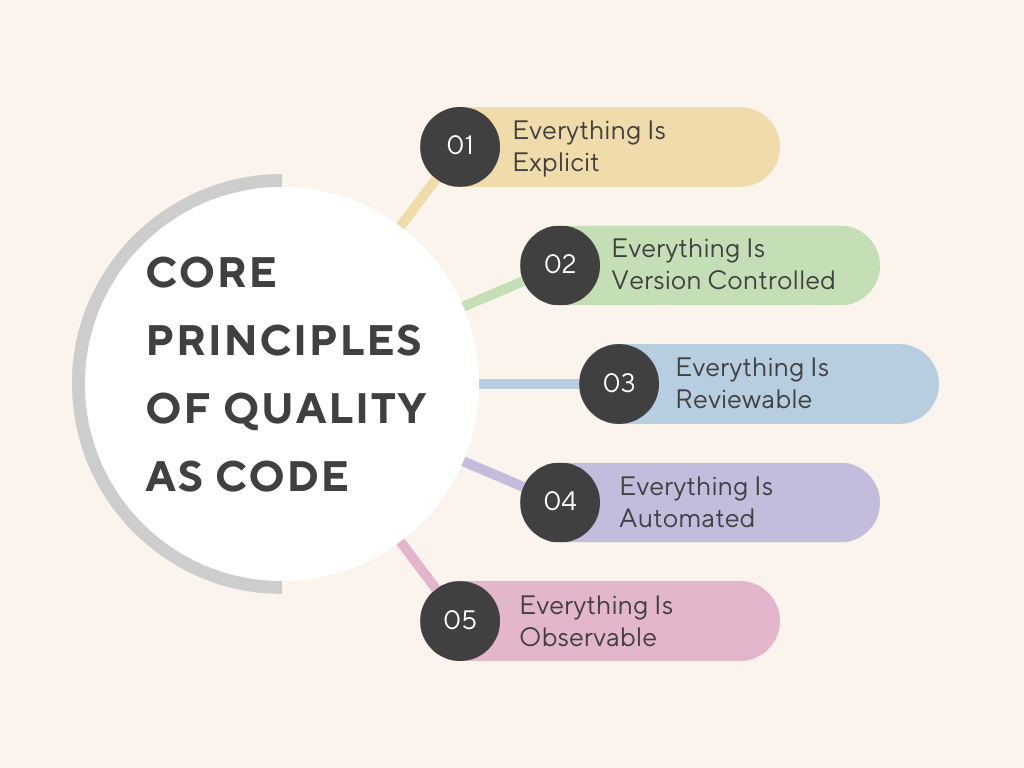
Everything is Explicit
There should be no assumption about quality at all. Environments, data flows, configuration settings, and quality gates also need to be very well documented for anyone on the team to understand how it all works. Explicit definitions remove ambiguity and minimize failures from hidden dependences or unspoken assumptions.
Example: Instead of describing in words how a test environment is constructed, the structure and behavior are defined such that every team member interacts with the same known setup published in one place.
Everything is Version Controlled
All quality-related assets should be version-controlled so that it can be traced and attributed. That gives the organisation a way to track what changed, when it changed and why – an executable record trail. Version control also allows you to revert to previous changes that may have caused issues and to see how quality systems have evolved over time.
Example: If one of the test environment configurations changed, they can scroll through the past versions and know which change exactly caused instability.
Everything is Reviewable
Quality Infrastructure deserves just as much attention as production code. Peer review ensures that changes are well thought out and adhere to team standards. It also shares knowledge throughout the team and prevents only a few individuals from having ownership of quality systems.
Example: If we look at what has changed for test data generation rules, then you get a heads up when there are overly optimistic assumptions before they break all tests that use them.
Everything is Automated
Manual processes lead to inconsistencies and errors, and are dependent on individual expertise. Automation makes sure that quality systems act the same way over and over, no matter who starts them or when they are executed. The latter is what is needed, and it provides us with reliability in terms of quality.
Example: When the environment setup is automated, you can avoid the scenario where one engineer sets up differently from another.
Everything is Observable
If it can’t be measured, it can’t be improved. Observability into the environment’s health, the stability of data, and configuration changes, so that you can identify problems earlier and learn how things have changed over time. Without observability, quality problems remain hidden until they cause failures.
Example: Observing test environment stability can identify repeatable infrastructure problems before they begin to result in widespread test failure.
Read: What is the Cost of Quality in Software Testing?
Why Quality as Code is Critical in Modern Software Development
Software development today is about speed, scale, and rapid change. Old-school quality techniques are ill-equipped for the new world of continuous releases, distributed teams, and flexible infrastructure. Quality as Code lays the groundwork for making sure dependability prevails in this fast-paced world.
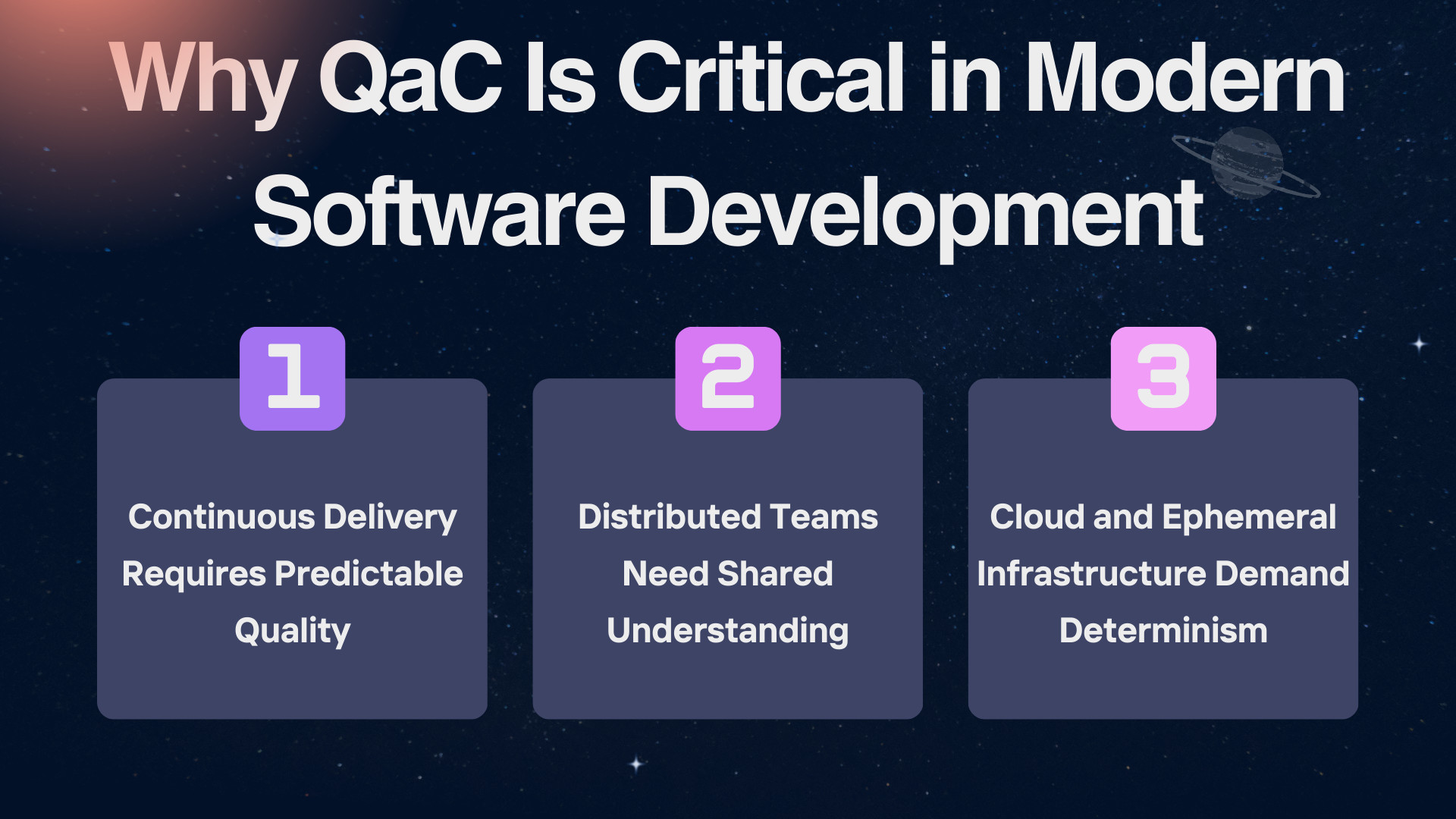
Continuous Delivery Requires Predictable Quality
Manual quality processes are ineffective at scale when implementing continuous delivery and deploying multiple times a day, with changes being made constantly. Quality must move at the speed of development, yet remain reliable and predictable. Quality as Code promotes continuous confidence by guaranteeing that validation systems act consistently every time they are executed.
Distributed Teams Need Shared Understanding
Remote and distributed teams can’t rely on verbal explanations, contextual setup guides or informal procedures. Code becomes the common thread that ensures all colleagues operate from a common set of assumptions, no matter where they’re located or what they do. Quality as Code objectifies quality knowledge, serializing it to reusable and portable assets that accompany the system.
Cloud and Ephemeral Infrastructure Demand Determinism
Modern infrastructure is designed to be dynamic; environments are dynamically created and destroyed as per requirement. In such a case, manual quality settings are inefficient and error-prone. Quality needs to be produced at will so that validation results are credible wherever and whenever they are executed.
Read: What is Cost of Poor Quality (COPQ)?
Technical Pillars of Quality as Code
Quality as Code is based on several technical cornerstones that enable it to maintain stable and omnipresent quality systems. These are designed to mitigate typical failure modes (based on conventional quality practices) by enforcing structure and engineering rigor in environments, data, and statistical configuration. Together, they form the foundation that precedes dependable validation in contemporary software systems.
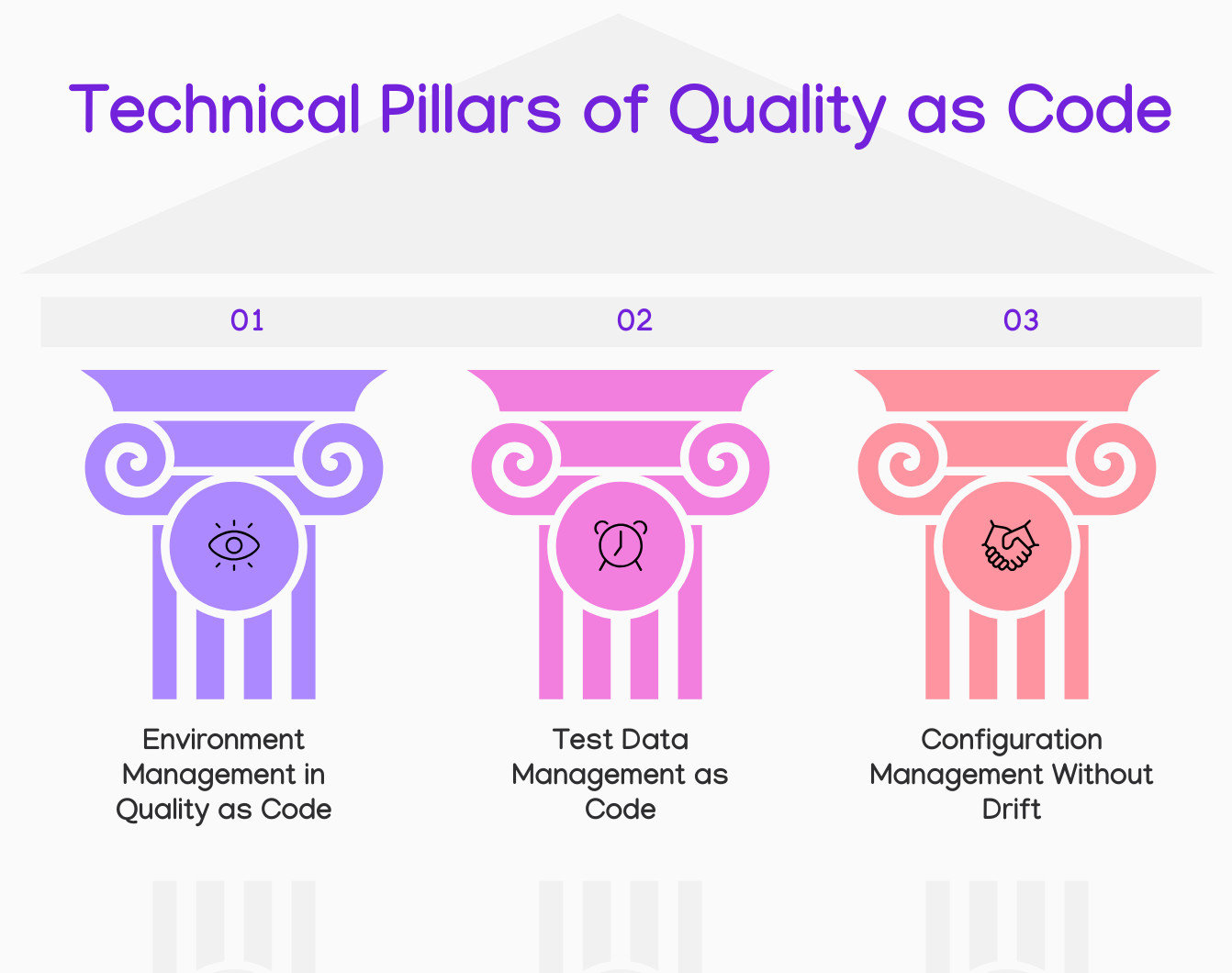
Environment Management in Quality as Code
Traditional quality setups are often plagued by unstable test environments. Many organizations will recognize their environments by name, not by definition. It’s only in the aftermath of failures that flaws are found. Installations steps vary based on who is doing the installation. Environments are engineered products for Quality as Code. Environments are explicitly defined, consistently created, and deleted when no longer used. This method eradicates whole classes of environment-based failures and greatly mitigates test flakiness.
Test Data Management as Code
One of the most neglected quality engineering aspects is test data. Most traditional methods are generally based on shared databases or manual curated data, and have uncertain ownership. Test data becomes stale and is unreliable after some time. Quality as code considers test data to be an engineered artifact. Data is not streamed naively but rather actively created with a scope for specific test cases, for mirroring realistic use. Cleanup is self-cleaning so that long term decay will not occur. This has a huge impact on the reliability and confidence in test results.
Configuration Management without Drift
Configuration drift is one of the most common sources of environment discrepancies and production-only errors. Even slight variations in how settings are configured can cause big changes in behavior, poor performance, and security vulnerabilities. Manual configuration management almost certainly means drift across time. Drift is avoided by turning differences in configuration to explicit, reviewable, and intended. When two environments behave differently, teams can tell at a glance why.
Read: Is QA More Cost-Effective Thanks to Automation?
Quality as Code Across the Software Lifecycle
Quality as Code influences every stage of software development.
- During development, engineers receive faster and more reliable feedback. Because quality environments and data are consistently defined, developers can validate changes early without waiting for manual setup or shared resources. This reduces rework and prevents defects from propagating downstream.
- During integration, validation becomes consistent and repeatable. Each integration point is tested under the same engineered conditions, eliminating variability caused by environment or configuration differences. As a result, integration failures are easier to reproduce and fix.
- During release, confidence increases because quality systems behave predictably. Teams can rely on validation outcomes knowing they were produced by a stable and deterministic quality infrastructure. This reduces last-minute testing, manual sign-offs, and release anxiety.
- During operations, post-release issues are easier to diagnose due to environment parity. Since quality environments closely mirror real-world behavior, teams can reproduce production issues more quickly and accurately. This shortens incident resolution time and improves overall system resilience.
Quality becomes an integrated capability rather than a late-stage activity.
Read: How to Save Budget on QA.
Organizational Impact of Quality as Code
Quality as Code does more than improve technical reliability. It fundamentally changes how teams collaborate, make decisions, and take ownership of quality across the organization.
Organizational Benefits
Quality as Code has an organizational impact beyond technical improvements. Transparency lowers the blame and encourages working together. Quality responsibility becomes a collective system defense as opposed to process enforcement. Teams are more willing to experiment because changes are controlled and reversible. “What this enables is a more engineering-focused culture and higher delivery confidence in general.
Common Misconceptions
Some people may think that Quality as Code is only for big organizations or mature companies. In fact, it scales bit by bit and can be very small at first. Some people think that all fancy tooling is necessary. Tools may be helpful, but discipline and mindset are far more important. Some worry it will slow teams down. In reality, it takes out the hidden latencies from rework, confusion, and instability.
Read: Why Startups Fail at Testing and How to Fix it.
Adopting and Evolving Quality as Code
Quality as Code is not a one-time transformation but an ongoing journey that evolves with the organization. It encourages teams to improve quality systems incrementally while building a foundation that supports long-term scalability and confidence.
Getting Started With Quality as Code
Adopting Quality as Code does not require a complete overhaul. Start with the most painful area, such as environments, test data, or configuration management, where instability causes the most friction. Make one aspect explicit and automated so it becomes repeatable and reliable. Measure the impact, gather feedback, and expand gradually. Incremental adoption delivers real value quickly and builds momentum across teams.
Read: How to Start with Test Automation Right Now?
The Long-Term Vision of Quality as Code
As organizations mature, Quality as Code enables self-service quality environments, predictable validation pipelines, high-trust automation, and continuous improvement. Quality becomes embedded into engineering workflows rather than enforced through checkpoints or approvals. Eventually, quality stops being a bottleneck or safety net and becomes an invisible enabler of speed, reliability, and innovation.
Read: A Non-Technical Founder’s Guide to Product Quality.
Quality as Code in Practice
Quality as Code is first and foremost a mindset and an engineering discipline rather than a tooling choice, but some tools can be helpful for the teams to express it in order to operationalize it. An example would be a tool such as testRigor, that adheres nicely to some of the key concepts from Quality as Code.
testRigor focuses on making quality intent explicit and executable by allowing tests to be expressed in clear, human-readable language. By abstracting away fragile implementation details such as selectors, scripts, and low-level orchestration, it minimizes the brittleness traditionally associated with automated testing. This supports one of the central goals of Quality as Code: ensuring that quality assets remain understandable, reviewable, and maintainable as systems evolve.
Read: testRigor Locators.
From a Quality as Code perspective, testRigor helps shift attention away from writing and maintaining test scripts and toward engineering stable quality systems. Test logic becomes easier to review and version, test behavior becomes more deterministic, and quality signals become more trustworthy. This enables teams to scale validation alongside continuous delivery without introducing excessive maintenance overhead or instability.
Read: Decrease Test Maintenance Time by 99.5% with testRigor.
Importantly, testRigor does not replace the need for disciplined environment management, intentional test data strategies, or configuration control. Instead, it complements these practices by making validation clearer, more resilient, and easier to integrate into modern engineering workflows. In this sense, it serves as an example of how tooling can reinforce Quality as Code principles without redefining them. Read this to know more: testRigor Features.
Conclusion
Quality as Code transforms software quality from a downstream function into an engineered, perpetually evolving competence that is woven through the fabric of your software lifecycle. By explicitly engineering Quality Assets, versioning, and automating them, and also by making them observable, teams will eliminate the fragile manual practices of the past with predictable and scalable system offerings. Today, quality ceases to be a bottleneck and becomes an invisible accelerator of velocity, confidence, organic innovation.
| Achieve More Than 90% Test Automation | |
| Step by Step Walkthroughs and Help | |
| 14 Day Free Trial, Cancel Anytime |