
What is Interoperability Testing?
 |
Today, software systems don’t just stand in isolation. A contemporary application is seldom a product in and of itself. But it is an integral part of a broader digital ecosystem that spans across applications, services, platforms, devices, and technologies. When that is the reality, ensuring systems can talk to each other, share data, and work across borders becomes more important. This is where interoperability gets involved.

Interoperability testing is part of software testing that checks whether two or more applications, systems, or components can work collaboratively and share data. This ensures that communicating systems can pass data back and forth. They should make the same sense of it, and not end up doing anything gloriously exciting without the other system involved being aware.
With the adoption of cloud computing, microservices-based architectures, IoT devices, SaaS platforms, and third-party integrations by organizations, interoperability testing has transformed from a “nice-to-have” activity to becoming a mission-critical quality discipline.
| Key Takeaways: |
|---|
|
What is Interoperability in Software Systems
- Exchange Data: Systems should be able to effectively communicate while sending and receiving information without losing, duplicating, or corrupting it.
- Understand Shared Data Formats: Both of the systems must interpret the exchanged data’s structure, types, and meanings in a similar fashion.
- Follow Agreed Communication Protocols: Systems should be compliant with shared guidelines for interacting through messages like APIs, transport mechanisms, authentication, and sequencing.
- Maintain Data Integrity: Information cannot become false, incomplete or altered in any manner while it is being transmitted and processed between systems.
- Coordinate Processes and Workflows: Systems that act on each other need to synchronize their business logic, state transitions, and timing for end-to-end functionality.
- Handle Errors Gracefully: Systems should clearly communicate errors and recover sensibly. That too, without causing collateral damage when other parts of a system fail.
- A payment gateway could accept a payment request, but still not be interoperable if it misunderstands the currency or amount.
- An API can return a response, but interoperability with the consuming system is breached if that consuming system cannot successfully parse or handle it.
- Two enterprise systems may share customer data, but if field mappings or formats differ, data corruption can occur.
- Interoperability testing is designed to uncover these kinds of issues before they impact users or business operations.
Read: How to do API testing using testRigor?
Why Interoperability Testing is Critical in Modern Software
Interoperability has become essential for the software industry, as modern applications work in complex, distributed, and integrated environments. With systems becoming more dependent on microservices, third-party APIs, and various devices, even small communication breakdowns can cripple vital business processes.
Read: API Testing Checklist.
Interoperability tests help to make sure that all integrated systems still communicate with each other in the correct way, stay compliant, and run smoothly despite changes by vendors and third parties.

The Rise of Distributed Systems
Modern software architectures are becoming more and more distributed. Monolithic systems are being superseded by microservices that run on cloud-native platforms and systems based on events. Everything could be built, deployed, and maintained separately.
This increases dependence on reliable service communication, although it increases scalability as well. Interoperability tests verify that these components, which develop independently of one another, correctly interoperate.
Dependency on Third-Party Services
- Contract Adherence (API schemas, payloads): Verifies that the application operates in alignment with the upstream third-party service’s specified API model, mandatory fields, and data types.
- Backward and Forward Compatibility: It ensures integrations work in conjunction with old versions, while still working seamlessly even with new API updates being introduced.
- Error-handling Behavior: Ensures the application gracefully handles failures, timeouts or invalid responses from the third party without impacting users.
- Version Changes and Deprecations: Get alerted for breaking changes early in the evolution of public APIs and deprecation of features, minimizing unexpected production incidents.
Without interoperability testing, even minor changes in a third-party system can break critical application flows. This is where automated integration regression becomes essential. With testRigor, teams can continuously validate critical user journeys that depend on third-party services (login providers, payment gateways, email/SMS services) so that breaking changes are detected early before they hit production. Read: How does testRigor work? AI writes tests, less maintenance.
Multi-Platform and Multi-Device Ecosystems
End users today use software across a plethora of platforms and devices, including web browsers, mobile devices, desktop apps, smart TVs, wearables, IoT, and so forth. Different platforms may employ diverse operating systems, screen dimensions, network capabilities, and interaction patterns, which make the integration of different systems complicated.
Interoperability testing validates that data exchanged between these various environments is accurate, consistent, and usable. It can check that applications work properly, that screen flows work the way they should, and ensure a good experience for users independent of device type and platform.
Regulatory and Compliance Requirements
In some regulated industries such as healthcare, finance, government, and telecommunications standards of interoperability may be mandatory under a law or industry standard. Non-compliance with interoperability can lead to consequences like legal sanctions, failed audits or revocation of standardization.
Interoperability testing facilitates the organization to show that its products are conformant with data exchange standards, security, and industry standards.
Read: How to Do Payments Testing: Ensuring Secure and Seamless Transaction Processing.
Key Objectives of Interoperability Testing
Interoperability testing seeks to mitigate the risks associated with multiple systems interacting across technologies, platforms, and organizations. The goal is to provide an interface for integrated systems to communicate information, behave as expected despite the heterogeneity of dependencies, and change in dependencies over time.
By testing more than just individual components, by checking that interactions are valid (not just that low-level code), interoperability testing safeguards business workflows and the experiences of end-users.
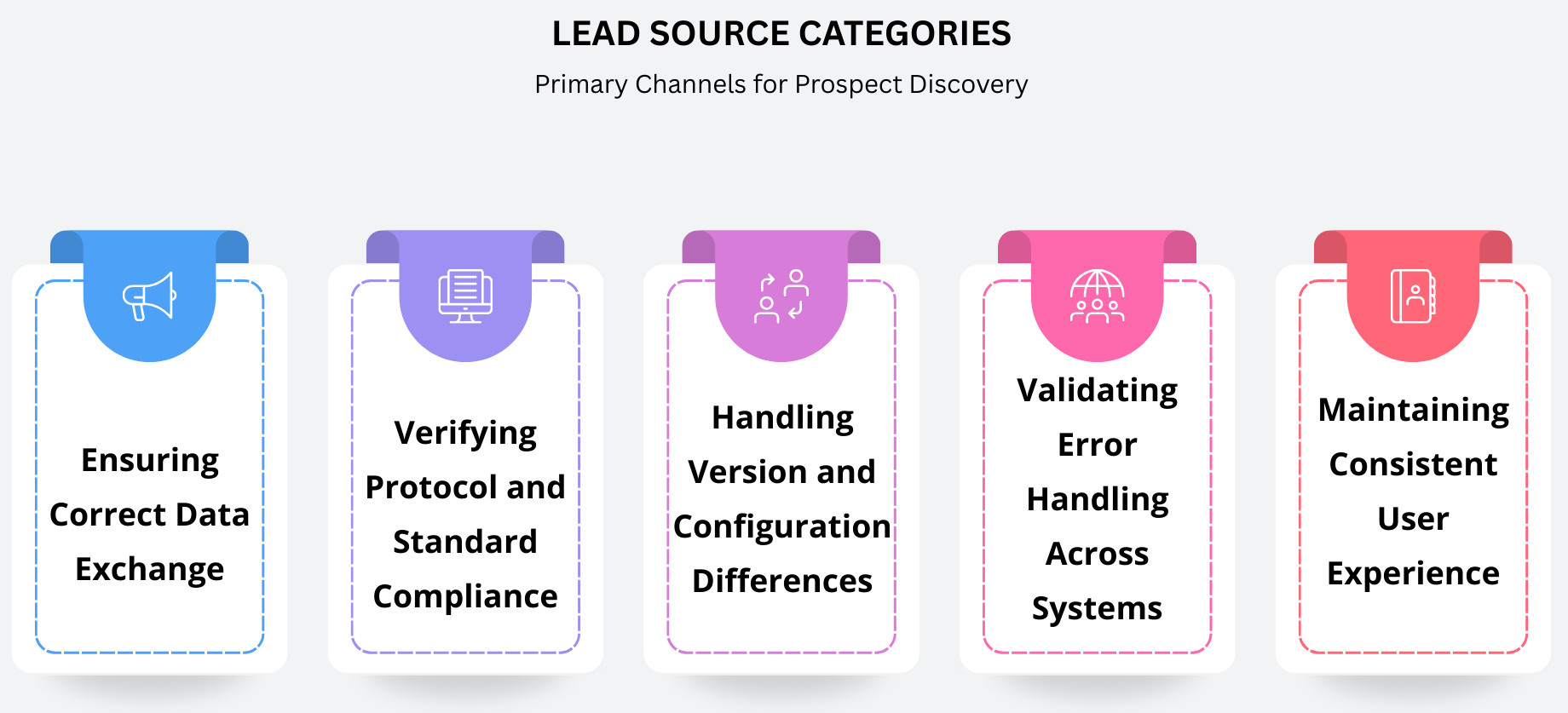
Ensuring Correct Data Exchange
One principle for interoperability testing is the validation of complete, accurate, and appropriate data exchange between systems. That means validating that data types are correct, field mappings make sense, encodings are what’s expected, units of measure are what the recipient is expecting and dates or times are represented as they’re supposed to be.
Even slight discrepancies in formatting or meaning can result in data corruption, computation errors, and interruption of work processes between systems.
Verifying Protocol and Standard Compliance
Today’s systems are built using standardized protocols and formats, like HTTP, REST, JSON, XML or HL7, and OAuth. Interoperability testing verifies that such standards are being used widely and consistently among collaborating systems.
Correctness ensures there is less room for interpretation, increases the dependability, and avoids misunderstandings between services built by different teams or vendors.
Handling Version and Configuration Differences
Collaborating systems are commonly based on different software versions and sets of parameters. Interoperability testing confirms backward compatibility, graceful handling of deprecated features, and tolerance of optional or missing fields.
This allows for timestamping changes made between current and previous versions, so that upgrades or partial feature rollouts won’t break existing integrations.
Validating Error Handling Across Systems
Error handling is one of the most important parts in interoperability testing since there will always be issues coming up with distributed systems. Functional verification ensures errors are propagated with an understandable code and message, and failures do not become runaway. It also confirms that retry, recovery, and fallback procedures are effective in the presence of a fault.
Maintaining Consistent User Experience
To the user, lack of interoperability typically manifests as missing functionality or incomprehensible behavior, rather than a disaster of crashing software. The Interoperability testing helps to make sure the operational workflows are maintained smoothly and predictably, regardless of participating systems. By verifying end-to-end transactions, it also ensures the continuity of the user experience and the quality of service.
Read: Integration Testing: Definition, Types, Tools, and Best Practices.
Types of Interoperability Testing
Interoperability tests can be categorised using the system interaction that is being validated. They each cover a certain layer of risk from low level technical communication to high level business processes. Collectively, these types of test are designed to verify that integrated systems work properly in practice and over time.
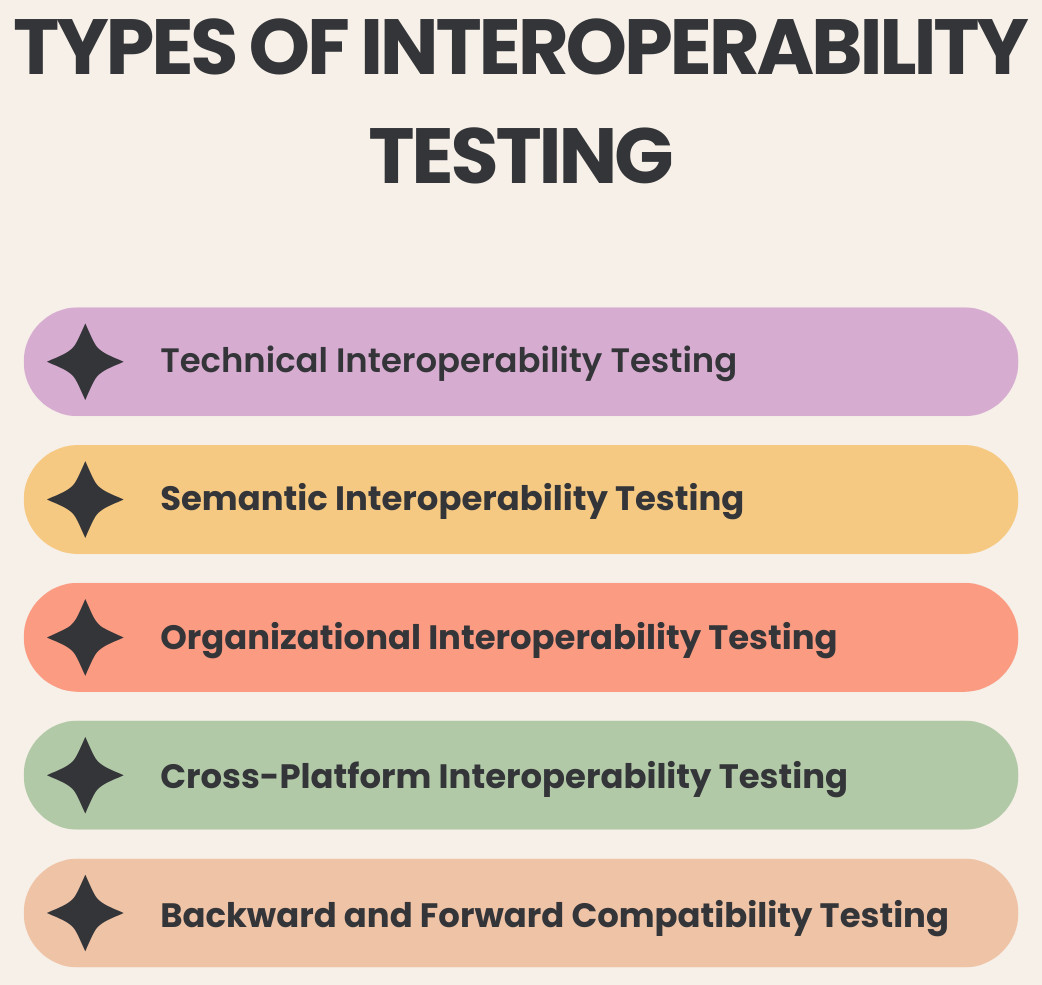
Technical Interoperability Testing
This ensures the base-line capability to communicate with each other. It verifies network connection, communication protocols, data formats, API calls, and message formats that you use for integration. The goal is that systems be capable of connecting, exchanging data without error, and processing received messages as expected.
Semantic Interoperability Testing
This verifies if the exchanged data is understood in the same way by one system to another. It validates business rules, terminology, and contextual definitions consistency across integrated components. Such testing is useful to reveal less visible problems like the fact that some fields or statuses are understood in a different way, which leads to making wrong business decisions.
Organizational Interoperability Testing
Interoperability testing at the organizational level verifies complete business processes that traverse several systems or organization. It guarantees workflows run as expected; transfers between systems are smooth and work is properly delegated or attributed. This type is crucial for enterprise integrations, B2B platforms, and partner ecosystems.
Cross-Platform Interoperability Testing
Cross-platform interoperability testing confirms that systems work in a consistent manner on various operating systems, browsers, devices, and hardware conditions. It guarantees that data and system behaviour are consistently reliable in the face of variations in the environment. Such testing is especially viable for mobile apps, IoT products, and multi-device solutions.
Backward and Forward Compatibility Testing
Backward and forward compatibility testing verifies that the systems still function together across diverse software or API versions. It guarantees that older integrations work after upgrades and newer releases are able to interface with legacy components. This testing helps in avoiding integration failures as a system evolves and is deployed in phases.
Read: Cross-platform Testing: Web and Mobile in One Test.
Interoperability Testing Process
The interoperability validation method teaches a systematic way to verify the interoperability between various systems. This results in integrations being tested automatically, bugs being caught sooner, and communication issues being ironed out before anything is released. A well-defined process helps in ensuring consistency, repeatability, and trust in the interplay of complex systems.
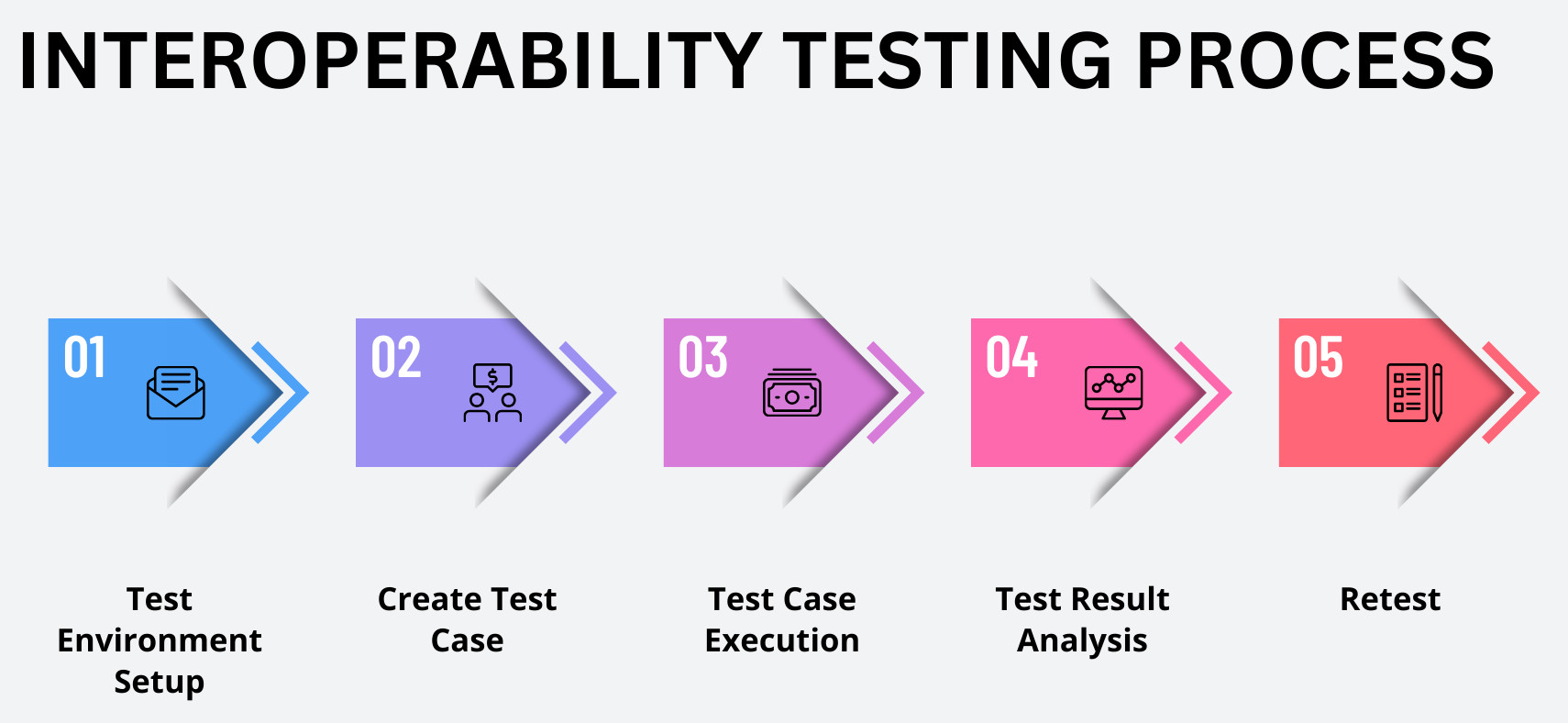
- Test Environment Setup: The primary goal of this phase is to set up a testing environment that comes as close as possible to the real-world integration scenario. All necessary systems, integrations, configurations, and dependencies are configured to allow interoperability testing in a meaningful way. Read: What is a Test Environment?: A Quick-Start Guide.
- Create Test Case: Tests cases will verify how systems communicate, share data, and process multiple scenarios of interactivity. These cases represent common usages as well as edge cases and failure modes. Read: Creating Your First Codeless Test Cases.
- Test Case Execution: Once test cases are generated or created, the next stage is to run tests and see how code interacts with the system in a well prepared environment. It is a valuable step to find communication failures, data inconsistency or protocol errors under real-time integration. Read: How to execute test cases in parallel in testRigor?
- Test Result Analysis: Test outcomes are then interpreted after test execution, to compare system performance with the expected. Identified faults are examined to check the causes of these and further determine which previous bugs have been addressed. Read: Test Reports – Everything You Need to Get Started.
- Retest: Whenever any defects are detected, they will be fixed, and the impacted test cases will be retested. This process would make certain everything is good, and changes didn’t break any new interoperations. Read: What is Retesting?
Advantages and Disadvantages of Interoperability Testing
There are numerous advantages to interoperability testing, as it verifies and validates seamless method exchange between cooperating systems. At the same time, this organically leads to certain complexities as systems evolve and dependencies grow, and when you have very little control over external services. The following table summarizes the major benefits and drawbacks of interoperability testing.
| Advantages | Disadvantages |
|---|---|
| Establishes reliable and error-free communication between different software systems | Interoperability requirements are often unclear or insufficiently defined |
| Ensures consistent data type handling across integrated systems | Accurate measurement and validation can be complex and time-consuming |
| Maintains uniform data formats during data transformation | Increases network and integration complexity |
| Preserves the semantic meaning of data across systems | High dependency on external or third-party systems |
| Detects integration issues early in the development lifecycle | Requires continuous maintenance due to frequent API and version changes |
| Improves overall system reliability and stability | Test environments can be difficult to set up and manage |
Interoperability Testing in Different Domains
- Enterprise Software: In enterprise software ecosystems, ERP, CRM, and HR systems interconnect with financial and other systems. Interoperability testing guarantees that information and data transfer are performed properly through all these connected centers.
- Healthcare Systems: Interoperability is what allows healthcare providers to share sensitive information across electronic health records, medical devices, insurers, and regulators. Testing helps prevent data disparities and ensures adherence to healthcare guidelines while maintaining the safety of patients.
- Financial Systems: Financial app platforms need fast and seamless integration to payment systems, fraud detection tools, regulators & fintechs. Interoperability tests focus on ensuring that high precision, security, and reliability are transmitted across the systems.
- IoT Ecosystems: There are a variety of devices, sensors, gateways, and backend platforms present in the IoT environments working together. Interoperability testing confirms that a device is compatible, data exchange is consistent, and communications are reliable between dissimilar systems.
- Cloud and SaaS Platforms: Cloud-based and SaaS application architectures leverage many managed services and external APIs. Interoperability testing is used to verify that services will integrate properly, work with the right APIs, and play nicely with multi-cloud or hybrid cloud constructs.
Conclusion
Interoperability testing provides the confidence that today’s interconnected software systems will be able to communicate, share data, and work together effectively in different platforms, across services and technologies. It’s not about testing individual units, but rather end-to-end interaction, semantics coherence, and robustness of a real-world integration.
It preserves business workflows, compliance, and user experience by catching integration problems early. While digital ecosystems are getting more complex, interoperability testing is also a fundamental stone to construct reliable and scalable software systems.
| Achieve More Than 90% Test Automation | |
| Step by Step Walkthroughs and Help | |
| 14 Day Free Trial, Cancel Anytime |