
How to Identify a QA Crisis: 5 Warning Signs to Watch
 |
“The software crisis emerged in the late 1960s as an increasing number of large projects experienced large cost overruns, missed deadlines, and failures to meet specifications. Some had to be canceled altogether. One response was calls for a discipline of ‘software engineering’” – Michael S. Mahoney.
It was back then, but today, when we talk about the QA crisis, in most organizations, it doesn’t start with a spectacular failure. There is no one catastrophic release that suddenly sends the message that something is wrong. Instead, it begins quietly, almost invisibly. Some more bugs slipped into production than normal. It takes a little longer to run a test suite. A release feels a bit riskier than the last one.
Signs are: teams start saying things like, “Let’s just monitor after release,” or “We’ll fix it quickly if something breaks.”
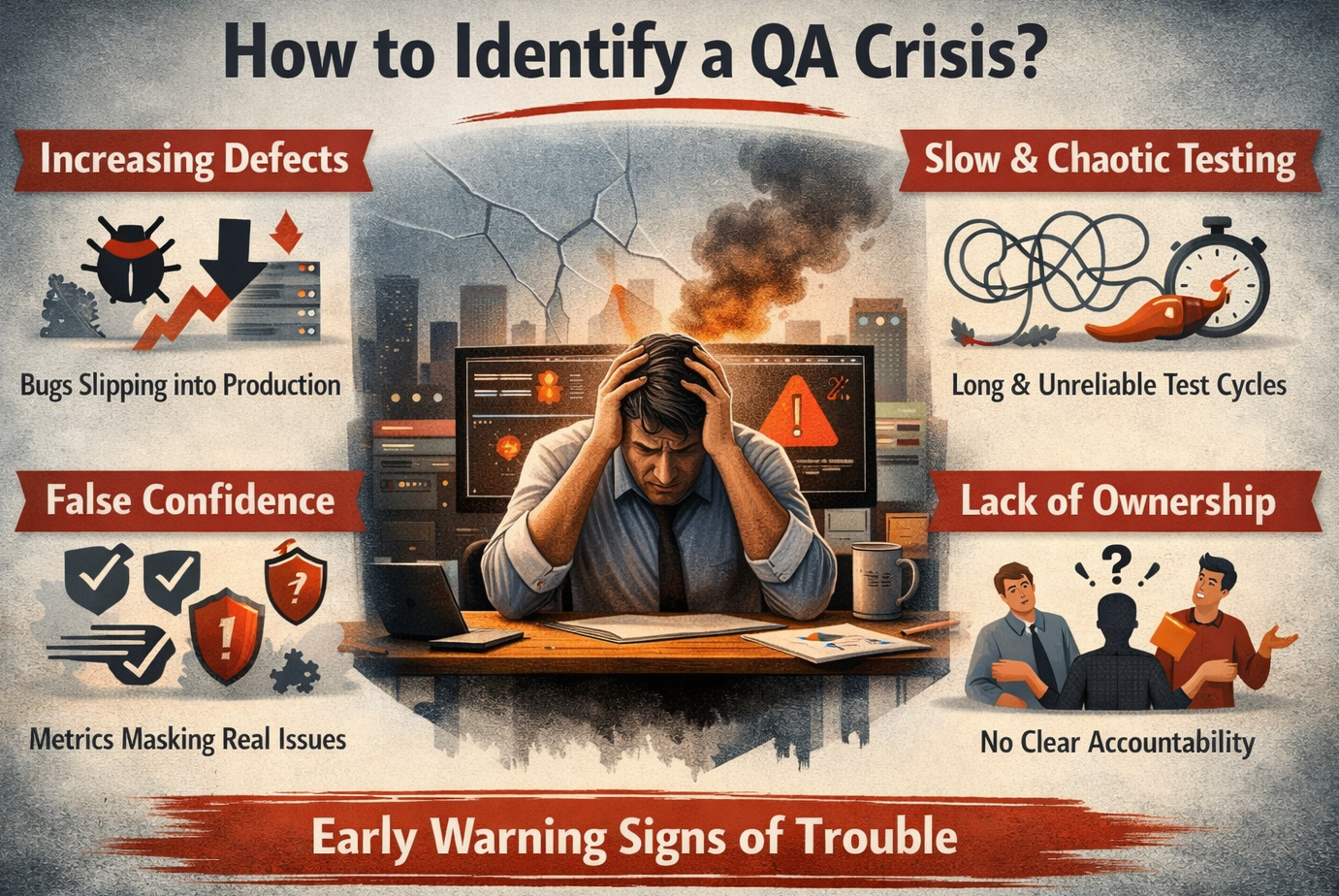
And this is how a QA crisis starts, not with a bang, but with an incremental loss of confidence, control, and predictability. But most teams are unable to sense this shift early. By the time the crisis is clear, through customer complaints or missed deadlines, perhaps production failure (we have all heard that joke), the damage is done.
The ability to recognize an emerging QA crisis as early as possible is one of the most important things a modern engineering organization can learn.
| Key Takeaways: |
|---|
|
What is a QA Crisis?
This QA crisis is much more than just a rise in defects; it signifies that it’s a deeper collapse in systems and processes that ensure software quality. It means all bets are off: no longer will testing provide confidence, nor can releases be predicted; quality assurance has lost the ability to yield actual and reliable validation.
This breakdown often turns QA from the windscreen into a rear-mirror, where you end up chasing rather than preventing issues. Consequently, risks start to build up quietly without teams having a clear view of the real health of the product.
At its heart, a QA crisis is a trust crisis that infects the company. It is even under the best structures and quarterly targets that it becomes difficult to deal with when developers, product teams, and leadership start losing trust in QA outputs.
Read: QA’s Role in the Full SDLC – Beyond Just STLC.
Why QA Crises Go Undetected
Software quality issues don’t surface overnight; they manifest themselves quietly over the long haul while teams think that everything is fine under the hood. What makes QA crises especially pernicious is that they can do a lot of damage while often not getting noticed. Recognizing the blind spots behind this blindness is the first step to curbing big failures.
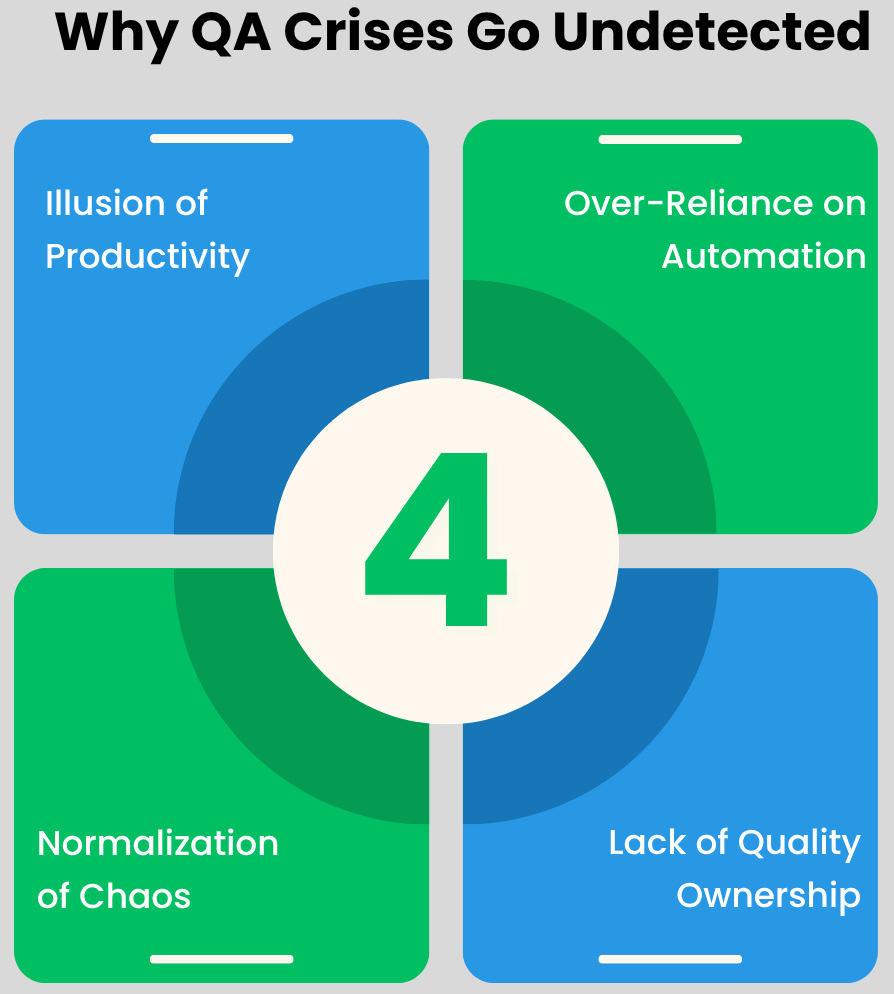
Illusion of Productivity
Teams frequently confuse activity with effectiveness, closing hundreds of tickets, running thousands of automated tests, and doing too many releases. These metrics, however, can obfuscate poor quality when they don’t validate actual user scenarios or important business flows.
For example, a team might be reporting 95% test pass rates but not notice that a checkout flow is broken because tests only cover UI elements and not end-to-end transactions.
Normalization of Chaos
When recurrent issues become routine, teams begin to accept them as part of the system rather than indications of systemic breakdowns. Saying things like “production bugs are normal” or “we’ll fix it in a hotfix” slowly lowers the bar for quality.
For example, if every release in the system has to have emergency patches within 24 hours, the team might stop asking themselves why releases are unstable in the first place.
Lack of Quality Ownership
QA works with the team, but when responsibility for quality is a task that solely belongs to QA, accountability becomes a distributed effort across teams. Developers expect defects to be caught by the QA, while QA expects developers to have implemented correctly.
One such example is if a feature is pushed with little unit testing because “QA will validate it later,” and ends up with defects that slip through the cracks due to a lack of clear ownership.
Over-Reliance on Automation
When companies value quantity over relevance, automation breeds a false sense of security. I’m not saying there can’t be thousands of tests, but if they are old, flaky, or out of sync with real user behavior, you lose most of the value.
For example, a set of 5,000 automated tests might pass all day long without ever detecting an important change in the API contract, simply because it was never updated to reflect new needs.
Read: Quality as Code: Defining Quality in Infrastructure & Automation for Modern QE.
QA Crisis Indicators: Five Early Warning Signs
Quality problems don’t typically emerge overnight; they develop over time through a series of small, often unheeded signals. Learning to recognize these early warning signs can help you avoid an all-out QA crisis that affects customer confidence and business results. The trick is recognizing patterns, not isolated acts, and stepping in before they gain traction.
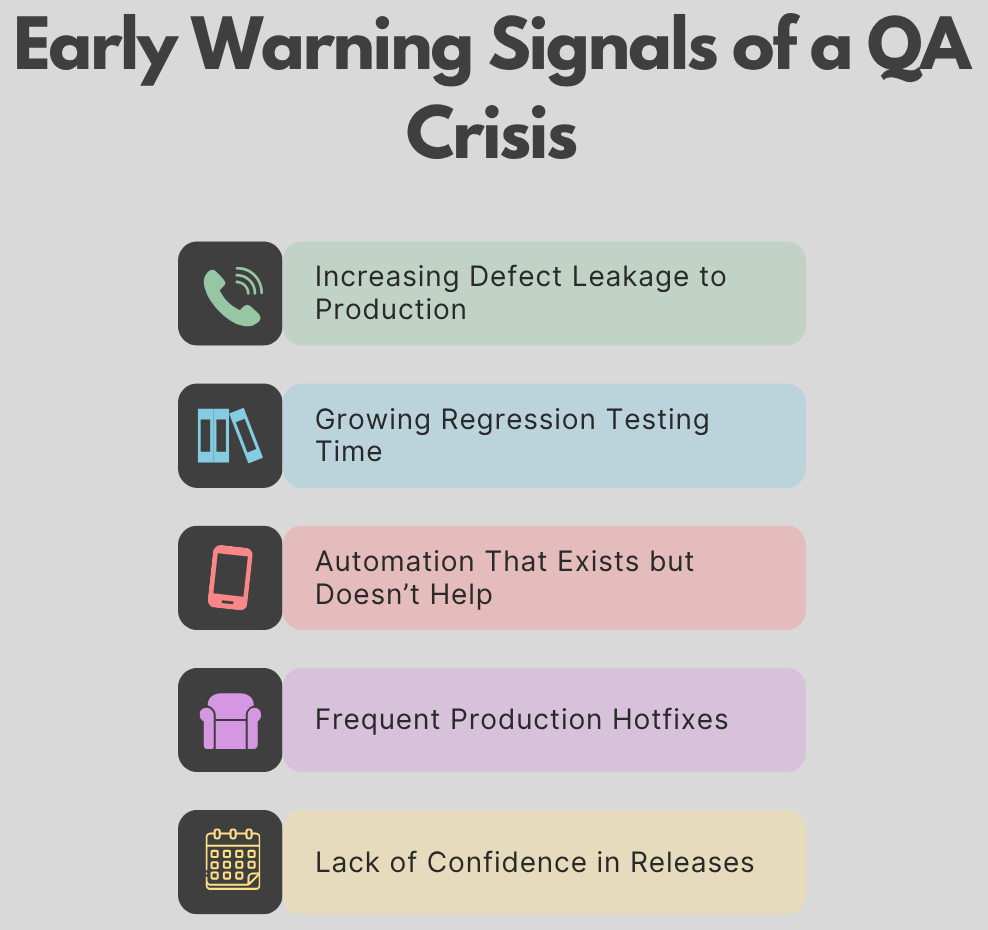
1. Increasing Defect Leakage to Production
When defects start to seep into production frequently, it indicates an underlying issue with the QA process. It is not a matter of the occasional miss, however, but rather repeated failures that suggest systemic weakness. In the longer term, this erodes customer confidence and puts unnecessary strain on support and engineering teams.
Symptoms:
- Critical defects found by customers instead of QA
- Repeated issues in the same functional areas
- Bugs resurfacing after being marked as fixed
Causes:
- Insufficient test coverage
- Outdated or irrelevant test cases
- Ineffective validation strategies
Read: What is Defect Leakage in Software Testing?
2. Growing Regression Testing Time
As a system matures, regression testing should be faster, not slower. An expanding regression cycle is indicative of inefficiencies in process and tooling. And this growth has a direct bearing on release velocity and on the team’s capability to deliver sustainably.
Symptoms:
- Regression cycles are taking longer with each release
- Increased reliance on manual testing
- Difficulty completing regression within sprint timelines
Causes:
- Poor automation strategy
- Inefficient test design
- Lack of prioritization in test coverage
3. Automation That Exists but Doesn’t Help
Automation is efficient only if it adds value, not simply because we have it. Badly designed or maintained automation will produce more noise than clarity. Instead of empowering speed and confidence, it does the opposite, becoming a weight on the team.
Signs of problematic automation:
- High maintenance effort
- Frequent test failures unrelated to real issues
- Low trust in automation results
- Tests that are rarely run or frequently skipped
In such cases, automation becomes a liability rather than an asset.
Read: Test Automation Playbook.
4. Frequent Production Hotfixes
Multiple hotfixes are a warning sign that quality issues are being released. When teams are always scrambling into reactive mode, it disrupts planning across the board and ultimately limits productivity. This leads to a reactive, firefighting approach rather than to proactive, long-term delivery.
Symptoms:
- High maintenance effort
- Frequent test failures unrelated to real issues
- Low trust in automation results
- Tests that are rarely run or frequently skipped
Causes:
- Fragile or poorly designed automation scripts
- Lack of proper test data and environmental stability
- No clear automation strategy or goals
5. Lack of Confidence in Releases
Maturity of QA practices is indicated by confidence in releases. Stakeholders slow down when they start to question readiness, and there are signs that quality signals are unclear. In exchange, such mistrust leads to slower decision-making and risk-averse behavior throughout the organization.
Symptoms:
- Stakeholders asking, “Are we sure this is ready?”
- Frequent concerns about risks and unknowns
- Uncertainty about what might have been missed
Causes:
- Absence of clear quality metrics
- Unreliable testing processes
- Lack of transparency in QA reporting
Read: How to Effectively Communicate Quality to Stakeholders?
Organizational Signals of a QA Crisis
A QA crisis is not only visible in technical failures; it resides deeply in the organizational patterns and team dynamics. Such signals often appear silently, smuggled into processes, communication vacuums, and cultural misalignment. When these dysfunctions are identified early, an organization can cascade changes to address systemic issues, staving off delivery challenges and preventing declining morale and product quality.
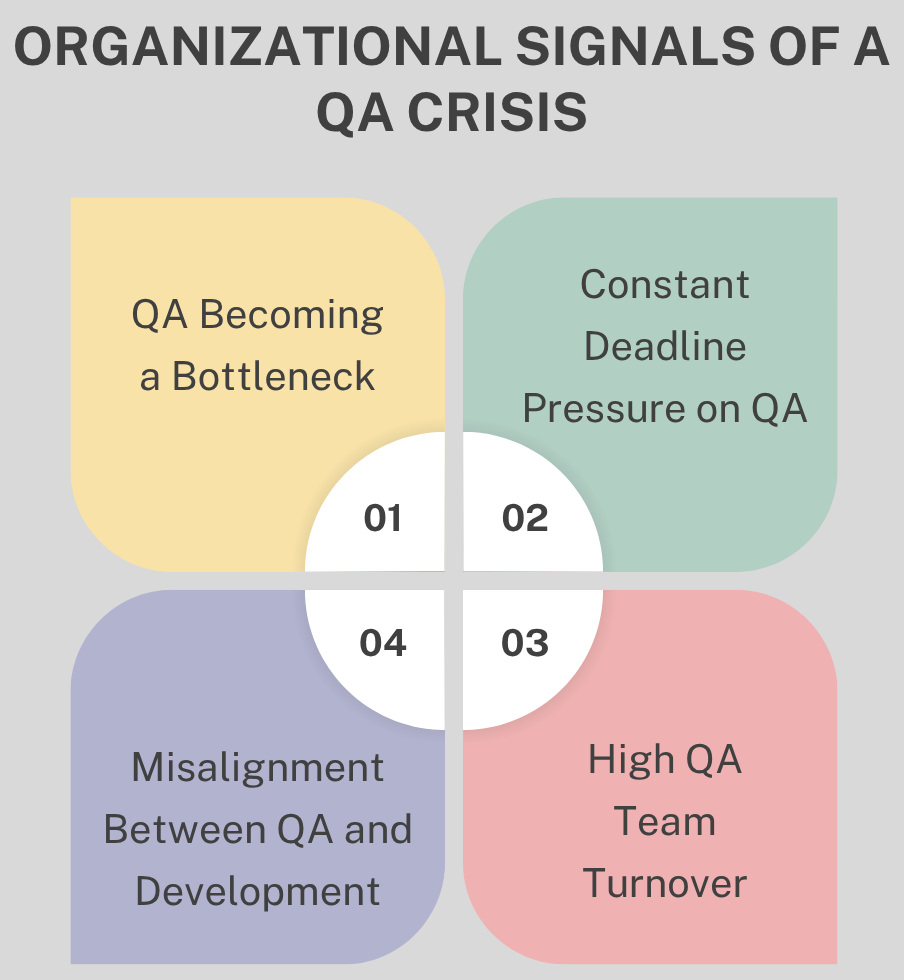
QA Becoming a Bottleneck
This is when QA begins to slow down releases, and it is often seen as a capacity or staffing issue. Yet, in the majority of cases, it comes down to inefficient processes and inadequate testing strategies that are scalable.
This is usually the point where QA suddenly becomes a bottleneck due to too much complexity, with inadequate automation, collaboration, and prioritization. Instead of accelerating speed, QA becomes a bottleneck that grinds progress to a halt, which reflects an underlying misalignment in the system.
Constant Deadline Pressure on QA
Persistent pressure on QA teams to “get done faster” is a powerful sign of an imbalance in the development cycle. It often translates into testing being crunched into unreasonable timetables and being under consideration.
Long-standing pressure results in burnout, leakage of defects, and a decrease in team morale. Time is now at a premium, but in services, when speed comes at the expense of quality over and over again, then long-term cost is always much higher than ephemeral profit.
High QA Team Turnover
The departures of a high number of QAs (Quality Assurance engineers) are seldom random events; they’re indicative of serious root causes. First, and most notably, engineers leave when they are undervalued or work in constant reactive high-stress environments.
Significant turnover breaks knowledge continuity and opens leadership gaps, with the potential to undermine the overall quality strategy. Conversely, a stable QA team speaks of an environment that supports sustainable working by having the right processes, tools, and culture.
Misalignment Between QA and Development
Unfortunately, quality becomes partial and in some way disjointed when QA and development teams work in silos. This misalignment is often what turns into a blame culture rather than an area for creating shared ownership over the result.
If collaboration in the design and development phases is not early, defects will be found later, resulting in increased cost and effort. Regardless of the activities, if the two teams do not see themselves working as a single system but as separate functions, they cannot achieve true quality.
The Role of Leadership in Identifying a Crisis
- Instead of fixed point-in-time metrics, leaders should pay attention to trends in quality over time so they can detect patterns and systemic issues.
- They have to do their part to support the timely reporting of transparent metrics, such that teams discover risks, failures, and major gaps in a blame-free environment.
- By establishing a robust and scalable quality function, which includes investing in QA capabilities, tools, skills, and processes.
- QA needs to become a strategic priority rather than simply an isolated activity, and leaders must align QA efforts with larger business objectives.
Read: Metrics for QA Manager.
How to Mitigate a QA Crisis
Detecting a QA crisis is only half the battle. The real challenge is to reverse that without adding more instability. At this stage, many organizations make a big mistake: they jump to solutions. They either invest in new tooling, increase their automation coverage, or implement tighter processes. These actions make sense on the surface. In practice, they usually make things worse, alleviating symptoms, not causes.
Turning Around a QA Crisis
A QA crisis is not always solved with a quick fix or a single improvement. It takes a systematic, intentional strategy that anchors the present and restores the base for quality in the long run. It also requires a change in mindset: viewing quality as an ongoing, collective effort instead of a last checkpoint.
Acknowledge and Diagnose the Crisis
Acceptance is the crucial first step, as many organizations are frozen in place simply because they do not acknowledge how dire things are. If we do not recognize the crisis, all efforts will only scratch the surface.
An honest and structured assessment of defect trends, common issues, and stakeholder feedback. This helps to root out more systemic inefficiencies, misaligned priorities, and outdated practices since a QA crisis is rarely caused by just one thing.
Stabilize the Current State
Once the crisis is real, you work to stop any further instability and take or regain control of testing. At this point in time, adding new tools or increasing the scope leads to more chaos rather than problem-solving.
Consider the foundation to be laid up around stabilizing existing systems in order to find those flaky tests, reduce noise, and create pipeline efficiency on critical workflows. Meaningful improvement cannot exist in chaos, so it is critical to have a stable baseline.
Rebuild Trust in QA
A QA crisis is fundamentally a breakdown of trust between teams and stakeholders. And without restoring confidence, even formally solid edits will fail to affect decision-making.
It is also important to align testing with real user journeys and provide transparent reporting on the risks and coverage. One way this can occur is through consistent and clear communication that allows stakeholders to view QA as a source of insight rather than one that causes bottlenecks.
Redefine the QA Strategy Around Risk
Once stabilized and trust secured, this would then need correction on the underlying strategy. Most of the QA out-failures have roots in how test quantity has been prioritized over their business-critical impact, leading to ineffective coverage.
A risk-based approach to testing allows concentrating on executing tests for critical paths and high-impact zones. This alignment brings more meaning, efficiency, and direct connections to business priorities into QA efforts.
Optimize Execution and Eliminate Bottlenecks
Having a strategy is just the onboarding; execution needs to be optimized for efficiency without losing quality. This includes optimizing automation, minimizing redundant manual work, and ensuring efficient workflow.
Automation works best in stable, high-value scenarios, while manual testing becomes exploratory and critical validations. When execution is efficient, feedback cycles shorten, defect handling improves, and QA processes can evolve from reactive to controlled.
Read: Test Automation Tool For Manual Testers.
Establish Continuous Feedback and Improvement
The last step is to ensure that the organization doesn’t have another QA crisis. Treating quality as a process, not a one-off recovery.
By strengthening feedback loops and promoting shared ownership across teams, QA practices can continuously evolve. Continuous improvement and adjustment build a resilient system that evolves alongside a shifting product and business landscape.
Read more: What are Software Testing Strategies? A Complete Guide.
Conclusion
A QA crisis is not failure; it is the systemic inability to prevent failure time and again; a deeper malaise in processes, strategy, and culture. Awareness, critical thinking, and the courage to question existing assumptions can go a long way to helping us recognize it before our KPIs and metrics start falling apart.
At the end of the day, a QA crisis is a trust crisis, when confidence in our ability to deliver reliable software fails, and identifying it early and acting on it becomes critical.
Frequently Asked Questions (FAQs)
- What is the difference between a temporary QA issue and a full-blown QA crisis?
A temporary QA issue is usually isolated and can be resolved with targeted fixes, such as improving a specific test case or addressing a defect spike. A QA crisis, however, is systemic; it reflects deeper failures in processes, ownership, strategy, and trust, where issues repeatedly occur despite ongoing efforts. - Can a team have high automation coverage and still be in a QA crisis?
Yes, high automation coverage does not guarantee effective quality assurance. If tests are outdated, flaky, or not aligned with real user behavior, they create a false sense of confidence while critical defects continue to escape into production. - How does a QA crisis impact business outcomes beyond engineering?
A QA crisis can lead to customer dissatisfaction, increased support costs, delayed releases, and reputational damage. Over time, it also affects revenue, customer retention, and stakeholder confidence in the organization’s ability to deliver reliably.
| Achieve More Than 90% Test Automation | |
| Step by Step Walkthroughs and Help | |
| 14 Day Free Trial, Cancel Anytime |