
Understanding the Tester’s Mindset
 |
Testing is often mistaken for mechanical work, involving clicking test cases, ticking check boxes, and ensuring the output matches what was expected. But the magic behind effective testing is not in the scripts, but in the mindset of the tester. A tester mindset influences the way professionals think and respond to uncertainty, risk perception, assumption challenges, and also acts as user quality advocates. It shapes how they think about systems, how they work with teams, and how they respond to uncertainty.
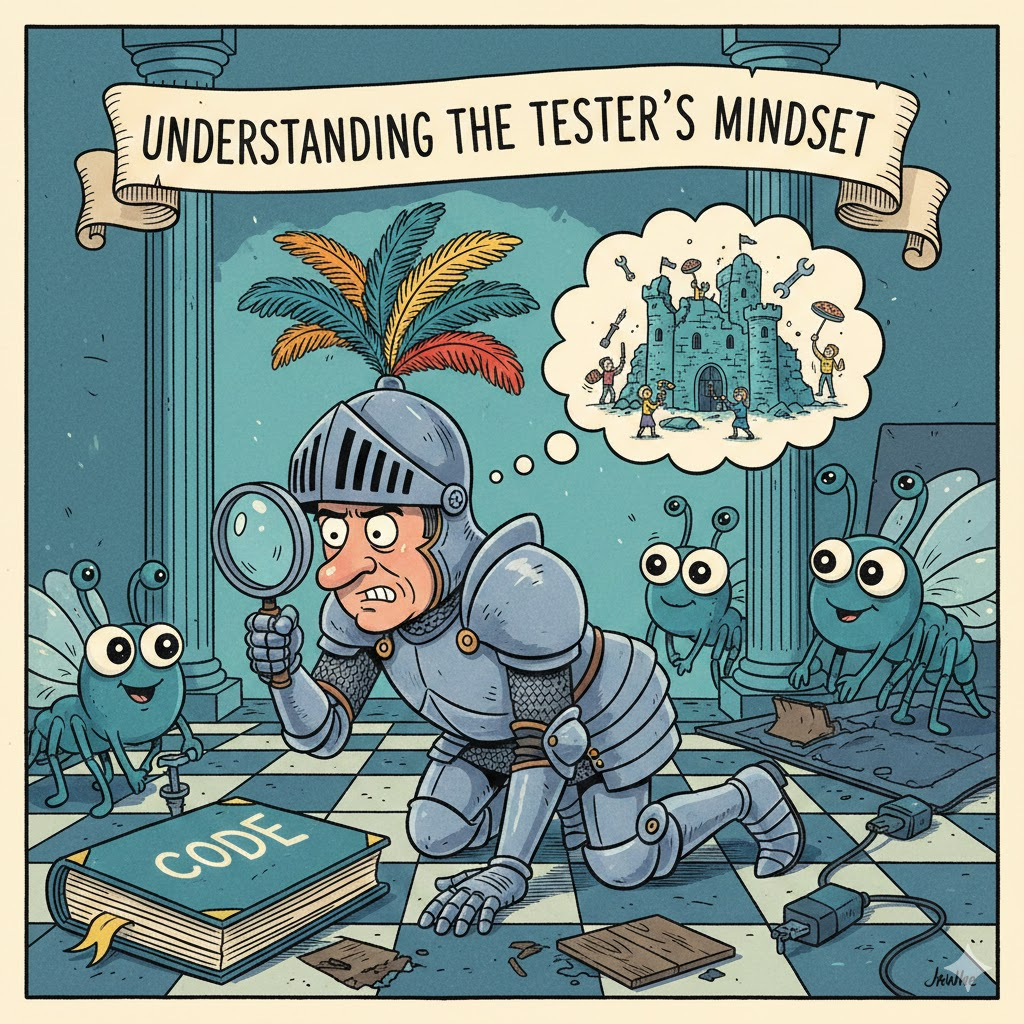
- What testers look for (risks, edge cases, failures)
- How they interpret information (requirements, feedback, artifacts)
- How they communicate results (bug reports, team dialogue)
- How do they add value beyond scripts and checkboxes
| Key Takeaways: |
|---|
|
Why Mindset Matters in Testing
Software testing is not just a technical activity; it is deeply cognitive, in terms of strategies, interpretation, questioning, reasoning, and creativity. Testers are considered thought workers whose most important asset is how they think, as opposed to what they do with their hands or tools. They are only as good as they can simulate user behavior, anticipate failure modes, and constantly question assumptions made in the system design, such that testing becomes more about critical thinking and less about executing prespecified steps to uncover risks that others may not consider.
Read more: Software Testing.
Key Elements of a Tester’s Mindset
- Critical Thinking and Questioning: Testers are the kind of people who don’t believe what they’re told. They never stop asking why, what if, how else, and why not?
- Scepticism. Testers are skeptical, not cynical, but through evidence-based skepticism.
- Risk Focus. Testers prioritize risk based on what could go wrong, not just that it works.
- Empathy. They can envision how actual users may interact with or misuse the software.
- Creativity. Great testers create new scenarios, configurations, and edge cases that others haven’t thought about.
Instead of scripted or checklist-only creators, testers are polymindset professionals who blend many views, including scientific, exploratory, inclusive, creative, and collaborative in context.
Read: A Tester’s Guide to Working Effectively with Developers.
Testers as Thought Workers
- Complex analysis
- Synthesis of requirements and user behaviour
- Anticipation of future problems
- Pattern recognition across systems
In this way, however, the tester’s product of work is usually not just test steps, but instead a test idea, strategy, insight, or hypothesis. This is important because it shifts the emphasis from doing to thinking: the value lies in the thought before the action, not just in the action itself.
This reorientation is what can ward off “checklist testing”, the phenomenon where testers strive to check things, not explore them.
Read: Why Testers Require Domain Knowledge?
How Testers Think Differently Than Other Roles
- Developers often think in solutions; how to build functionality, improve code, and make things work.
- Testers think about problems, how to make things fail, where assumptions break, and what might slip past spec.
- Where a developer sees functionality, a tester sees potential failure modes.
- Where a product manager sees feature delivery, a tester sees risk areas that impact users.
- Where automation engineers see code coverage, a tester sees gaps in behaviour not addressed by automated assertions.
This isn’t to say testers must have a negative outlook; no, instead, they subscribe to also being reverse thinkers, where everyone else believes the software is working fine, their consistent response is: “But what if it isn’t?”
Read: Top QA Tester’s Skills.
The Cognitive Pillars of the Tester’s Mindset
The tester mindset is constructed from a group of cognitive principles that shape how testers perceive, reason about, and critique a system. These are constructs that affect not only the way testing is performed, but also how testers measure risk, quality, and uncertainty. Together, they are the bedrock of the thinking that allows testers to find things others didn’t.
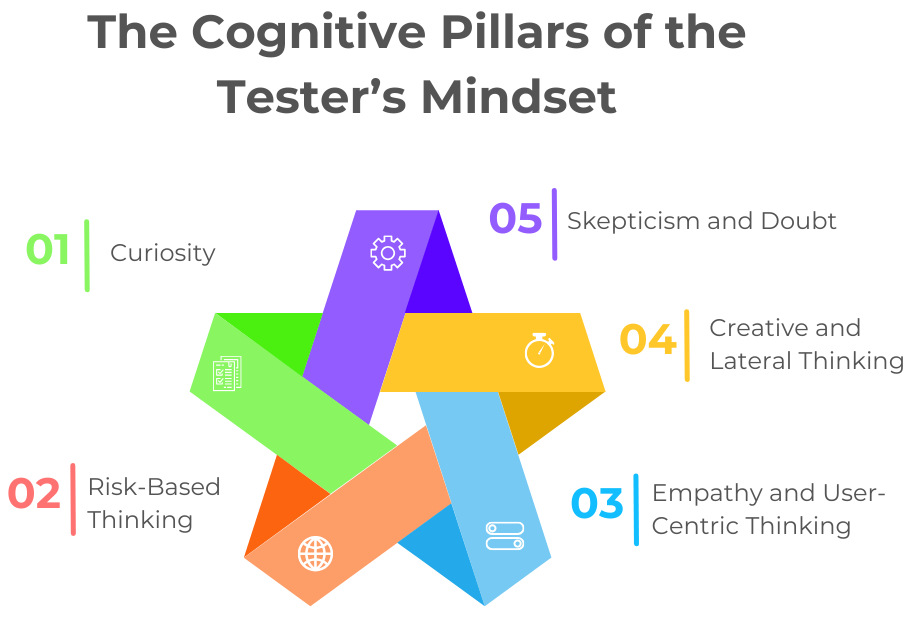
Curiosity
A common trait of testers is curiosity, not accepting what may be right in front of them but pushing beyond the “it works here” mentality. They keep asking about what goes on in non-typical environments, when the system is interfered with by strange inputs, and what else isn’t documented or is assumed. This inquisitiveness encourages testers to find discrepancies, unexpected results, and surprises instead of being limited to the expected “outcomes.” It is the base of exploratory testing in such a way, instead of a fixed, scripted steps investigation.
Skepticism and Doubt
Scepticism in the testing process is not false negativity but disciplined doubt, consciously used to dig out the hidden potential for risk. Testers challenge assumptions, though there are features or functionality that are said to be correct by specification, developers, etc, and they look for ambiguity, gaps, or missed dependencies. They constantly think about what assumptions a feature contains, where requirements are ambiguous, and different parts of the system can fail together. This mode of reflection encourages testers to be deliberate about thinking rather than just thinking deliberately.
Empathy and User-Centric Thinking
Empathy provides a way for testers to get outside the internal logic of a system and look at that software as users would see it. Through a variety of user personas, user paths, and unintended use cases, testers bring out the problems that are invisible during technical or requirement-driven reviews. This focus is user-centric and identifies issues (usability breakdowns, accessibility barriers, workflow friction) that run contrary to the real needs of end-users.
Creative and Lateral Thinking
By thinking outside of the box, testers can imagine and design a wide range of bizarre usage patterns, unexpected edge cases, abuse or misuse scenarios that exceed any “acceptable” functional assumptions. Instead of playing it safe with a logical or documented limitation, testers intentionally go off the beaten path and mix and match things. This creativity is akin to an exploratory mindset, as much as these thoughts about new ways of working. This can often expose flaws buried deep in code, workflows or design decisions.
Risk-Based Thinking
Testers use risk-based thinking to help focus their efforts in areas that would be most damaging if they failed, not just what is easiest to test. These risks are not limited to defective code, damage to user trust, data integrity questions, liability exposure, and security threats, all of which can be affected. Looking at impact and likelihood allows us to focus testing efforts where it will have the greatest value, optimize the use of precious time and resources, and develop test strategies based on actual business and user risk.
Read: How to Start as a QA Tester.
Mindsets Within the Tester’s Mindset
One important observation is that testers should not stick to thinking in a particular way; they must develop knowledge of several mindsets. Various testing contexts require various cognitive behaviors: analytical thinking towards requirements review, creative thinking at exploration or as a work hypothesis-making process, and critical thinking on risk assessment. Good testers drive through the appropriate one rather than trying to use the same one end-to-end. It is this kind of flexibility that enables them to react more intelligently to new systems, restrictions, and uncertainties.
Some Recognised Testing Mindsets Include
- Inclusive Mindset: Identifies and considers a wide range of potential users, abilities, and contexts when defining software quality.
- Sceptical Mindset: Regularly questions assumptions, doubts truth, and seeks clarity in ambiguity or when information is missing.
- Scientific Mindset : Tests based on hypotheses, observation, and evidence to confirm or refute assertions about the system.
- Exploratory Mindset: Goes beyond scripted scenarios to explore, learn, and modify testing paths based on new information.
- Risk-based Mindset: Concentrates on what the actual impact and likelihood of any given failure are, to test based on where failures would be most catastrophic.
- Collaborative Mindset: Works with developers, product, and business teams to build a shared understanding of quality and collectively own it.
- Creative Mindset: Thinks outside the box to discover unusual inputs, flows, and scenarios, revealing hidden or not immediately evident behaviors.
- Holistic Mindset: Thinks holistically, identifying dependencies, integrations, and the ripple effects between components.
- Ethical Mindset: Considers fairness, inclusivity, and societal impact when assessing risks and making quality-related decisions.
- Critical Mindset: Reflects on biases, assumptions, and blind spots to continuously improve judgment and decision-making.
These mindsets aren’t exclusive; a tester may switch between them depending on context.
Read: Why a QA Mindset Is an Asset for Developers.
The Psychology of Testing
Testing is not only an exercise in logic or technology, but it is also heavily grounded in human psychology. All testing decisions are biased by perception, judgment, attention, and experience. When we know about these psychological factors, we can spot where we fall into the same traps in our own thinking and learn how to assess software better.
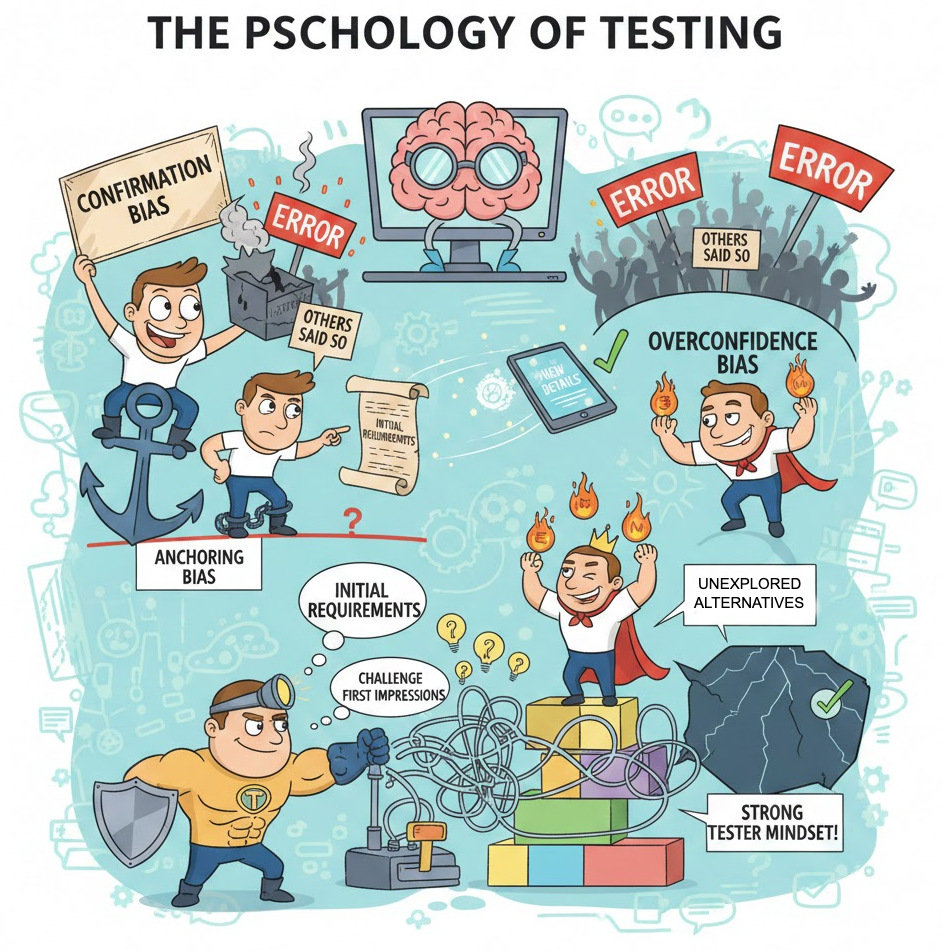
Cognitive Biases and Testing
- Confirmation Bias: Expecting something to work because others said so, leading testers to look for evidence that supports existing beliefs rather than signs of failure.
- Anchoring Bias: Fixating on an initial interpretation of requirements or early information, even when new details suggest a different understanding.
- Overconfidence Bias: Assuming a feature works correctly based on limited exposure or past experience, reducing the motivation to test deeper or explore alternatives.
A strong tester mindset includes actively recognising these biases and deliberately challenging first impressions to expand coverage and insight.
Metacognition: Thinking About Thinking
Metacognition is the act of stepping back and thinking about one’s thoughts in a testing context. Testers who adopt this approach become more conscious, recognizing when they are acting from assumption or habit, or on autopilot. By actively shaping both how we think, they can build deeper exploration, improve judgment, and guide more intentional testing decisions.
Practising the Tester’s Mindset
The strong tester’s mindset doesn’t just happen; it requires a set of conscious habits and lots of practice. Testers work out the brain for sure by practicing how to think, and in doing so, they help build curiosity, judgment, and adaptability. Practices like these help make testing the considerate-wisdom of practice rather than a mechanical chore.
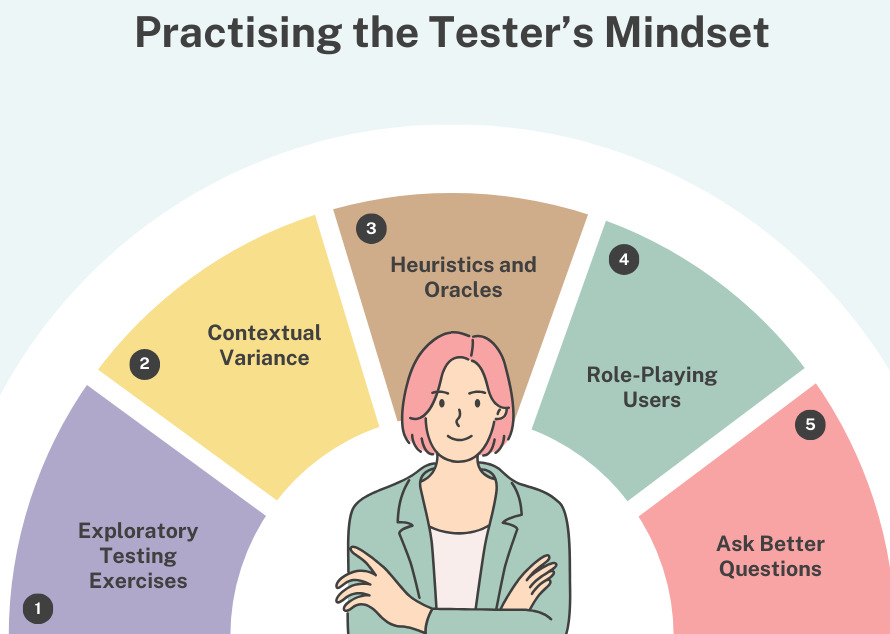
- Exploratory Testing Exercises: Exploratory testing promotes testers to discard their checklist-bound shackles and test according to observation, reasoning, and intuition. Uninstructed testing is a way to provoke assumptions, challenge expectations, and look for evidence based on what you just saw – not something that was simply done as per steps.
- Contextual Variance: Different contexts, such as browsers, devices, or locales, break habitual thinking and stimulate curiosity. This kind of difference opens up all kinds of hidden behaviors and edge cases that you may never see in any single, stable environment.
- Heuristics and Oracles: Heuristics and oracles are mental models used to direct the testing, not limit it. SFDPOT(Structure-Function-Data-Platform-Operations-Time) or RCRCRC(Rules-Constraints-Relationships-Comparisons-Ranges-Consistency) types of models assist testers in thinking systematically, yet being flexible and responsive to what they see.
- Role-playing Users: By role-playing as other user personas, the testers get out of their own bias. They do so by playing novice, expert, frustrated or malicious users, finding usability, security, and workflow problems inspired by the quirks of human behavior.
- Ask Better Questions: Strong testing begins with strong questions that challenge surface-level understanding. Regularly asking what could go wrong or what scenarios have not been considered pushes testers toward deeper exploration and better risk discovery.
Communication as Part of the Mindset
The ability to report issues effectively, diplomatically, and constructively is a core part of a tester’s job. Testers must translate their observations and reasoning into shared understanding, using clarity over jargon, evidence over opinion, and a constructive tone. Good communication is about teaming, not blaming. It helps teams view problems as opportunities so they can continually improve. Testers support this by gaining trust and building relationships, reinforcing that quality is something we all own, and not just one person’s fight.
The Tester’s Mindset Across the SDLC
- Requirements Phase: Testers anticipate misunderstandings, ambiguities, and missing information before they become embedded in the solution.
- Design Phase: They question assumptions, challenge completeness, and consider how design decisions might introduce risk or complexity.
- Development Phase: Testers explore integration points, data flows, and interactions between components as the system takes shape.
- Testing Phase: They execute tests with strong risk awareness, adapting exploration based on findings and emerging patterns.
- Release and Maintenance Phase: Testers evaluate system stability, real-world usage scenarios, and the long-term impact of changes on users and operations.
Read: Shift Everywhere in Software Testing: The Future with AI and DevOps.
Wrapping Up
The tester’s mindset is the true engine behind effective software testing, transforming it from a procedural activity into a thoughtful, risk-driven discipline. By combining curiosity, skepticism, empathy, creativity, and psychological awareness, testers uncover issues that tools, scripts, and checklists alone cannot reveal. Ultimately, cultivating this mindset enables testers to act as quality advocates who continuously adapt, think deeply, and add value across the entire software lifecycle.
| Achieve More Than 90% Test Automation | |
| Step by Step Walkthroughs and Help | |
| 14 Day Free Trial, Cancel Anytime |