
Test Cases for Hotel Bookings
 |
Something weird happens sometimes when booking a room on a website. Dates might reset without warning. Prices shift right before finishing. Even scarier, money leaves an account, yet no reservation shows up in your email or phone. This makes it clear why people search for test cases for hotel bookings.
Hotel booking systems look simple on the surface. Pick dates, choose a room, initiate payment, that’s it, finished. Yet when teams actually build them, surprises pop up constantly. Calculating nights gets messy fast. Rates shift without warning. Rooms show availability but vanish by checkout. Payments hiccup across services. Mobile vs. desktop behavior. Modify one piece, and something else three screens away stops working.
Testers, QA leads, and product teams return to this again and again. Not because they need another checklist. Because they want clarity on what truly counts, scenarios prone to failure, plus ways to test that hold up when specs shift suddenly. Yet still stay light on their feet.
This blog builds on actual tests done when booking hotels, common behaviors spotted in live systems, plus insights teams usually gain after mistakes. Instead of simply listing test targets, it shapes how thoroughly you might dig, guiding choices through sharper testing, not heavier loads.
| Key Takeaways: |
|---|
|
Why do we Need Test Cases for Hotel Booking Systems?
Fair point.
- A bug escaped to production.
- Midway through the demo, something went wrong with the booking. The system just stopped working when it was needed most.
- Prices don’t match what users saw earlier.
- Or automation scripts broke after a “small” UI change.
Hotel booking systems sit at the intersection of user experience, business rules, and external dependencies. On paper, it seems fine – yet real life shows different results when booking systems run into edge cases.
- Users booking across time zones
- Partial payments or retries
- Inventory updates coming late from partners
- Mobile users switching apps mid-flow
Good test cases aren’t about covering every possibility. What matters is hitting the real dangers, those that actually break things.
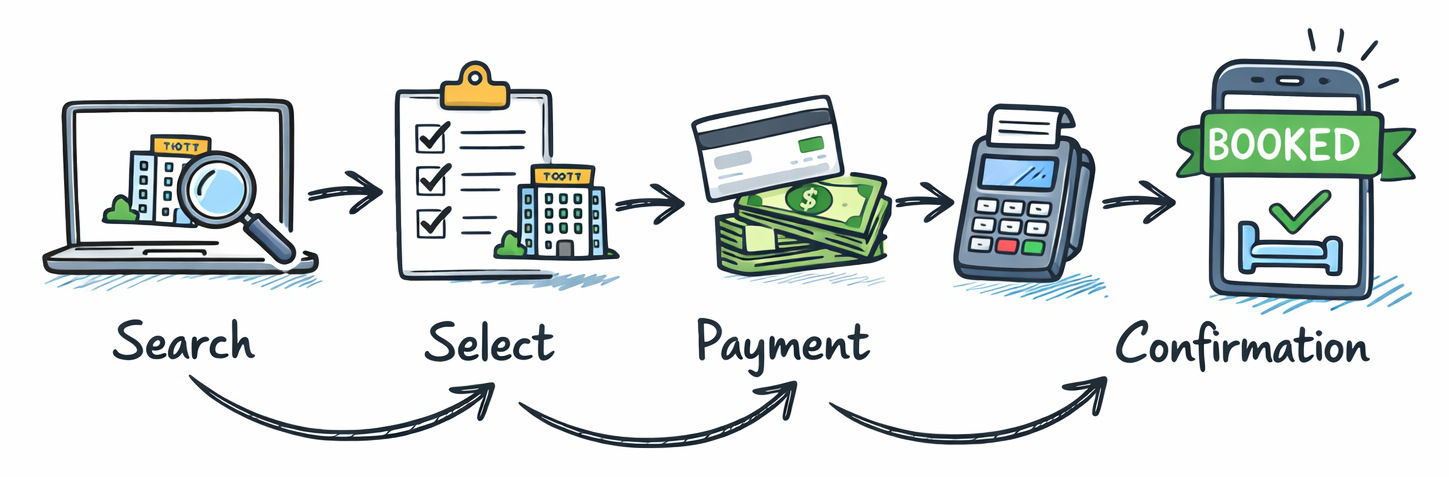
Know the Hotel Booking Workflow Before Writing Test Cases
Jumping into writing test cases? First, be clear on the thing you’re really validating. What’s being tested matters most.
- Location validation
- Hotel search and filtering
- Date selection and availability checks
- Room selection and pricing
- Guest details and preferences
- Payment and confirmation
- Modification, cancellations, and successful refunds.
In real projects, things often fail because people check segments alone, yet skip testing how they fit together, i.e., the full journey. Just because a reservation flows smoothly one time does not guarantee it holds up when traffic spikes, following an error replay, or if someone adjusts their trip near the deadline.
Because of this, testing a hotel booking system means combining checks that look at features, errors, then full user paths. It needs to be a mix of functional, negative, and end-to-end scenarios.
Functional Test Cases for Hotel Booking Applications
When things run smoothly, functional tests check if the system does what it should. Built on these basics, yet depending only on them leaves massive gaps.
Test Cases for Hotel Search Functionality
This is where most users start their journey, yet quiet mistakes often slip through. A small, subtle logic error can linger without notice.
- Search with a valid city, dates, and guest count
- Search with check-in date after check-out date
- Search with past dates
- Search when no rooms are available
- Search with maximum and minimum guest limits
One limitation teams often underestimate is date handling across locales. Imagine a calendar navigation happening just fine in Tokyo, then falling flat in Lisbon. Time stamps change. Appointments move. What feels obvious in one region becomes nonsense three time zones west.
Test Cases for Room Availability and Pricing
Availability and pricing are rarely stable. They keep changing based on holiday season, function, events nearby, day of the week, etc.
- Real-time room availability updates
- Price consistency across search, selection, and checkout
- Taxes, fees, and discounts applied correctly
- Promo codes and special offers
When pricing rules spread across several services, things often go wrong in practice. One part of the system shows a new price while another sticks to the old one. That mismatch sneaks into search listings yet vanishes at payment time. Users notice the difference, then start doubting what they see.
Test Cases for Guest Details and Reservation Forms
This part seems clear at first, then suddenly trips you up.
- Mandatory field validation
- Email and phone number format checks
- Special character handling in names
- Multiple guest entries
- Adjustments according to children/adult combinations
- Guest preferences (bed type, smoking/non-smoking)
This sounds simple, but in practice, form validations often behave differently on mobile devices or older browsers.
Test Cases for Online Hotel Booking Payments
Beneath the surface, payments carry serious risk along with major consequences.
- Approved gateways handle the payment transfer smoothly. Funds go where they are needed when everything checks out right.
- Payment failure handling
- Duplicate payment prevention
- Partial or delayed payment confirmation
- Redirects to and from payment gateways
When live systems run, shifts in how payment providers operate often cause things to stop working. Something working perfectly one day might just quit the next without warning.
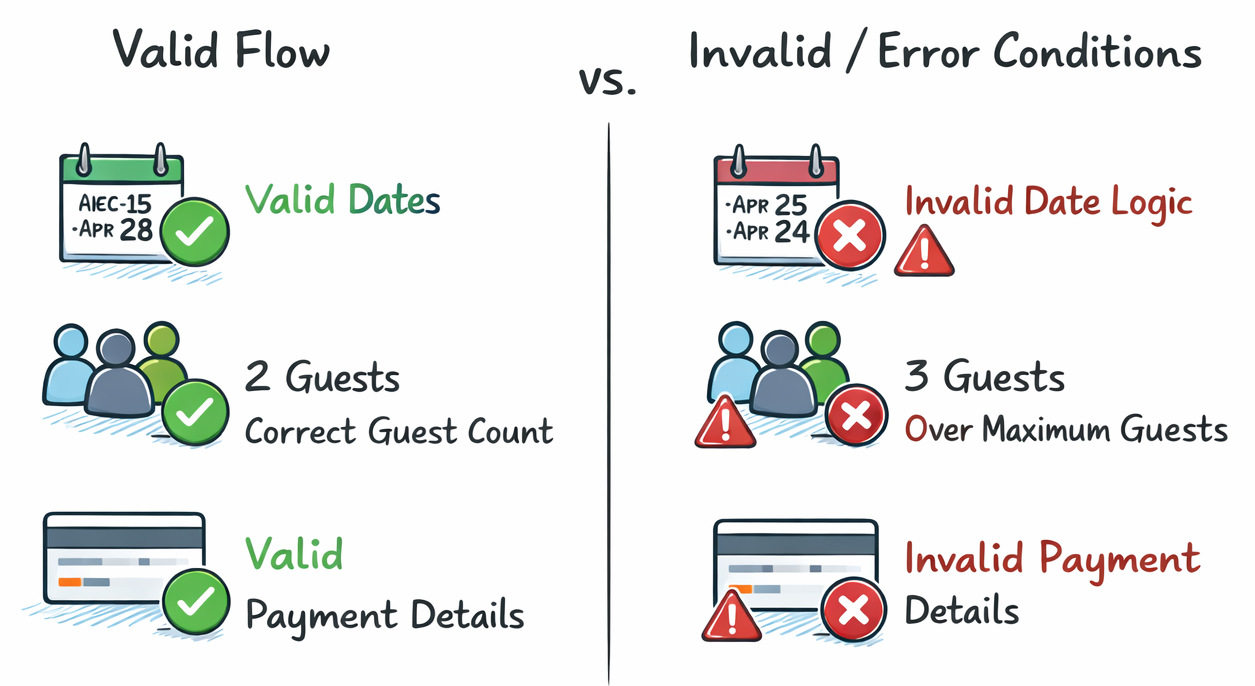
Negative Test Cases for Hotel Booking Systems
Negative testing is where many systems reveal their cracks.
- Invalid card details
- Network interruption during payment
- Session timeout mid-booking
- Browser refresh during checkout
- Back button usage after payment
This might seem pessimistic, yet people act in surprising ways. When systems adapt well to such moments, confidence grows. When they fail, customers walk away quickly.
End-to-End Test Scenarios for Hotel Booking Systems
A full end-to-end test suite that mirrors how someone actually uses the system.
- User searches for a hotel
- Selects dates and room
- Enters guest details
- Completes payment
- Receives confirmation
- Change or stop a reservation
It happens more than you’d think: what shows up in a confirmation email doesn’t match the booking log. It demands data consistency across services. Behind the scenes, databases sometimes tell different stories. Misalignment sneaks in when systems aren’t talking properly. What one service logs, another might overlook entirely.
Test Cases for Hotel Booking Cancellation and Refunds
Cancelling happens often. It is not an edge case.
- Cancellation within the free cancellation window
- Cancellation after penalty applies
- Partial refunds
- Failed refund processing
- Confirmation updates after cancellation
Fine in theory, yet real life shows refunds are where money rules, law terms, and code overlap. That’s when glitches crawl out.
Non-Functional Test Cases for Hotel Booking Applications
A working system can still frustrate people. Functional correctness doesn’t guarantee a good user experience.
Performance Test Cases
- Handles peak booking traffic
- Responds within acceptable time limits
- Maintains stability during promotions
Real projects often observe things fall apart when the crowd shows up. Suddenly, there’s ten times more clicking than anyone planned for.
Security Test Cases
- Protecting personal and payment data
- Preventing unauthorized access
- Ensuring secure session handling
Fault lines appear when private details slip out: via logs, errors, or outside tools. Teams tend to underestimate how fast it happens.
Usability and Compatibility Test Cases
- Mobile vs. desktop behavior
- Browser compatibility
- Accessibility compliance
This sounds secondary, but poor usability can kill conversions even if everything “works.” A smooth machine means nothing if people struggle to click through.
Hotel Booking Systems: Manual vs. Automated Test Cases
- Exploratory testing
- UI and usability feedback
- Early-stage validation
Fresh updates appear at hotel booking setups all the time due to holiday seasons, festivals, events, etc. Not just prices – layouts shift too, along with how tools integrate together. Everything moves at once, never pausing long enough to feel settled.
When the actual project begins, things often fall apart if test scripts cling too closely to interface parts. Overnight, a tiny UI change up front might wreck heaps of checks at once.
Here’s when approach matters more than tool choice.
AI-Powered Test Automation for Hotel Booking Test Cases
Here’s when modern testing methods begin to differ.
- Technical scripting skills
- Frequent maintenance
- Tight coupling to UI selectors
Fine on a spreadsheet, sure, yet real life shows engineers patching tests instead of chasing bugs. Instead of following traditional methods, tools such as testRigor use artificial intelligence in a unique way.
Teams skip brittle scripts now, opting instead for plain English tests that mirror real user or customer actions.
- Test cases remain readable by non-technical stakeholders
- UI changes don’t immediately break tests
- End-to-end flows are easier to maintain
- Near-zero maintenance with testRigor’s self-healing
When organizations try out hotel booking tools that update a lot, less maintenance means more time deciding what needs verifying instead of repairing broken tests. Confidence grows when testing feels easier. Removing bottlenecks lets teams move faster, try more, and stay sharp.
So, a simple end-to-end testing example of trying to book a room in a hotel and validating if the page has navigated to the confirmation message is shown below:
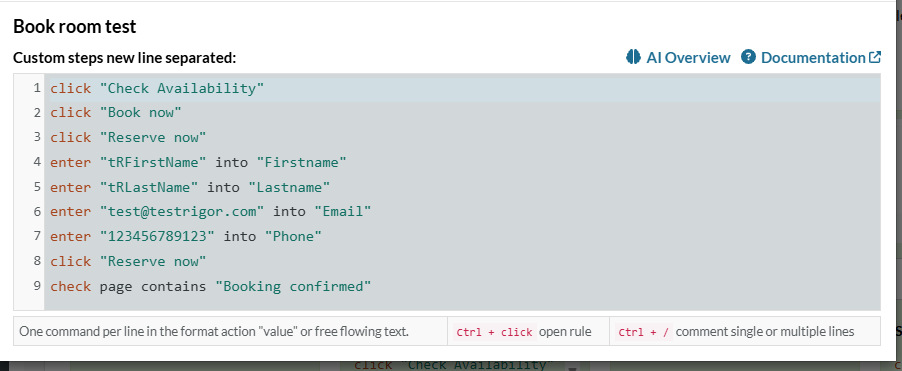
You first check which dates are available, and you proceed with filling in the details to book the room. If the details being filled in match the parameters set by the system, then the booking should be successful, and you should see a confirmation message:
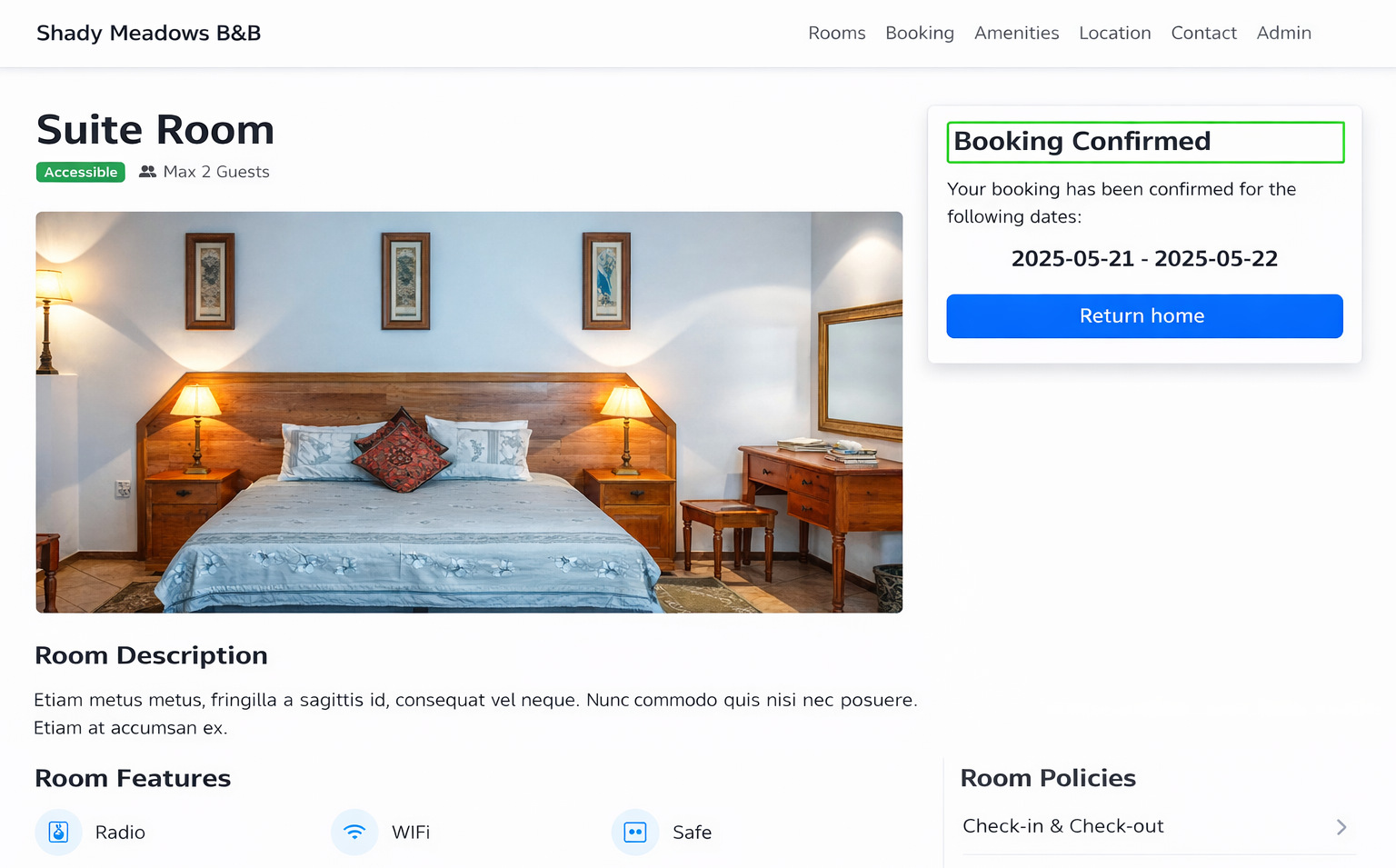
So, this was a normal test. Let us now try a test case, where we try to test what happens if we don’t fill in some details, and how the system behaves:
Do not provide the first name and the phone number. Let’s see what should be the test case for such a scenario:
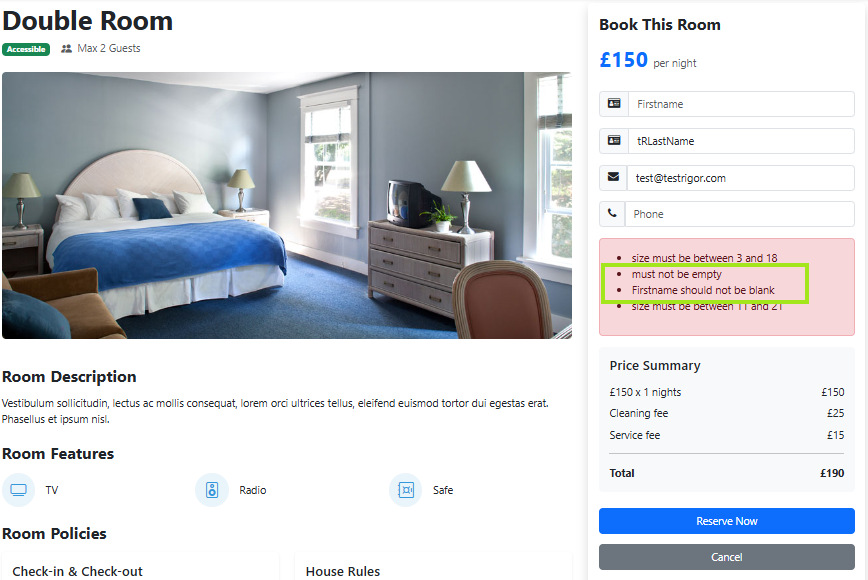
The tool will flag when details are missing or wrong, and it will restrict the workflow from progressing to the next step.
How to Decide What Test Cases You Actually Need
Pick just a few of those test cases mentioned above. Be very clear on what your booking application requires to be tested.
- Where does money change hands?
- What do users abandon the flow?
- Into which parts do external tools integrate?
- What has the system failed before?
In real projects, this usually breaks in the same 20% of the flow. Search rules tend to fail first. Pricing gaps show up next. Payment steps get messy. Confirmations fall apart last.
From that point, move further. Dive into details carefully. Let automation follow smart choices and keep critical paths stable.
What Should You Do Next?
- If your system changes often, brittle automation will slow you down.
- If your team spans technical and non-technical roles, unreadable tests create silos.
- If bookings drive revenue, flaky tests are a business risk.
Speed picks up when tests are well designed, especially if AI-driven tools such as testRigor handle the heavy lifting behind the scenes. Confidence stays high even as the pace increases.
The key point here? It’s not about having test cases for hotel booking. What matters is if the tests keep running once the system shifts, as it always does. And that’s the difference between testing that looks good on paper – and testing that actually protects your product.
Frequently Asked Questions (FAQs)
Should test cases for hotel bookings differ for mobile and desktop?
A: Yes, absolutely. Mobile users behave very differently. They switch apps, lose network connectivity, and rely heavily on autofill. Many booking issues only appear on mobile-especially around date pickers, form validations, and payment redirects. Treating mobile as “just another screen size” is one limitation teams often underestimate.
When should teams prioritize automation over manual testing for hotel bookings?
A: Automation makes the most sense for stable, high-impact flows like search, booking, payment, and cancellation. Manual testing remains valuable for exploratory scenarios, usability testing, and early feature validation. The mistake teams often make is trying to automate everything at once. Starting with critical revenue-impacting flows usually delivers the fastest return.
How early should test cases be written for a hotel booking feature?
A: Earlier than most teams expect. Writing test cases during requirement discussions often exposes missing scenarios, unclear pricing rules, or inconsistent cancellation policies. Waiting until development is complete usually means testers are reacting to design decisions instead of influencing them.
| Achieve More Than 90% Test Automation | |
| Step by Step Walkthroughs and Help | |
| 14 Day Free Trial, Cancel Anytime |