
What Are Software Quality Attributes?
 |
If you have worked on apps before, you likely would have heard people say, “We need to make sure the quality is good.”
What is “good quality” really about? You hear this term tossed around excessively at meetings, design talks, and project chats. In fact, anywhere across the development cycle. Yet once someone asks, “Alright, what do we actually mean by software quality?”. Responses often lack clarity, are vague, or are way too jargon-heavy.
Here’s when software quality attributes step in. Those traits turn the vague sense of quality into something clear. Instead of only focusing on functions, they show how smoothly a system runs. But often, these aspects weigh just as heavily. Or even heavier, compared to the features listed in user stories.
| Key Takeaways: |
|---|
|
Let’s get started. Forget technical terms. Here’s an article about what software quality attributes mean. Why they are important, the different types there are, and how new tech like AI-powered testing is helping teams today.
What Software Quality Attributes Really Mean?
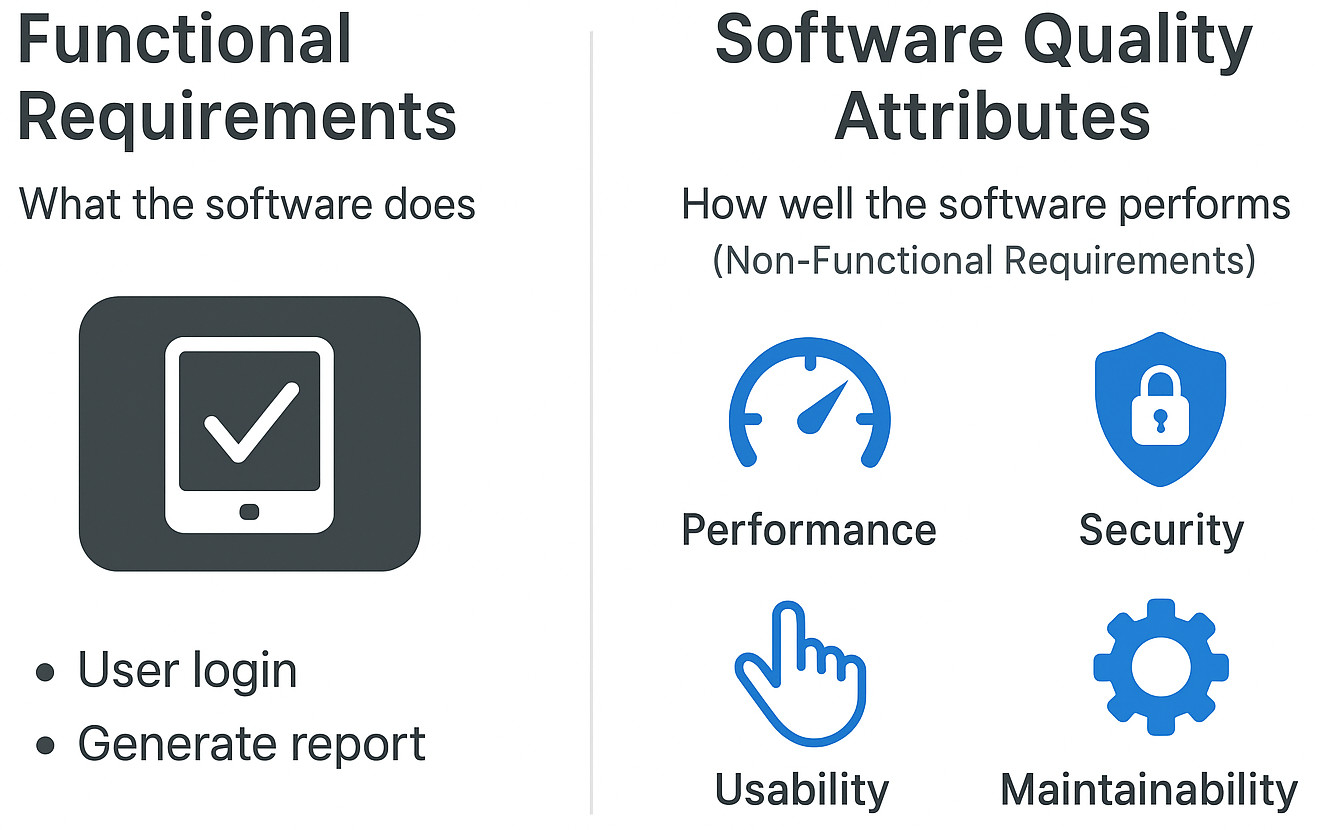
A software quality attribute is basically a feature showing how well a system works in particular situations. There are attributes shaping what the software feels like. Sort of like two folks driving, both get from A to B. Yet one takes it slow, while the other rushes through every turn. Same goal? Sure. How do they act along the way? Not even close.
That’s exactly what sets functional needs apart from performance attributes. The first says what it should do, while the second shows how smoothly it runs.
For example:
- One banking app could allow transfers, while another does the same thing (functionality).
- One finishes in a second, while the other needs eight (speed difference).
- One is intuitive and clean; the other makes you click through 6 confusing screens (usability).
- One never goes down; the other crashes during peak traffic (reliability).
Look, these attributes define how users feel, affect company results, influence tech stability… all of it.
Nowadays, in building software, these features matter way more since setups keep scaling. More expanded, complex, and also depending heavily on automated tools.
Why Software Quality Attributes Matter More Than Ever?
The truth is, most people won’t wait around when an app runs slowly or feels outdated. Maybe it even stumbles now and then- they bail right away. Out goes the install, in comes a harsh rating, off they go to whatever’s new down the road.
But it’s not just about users.
- Time to market
- Cost of maintenance
- Scalability during growth
- Security and risk
- Performance under load
- Support overhead
- Overall brand trust
Good software design leans heavily on quality traits. Instead of focusing only on functions, software builders usually prioritize things like ease of updates, uptime, safety, or room to grow.
If you built a house, it’d start with basics: like support beams, pipes, weather barriers, instead of paint tones.
How AI is Changing the Approach
Something cool is going on in software these days. Teams don’t only want speedier tests. They aim for solid quality right from step one, while AI sneaks in as the hidden tool making it work.
How well something works, how easy it is to fix or use, and if it’s ready when needed? Answers to these questions mostly come down to how frequently and how deeply teams test their work while building it. Yet traditional testing? It shows up way later, often once bad choices are already baked in. This is where AI changes the game instead.
Tools driven by AI, testRigor, for instance, let teams weave quality checks into dev cycles without piling on tasks. Because testRigor creates tests in everyday English, now pretty much any team member can jump into testing. Take product leads, QA specialists, or support reps, they’re all able to pitch in real-world usage cases.
This pulls off a surprisingly strong move:
Teams get a quick look at how choices could impact real-world performance.
For instance, testRigor runs complete end-to-end checks on its own whenever a new build drops, so glitches in navigation, user experience, wrong sequences, or unstable actions show up early, way before live deployment. Since tests remain stable due to Gen AI, Vision AI, and AI context, which spot page elements almost like people do. Teams skip endless script repairs. This one change cuts maintenance hassle while speeding up releases.
Read: Decrease Test Maintenance Time by 99.5% with testRigor.
Actually, AI doesn’t only make tests faster. Instead, it changes how teams see quality from the ground up. This shift lets them build software that holds up well, works smoothly, handles stress better, plus behaves in ways you can count on. All while keeping dev speed high.
The Most Important Software Quality Attributes (Explained Simply)
Let’s go over the usual attributes teams talk about when judging software, no jargon, just straight-up clarity.
1. Performance
Performance is basically “How fast is this app?”
It is about speed. How fast things react, how smoothly they run on memory or CPU. Yet still handle stress without crashing.
- Is the page load less than one second?
- What happens to the system if 5,000 people log in simultaneously?
- Is it sluggish, or does it keep going steady?
Speed is a big deal these days. Think live updates, online stores, banking apps, games, or stuff people interact with directly.
Read: What is Performance Testing: Types and Examples.
2. Reliability and Availability
Reliability means the system runs without hiccups every time. On the flip side, availability tells you how often it’s running and ready to use. Downtime hits organizations hard. Millions can be lost fast. When key systems fail, like in hospitals or planes, trouble follows close behind.
Basically: Does your software run without breaking? And can your users access it whenever they need to?
Read: Reliability Testing – A Complete Guide.
3. Security
Keeping data safe means blocking threats, stopping hackers from sneaking in, while making sure vulnerabilities aren’t left open.
- Safeguarding user information
- Preventing unauthorized access
- Avoiding vulnerabilities
- Ensuring encryption is handled correctly
Security’s something you must nail from day one. One breach and trust vanishes forever.
Read: Security Testing.
4. Usability
Apps should help people, not pile on tasks. Usability is typically: “Can someone figure out how to use this without needing a manual?”
Good usability helps people relax while using a product. When it is poorly designed, folks get annoyed, calling support more or simply abandoning. Read: Automating Usability Testing.
5. Maintainability and Modifiability
- Fix bugs
- Add new features
- Make improvements
Changing one component without breaking others. That’s what modifiability means. It is like replacing a battery instead of rebuilding the whole device. Poor maintenance leads to sluggish progress and bigger expenses. Teams get burdened by technical debt.
6. Interoperability and Integration Flexibility
- APIs
- Databases
- Third-party services
- External tools
- Cloud platforms
Interoperability ensures your software can integrate smoothly without drama.
7. Scalability
Can it grow without crumbling? Growth needs can be managed: scalability makes that possible. Extra users, extra info, yet no meltdown on your end due to a solid setup holding things together. This matters more now since firms can blow up pretty fast. You wouldn’t want your site going down when tons of people show up out of nowhere.
Read: Scalability Testing: Automating for Performance and Growth.
8. Testability
Testability? That’s a curious thing. Basically, it boils down to: testing the system, how simple is that? Some setups just work well when you’re checking them out.
- Release speed
- Coverage quality
- Manual testing effort
- Regression cycles
- Confidence during deployments
This is precisely where intelligent test automation tools such as testRigor work well. Read: Software Testability: Benefits & Implementation Guide.
9. Portability
Portability lets software work on various systems without heavy changes. Using it elsewhere just takes small tweaks instead. This is key in multi-cloud systems. Also seen in hybrid designs or when dealing with mobile networks, where splits are common.
How Software Quality Attributes Shape Real Projects
Sometimes it’s hard to fix every single thing right away.
- Security vs. usability
- Performance vs. cost
- Maintainability vs. quick delivery
- Scalability vs. simplicity
Software traits let teams talk things through up front. This means they build systems that focus on what matters most. Designing with quality in mind from the start is far simpler; fixing things afterward takes more effort. Read: Minimizing Risks: The Impact of Late Bug Detection.
Software Quality Attributes & AI-Powered Test Automation
Let’s dive into what you were curious about: How software testing connects with quality traits. Checking things through tests is a solid way to review how well software performs. Even though looking at code, planning structure, and setting rules matter, running tests serves as the final guard to confirm it all functions right.
Here’s the thing, though. Today’s apps move fast, constantly changing, and way more complex. Relying only on manual testing just falls short. Traditional automated tools? They often choke on flaky test runs, messy configurations, or fall apart the moment the interface gets changed.
Now teams aim for sharper ways that bounce back easier.
This is when test automation with the power of AI steps in.
How testRigor Helps Improve Software Quality Attributes
testRigor’s tool uses intelligent tech to run tests. It blends naturally with how we verify quality across different areas. Here’s what that actually means in everyday terms.
1. Improving Testability with Natural Language Testing
Writing automated tests often feels tough because building test scripts through coding takes effort. Maintaining and updating them brings more hassle. testRigor turns things around by enabling test creation in plain English.
Enter "[email protected]" into "Email"

enter "mypassword" into "Password"

check that page contains "Welcome John"
That’s it.
No code, forget about selectors. Ditch fragile scripts. This capability improves how easy it is to test stuff, especially for teams that don’t have dedicated automation engineers. Better testing means higher quality.
2. Reducing Flakiness to Improve Reliability
Flaky tests? Total nightmare. They drag out launches while killing trust.
Since testRigor depends on Gen AI, AI context, NLP, and Vision AI, tests keep working even if the interface changes. While design changes happen, scripts still run without failing through self-healing. Even as layout or requirements change, tests stay solid.
A more stable test suite à higher reliability in your releases.
3. Faster Regression Testing to Improve Performance & Delivery Speed
As regression cycles shrink from weeks to days. Then hours, even minutes, suddenly dev speed hits a totally different zone. It is fueled by constant tweaks instead of delays piling up. testRigor’s AI accelerates testing by running tests at the same time. So teams can deploy updates regularly while keeping standards high through continuous testing.
4. Validating Security-related User Flows
- Authentication flows
- Role-based access
- Session handling
- Data visibility rules
This boosts how secure your setup feels. Using it makes things stronger while keeping risks low because protection matters more every day.
5. Supporting Maintainability Through Stable Tests
Since tests rarely fail or need big changes, teams save effort on updates or test maintenance. So, they can focus extra energy and time on boosting the real software. This eases software upkeep when it comes to how solid the code is.
6. Human Emulator
- Buttons not visible
- Broken flows
- Unexpected popups
- Misaligned layouts
Testing actual workflows well makes things easier to use. So, testing is one of the most practical ways to improve and check software. It validates how well software works. Tools driven by AI help teams concentrate on product quality instead of getting stuck in fixing broken tests all the time.
- Faster releases
- Higher confidence
- Lower testing costs
- Better coverage
- Fewer production issues
- Stronger long-term quality
That’s why teams stay happier while the system handles stress without falling apart.
Quality Attributes are the Heart of Great Software
Software quality attributes aren’t just about having you tick off a list. They are what actually make programs work well. Smooth for people using them, clean for coders building. Helpful for companies executing them. When tech setups become messier, managing these features gets tougher, yet way more essential.
Yet this is exactly where modern methods are helpful. Intelligent test automation run by AI helps build apps that work well and feel solid.
| Achieve More Than 90% Test Automation | |
| Step by Step Walkthroughs and Help | |
| 14 Day Free Trial, Cancel Anytime |