
What is Failure Modes and Effects Analysis (FMEA)?
 |
Failure Modes and Effects Analysis (FMEA) is a systematic, proactive approach to identifying potential failures in a process, product, system, or service, evaluating their causes and effects, and prioritizing actions to mitigate risks before failures occur.
| Key Takeaways: |
|---|
|
This article examines how this forward-thinking approach enhances safety, reliability, quality, and customer satisfaction while reducing costs associated with defects, rework, recalls, and downtime.
What is Failure Modes and Effects Analysis (FMEA)?
Failure Modes and Effects Analysis (FMEA) is defined as a systematic, proactive approach that identifies potential failure points in a product, process, service, or system. It analyzes their causes and effects, and prioritizes actions to eliminate or mitigate these failures before they cause harm or defects.
- What could go wrong?
- Why may it happen?
- What consequences does it bring with it?
Once it finds answers to these questions, it ranks the risks associated with them using metrics such as occurrence, severity, and detectability to calculate a Risk Priority Number (RPN). The one with the highest priority is mitigated first.
Origins and Evolution of FMEA
In the late 1940s, the U.S. military developed FMEA as a formal approach to assess system reliability. However, in the 1960s, NASA adopted it during the Apollo space program to reduce mission risks, garnering widespread recognition. In later decades, the automotive industry integrated FMEA as part of defect-prevention and quality improvement initiatives.
Since then, FMEA has been embraced by industries as diverse as medical devices, aerospace, and automotive. It supports various risk management tasks and helps establish proof of compliance as a tool that mitigates risks and ensures compliance with international regulatory standards, including ISO 14971, ISO 13485, IATF 16949, and AS9100.
- IATF 16949 (automotive quality management)
- ISO 9001 (quality management systems)
- ISO 14971 (medical device risk management)
- AS9100 (aerospace quality standards)
As time progressed and industries evolved, FMEA has also evolved from a manufacturing-focused technique into a versatile risk-analysis framework.
Today, it applies to software, business operations, processes, and services.
The Core Purpose of FMEA
- Detect potential failure modes within a software system or process.
- Understand the causes of each failure mode.
- Analyze the consequences of each failure on customers, users, or downstream processes.
- Calculate and prioritize failures based on their associated risks.
- Define actions to mitigate the most critical risks.
- Document risks and mitigation measures for continuous improvement.
When the failures are addressed early in the design or planning phase, organizations save costs that they would have incurred if the failures were detected in production or operation.
Key Terminology in FMEA
Here are some of the core terms used in FMEA for your understanding:
| FMEA Terms/Components | Description |
|---|---|
| Failure Mode | When a component, a process, or a system fails to meet the specified requirements, that specific way is a failure mode. For example, a component may malfunction, a process step may be skipped, or software may produce incorrect output. |
| Failure Effect | The consequence of the failure mode is the failure effect. Failure effects may impact functionality, performance, safety, compliance, or customer satisfaction. For example, a failed software component is unable to produce output. |
| Failure Cause | An underlying reason that caused the failure to occur is a failure cause. A software component may fail due to reasons such as incorrect design or a heavy data load. |
| Controls | Existing measures that can detect failures or prevent them from occurring before they reach production are known as controls. |
| Severity (S) | This defines how serious the effect of failure is. |
| Occurrence (O) | Occurrence refers to the frequency or likelihood of the cause happening. |
| Detection (D) | This is the measure of how easily the failure can be detected before reaching the customer. |
| Risk Priority Number (RPN) | RPN = S x O x D; it is used to prioritize which failures to address first. The failure with the highest RPN is mitigated first. |
When to Perform an FMEA?
FMEA is not a one-time event, but is a continuous process. For FMEA to be effective and produce the best results, it should be implemented at different stages for different objectives across the development cycle. People with different perspectives and insights can focus on one system or a sub-system at a time for FMEA implementation.
- Developing a brand new design, process, or technology.
- Updating or modifying an existing design or process.
- Altering the application, location, environment, or usage profile of a design or process.
- Responding to a regulation update affecting a design or process.
Types of FMEA
FMEA is primarily applied at different stages and levels of a system. The two core types of FMEA include:
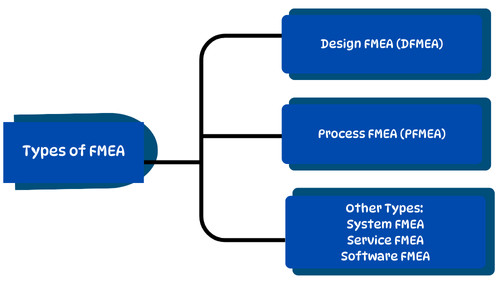
- Design FMEA (DFMEA): It deals with potential failures related to product or system design. It is implemented during the design and development phase and ensures that the design meets functional, reliability, and safety requirements. The failures that are reviewed by the product team in DFMEA are the possibility of reduced product life, potential product malfunction, and safety and regulatory concerns.
Example: A DFMEA might identify the risk of a login process failing under a high number of users trying to log in simultaneously.
- Process FMEA (PFMEA): It identifies and analyzes failures that may occur during operations or manufacturing. It identifies potential failures that compromise product quality or reliability, leading to customer dissatisfaction, and helps improve process stability and reduce defects.
Example: A PFMEA might examine the potential consequences of any algorithm on providing specific inputs.Apart from the above core types, FMEA is also classified into:
- System FMEA: This evaluates failures of the entire system or subsystem, especially in complex systems where multiple components interact with each other and the environment. For example, an enterprise system wherein the frontend and backend work together with third-party components.
- Service FMEA: Potential failures in service delivery, customer support, or administrative processes are detected by service FMEA. As an example, failure to notify customers about the latest update to the cloud application is part of service FMEA.
- Software FMEA: Risks related to software logic, interfaces, data handling, or system integration can be assessed using software FMEA. It will typically identify risks related to the integration of various components of an application or the failure of microservices.
The FMEA Process: Step-by-Step
The standard FMEA process has a structured sequence of steps as follows.
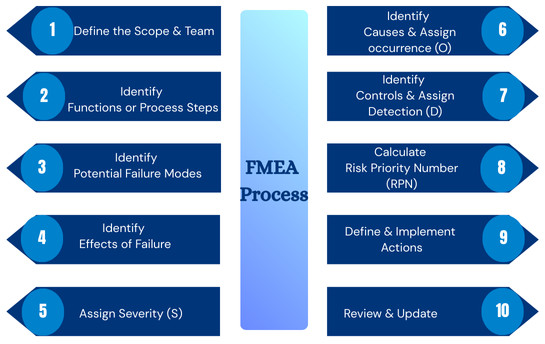
- Step 1. Define the Scope and Team: In the first step, clearly define what is being analyzed (scope), whether it is a process, service, product, or system. Also, determine the boundary and how detailed the scope should be. If necessary, use flowcharts to identify the scope so that every team member understands it.
Once the scope is defined, establish a multidisciplinary, cross-functional team of people with diverse knowledge about the process, product, or service, as well as customer requirements. Include representatives from design, manufacturing, quality, testing, reliability, maintenance, purchasing (and suppliers), sales, marketing (and customers), and customer service in the team.
- Step 2. Identify Functions or Process Steps: Identify and list each function, requirement, or process step. This is done by breaking the scope into separate subsystems, items, parts, assemblies, or process steps and identifying the function of each. This provides the foundation for identifying potential areas of failure.
- Step 3. Identify Potential Failure Modes: For each function or step, brainstorm and identify potential ways it could fail. The failure modes identified should be specific and realistic. This is the most important step in FMEA. If required, rewrite the function or step by adding more details so that the failure modes show a loss of that function.
- Step 4. Identify Effects of Failure: For each failure mode, the effects of the failure on the related system, process, product, service, regulations, or customer should be identified. These consequences of each failure mode should be documented.
- Step 5. Assign Severity (S): Severity measures how severe the effect of the failure would be if it occurs. It is usually rated on a numerical scale (1=significant; 10=catastrophic), where the higher the value, the more severe the consequence.
- Step 6. Identify Causes and Assign Occurrence (O): Each failure mode has one or more causes of failure. Occurrence is the measure of how frequently the failure may happen. This is also a numerical value.
- Step 7. Identify Controls and Assign Detection (D): Detection is the measure of the likelihood that current controls will detect the failure before it reaches the customer. A higher rating indicates lower detectability.
- Step 8. Calculate Risk Priority Number (RPN): Risk assessed is quantified using the Risk Priority Number given by:
RPN=SeverityxOccurrencexDetectionHigher RPN values indicate higher risk and require priority attention. - Step 9. Define and Implement Actions: For high-risk items, identify corrective or preventive actions to reduce severity, occurrence, or improve detection.
- Step 10. Review and Update: Review and update the FMEA document. It should also be updated when designs change, processes evolve, or new data becomes available.
Benefits of Using FMEA
- Proactive Risk Prevention: FMEA proactively identifies potential failures early in design and helps prevent issues before they arise.
- Improved Product and Process Reliability: It strengthens designs and processes, leading to more consistent performance and fewer defects, making systems/products more reliable.
- Enhanced Safety and Compliance: FMEA enhances safety in high-risk industries (aerospace, healthcare, automotive) by preventing failures that could harm users. It provides structured evidence for audits and meets industry standards (e.g., PPAP, APQP).
- Reduced Costs: FMEA prevents costly production stage fixes, recalls, and warranty claims, and reduces the overall Cost of Poor Quality (COPQ).
- Better Cross-functional Collaboration: It encourages teamwork among various departments in an organization, such as planning, development, quality, and so on.
- Improved Customer Satisfaction and Trust: FMEA delivers more reliable, higher-quality products, inducing trust and loyalty.
- Operational Efficiency: It reduces downtime and bottlenecks, improving overall throughput of the system.
- Knowledge Management: FMEA creates organized documentation for current and future use, supporting continuous improvement.
Limitations and Challenges of FMEA
- Time-consuming: FMEA can be time-consuming and resource-intensive, especially for complex systems.
- Subjective: It relies heavily on the team’s judgement for S, O, and D, leading to subjective results that may introduce potential bias.
- Single-Failure Focus: FMEA considers one failure at a time. Thus, it misses complex interactions from multiple simultaneous failures, like timing/sequencing issues or effects on redundant systems.
- Data Dependency: Ratings may be unreliable as FEMA lacks good historical data needed for accurate risk assessment.
- Scope Issues: The Scope defined may be too broad or too narrow. Potential hazards may also be missed if the team is inexperienced.
FMEA in Modern Industries
- Software and IT: FMEA is used in software development to identify failure points in logic, interfaces, algorithms, and system integration.
- Services and Business Processes: FMEA in services minimizes delays, errors, and service breakdowns, improving customer experience.
- Manufacturing: In the manufacturing industry, FMEA is widely used to reduce defects, improve process capability, and ensure product consistency.
- Automotive: FMEA is used in the automotive industry to prevent safety-critical failures and ensure regulatory compliance in standards like AIAG-VDA FMEA Handbook guidelines.
- Aerospace & Defense: FMEA is essential for mission-critical systems where reliability is critical. It helps to analyze potential failures in aircraft design, fuel systems, and more.
- Healthcare: Hospitals and medical device manufacturers utilize FMEA to enhance patient safety and mitigate clinical risks. Read: Healthcare Software Testing – AI-based Testing with testRigor.
FMEA from a Software Engineering Perspective
- Business logic (incorrect calculations, rule violations)
- User workflows (broken navigation, invalid state transitions)
- APIs and integrations (timeout failures, schema mismatches)
- Data handling (corruption, loss, incorrect transformations)
- Performance and scalability (system crashes under load)
- Security and access control (authentication failures, data exposure)
- Severity: Impact on users, business, or compliance
- Occurrence: Likelihood of the failure in real usage
- Detection: Ability to catch the issue before production
This allows teams to prioritize engineering and testing efforts where risk is highest, instead of treating all defects equally.
Role of Software Testing and Automation in FMEA
- Risk-based test design driven by high-RPN failure modes
- Automated regression tests to prevent reoccurrence
- Continuous testing in CI/CD pipelines
- AI-driven test maintenance to keep detection controls effective as systems evolve
By embedding FMEA insights into automated testing, teams shift from reactive bug fixing to proactive risk prevention.
Best Practices for Effective FMEA
- The cross-functional team involved should possess real process knowledge.
- Focus on realistic failure scenarios.
- Base your ratings on data whenever possible instead of subjectivity.
- Prioritize actions, not just scoring.
- Treat FMEA as a living document and update it continuously.
- Integrate FMEA into continuous improvement initiatives.
Conclusion
FMEA is a powerful, structured approach that identifies and mitigates the risks associated with systems or products before they turn into costly failures. By systematically analyzing potential failure modes, finding their causes and effects, and prioritizing corrective actions, organizations can significantly improve safety, quality, and reliability.
While FMEA requires time, discipline, and cross-functional collaboration, its benefits far surpass the effort. In an increasingly complex and competitive world, FMEA remains a vital tool for developing robust systems, preventing failures, and delivering consistent value to customers.
| Achieve More Than 90% Test Automation | |
| Step by Step Walkthroughs and Help | |
| 14 Day Free Trial, Cancel Anytime |