QA’s Role in the Full SDLC – Beyond Just STLC
 |
Quality Assurance (QA) has been the most maligned, under-appreciated, and misplaced role in software companies for decades. In many groups, QA is thought of as the final gate before releasing software. Testers in a “test” group are those who validate what developers build and they find bugs. The outcome of this definition is scarce, not just for the QA as a profession, but even in terms of software quality.
Actually, it’s pretty straightforward, but it is so difficult for many organizations to confront the truth. Testing does not build in quality. Quality increases or decreases at every phase of the Software Development Life Cycle (SDLC). Testing only tells us about decisions that have already been made.
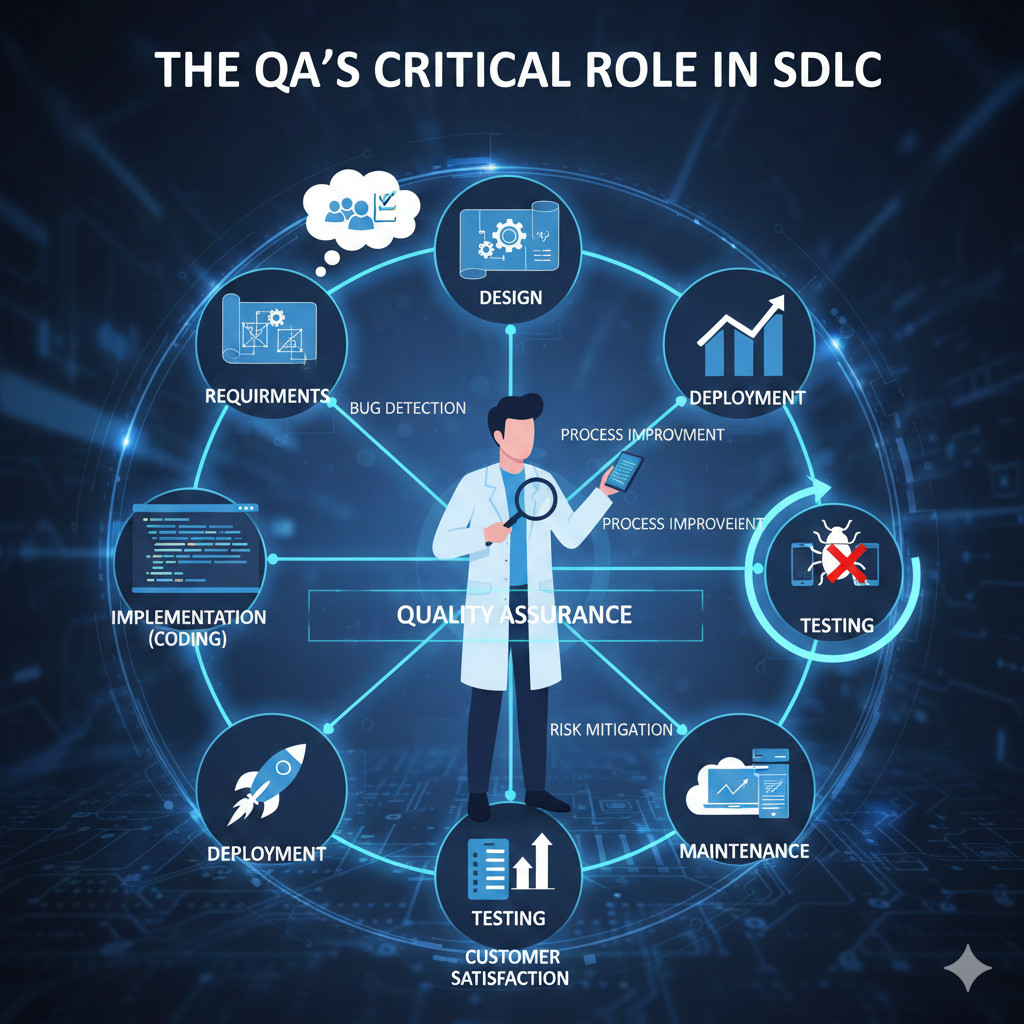
When QA is only involved in STLC, it is too late. By the time you’re writing test cases, architectures are locked in, requirements are frozen, and assumptions have been integrated into code. Now, QA can only find problems. It cannot prevent them at that stage.
A seasoned organization knows QA is not a phase. QA is an ongoing obligation affecting SDLC at all levels, from ideation to post-production learning.
| Key Takeaways: |
|---|
|
Understanding SDLC vs. STLC
The Software Development Life Cycle (SDLC) describes all aspects of the software development process from the inception of the idea, through development and completion. It progresses on to development and testing. Where the solution is constructed and tested, until it is polished enough and fulfills the desires of users or businesses. Finally, we ship the product, maintain and develop it to guarantee its performance over time.
The Software Testing Life Cycle is a subset of this journey. It focuses on:
- Test Planning: Describes a set of activities or artifacts that one would perform if one were going to plan a product test.
- Test Design: Testers in this phase develop and review test scenarios, cases, and data sets based on the requirements and system functionality.
- Test Execution: Test cases are run against the application, and actual results are compared to expected ones to report any issues.
- Defect Reporting: Any defects or issues identified during the execution are reported, registered, and communicated effectively to the development team for resolution.
- Test Closure: This last phase reviews test completion criteria, a summary of testing completed, and the lessons learned. Then, it formally closes the testing activities.
The issue here is when companies equate QA with STLC ownership only. This confines the role of QA as a validation function. It discounts QA’s potential role in prevention, influence, and optimization.
A QA who works only during STLC is reactive. A QA who works across SDLC is a proactive one.
QA as a Quality Strategist During the Ideation Phase
At the ideation stage, QA acts as a quality strategist in forming the definition of what quality is. This happens even before the first line of code is even written. QA is not about validating the features later. It is rather how QA helps to shape the product thinking on what the risks, blockers, and hidden assumptions are.
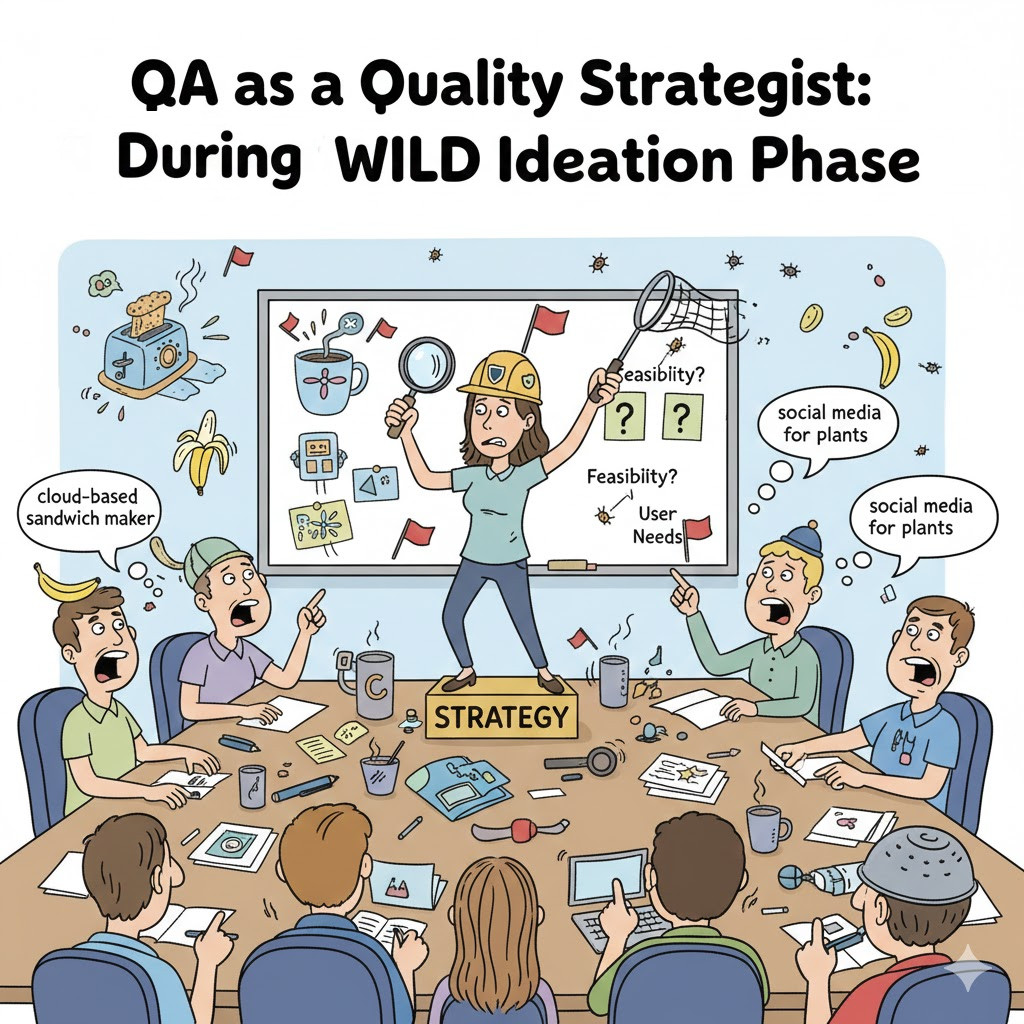
Why QA Belongs at the Idea Table
The first stage of the SDLC, ideation and product vision, is where vital quality decisions are taken. So, things such as target users, usage environments, risk appetite, regulatory boundaries, non-functional expectations, and time-to-market pressure are already shaping the product. And they do that long before development even starts.
If QA is not included at this point, these decisions become implicit assumptions that will emerge as defects/rework/failures. While failing and being misused barely scratch the surface, by scaling and defining “good”, QA makes innovation anti-fragile rather than just sustainable.
Quality Starts With Clarity of Intent
QA encourages moving a product idea from the abstract to something that can be clearly defined and tested. They do this by simply asking what it means for that product to have succeeded or failed. By questioning ambiguity and revealing exposure early in the project, QA both reduces that uncertainty and helps prevent whole classes of defects from accruing before development even starts.
Read: Understanding the Software Development Process.
QA’s Role in Requirement Discovery and Analysis
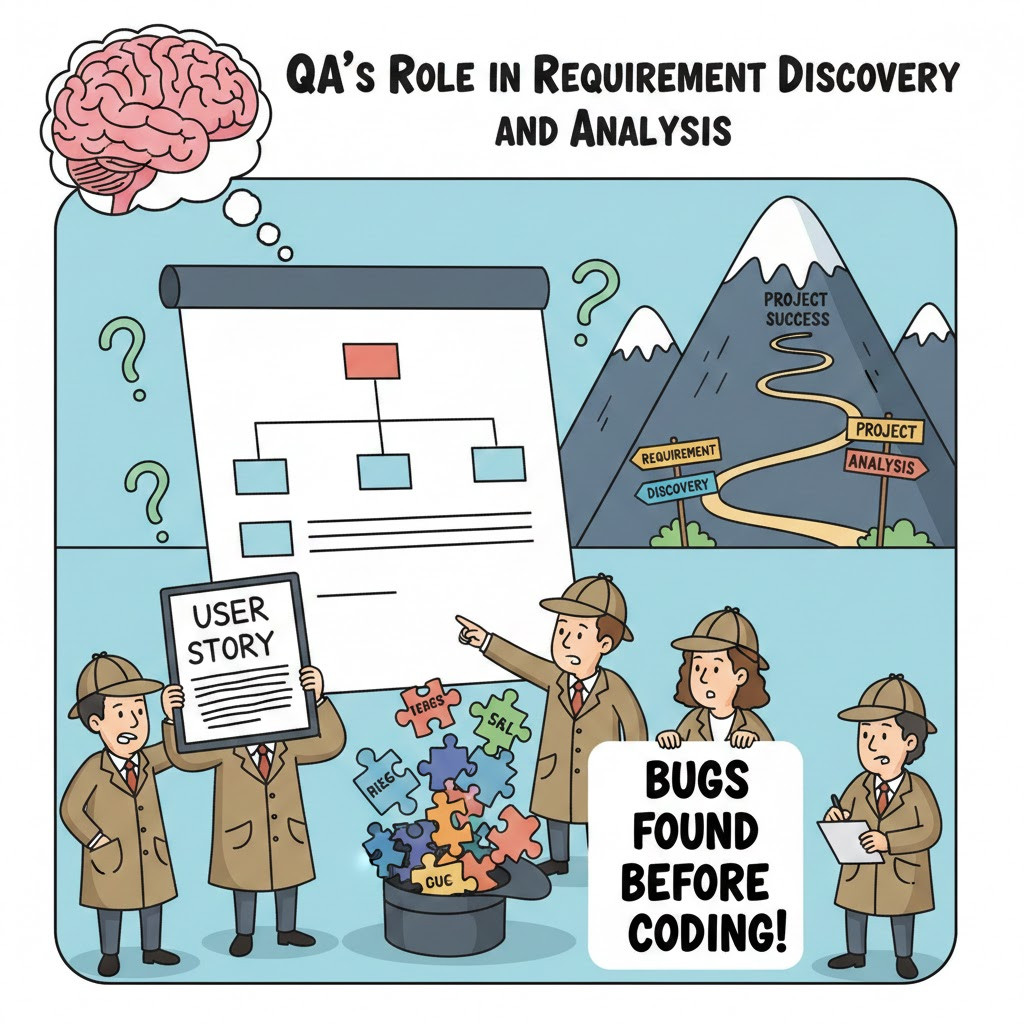
For requirement discovery, QA is a layer of critical thinking that makes sure assumptions are tossed out before they can become fatal bugs. By scrutinizing requirements upfront, QA can also help clarify that those requirements are clear and complete, based on real-world use rather than ideal use.
Requirements are Hypotheses, Not Truths
Requirements are approximate expectations of how users and systems will behave, rather than guaranteed certainties. QA stress tests these assumptions by “moving” requirements that had been taken for granted, exposing hidden dependencies, and questioning acceptance criteria for completeness or testability.
A QA reading requirement never says, “How can I test this?”
Instead, they say,” How would this ever break in real life?”
Asking the Questions Others Avoid
QA asks those awkward, but hard questions. They are about failure, concurrency, performance, and unruly user behavior. In doing so, QA delivers a specification of requirements that have been given an unambiguous meaning. This greatly reduces the likelihood of costly discontinuities and last-minute disappointments in expectation.
Read: STLC vs. SDLC in Software Testing.
QA as a Design Reviewer and Risk Assessor
During design, QA serves as a risk evaluator by considering architectural decisions. These include decisions affecting quality characteristics far before any line of code is ever written. Instead of verifying the results after, QA is a process to bake in scalability, reliability, and testability into the system design.
Quality is Designed, Not Inspected
Scalability, maintainability, testability, observability, and failure tolerance are core features, not aspects of potential testing efforts. QA looks at a design through a lens of quality instead and asks how this failure will be identified, isolated, and verified in large-scale deployment options. This engagement aims to uncover assumptions, risks, and blind spots that pose threats to system behavior in the real world. By mitigating these risks upfront, QA helps to combat systemic flaws that cannot be solved by testing alone.
Designing for Testability is a Quality Responsibility
Designing without testability leads to fragile, opaque systems that are difficult to validate. QA cares about understandable and deterministic interfaces, meaningful logging, observable system states, etc. Also, about consistent staging between every stage of deployment.
These features support not just testing, but also debugging, monitoring, and long-term maintenance. When QA drives design, not the other way around, testing is simple. Because the system itself is designed to be testable and less error-prone.
Read: What is Testware?
QA’s Role During Development
In a development-stage environment, QA is an active quality partner, and not a downstream checkpoint. QA influences decisions that are directly related to the system’s behavior, stability, and correctness.
QA is Not Waiting for Code; QA is Watching Decisions
Development happens in an ongoing manner in the current SDLC models, and QA is associated with it from the start. QAs review user stories before devs start coding and verify acceptance criteria as features are built. They provide early feedback on in-progress work.
By watching how decisions get made, not just what code gets written, QA can actually spot new issues as they are starting to emerge before they become a defect. This allows the team to course-correct at the halfway point when changes are still relatively cheap.
Preventing Defects Instead of Logging Them
By collaborating with QA early, development can eliminate the confusion or misunderstandings that might follow. Edge cases, integration problems, and behavioural variances are ironed out at the top before they affect the rest of the system.
This really cuts out the rework, delays, and piles of defects. The cleverest value-add QA adds to the development process is pre-emption of defects.
Read: Why a QA Mindset Is an Asset for Developers.
QA Beyond Functional Testing: Non-Functional Guardianship
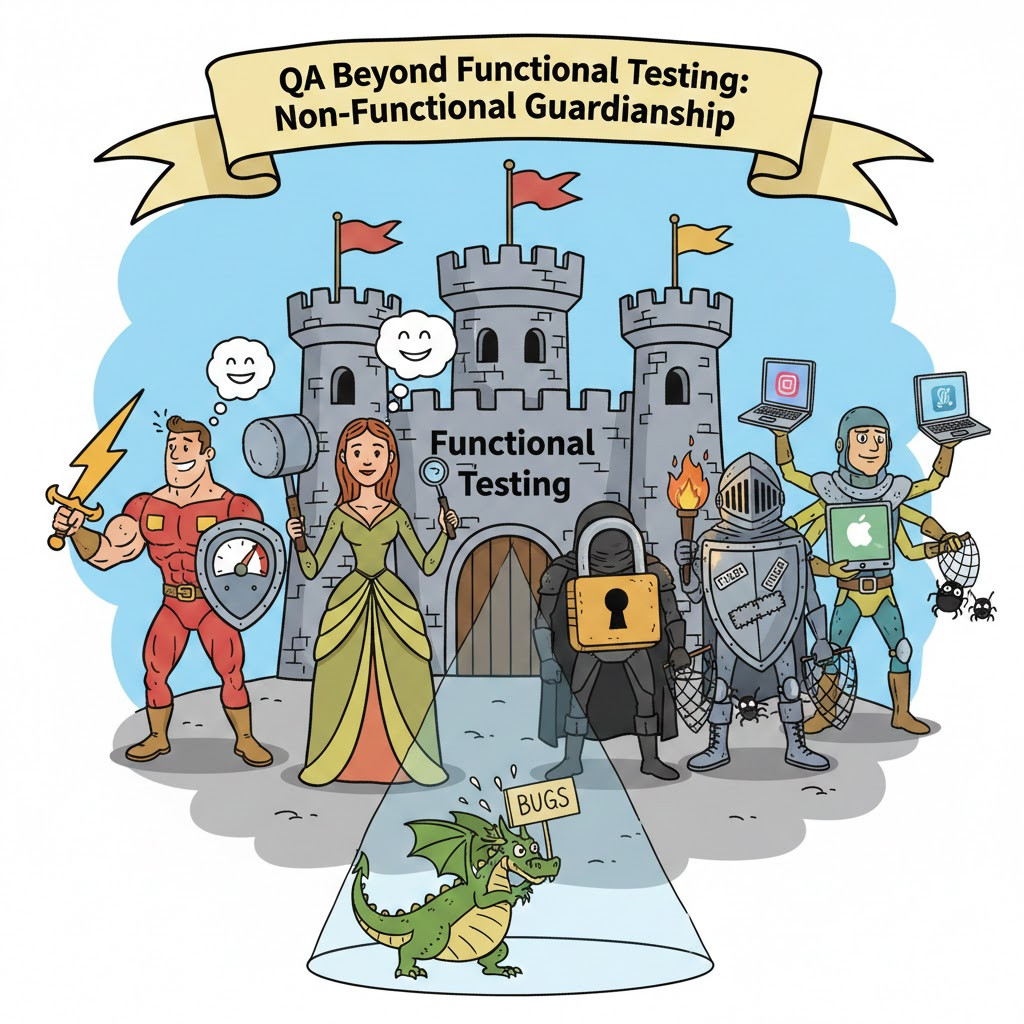
Quality goes beyond whether a feature technically works. By advocating for non-functional aspects as well, QA makes sure the product stays trustworthy, usable, and resilient in reality.
Quality is More Than “Does it Work?”
QA is about a feature that satisfactorily fulfills a requirement, but is poorly performing, insecure or irritating to users, or lacks quality. The critical non-functional attributes, such as performance, reliability, usability, accessibility, security, and compatibility, are verified by QA. These features should be baked into the SDLC. Early thinking could prevent systemic failures that are expensive or impossible to fix later.
QA as the Voice of the User Under Stress
Developers typically test for the ideal conditions, but QA tests how the system responds under unpredictable situations. QA tests on bad networks, old browsers and devices, strange user scenarios, under massive load, partial system failures, and more. QA does this by consistently acting as a user in less-than-perfect scenarios and ensuring that products can handle day-to-day wear and tear, not just the ideal case.
Read: A Tester’s Guide to Working Effectively with Developers.
QA During Integration and System Validation
In the integration and system validation stage, Quality Assurance makes sure that the product works as a whole and not as a byproduct of many loosely connected components. This phase is important, as the system’s interactions and team/data flow will show risks that are invisible when a single feature is developed.
Read: Quality Assurance to Quality Engineering Transformation – A Guide.
Integration is Where Assumptions Collide
Separate modules are fine, but when you put them together, they may not always work. QA checks integration risks between end-to-end workflow, cross-system data movement or ownership hand-offs to other teams. This includes the checking of consistency in data, temporal issues, and dependencies. By taking a systems-level perspective, QA uncovers system-wide problems that cannot be found by testing each component separately.
QA as a System Thinker
QA has shifted from feature testing to system behavior testing. QA determine whether the system behaves predictably, degrades gracefully in the face of failure, and offers meaningful user feedback. Recovery flows, error recovery, and user resilience are the centre of focus. This level of system thinking means that even when stuff goes bad, the product is still stable and usable.
Read: How Code Reviews Help QAs.
QA in Release Readiness and Go-Live Decisions
In release readiness, QA has transitioned to a strategic asset that provides informed go-live decisions instead of being a gatekeeper. Emphasis moves from pass-fail validation to easily understood communication of risk, confidence, and readiness throughout the enterprise.
QA is Not a Gatekeeper; QA is an Advisor
In more mature teams, QA does not “approve” or block releases, but advises management based on risks. QA defines what can be known, what is unknowable in advance, but must still be tested. Also, what has changed since the last release, and where are the places most likely to fail? Stakeholders can then consciously make trade-offs between speed, quality, and risk.
Risk Transparency Over False Confidence
A decent QA culture never pretends that all testing gets done. Alternatively, QA offers clear coverage and understood risks, identified restrictions, and probability-responsive tactics. It is this visibility that gives rise to credibility and shared risk liability. QA sets the expectations that help you avoid eleventh-hour whoppers and post-launch nightmares.
Read: QA Tester Career: Average Salary and Weekly Hours Explained.
QA and Production Feedback Loops
QA continues to be important even post-deployment, as product quality should only improve with more ‘in the field’ uses. There is no pre-release test that can reveal how software will perform in production based on real-world stimuli and failure. By making sense of those signals and looping them back into planning and design, QA moves the org away from fire-fighting towards a quality mandate.
Quality Does Not End at Deployment
Real users in real conditions, not test ones, are what your code will have to deal with when it lands in production. QA review is there to detect and root cause systemic weaknesses, not single issues. Lessons learned from these results are used to refine testing strategies and maximize future coverage. Problems in production are not flaws, but lessons.
Closing the SDLC Loop
QA makes sure that what we have learned from the production experience adds value back to the early stages of SDLC. Production incidents influence design decisions, usability enhancements are made based on user complaints, and risk assessments are more robust due to failures. This closed-loop feedback ensures repetitive problems are not allowed to exist, and quality cannot deteriorate. Without it, teams continue to make the same mistakes from release to release.
Read: How to use AI effectively in QA.
QA as a Cultural Catalyst in SDLC
Beyond practices, tools, and methodologies, QA’s ultimate value comes in shaping how an organization thinks about quality. Optimizing mindset, behaviors across the team, and QA helps get quality ingrained as a shared value throughout the SDLC. This change of culture ensures that quality is consciously considered during normal decision-making, rather than being an afterthought.
Quality is a Culture, Not a Department
QA shifts the way teams should look at solving problems. It is not just about adding features but building the right solutions, which are safe and usable. The emphasis shifts away from passing tests toward delivering real value. And also from shipping fast to shipping responsibly.
QA demonstrates critical thinking by challenging assumptions, building curiosity, and preserving responsibility. This cultural shift makes quality integral to every decision and not just something to be performed while testing.
Teaching Teams to Own Quality
In established QA organizations, ownership of quality isn’t centralized under one team. QA is not the “gatekeeper” of a product. Its aim is to coach developers, collaborate with Product Managers, and advise stakeholders on risks in relation to quality. Through shared ownership, QA is helping teams to learn how to be more autonomous and make decisions without being told what to do. The ultimate objective is to improve the maturity of an organization in quality so that it can become self-supporting.
Read: What is Cost of Poor Quality (COPQ)?
Why QA Must Think Like an Architect, Not a Tester
QA people need to think like an architect, because quality comes from system behaviour over time, not the results of individual tests. As testers emphasize validation, QAs make quality decisions in accordance with business objectives and the actual behavior of the users. This mentality needs to be factored in for systemic risk, whilst making a tradeoff between the speed of delivery and long-term stability. At this level, QA becomes critical to the success of the entire SDLC.
Read: More Efficient Way to Do QA.
The Cost of Limiting QA to STLC
Organizations that restrict QA to the STLC often discover defects late, leading to frequent rework and production instability. This reactive approach increases pressure on QA teams, resulting in burnout and strained, adversarial relationships with development. The root cause is not insufficient testing but the exclusion of QA from early and strategic SDLC decisions. These outcomes reflect fundamental SDLC design failures, not flaws in QA execution.
Read: Is QA More Cost-Effective Thanks to Automation?
Reframing QA as a First-Class SDLC Role
To realize the true value of QA, businesses need to incorporate it from day one and view it as a strategic asset, rather than just a downstream checker. Promote system-level thinking and measure defect prevention, not just detection, to move the focus of quality from reactive to proactive. When questions are as richly valued as answers, risk is brought to the surface earlier, and the pushback on assumptions is more constructive. Embedded throughout the SDLC, QA is a competitive asset for product’s quality.
Conclusion
Quality is not the product of test cases, but the decisions made at each phase of the SDLC. QA’s real responsibility is to question assumptions, articulate intent, predict failure, and maintain an end-user’s voice throughout. By being constrained within the STLC, QA is always reactive and participates only when issues are reported. If it’s embraced in all phases of SDLC, then quality turns into intentional and strategically viable by nature. The future of QA is not to test more. But it is to think better, earlier, and systematically into QA as an integral part of the SDLC success rather than an optional add-on.
| Achieve More Than 90% Test Automation | |
| Step by Step Walkthroughs and Help | |
| 14 Day Free Trial, Cancel Anytime |