LambdaTest Alternative
 |
What is LambdaTest?
LambdaTest, now known as TestMu AI, is a cloud-based testing platform primarily focused on cross-browser and cross-device testing. It allows teams to run tests across thousands of browser and OS combinations without having to maintain their own infrastructure.
It supports both manual and automated testing, typically using frameworks like Selenium, Cypress, and Playwright. Teams can execute tests on real browsers and devices in parallel, which helps speed up test cycles.
In recent updates, LambdaTest has introduced AI-powered features as part of its platform that are meant to help with test automation. LambdaTest is often used as part of a broader testing stack, especially when teams need scalable infrastructure for running tests across environments.
Advantages of LambdaTest
- Extensive cross-browser and device coverage: Run tests across thousands of browser and OS combinations in the cloud.
- No infrastructure management required: Eliminates the need to maintain local device labs.
- Supports popular automation frameworks: Works with Selenium, Cypress, Playwright, and more.
- Parallel test execution: Run multiple tests simultaneously to reduce execution time.
- CI/CD integrations: Easily integrates with modern DevOps pipelines.
Disadvantages of LambdaTest
- Test creation still depends on code or scripts: Teams need technical expertise to build and maintain tests. Even LambdaTest’s AI is more of an assistant added to a developer tool.
- Maintenance effort remains with the user: Test stability depends on how scripts are written.
- AI features focus on execution, not creation: AI helps optimize tests, but doesn’t eliminate scripting.
- Toolchain complexity: Even with AI, the platform still works alongside frameworks rather than replacing them.
- Infrastructure costs: Although it provides the cloud option, its pricing models often separate execution from AI authoring.
What is testRigor?
testRigor is an AI-powered test automation platform designed to simplify how tests are created, executed, and maintained. Unlike LambdaTest, which integrates AI into its platform originally meant for SDETs and developers, testRigor is an AI-first platform that removes the need for programming expertise entirely.
Instead of writing code, users create tests in plain English, which the system translates into executable steps. testRigor doesn’t depend on selectors and XPaths at all to identify UI elements. It sees the page like a human.
It supports end-to-end testing across web, mobile, APIs, desktop, mainframe, and more within a single platform. testRigor focuses on reducing the effort required for both test creation and maintenance, making automation accessible to a broader team, not just the technical silo.
Getting started with testRigor is straightforward. There’s no need for long setup cycles or specialized training. Teams can begin automating tests almost immediately, which is especially valuable for fast-moving products and frequent releases. It is as simple as:
- Launch the testRigor app on the web and choose the desired settings for your test suite.
- Entering test steps in plain English language. (want to know more about the supported commands? Take a look here)
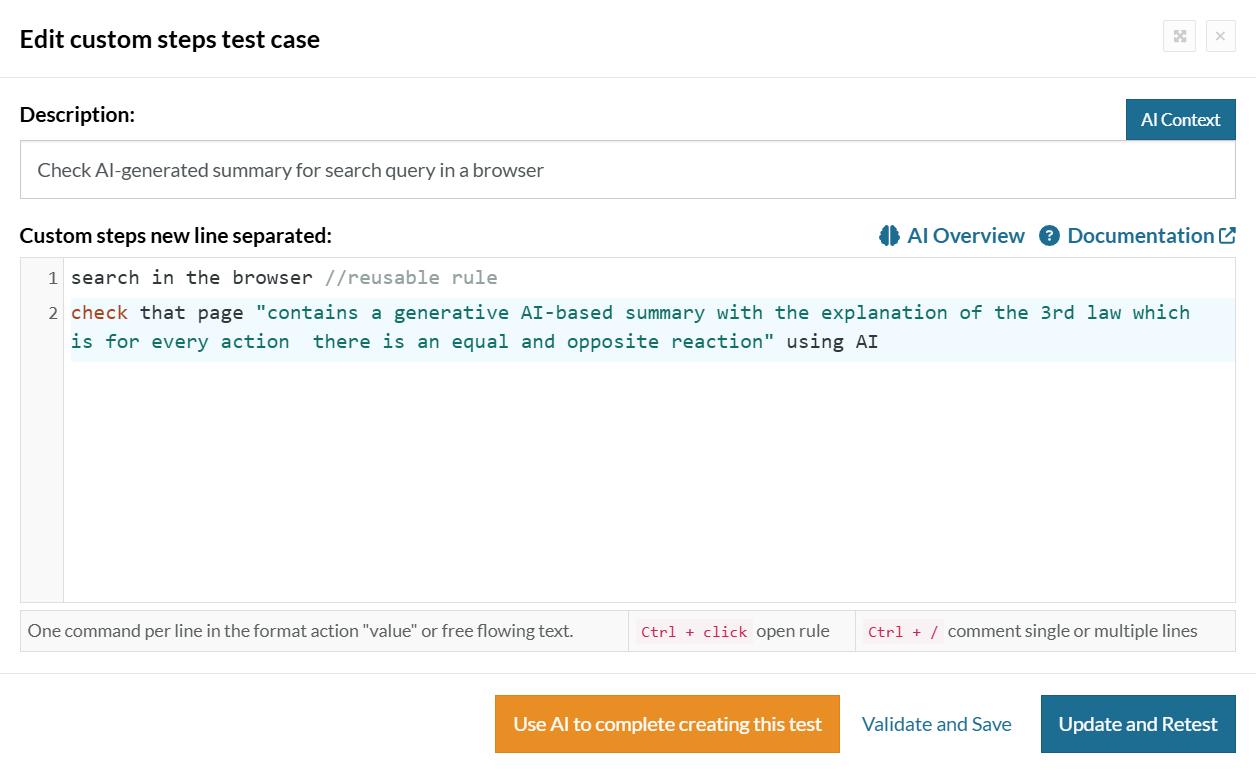
How testRigor is Different
| Factor | testRigor | LambdaTest |
|---|---|---|
| Approach to AI in testing | testRigor uses AI as part of the core workflow. Tests are written in plain English, and the system interprets them directly during execution. This reduces the need to translate test logic into code. | LambdaTest’s AI is designed to assist with test automation tasks such as generating test steps, converting manual tests, and improving debugging. It works alongside existing frameworks rather than replacing them. |
| Test maintenance | testRigor reduces maintenance effort by allowing tests to be written in English (based on visible elements and user actions). This helps minimize updates when applications change. | Test maintenance depends on how automation scripts are written in external frameworks. While AI features like self-healing can help reduce failures, teams are still responsible for maintaining test scripts and selectors. |
| Framework dependency | testRigor provides a single platform where tests can be created, executed, and managed without relying on external frameworks. This reduces the need to maintain separate tools or framework configurations. | Teams typically use it alongside automation frameworks like Selenium, Cypress, or Playwright. This means test creation, updates, and framework management are handled outside the platform. |
| Onboarding and setup | Teams can start creating tests quickly without setting up frameworks. Existing manual test cases can be converted into automated tests using plain English steps. | Getting started typically involves setting up automation frameworks, integrating with CI/CD pipelines, and configuring environments. |
testRigor vs LambdaTest – Feature Comparison
| Feature | testRigor | LambdaTest |
|---|---|---|
| Primary focus | End-to-end test automation platform (creation + execution + maintenance) | Cloud-based testing platform for cross-browser/device execution |
| Test creation | Plain English test steps (no coding required) | Typically requires frameworks (Selenium, Cypress, Playwright), even with the AI feature |
| AI-based test creation | Built-in: generate tests from plain English or manual cases | AI supports a natural language way to generate coded test scripts |
| Need for coding | Not required | Usually required for automation workflows |
| Framework dependency | No external frameworks needed | Relies on external frameworks for automation |
| Test maintenance effort | Reduced due to abstraction (no XPath dependency) | Depends on script quality; AI helps but does not remove maintenance |
| Handling UI changes | More resilient (uses visible text/user behavior instead of locators) | AI-based self-healing is available, but tied to underlying scripts |
| Execution infrastructure | Built-in, with integrations for external grids if needed | Strong cloud infrastructure across many browser/device combinations |
| Cross-browser testing | Supported (can integrate with cloud grids) | Core strength (large-scale browser/device coverage) |
| Parallel execution | Supported | Core feature with large-scale parallel runs |
| Test coverage | Web, mobile, desktop, API, mainframe, cross-browser/device testing, end-to-end workflows | Web, mobile, cross-browser/device testing |
| Ease of use | Designed for non-technical users (plain English interface) | Easier with AI, but still tied to frameworks and workflows |
| Team accessibility | QA, product managers, and business users can contribute | Primarily QA engineers and developers |
Which tool is right for you?
| Choose testRigor if you want to: | Choose LambdaTest if you: |
|---|---|
|
|
Conclusion
LambdaTest with AI is a strong platform for running tests across browsers and improving productivity within existing automation frameworks. testRigor, on the other hand, takes a different approach – helping teams simplify the entire process by removing the need for scripting, reducing maintenance, and enabling faster test creation.
If your goal is to reduce complexity and make automation more accessible across your team, testRigor is your way ahead.
| Achieve More Than 90% Test Automation | |
| Step by Step Walkthroughs and Help | |
| 14 Day Free Trial, Cancel Anytime |