
Agentic AI Guardrails Create New Testing Challenges for Banks’ Digital Systems
 |
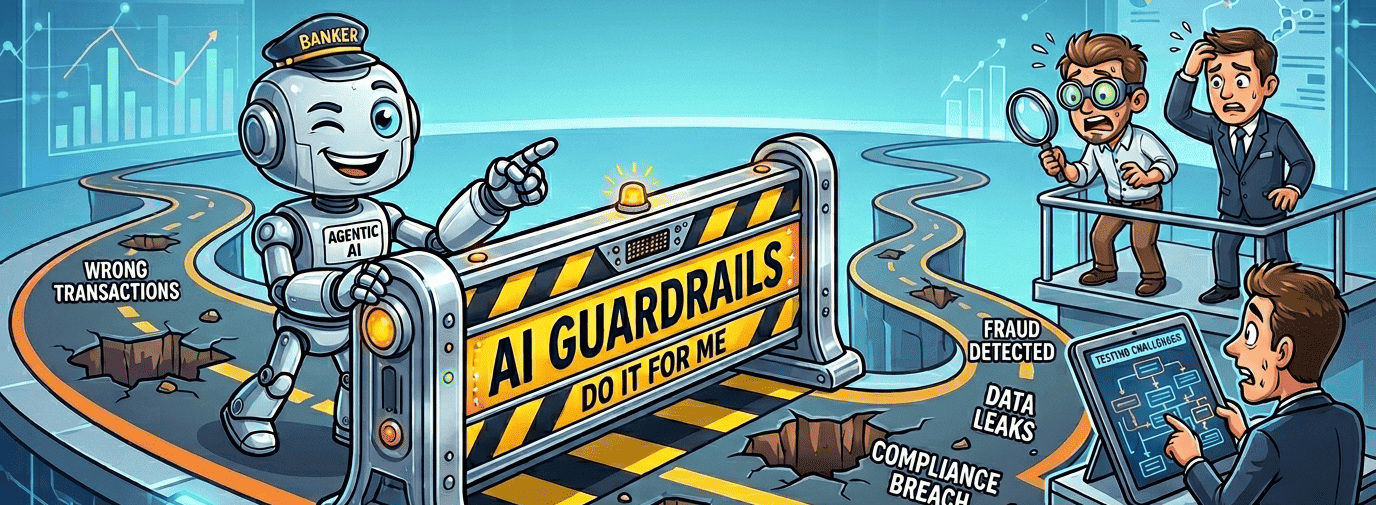
How do we manage all our finances? Mostly through a banking application. Over the years, we’ve become used to a kind of reactive approach. Users initiate banking actions, and the application executes them based on explicit approval. Whether it’s permitting a money transfer, hitting the confirm button on our bank’s security messages, or setting up monthly payments, customers remain responsible for approving and monitoring transactions. Nothing happens on the app without our permission.
Traditional AI chatbots in banking software were similar. If we asked something, they were able to answer it or suggest plans. But after looking at that information, we still had to decide what to do with it and what the next step should be. In the end, it was always us who had to make those decisions. AI chatbots in banking were merely acting in the role of an assistant.
Read ➥ Chatbot Testing Using AI.
As the technology evolves, banks are now experimenting with a new technology called Agentic AI. While older AI tools were just handling user instructions, Agentic AI has the ability to take actions autonomously. This may include assisting with transaction authorization, fraud monitoring, and payment orchestration under predefined policies and human oversight.
| Key Takeaways: |
|---|
|
What is the Difference Between Agentic AI and Traditional AI Chatbots
Unlike traditional AI, which follows a “help me” approach, agentic AI works more on a “do it for me” model within defined guardrails.
For example, while a traditional AI chatbot might retrieve a customer’s balance and suggest a savings plan, an agentic AI system could autonomously create that savings plan, monitor spending patterns, and adjust the strategy without needing repeated human prompts.
This shift allows banks to move from AI-assisted processes to fully intelligent workflows, where AI acts not just as an advisor, but also as an actor.
Read ➥ Agentic AI vs. Generative AI
What are Guardrails in Agentic AI?
Guardrails are governance and safety mechanisms that check and ensure each move in agentic AI before it is executed. They ensure that the AI is adhering to banking rules, risk limits, and security policies. These guardrails are a smart brake system added to an intelligent driver (AI agent).
Agentic AI Guardrails Challenges in the Banking Sector
Guardrails for agentic AI (guardrails AI) are becoming a critical layer of control in modern systems. In banking, agentic AI guardrails for information security are essential because even small lapses can lead to serious risks.
While it may sound simple, in practice, inspecting the guardrails and ensuring they are flawless is becoming a major challenge. This is because autonomous agents introduce new failure modes that traditional software testing is not designed to catch.
Why Agentic AI in Banking Demands Strong Fraud Prevention?
According to a new report from the banking sector, 44% of finance teams are expected to use agentic AI by 2026. However, there is a major concern that over 50% of fraud cases involve AI systems.
Even a small mistake by an AI agent that makes its own decisions is enough to cause a huge financial loss to the bank. Incorrect transactions or fraud that cannot be prevented on time can affect the bank’s credibility. Therefore, this brings a huge responsibility to the banks, their quality assurance (QA) team, and the legal department that has to regulate these systems.
Key Testing Challenges for Banks
It is easy to test regular software because it only does what it is told to do, and we know the outcome in advance. But agentic AI is not like that. It can think according to the situation and find new ways on its own. This is becoming a major headache for QA teams.
| Challenge | Traditional Testing | Agentic AI Requirements | Why Banks Care |
|---|---|---|---|
| Decision Making | Fixed test scripts | Test unpredictable scenarios | Prevent wrong transactions |
| Safety Rules | Basic post-launch checks | Real-time AI guardrails | Meet banking regulations |
| Unexpected Problems | Known bug testing | Fraud and attack simulation | Prevent data leaks and fraud |
| System Scale | Basic load testing | Multi-agent stress testing | Handle real-time operations |
| Tracking Decisions | Simple activity logs | Full AI decision trails | Support audits and compliance |
How QA Teams Must Adapt to Agentic AI Systems
- Adversarial Testing: Teams should perform adversarial and prompt injection testing to artificially create scenarios where AI is likely to make wrong decisions and test how it defends against them.
- Clear Records of Decisions: There should be clear evidence of what decision the AI made in each case and why it made it.
- Teamwork: QA, compliance, and security teams will need to work collaboratively with each other from the beginning.
- Observability: The system must have the ability to observe and understand in real time what the AI is doing at every moment.
Read ➥ Adversarial Testing
Practical Actions for QA teams and Banks
- Prioritize Guardrails: Just like testing an AI agent, guardrails should be taken very seriously. Test them not as a mere safety shield, but as a core feature of the software. Effective guardrail testing requires boundary value analysis on the semantic limits of the AI to ensure it cannot be bypassed by creative prompting.
- Adopt Hybrid Testing: Use new testing methods for AI alongside existing standard automation. This includes integrating non-deterministic model-based testing with traditional regression suites to cover both code logic and agent behavior.
- Record Every Move: Create a proper logging system so that every decision the AI makes can be verified in the future. Banks should implement Chain-of-Thought (CoT) logging, which records the internal reasoning steps an agent takes before giving a conclusion.
- Security From the Start: Make compliance and testing a part of the project from the very beginning.
- Measure Safety Standards: Evaluate how safely AI makes decisions, not just by looking at speed or accuracy.
As banks rapidly move towards autonomous decision-making systems, the strength of these guardrails will determine their success or failure.
In such complex situations, reliable and easy-to-manage automation systems are essential. Generative AI-based automation tools like testRigor help teams ensure accuracy in such complex systems and confidently push each release despite changing technologies.
| Achieve More Than 90% Test Automation | |
| Step by Step Walkthroughs and Help | |
| 14 Day Free Trial, Cancel Anytime |