
How to Turn Defects into Insights?
 |
Defects are something that software teams deal with on a daily basis. Bugs happen in planning, during design, throughout development and QA, or even in production (where it probably stings the most). While it’s no secret that defects will inevitably occur (every engineer, tester, designer, and product manager knows this), seldom do organizations understand what defects really are.
Most companies treat defects as failures. They see these as mistakes, inefficiencies, or discipline problems. They view defects as evidence that someone “didn’t pay attention” or “missed something important.” And with such an attitude, faults become emotional triggers for accusation, confrontation or anger.
But defects are not failures. Defects are feedback.
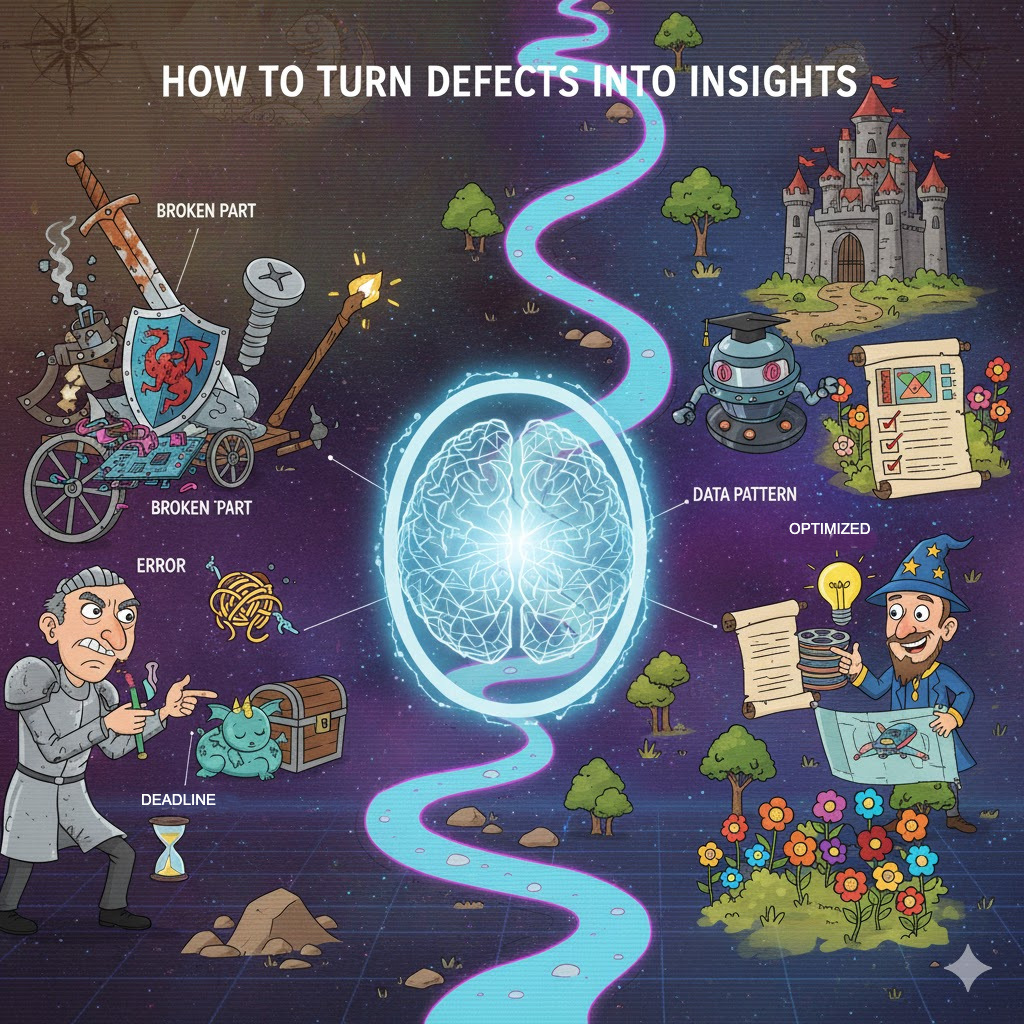
These are messages from your system. They are the mirrors of how you run your processes, how you roll in collaboration, how communication breaks down, and how assumptions drive the product you ship. When bugs are seen as information, not errors, the whole realm of software engineering opens up in a different way.
| Key Takeaways: |
|---|
|
Why Defects Alone are Not Enough
When we find a defect, you typically are reactive, the main plan will be to fix the defect, close out the ticket, and move on. The bug is gone on the surface, but the underlying condition that gave rise to it frequently remains. These, in turn, lead to defects compounding over time, technical debt accruing, processes crumbling, and morale slipping.
This sets the stage for a “patch and pray” philosophy in some companies where developers, support or even operations teams patch around issues, hoping they won’t come back. This may seem effective in the near term, but it is ultimately unsustainable. As one writer mentioned, without delivering true root-cause analysis, “we’re basically applying a band-aid to a bullet wound.”
Also, constantly putting out fires makes it so that people see defects as the enemy that needs to be hidden, fixed quickly, and forgotten about, instead of as signs of deeper process problems or chances to get better.
Read: Defect Lifecycle.
Lack of Learning Leads to Repetitive Mistakes
In the absence of a structured approach to defect analysis, root causes are simply not visible. Teams work in silos, developers fix code, QA writes test cases, operations manages failures, and nobody sits together to say why they keep failing.
This prevents organizational learning. And knowledge remains tacit, context-specific, and also ephemeral. Now, after a while, the same defect patterns resurface in slightly altered forms. Teams end up spending more time reworking repeat problems than they do creating new functionality or delivering value.
Read: Defect Clustering in Software Testing.
The Power of Root Cause Analysis (RCA)
A systematic and structured approach is necessary to turn defects into useful insights. That’s where Root Cause Analysis (RCA) comes in. RCA is a set of methods that guide people to look thoroughly beneath the surface when defects or problems happen and find the way to effective solutions, which could be called “root causes”.
- How did this happen?
- Under what circumstances could it come to light?
- Where, in the process, did things go wrong
- How can we ensure that similar errors don’t occur again?
Read: Root Cause Analysis Explained.
Common RCA Techniques
- 5 Whys: Asking “Why?” over and over. (Sometimes up to five times) In order to remove layers and layers of cause and effect and find the underlying base.
- Fishbone Diagram: Also known as an Ishikawa Diagram or Cause-and-Effect Diagram, is a structured method of presentation that categorizes potential causes (e.g., Man, Machine, Method, Materials, Measurements, and Environment) to facilitate detailed analysis.
- More sophisticated or data-oriented techniques (esp in large-scale or distributed systems), like event correlation, statistical analysis, logs & metrics, empirical/causal modeling.
Each method has its pros and cons, with a combination of different methods frequently providing the most insight, particularly when defects are recurrent or complex in nature.
Read: Masked Defects Uncovered: Shining Light on the Hidden Flaws.
Benefits of RCA
- Prevents Further Occurrence: RCA prevents repeat issues from occurring in the future by actually tackling root causes rather than just healing superficial symptoms.
- Systemic Process Improvement: An audit is a source of untold reveals of gaps in tooling, design, requirements, training, workflow or infrastructure that can be fixed for the long haul.
- Cultivates a Culture of Continuous Improvement: It helps teams move from firefighting to learning, reflecting, and evolving proactively.
- Facilitates Data-Driven Decisions: RCA replaces subjective views and finger-pointing with hard evidence, trend identification, and quantifiable insights that drive better judgment.
In short, RCA transforms defects, no matter how unavoidable they are, from distractions into opportunities for permanent improvement.
Read: Minimizing Risks: The Impact of Late Bug Detection.
From Defects to Insights: A Step-by-Step Framework
Defects aren’t only issues to be addressed; they’re a sign that indicates how your system, process, or workflow actually works. When captured and analyzed correctly, they actually are one of the most potent sources of organizational learning. This process explains how to turn hurdles into treasure, actionable data that leads to iterative improvement in quality through teams.
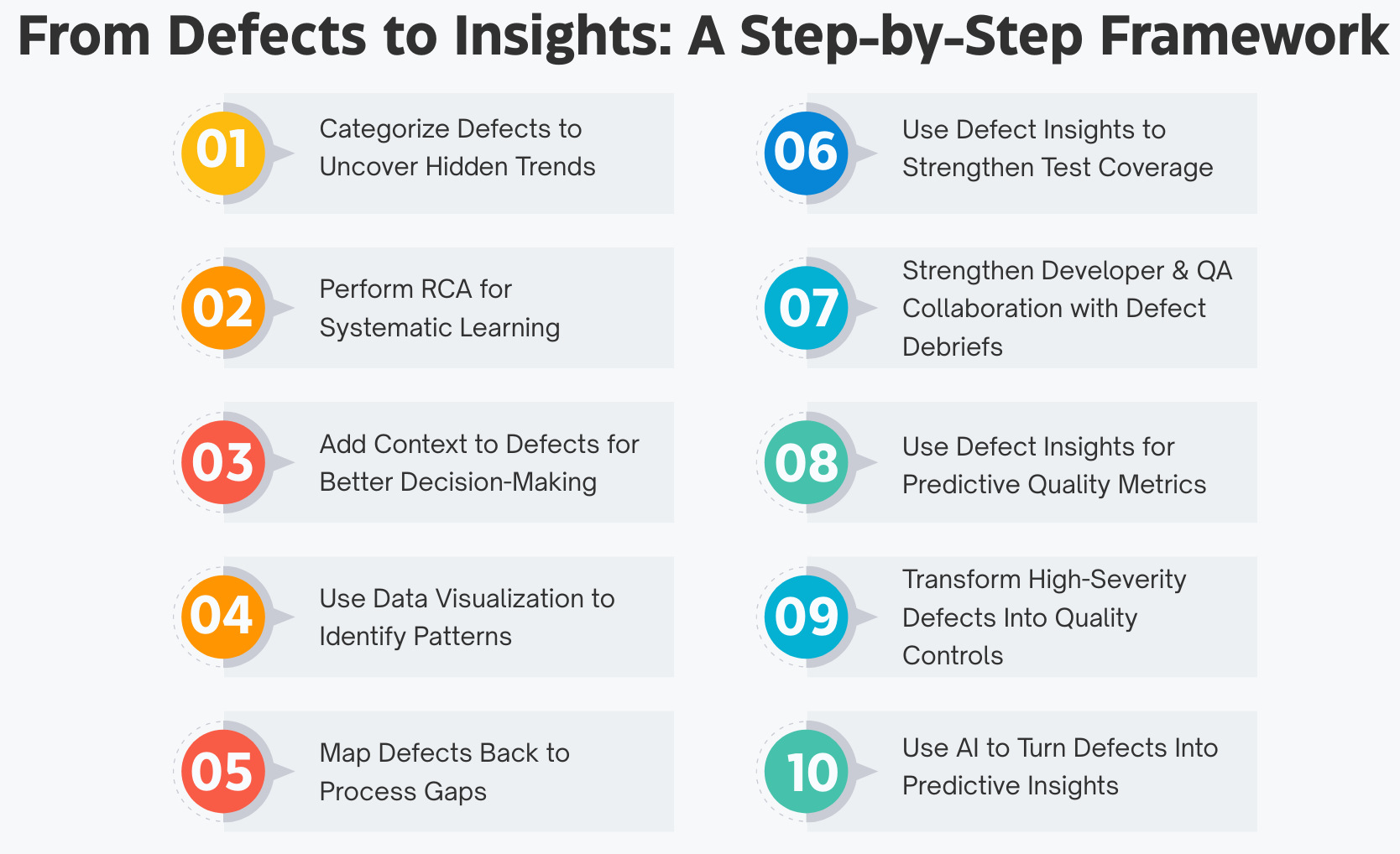
Step 1: Categorize Defects to Uncover Hidden Trends
Classifying defects helps teams learn where problems tend to surface and avoid thinking of every bug as an incident on its own. It exposes convergence across modules, features, and workflows that warrant more extensive testing. By categorizing defects by type, severity, or root cause, teams can better focus on where to improve.
Step 2: Perform RCA for Systematic Learning
Root Cause Analysis helps teams get past merely patching the surface-level bug and understanding the underlying issue behind it. It exposes process breakdowns, poorly defined requirements, or misinterpretations that cause defects to happen. The use of tools such as the 5 Whys or Fishbone diagrams helps to make the investigation structured and actionable.
Step 3: Add Context to Defects for Better Decision-Making
Bugs make a lot more sense when you have rich context such as screenshots, logs, and environment information. When you interpret several contextualized bugs together, patterns start to form around the scenarios that the team might have overlooked. These are insights that can help enhance test cases and clarify user stories. testRigor automatically captures screenshots, system context, execution steps, and reproductions in plain English. You can show how this reduces defect ambiguity. Read: Decision Table in Software Testing.
Step 4: Use Data Visualization to Identify Patterns
Visual dashboards translate raw defect data into clear insights that can be easily grasped by teams. The ability to visualize defect frequency, trends in severity levels, and module hotspots makes problem areas clear. These graphics show quality trends that would be difficult to spot when scanning a list of tickets. Visualization also allows teams to forecast where there is risk in the future, as long as tracking can be consistently monitored. Read: What are Testing Patterns?
Step 5: Map Defects Back to Process Gaps
Linking defects to the appropriate phase in the development lifecycle helps identify potential weaknesses in requirements, design, code, or testing. This connection helps teams understand what best practices they failed to observe that would have caught the issue earlier. By understanding process gaps, teams can focus on corrective action like improving grooming, enhancing reviews, or bumping up test coverage. As time goes by, this mapping decreases the defect leakage into deeper stages.
Step 6: Use Defect Insights to Strengthen Test Coverage
Defects are straightforward indicators of what the test suite missed and, hence, serve as a template for increasing test coverage. By examining defect patterns, teams may be able to add some missing edge cases, write integration tests, or create realistic test data. At least one new or updated test should be added for every resolved bug. By using AI-based test generation, testRigor can easily capture all the edge cases, thereby increasing the coverage. Read: What is Test Coverage?
Step 7: Strengthen Developer & QA Collaboration with Defect Debriefs
Defect debriefs allow teams to talk about what went wrong and what can be better without accusations. These discussions expose disconnects between development, testing, and product teams. As best practices are disseminated, the team as a whole has a stronger foundation of system knowledge and doesn’t repeat mistakes.
Step 8: Use Defect Insights for Predictive Quality Metrics
Thanks to historical defect data, teams can predict which components are expected to fail in upcoming releases. Metrics like defect density, leakage rates, and trend of impact are guiding teams on the level of stringent testing to be applied in various segments. Predictive analytics allows for focusing resources efficiently on areas of interest. Read: Essential QA Metrics to Improve Your Software Testing.
Step 9: Transform High-Severity Defects Into Quality Controls
High-severity issues are typically a sign of architectural weakness or broken workflows that should be fixed as soon as possible. These complex problems should be transformed into guardrails, such as automated checks, validations, or monitoring alerts. Teams avoid similar failures in the future by converting severe bugs into permanent checks.
Step 10: Use AI to Turn Defects Into Predictive Insights
AI tools can analyze large volumes of defect data to uncover patterns humans may miss. They cluster related defects, highlight recurring root causes, and identify high-risk modules. AI can even recommend new test cases or predict where future defects might appear. As AI models learn from ongoing defect patterns, development cycles become more intelligent and proactive. Read: Prompt Engineering in QA and Software Testing.
Turning Defects into a Feedback Loop
What truly changes is when people stop asking “who did this?” and just start asking, “What did this defect teach us about how we work?” This transition eliminates fear and defensiveness, making way for transparency and early detection, which naturally leads to higher quality.
Psychological safety means that people can report problems early and bring misunderstandings to the surface without fear. Hence, defects are a precious feedback signal that supports collaboration, decisions, and system stability instead of interference with the work.
Building a Culture that Learns from Defects
Learning from failures is not fundamentally a technical issue; it is a cultural one. Processes and methodologies can ensure quality, but only a strong culture of learning will sustain it. When defects are considered signals, not failures, then continuous improvement is just a natural part of work.
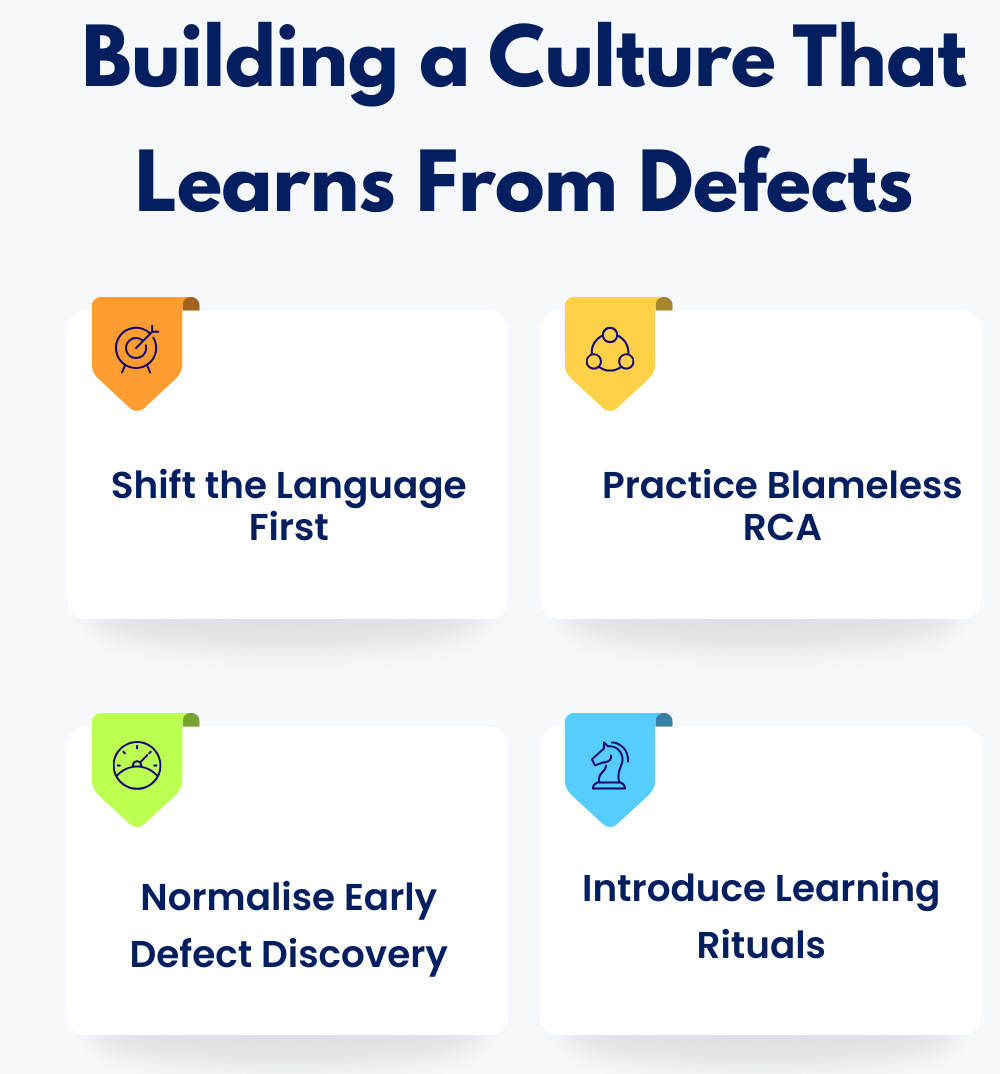
- Shift the Language First: Language is a mirror of our thoughts, and if we change our vocabulary from blaming to learning, teams begin interpreting defects differently. Even subtle linguistic shifts, like replacing the word “mistake” with the word “signal,” significantly affect team behavior and culture.
- Practice Blameless RCA: With blameless RCA, the discussion can focus on systems and processes rather than individuals. The removal of names, emotion, and blame enables teams to find real causes without deterring open and honest debate.
- Normalise Early Defect Discovery: High-performing teams value finding defects early, as it reduces risk and saves time and effort further down the line. That encourages people to speak up earlier rather than when it’s too late.
- Introduce Learning Rituals: There are structured practices for learning built into the team’s system, such as defect debriefs, quality circles, and blameless postmortems. These rituals reinforce that defects are valuable sources of insight, not signs of failure.
How are Defect Goals Beneficial to a Project?
Defects are more than simply an engineering problem; they’re powerful strategic signals that expose weaknesses in product understanding, design alignment, system architecture, and organizational clarity. High-performing teams use defect patterns like feedback loops to make smarter decisions across departments. Framed properly, defects are a treasure map to future product development, operational excellence, and business synchronization.
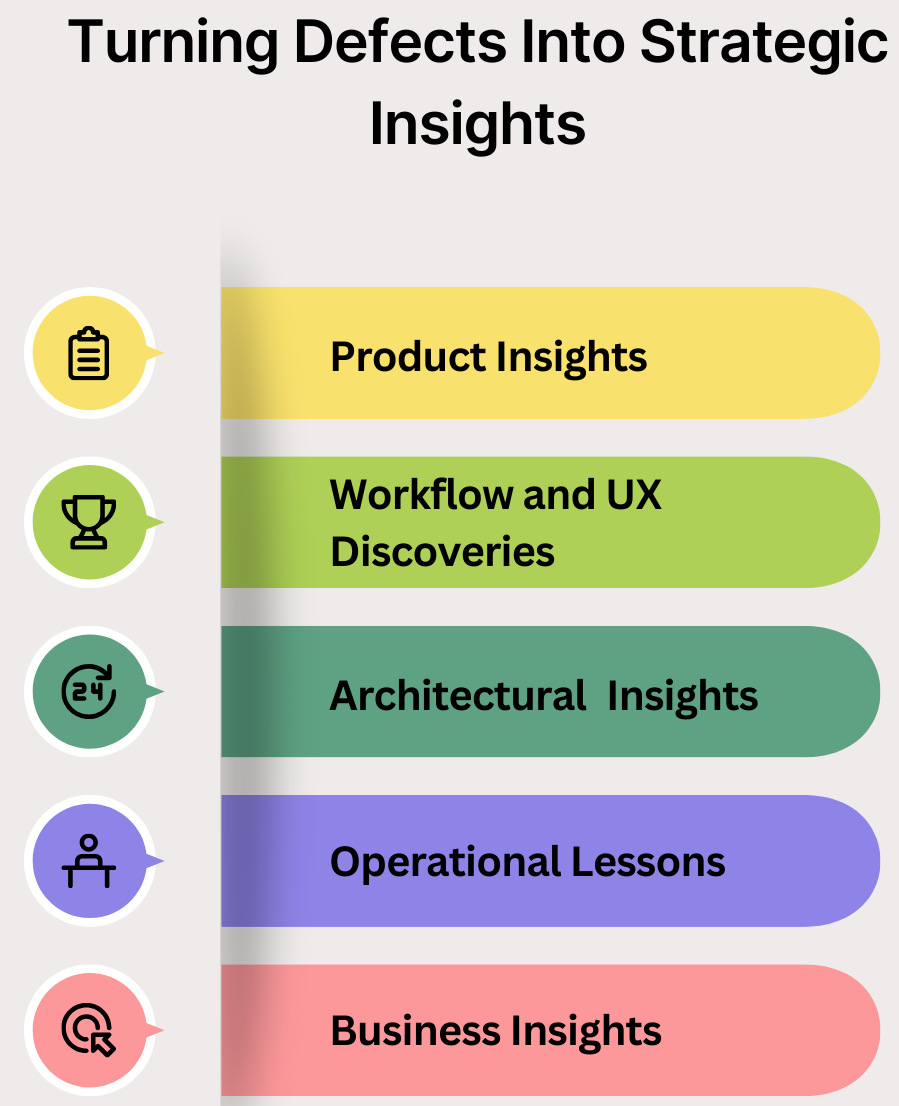
- Product Insights: Defect patterns are the symptoms and often reveal ambiguities in requirements, misunderstandings of user goals or a wrong assumption about behaviour. Issues submitted by customers, in particular, expose how users are really using the product versus how the team thought they would.
- Workflow and UX Discoveries: UI/UX bugs uncover hidden friction within a user experience, like confusing flows or inconsistent states. These findings serve directly as a basis for design revisions that improve usability and accessibility.
- Architectural Insights: A bunch of defects related to certain modules suggests underlying architectural problems, such as high coupling or fragile integrations. These patterns are helpful for engineers and architects when they need to trace structural issues that call for refactoring or redesign.
- Operational Lessons: Many times, production issues expose a lack of monitoring, weak alerting or environment divergence. Each incident becomes an opportunity to increase system reliability and operational robustness.
- Business Insights: Mismatches between product and expectations reveal gaps in market understanding or customer communication. These signals help realign product direction long before traditional metrics reveal the problem.
Conclusion
Defects are not failures; they are strong signals that indicate how our systems, teams, and processes actually work. When defects are seen as opportunities for learning rather than blame, organisations open the door to ongoing learning, more collaboration, and long-term quality improvement. Through structured analysis, open communication, and building a culture of psychological safety, teams can turn defects into strategic assets. In the end, the companies that learn from defects most rapidly are those that make the strongest products and strongest teams.
| Achieve More Than 90% Test Automation | |
| Step by Step Walkthroughs and Help | |
| 14 Day Free Trial, Cancel Anytime |