
Test Automation Frameworks: Everything You Need to Know in 2026
 |
In 2026, software is being shipped faster than ever, across more platforms, with higher expectations of quality, reliability, and scalability. The pressure to deliver quality software swiftly has pushed test automation beyond merely writing scripts into a discipline encompassing architecture, governance, observability, and product thinking. In today’s world of software testing driven by AI, a test automation framework is no longer a nice-to-have, but is the system that makes automation scalable, maintainable, and trusted.
Selecting the automation framework is one of the critical aspects of implementing test automation. According to a survey by GitHub, developers reported spending 26% of their time writing test scripts, and 38% stated that automated tests positively impact their workday.
In this article, we’ll review some of the most common test automation frameworks. We will highlight their standout features so you know which one to choose.
| Key Takeaways: |
|---|
|
What Are Test Automation Frameworks?
A test automation framework is a structured set of guidelines, tools, libraries, test data handling methods, and conventions used for automated software testing.
Test automation frameworks help you to design, organize, write, execute, and report automated tests. By implementing the proper test automation framework, a software team can significantly reduce the time and effort spent on setup, test creation, and maintenance. This means more intelligent resource allocation and tighter test coverage. Read this article to learn more about- What is a Test Automation Framework?

A good test automation framework defines:
- How tests are written, including patterns, naming conventions, and architecture.
- How is test data managed in terms of fixtures, factories, and masking?
- How are tests executed? Whether they are local vs CI, parallelization, or environments?
- How are results reported? Are they reported in logs, traces, screenshots, or artifacts?
- How failures like flakiness, controls, retries, and triage are diagnosed?
- How does the framework evolve in terms of standards, ownership, and extensibility?
In general, frameworks are increasingly judged not by “how many tests they run,” but by how quickly they enable the team to make decisions.
Why Frameworks Matter More in 2026
Modern software applications are no longer simply “web app plus database.” Many teams ship combinations of:
- Web, mobile, desktop, and API layers
- Microservices and event-driven systems
- Feature flags and progressive delivery
- AI-assisted features with nondeterministic behavior
- Complex privacy/security requirements
This variation in applications introduces two major requirements as far as test automation is concerned:
- Automation must scale operationally with parallel execution, reliable environments, fast feedback, and clear ownership. A framework is what prevents tests from turning into a fragile tax.
- Reliability is the key, as engineers should trust automation to use it. The job of a test automation framework is to maximize signal and minimize noise.
Types of Test Automation Frameworks
There are several test automation frameworks, each with its own approach to testing. In this section, we’ll take a look at the different types of test frameworks:
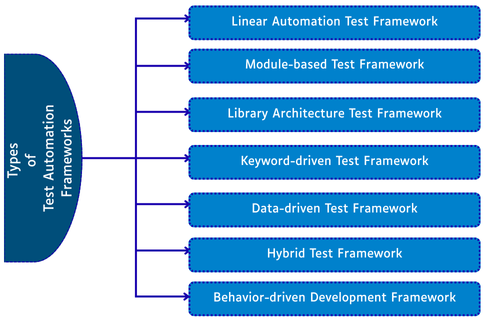
Linear Automation Test Framework
This is the simplest type of automation test framework, where each test is a script with steps and assertions. The key aspect here is to record the steps of tests as a sequence, with testers leveraging a user interface to save the steps as a test. This type of framework is also known as a record-and-playback framework.
The linear automation test framework is most suitable for basic testing, such as with simple websites and smaller, less complex software applications. Linear test automation is also best for prototyping and proof-of-concept (POC) automation.
The advantage of linear automation test frameworks is that they’re typically simple and quick to start, and make it easy to automate the manual testing process with minimal abstractions. However, linear test automation doesn’t offer the benefits of more complex testing frameworks, such as scalability, and may not work well for end-to-end testing. It might have high duplication and be difficult to maintain.
Read more about record-and-playback testing in 2026.
Module-based Test Framework
A modular test framework divides the application under test into smaller, isolated modules. This allows testers to create and run test scripts first to identify defects in individual components and then combine these scripts to build larger test cases for testing the application as a whole. With the modular approach, testers can simply modify the test script of that specific module whenever a code change is introduced in the application and reuse all other test cases. This results in reduced test time and maintenance.
For example, while testing an e-commerce application, modules such as login, add to cart, payment, and viewing order information are created. Common steps are modularised into reusable steps and used whenever required.
A modular test framework is ideal for teams that intend to move beyond basic scripted automation. It reduces duplication and provides a clearer structure that is easier to maintain.
However, it can still become brittle if modules are UI-heavy, and sometimes they hide their complexity.
Library Architecture Test Framework
The library architecture testing framework enables testers to group similar tasks within the test script into standard functions. These grouped tasks are then assigned to a library, ready to be used in other parts of the software application.
Like the modular-based test framework, this architecture also uses the modular approach, which helps minimize the cost of maintenance. Similarly, code reusability allows QA teams to speed up the testing workflow efficiently and cost-effectively.
For example, the login steps are coded and stored in the shared library. Any test case requiring user logging can call this library and use the login functionality, reducing redundancy and code complexity.
Keyword-driven Test Framework
In the keyword-driven test framework, test data is separated from script logic and stored inside a library file/object repository. Next, keywords for each action (like openBrowser, clickLoginButton, EnterText, VerifyVisible, etc.) are stored in an external data table. Each keyword has its corresponding test implementation inside the library file.
Then, a test automation tool reads keywords based on the specified order of test steps in the data table and finds their corresponding test implementation inside the library file. Finally, it executes the test in the GUI of the software application.
Keyword-driven testing is applicable in programming languages such as Java and Python. It also enables less-savvy users to run keyword-driven tests using keywords without requiring coding experience. These keywords are highly reusable across multiple test cases, reducing the cost of running and maintaining tests.
Keyword-driven testing is best for organizations with strong process requirements, regulated domains, or broad QA participation.
Data-driven Test Framework
Similar to the keyword-driven test framework, the test data and script logic are separated in the data-driven framework. The test data is stored in an external Excel sheet, CSV file, or SQL table file. As the test data is not hard-coded in test scripts, testers can validate the same functionality of an application multiple times with different data sets in various test scenarios. For example, a login test could be executed multiple times using a table of usernames and passwords.
In addition, the data-driven testing framework enables testers to reuse test scripts, reduce test maintenance, and increase test coverage.
Data-driven test frameworks provide high coverage with fewer test definitions and are easier for edge case expansion. If data sets are messy, they are harder to debug. A data-driven test framework is mainly used for API tests, validation-heavy flows, and boundary (edge-case) testing.
Hybrid Test Framework
The hybrid test framework combines two or more testing frameworks to obtain the best test results. For example, the hybrid test framework in Selenium combines the data-driven framework (which externalizes test data in Excel, XML files, etc.) with the keyword-driven framework (which externalizes keywords in a separate library file).
Another example is a test scenario for an e-commerce website, which might involve keyword-driven steps to navigate through the site. It utilizes data-driven inputs for user registration details from an external file, as well as modular components for reusable functions, such as login.
Test automation is crucial for agile testing processes, and hybrid test frameworks can offer the flexibility testing teams need to implement continuous integration/continuous testing while working on different aspects of the same project.
In 2026, “hybrid” is essentially the default, as no single approach suits all application layers (API, UI, integration, performance, and contract tests).
Behavior-driven Development Framework
Behavior-driven development (BDD) enables the creation of test scenarios for features that haven’t been coded yet. The goal is to shorten the feedback loop by expanding communication between technical and non-technical team members.
BDD has proven to be nearly impossible to implement as designed, which is why very few companies use it today. However, we think that the fundamental concept of BDD is excellent, which is why we’ve created a similar concept called SDD, which improves all the implementational aspects of BDD. Here is a BDD case study.
BDD framework has a shared understanding between product/QA/engineering, and is suitable for acceptance criteria and user journeys.
However, there is a step definition maintenance overhead in the BDD test automation framework, and it is easy to misuse it as “UI automation in disguise.”
How to Build a Test Automation Framework
Read this article, How to Build a Test Automation Framework, to understand why you need a test automation framework and the detailed steps to build a stable and efficient one. Discover the drawbacks of legacy test automation frameworks and explore the solutions to these problems.
Choosing Among Popular Test Automation Frameworks
This guide helps you choose among popular test automation frameworks. It discusses how automation testing helps in QA and its lifecycle. Learn in detail about the test automation frameworks and steps to choose the most suitable one. It also discusses an easy solution to all this hassle of finding the proper test automation framework.
Test Automation Best Practices
Read Test Automation Best Practices to learn about test automation concepts such as repeatability, data-driven testing, use of variables, etc. Additionally, learn about the best practices to keep your test automation efficient, stable, relevant, and valuable to its maximum potential.
Top 7 Automation Testing Tools to Consider
In this article: Top 7 Automation Testing Tools to Consider, we have discussed the top 7 test automation tools and their helpful features in detail. Know about JUnit, Postman, LambdaTest, Apache JMeter, testRigor, OWASP ZAP, and Datadog to choose the supportive tools for your project or business.
How to Get The Best ROI in Test Automation
This informative article is an inventory of knowledge: How to Get The Best ROI in Test Automation. Learn what ROI is, why it is essential to measure it, and how to calculate it with a detailed example. Also, learn factors to be considered for successful test automation and drawbacks of why traditional test automation tools do not provide maximum ROI (with reasons and solutions).
Guide to End-to-end Testing Frameworks
A detailed guide to End-to-end Testing Frameworks helps you understand why they are needed. Read a detailed list of the most popular end-to-end testing frameworks to help you select the best one that suits your needs.
The Future of Test Automation Frameworks
In terms of where test automation frameworks are headed in 2026, cutting-edge platforms like testRigor are utilizing generative AI to eliminate scripting and further optimize and evolve the software testing process. Use plain English commands to write, generate, or record your test scripts. Seamlessly test web, mobile (hybrid and native), API, and desktop applications in simple English. Here are testRigor’s top features.
Read this futuristic article to learn how software testing will be done in the near future and over the next 10 to 30 years. With the increasing use of AI in every domain, you would like to read: Will AI Replace Testers? Choose Calm Over Panic.
Conclusion
“To make the future is highly risky. It is less risky, however, than not to try to make it.” – Peter F. Drucker.
As we know, the best way to predict the future is to create it ourselves. This is what we aim to achieve with test automation. Using AI in software testing will make it easier, more stable, and more efficient than it is today.
Use the supportive testing tools to make this journey enjoyable and worthwhile. Intelligent tools like testRigor are here to ease your testing process with less effort and time. Use the saved time to build more robust tests, which enhance the test coverage and provide excellent product quality.
| Achieve More Than 90% Test Automation | |
| Step by Step Walkthroughs and Help | |
| 14 Day Free Trial, Cancel Anytime |