What is PDLC? How is it Different from SDLC?
 |
These days, software development is rarely done in isolation. The best digital product teams have a lifecycle behind them, guiding the team from ideation to delivery and beyond. Most of the professionals from the technology domain are familiar with the term SDLC (Software Development Life Cycle). It encompasses everything about how software is made, from design and dev through testing and deployment.
While SDLC conceptualizes how to build software correctly, PDLC informs us as to what the right product to build is. The distinction may seem nuanced, but it has a significant influence on how teams design, test, release, and improve the product.
PDLC is important for QA teams, test automation engineers, product managers, and engineering leaders. It bidirectionally modifies how test strategies are designed and requirements validation is performed, keeping users in mind.
| Key Takeaways: |
|---|
|
Understanding Product Development Life Cycle (PDLC)
The PDLC is a structured approach to deliver a product, from concept to final release. This involves multiple phases like planning, designing, product building, and testing.
What is PDLC, and Why Do You Need to Know About it?
The objective is that each stage of development provides value for the customer as well as the organization.
The Software Development Life Cycle (SDLC) is mainly concerned with writing software, while PDLC encompasses product development and release. It includes not just development but product planning, user research, design, engineering, testing, marketing, and customer interaction as well. In layman’s terms, PDLC encompasses the entire process of a product from concept to production.
- SDLC = How software is built
- PDLC = Why the product is built and how it evolves
Read: Understanding the Software Development Process.
The Importance of PDLC in Product Development
We know of examples where software failed not because of bad engineering. They failed because they tried to fix the wrong problem altogether.
Often, teams create systems that technically work well, but do not solve actual user problems or address market needs. In the past, we have seen that organizations were super focused on their engineering execution and had great development practices. Though these processes improved the development cycles, they often lacked the means to verify that the product held value for the buyers.
To fill this space, PDLC was designed. Because it synchronizes product development with users’ real pain points and business objectives. It creates a transition from developing technology to building products that matter with value for their users.
- The right problem is clearly identified before development begins.
- The right solution is carefully designed to address the identified problem effectively.
- The product delivers measurable value to users and supports business objectives.
- The product continuously evolves based on user feedback and real-world usage.
Read: QA’s Role in the Full SDLC – Beyond Just STLC.
The Eight Stages of PDLC
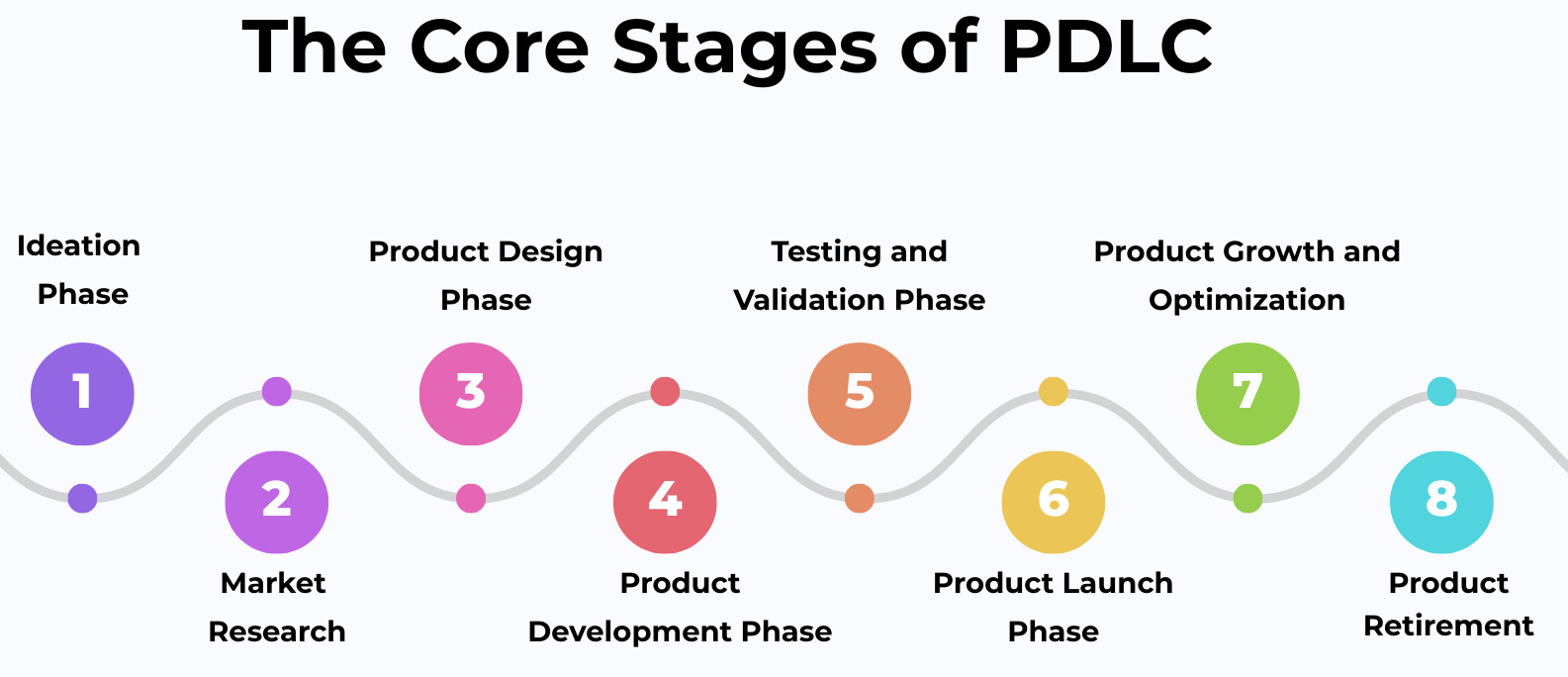
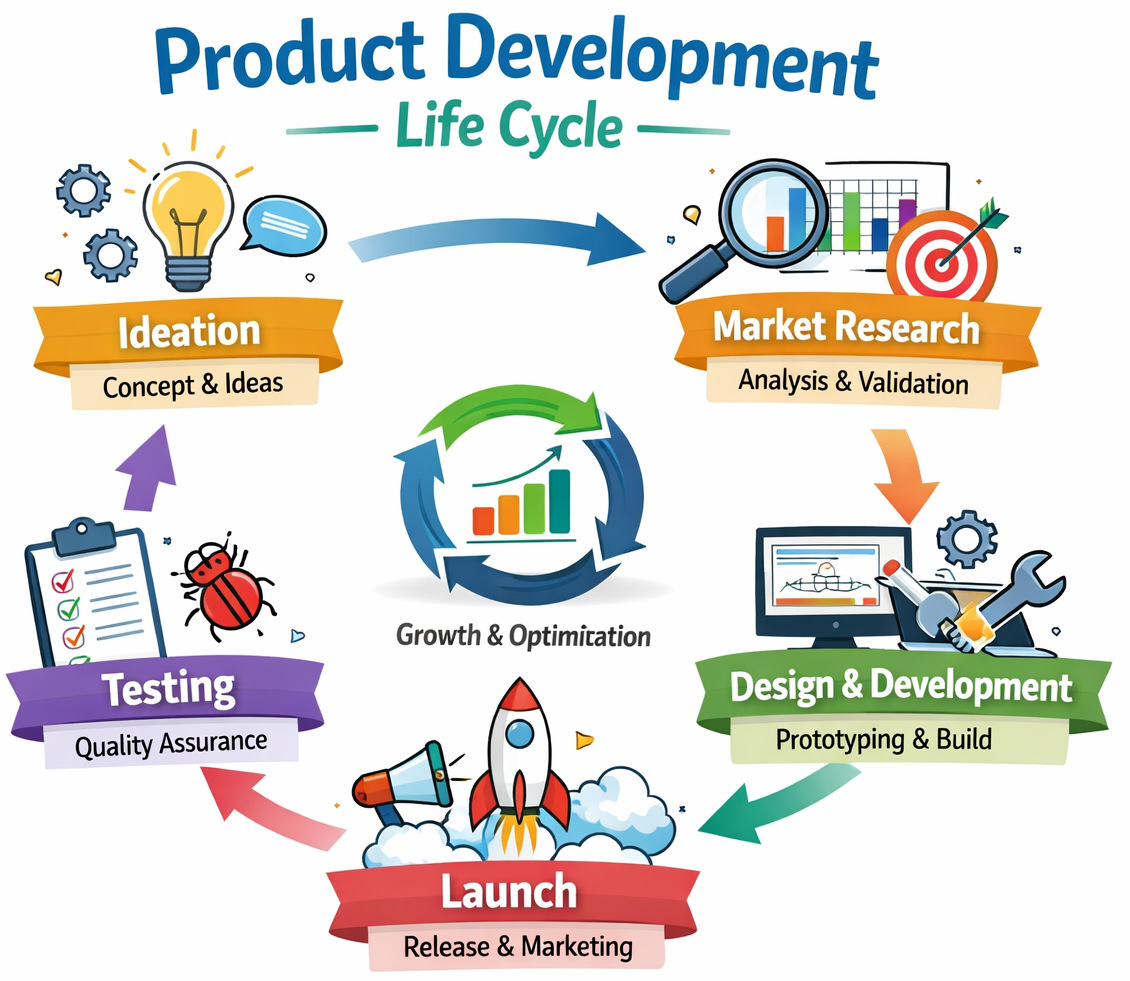
The Product Development Life Cycle (PDLC) has stages that guide a product from an initial idea to a fully developed and evolving solution. Each stage has a role to make sure that the product aligns with user needs, market demands, and business goals. By following these stages, organizations can transform ideas into successful products. All this while minimizing risks and maximizing value.
Phase 1: Ideation
What is ideation? The ‘Ideation Phase’ marks the beginning of the Product Development Life Cycle. Here, the teams identify potential product opportunities. Organizations analyze market gaps, customer pain points, technological possibilities, and competitors. This is done while gathering insights from customer interviews, sales teams, support teams, industry trends, and data analytics. The goal is not to build a product immediately. But to generate ideas that solve real problems and show clear market demand or business potential.
For example, a SaaS company may notice through customer feedback and support tickets that users struggle to track test execution results across multiple environments. Based on this knowledge, the product team might propose building a centralized test reporting dashboard. Which can be used to consolidate results, improve visibility, and help teams make faster release decisions.
Phase 2: Market Research
Here, the initial product ideas are validated if they can succeed in the market. Teams identify the target audience, competitors, market demand, pricing strategies, and potential risks.
Product teams also create key artifacts such as Product Requirement Documents (PRDs), market analysis reports, business models, early product roadmaps, etc. These documents help clearly define the product vision before the actual development begins.
For example, a business intending to develop an AI-based test automation platform may examine existing tools, customer expectations, and pricing models used by competitors. This confirms that the product solves a real need. Also, it helps QA teams by providing more specific requirements that make it easier for them to plan and execute good tests.
Phase 3: Design
The ‘Product Design Phase’ begins after the product idea has been validated. During this stage, teams design the UI, product architecture, user experience, system workflows, and technical feasibility. UX designers create wireframes, mockups, prototypes, and user journey maps to show how users will interact with the product.
For example, while designing a new test reporting dashboard, QA engineers may review requirements and identify scenarios such as handling incomplete test data or large volumes of test results. By identifying these edge cases early, teams can refine the design and prevent potential issues before development begins.
Phase 4: Development
Here, the engineers come together and work to build the product. This stage is tied to SDLC. The team builds frontend systems, backend services, APIs, integrations, databases, and supporting infrastructure. The development teams use Agile, Scrum, Kanban, or DevOps pipelines to control and simplify the process.
For instance, when developing a new test reporting dashboard, the frontend engineers build the interface, while the backend engineers create APIs to fetch and process test execution data. Simultaneously, teams in the QA process work with the developers to ensure that the features adhere to the specified requirements and prevent problems later in development.
Phase 5: Testing and Validation
The ‘Testing Phase’ is one of the most important stages of the Product Development Life Cycle. While SDLC often treats testing as a verification activity, PDLC views it as product validation. It checks that the product works correctly, performs reliably, solves real user problems, and delivers a positive user experience. Testing activities may include functional testing, regression testing, usability testing, performance testing, security testing, and compatibility testing. This phase is often supported by AI-driven test automation to handle rapid product iterations.
For example, upon launching an update on a Test Reporting Dashboard, QA teams can validate if test results actually look right? They make sure the dashboard works well with large datasets, and verify that it has cross-browser compatibility. Automated testing tools may even continuously run regression tests to ensure that the latest updates don’t break existing functionality.
Phase 6: Launch
Here, the product is introduced to the market. This stage includes production deployment, marketing campaigns, sales enablement, and customer onboarding. A successful launch requires close coordination between engineering, QA, marketing, sales, and customer success teams.
Testing continues to play an important role during launch by monitoring the product’s behavior in the production environment. QA teams help verify deployment stability, monitor real-world usage, and quickly identify any issues that may affect users after release.
Phase 7: Growth and Optimization
The development lifecycle doesn’t cease after a product is introduced. Because the products continue to evolve based on real-world usage and feedback. This is where enhancements in features, performance optimization, customer feedback, usage analytics, and response to changing competition are needed.
QA teams are critical throughout this stage. They make sure that new features don’t break existing functionality or compromise overall product quality. Regular testing is then necessary to make sure user workflows are still working as the product evolves.
Phase 8: Retirement
Few products eventually reach the End of Life (EoL) when they stop being viable or are less aligned with business objectives. This can occur because of market changes, technological evolution, shifts in business strategy, or the release of a replacement product.
The phase of retirement consists mostly of user movement, system archival, and infrastructure shutdown. Testing is critical to validate and smoothen the whole migration process. We need to make sure that users are migrated seamlessly without data loss or disruption of service.
Read: STLC vs. SDLC in Software Testing.
What is Software Development Life Cycle (SDLC)?
The Software Development Life Cycle (SDLC) is a formal process that engineering teams use to design, develop, test, and maintain software applications. It is mainly concerned with software engineering as opposed to higher-level product strategy or market aspects.
SDLC focuses on building software systems that are reliable, maintainable, scalable, secure, and high-quality. Development teams can create consistently performing systems that also grow over the long term, through defined steps and practices.
The SDLC Phases
These are the stages that guide software development from initial planning to continuous maintenance. These phases help teams build software in a structured, predictable manner. At the same time, maintain the quality and reliability throughout the development process.
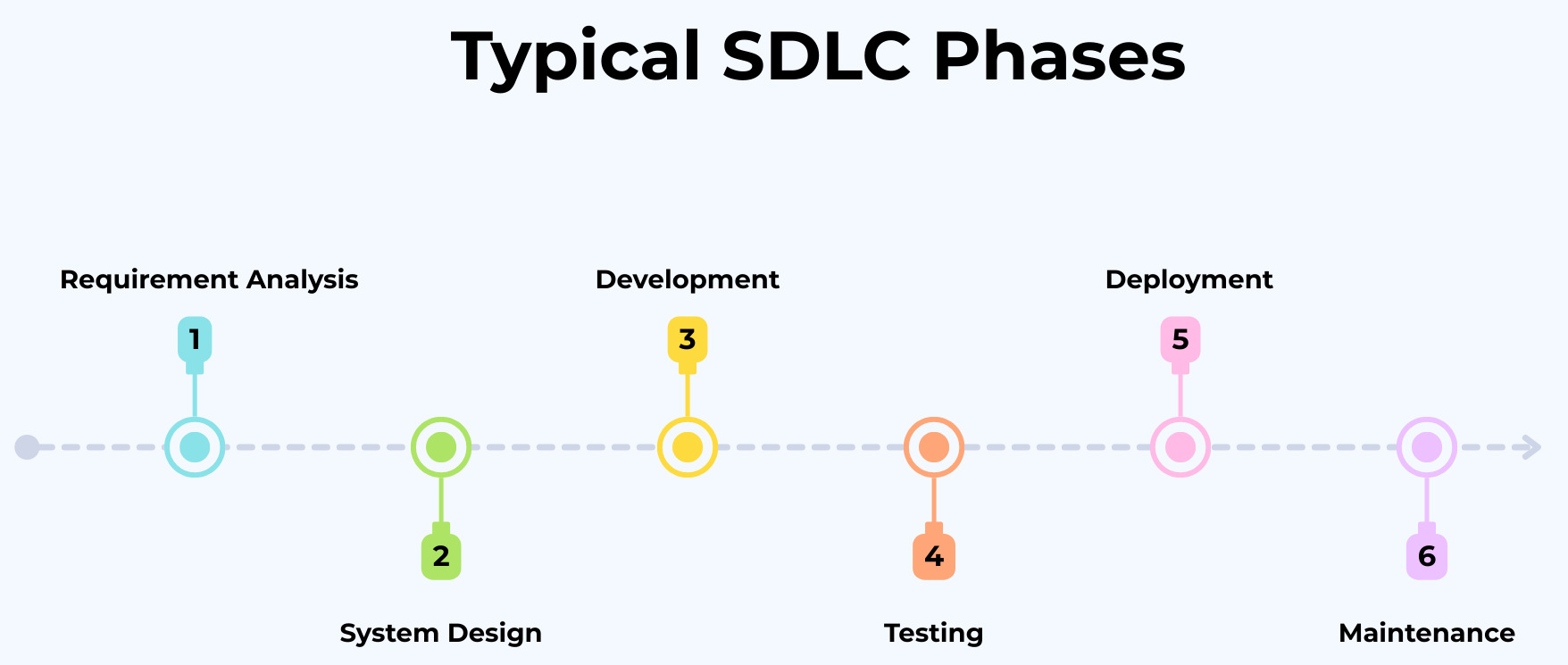
- Requirement Analysis: In this phase, the teams gather and document what the system must do. This includes defining functional requirements, non-functional requirements, system constraints, and technical dependencies. This stage requires creating artifacts such as SRS documents, architecture outlines, and initial test strategies.
- System Design: In this phase, engineers define how the software will be structured and built. This includes designing system architecture, database schemas, APIs, and integration structures. At the same time, QA teams begin early test planning to reduce potential defects.
- Development: This phase involves the actual coding of the application based on the approved design specifications. Engineers build application components, integrate modules, create APIs, and implement UI elements. QA teams often start preparing automated tests in parallel.
- Testing: Here, we test that the software meets quality standards and functions as expected. Teams perform various testing activities such as unit testing, integration testing, system testing, regression testing, and acceptance testing.
- Deployment: The completed software is released into the production environment. This stage includes infrastructure provisioning, application configuration, release management, monitoring setup, and post-deployment validation by QA teams.
- Maintenance: This phase begins after deployment and focuses on keeping the software stable and updated. Activities include fixing bugs, improving performance, adding enhancements, applying security updates, and continuing testing to maintain system reliability.
Differences Between PDLC and SDLC
PDLC and SDLC are closely related frameworks. However, they serve different purposes. As PDLC focuses on the entire lifecycle of a product from idea to retirement, SDLC has a focus on the engineering process of building and maintaining the software.
| Aspect | Product Development Life Cycle (PDLC) | Software Development Life Cycle (SDLC) |
|---|---|---|
| Focus | Focuses on the overall product and its value to customers and the business. | Focuses on the software system itself and engineering. |
| Scope | Wider scope. Works on market research, product design, product strategy, and lifecycle management. | Narrower scope. Focuses on software engineering activities only, such as development, testing, and deployment. |
| Responsibility | Product managers and leadership, business stakeholders, etc. | Engineering and QA teams, technical leads, etc. |
| Duration of Lifecycle | Spans the entire lifespan of a product, from ideation to retirement. | Repeats as software is continuously built, updated, and released. |
| Metrics | Business-based metrics. Examples: customer adoption, revenue growth, market share, and user satisfaction. | Engineering-based metrics. Examples: defect density, release stability, code quality, and development velocity. |
Why Should QA Teams Know About PDLC?
Testing teams have worked keeping the Software Development Life Cycle (SDLC) in mind for a long period. Their main job was to confirm that the software behaves properly and fulfills technical specifications.
However, the role of a modern QA team has shifted today. It needs an understanding of PDLC since product success is dependent on UX and thorough testing. Knowing about PDLC helps QA teams integrate testing activities with the larger objectives of the product and know what customers want.
This way, they can bring more value to QA. All this can be achieved by prioritizing critical user flows, validating real-world scenarios, and then contributing to the product’s continuous growth. Actually, QA is not just about finding defects. It is also about helping to check if the product is actually delivering real value to users.
Read: What Is the Software Testing Life Cycle? A Complete Guide.
Conclusion
So, do you think knowing PDLC is helpful for QA? SDLC helps in building good software systems effectively. On the other hand, PDLC makes sure the product provides value to users and works with business goals.
Today, testing has grown beyond just defect detection. We need to perform validation of the overall product experience and ensure that we deliver value to users.
FAQs
- How is PDLC different from SDLC?
PDLC focuses on building the right product by aligning development with customer needs and business strategy. SDLC focuses on how to build the software correctly, covering engineering activities like coding, testing, and deployment.
- Is SDLC part of PDLC?
Yes, SDLC usually operates within the broader PDLC framework. A product may go through multiple SDLC cycles as new features and improvements are developed during its lifecycle.
- Why do some products fail despite strong SDLC processes?
Products can fail if teams focus only on engineering execution without validating whether the product solves real user problems. PDLC helps address this by emphasizing customer value and market fit.
| Achieve More Than 90% Test Automation | |
| Step by Step Walkthroughs and Help | |
| 14 Day Free Trial, Cancel Anytime |