
Why Critical and Lateral Thinking Matter for Testers
 |
“The important thing is not to stop questioning. Curiosity has its own reason for existing” –Albert Einstein.
Similarly, there is more to software testing than just executing test cases or confirming that a product behaves as expected. Software testing is a discipline built on curiosity, analysis, creativity, and a continuous pursuit of quality. As organizations increasingly rely on software applications to achieve critical functions, testers have become watchdogs of reliability and user experience.
Among many skills that testers should have, two cognitive abilities are indispensable for successful software testing: critical thinking and lateral thinking.
| Key Takeaways: |
|---|
|
This article explores both forms of thinking and their individual importance in modern software testing. You will learn how they complement each other, and how testers cultivate them to enhance their impact.
The Role of Thinking in Testing
Software testing is a skill that incorporates both science and art. Traditional software testing models primarily used predefined test scripts and predictable flows and were based on static requirements. However, they are no longer suitable in today’s fast-paced, user-centric world.
Modern applications continuously interact with vast ecosystems, rely on distributed services, and must operate reliably under varied conditions. A tester must not only verify what is written but also question what is missing, ambiguous, or unexpected.
While automation tools streamline repetitive tasks, it is the “thinking” that differentiates an excellent tester from an average one. Thinking, especially critical thinking, is central to effective testing that moves beyond script-following to deeply analyzing requirements, designing intelligent test cases, identifying hidden bugs, or improving processes.
In essence, the tester’s thought process affects software quality and user satisfaction. Humans naturally excel at questioning assumptions, recognizing patterns, and considering diverse perspectives. Critical and lateral thinking can help testers move from surface-level validation to deep exploration.
Aided by critical and lateral thinking, testers are no longer simple button-clickers. Instead they are vital problem-solvers who can anticipate failures and challenge assumptions. Thereby they protect projects from disasters.
What is Critical Thinking in Testing?
Critical thinking is the ability to objectively analyze information, evaluate assumptions, and draw logical conclusions.
In testing, it involves:
- Asking probing questions such as “What assumptions were considered when developing this feature?” or “Why does the system behave in this way?”
- Challenging requirements that are incomplete, unclear, or contradictory.
- Identifying risks and prioritizing components or areas for initial testing.
- Distinguishing between expected outcomes and potential unintended effects.
- Using critical thinking instead of mere intuition to make data-driven decisions.
Testers can make informed decisions and investigate defects appropriately when they apply critical thinking to testing, examining cause-and-effect relationships, and seeking evidence before concluding. Testers no longer test applications by merely following the scripts.
What is Lateral Thinking in Testing?
Lateral thinking in testing involves creativity, unconventional reasoning, and out-of-the-box ideas.
It encourages individuals to explore problems from new angles. Which is different from relying on standard step-by-step logic and procedures. Edward de Bono popularized the concept of lateral thinking in testing, which involves asking “what if” and “why not” to challenge assumptions and find novel solutions, ensuring a deeper exploration beyond surface-level checks.
In testing, lateral thinking:
- Considers unusual and unconventional user behaviors.
- Imagines misuse cases instead of just use cases.
- Tests beyond documented scenarios that are out-of-the-box.
- Generates new hypotheses by connecting unrelated pieces of information.
- Searches for not-so-obvious defects.
Testers use lateral thinking to uncover surprising issues, those that often slip into production because nobody thought to check them.
Why Critical Thinking is Important for Testers?
With critical thinking, testers can look beyond scripted checks and reveal hidden risks, question assumptions, and identify real-world issues. It makes sure that we achieve software quality by anticipating user behavior, analyzing complex scenarios (such as AI inputs or accessibility needs), and communicating findings effectively. That is ultimately, building more reliable products and saving costs by identifying bugs earlier. Read: Minimizing Risks: The Impact of Late Bug Detection.
Here are some of the reasons critical thinking is essential in testing:
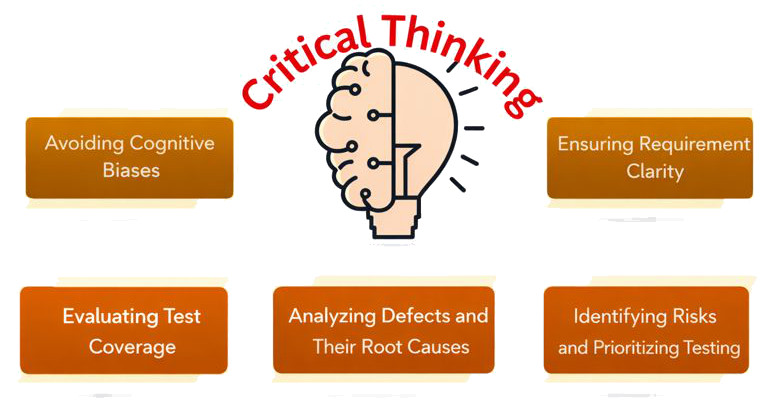
Ensuring Requirement Clarity
Testers must interact with requirements daily to perform their testing. If requirements are written or understood poorly, it leads to inadequate testing and product defects. When testers employ critical thinking, they can identify ambiguities, contradictions, or missing details at an early stage.
For example, if a requirement states “The system should respond quickly,” a critical thinker probes:
- What is the acceptable response time that the system should respond within?
- Does it apply to heavy load or normal load?
- What does “quickly” mean to the user?
Such clarifications prevent misunderstanding and reduce rework.
Identifying Risks and Prioritizing Testing
Software projects often face various constraints, including limited time, resources, or environments. Critical thinking helps testers to assess risks and make informed choices:
- Which areas are most prone to defects and failure?
- What would be the impact if a defect appeared here?
- At which point does the system integrate with another service?
Risk-based prioritization of testing ensures that the most critical functions receive the closest attention, improving efficiency and product reliability.
Analyzing Defects and Their Root Causes
With a critical thought process, testers can track patterns, evaluate evidence, and isolate conditions that cause the defect. They can communicate meaningfully with developers and aid them in faster debugging. A tester who practices critical thinking will document issues clearly, include defect reproduction steps, and propose hypotheses instead of vague descriptions like “It doesn’t work sometimes.” Read: Mastering Bug Reporting in Manual Testing.
Evaluating Test Coverage
Test cases should always cover the system’s functioning. Critical testing aids testers in answering questions such as:
- Have all boundary conditions been tested?
- What happens when negative scenarios occur?
- Is there any dependency we overlooked?
Covering all the aspects of testing ensures that it is not superficial or checklist-driven but thorough and effective. Read: Test Design Techniques: BVA, State Transition, and more.
Avoiding Cognitive Biases
Biases, including confirmation bias and anchoring, often influence decision-making. Testers who utilize their critical thinking skills are aware of these challenges and can objectively reevaluate the testing process.
Why Lateral Thinking is Important for Testers
Lateral thinking enables testers to deviate from obvious paths, reveal hidden bugs, uncover risks, challenge assumptions, and devise innovative and efficient test strategies. This ultimately leads to more robust software by exploring unconventional scenarios and thinking beyond the expected. Lateral thinking encourages creativity and adaptability, preventing blind spots and ensuring comprehensive test coverage, especially in complex systems where standard logic might fail.
Lateral thinking is essential for the following reasons:
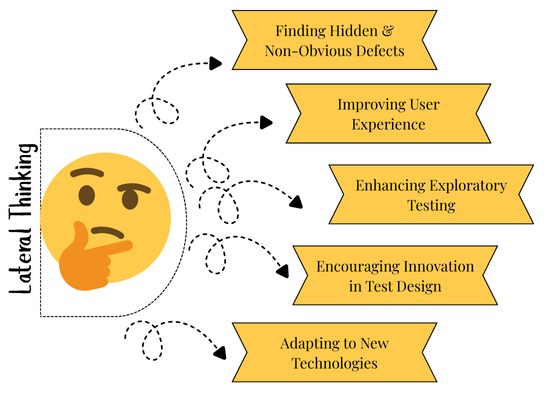
Finding Hidden and Non-Obvious Defects
Most defects in production are due to unexpected behaviors or scenarios that are not covered by the requirements. Looking beyond standard paths, exploring “what if” scenarios, and finding bugs in unexpected places can uncover hidden and non-obvious defects.
Lateral thinking helps testers to uncover:
- Edge cases
- Rare combinations of actions
- Unusual user paths
- Errors caused by misuse
For example, a typical test might check valid login credentials. A lateral-thinking tester thinks beyond the obvious and explores:
- What if multiple logins coincide?
- What if a user copies and pastes a long string into the username field?
- What happens if the browser is refreshed during the login process?
These creative scenarios reveal potential bugs that would otherwise go unnoticed.
Improving User Experience
Testers with a lateral thinking process put themselves in the shoes of various personas, like novice users, power users, elderly users, or users with disabilities. They imagine realistic and sometimes extreme behaviors, including:
- Skip steps
- Enter unexpected data
- Make deliberate mistakes repeatedly.
- Navigate inconsistently
Performing these acts reveals usability issues and enhances the product’s robustness.
Enhancing Exploratory Testing
Lateral thinking drives spontaneous test flows in exploratory testing that extend beyond scripted tests, driving freedom, curiosity, and improvisation. Testers ask questions such as:
- What other testing scenarios can I try?
- Can I combine these two actions?
- What if the system is pushed beyond its limits?
Such extreme tests often reveal deep and complex bugs.
Encouraging Innovation in Test Design
Lateral thinking encourages testers to design innovative test approaches:
- Using analogies to simulate real-world stress (e.g., rapid clicking mimics impatient users)
- Adopting randomness to uncover unpredictable defects
- Using new tools or automation strategies
- Generating novel test ideas is especially beneficial when AI handles routine checks.
Adapting to New Technologies
With rapid technological advancements in fields such as AI, cloud computing, and microservices, testers must contend with unfamiliar architectures and emerging risks. Lateral thinkers adapt more easily to these because they approach challenges with open curiosity rather than rigid logic.
Lateral Thinking vs. Critical Thinking
The following table summarizes key differences between lateral and critical thinking:
| Aspect | Lateral Thinking | Critical Thinking |
|---|---|---|
| Definition | An ability to break established patterns and logical sequences to approach problems from unexpected angles. | A broad cognitive process focused on generating novel and valuable ideas, involving imagination, intuition, and extensive exploration. |
| Goal | To generate insight by deliberately shifting perspective and challenging assumptions, finding solutions “beside” the obvious path. | To explore a broad spectrum of possibilities, even impractical ones, to find innovative solutions. |
| Methods | Using provocations, random input, challenging the status quo, and seeking alternatives. | Brainstorming, mind mapping, role-playing, challenging norms. |
| Nature | Indirect, non-linear, pattern-breaking. | Divergent, multidirectional, open-ended. |
| Scope | Lateral thinking is a tool under the umbrella of critical thinking. | Critical thinking is the umbrella. |
| Approach | Lateral thinking asks, “What if we started here instead?” or “What if the opposite were true?” | Critical thinking asks “What if?” |
| Process | Lateral thinking intentionally disrupts and re-routes thinking paths. | Critical thinking explores broadly. |
Is Lateral Thinking the Same as Critical Thinking?
Lateral thinking helps testers generate new, diverse ideas by exploring different possibilities (creative, “outside the box”). In contrast, critical thinking evaluates and refines those ideas, judging their value, identifying flaws, and finding logical and practical solutions (analytical, “inside the box”). One finds possibilities; the other finds the best path forward, with both essential for comprehensive problem-solving, as they move from broad ideation to focused execution.
So, No! Lateral thinking is not the same as critical thinking. However, you can think of critical thinking as one big umbrella, and lateral thinking is a tool operating under that umbrella.
Lateral thinking is a divergent ability that thinks outside the box, makes unusual connections, and seeks alternative approaches. Its primary focus is on the movement value of ideas or answering questions like “What could be?” For example, when stuck in traffic, lateral thinkers will look for an alternative route or even use a different mode of transportation instead of just waiting.
Critical Thinking is a convergent ability that reaches a logical, well-supported conclusion and finds the best solution. Its focus is mainly on what is rational. For example, when going from one place to another, critical thinkers will analyze the pros and cons of several alternative routes and choose the fastest one.
Although lateral and critical thinking are distinct, they complement each other. Critical thinking involves analyzing existing information logically to evaluate its validity and value. In contrast, lateral thinking employs creativity and non-linear methods to generate new ideas, moving sideways from established patterns to find fresh perspectives.
Critical thinking evaluates, while lateral thinking explores possibilities; both are essential for comprehensive problem-solving.
How Critical and Lateral Thinking Complement Each Other
While they seem different, critical and lateral thinking are deeply interconnected. Critical thinking provides structure, discipline, and logical rigor. Lateral thinking complements it by adding creativity, flexibility, and a broader perspective. A successful tester combines both:
- Critical thinking to ensure comprehensive coverage.
- Lateral thinking to ensure creative coverage.
If critical thinking is a big umbrella, then lateral thinking is a tool under that umbrella. Critical thinking tells you what must be tested, while lateral thinking reveals what else should be tested.
Together, they enable testers to thoroughly assess functionality while uncovering unpredictable issues.
For example, while evaluating a payment gateway:
- Critical thinking identifies mandatory tests such as data validation, security checks, and transaction logs.
- Lateral thinking generates scenarios such as partial payments, network interruptions, rapid resubmission, or changes in device orientation during the checkout process.
Using both approaches significantly expands the test landscape.
Practical Examples of Critical and Lateral Thinking in Testing
Here are some examples of critical and lateral thinking in testing:
Case 1: Critical Thinking Prevents Requirement Gaps
A requirement for an e-commerce system reads: “The discount should apply automatically.” A critical thinker asks questions as follows:
- To which products?
- Under what conditions?
- Can discounts stack?
By seeking clarity on discounts, the tester prevents potential misunderstandings and ensures correct implementation.
Case 2: Lateral Thinking Uncovers an Edge Case
A banking app allows users to transfer money. Standard tests verify expected workflows. A lateral-thinking tester asks:
- What happens if a user initiates a transfer while switching network modes?
- What if the app is minimized during the confirmation process?
- What if the transfer amount is in a foreign currency with exact decimals?
One such scenario may reveal a defect causing transaction duplication, something no requirement mentions.
Case 3: Combining Both for Robust Testing
When testing a form:
- Critical thinking checks validation rules, boundary values, and field dependencies.
- Lateral thinking involves copying and pasting from unusual sources, using emojis, SQL keywords, dragging and dropping unexpected content, or simultaneous multi-tab editing.
The combination of critical and lateral thinking uncovers both logical and unexpected failures.
Benefits to the Organization
When testers apply critical and lateral thinking, organizations gain several benefits as follows:
- Higher Product Quality: Fewer defects escape to production, improving customer satisfaction, trust, and reducing support overhead.
- Reduced Development Costs: Requirement gaps and logical issues are identified early, resulting in significant savings from rework.
- Better Collaboration: Critical thinkers communicate clearly with developers and product teams. They provide insights that help refine designs and prevent misunderstandings.
- Innovation Culture: Testers with lateral thinking inspire teams to explore fresh ideas, improving processes and product features.
- Stronger Competitive Advantage: Products tested with lateral and critical thinking mindsets stand out in reliability and user experience.
The Future of Testing: Critical and Lateral Thinking
As AI-driven test automation tools automate more routine and repetitive tasks, testers must shift their focus to areas that require human intellect. Machines follow rules; testers break them to uncover hidden flaws. Machines test what they are told; testers imagine what the machine cannot test.
With critical thinking, testers can collaborate with AI, evaluate outputs, and maintain accountability. Lateral thinking will help them generate diverse scenarios that AI might overlook.
In an era of continuous delivery, rapid innovation, and increasing complexity, the combination of critical and lateral thinking becomes not just beneficial but critical. Read: Continuous Integration and Continuous Testing: How to Establish?
Conclusion
A tester’s role is evolving fast. Testers are no longer just executors of test cases. They are also investigators, analysts, designers, and creative explorers. Critical thinking helps them to understand, question, and validate systems with logical precision. Lateral thinking empowers them to challenge norms, discover hidden defects, and ensure products behave well in unpredictable and unusual real-world conditions.
Together, these thinking modes transform testers into influential contributors to product quality. They enhance risk detection, improve user experience, encourage innovation, and ultimately safeguard the software’s credibility.
As technology continues to grow in complexity, the importance of these abilities will only intensify. Therefore, for any tester aspiring to be successful, developing critical and lateral thinking is not just an advantage. It is a necessity.
| Achieve More Than 90% Test Automation | |
| Step by Step Walkthroughs and Help | |
| 14 Day Free Trial, Cancel Anytime |