
Will AI Replace IDEs? The Rise of Agentic Coding
 |
| Key Takeaways: |
|---|
|
“IDEs Are Next.” Should We Believe That?
Boris Cherny, the creator of Claude Code at Anthropic, said that he hadn’t written any code or used an IDE for several months. He followed that up with another prediction:
“There’s a good chance that by the end of the year, people won’t be using IDEs anymore.”
This statement has become a hot topic of discussion. As agentic coding takes over the software development landscape, the question now being asked in engineering and QA circles is: what will happen to developers, QA engineers, and the test suites they maintain?
Reports suggest that a large portion of Anthropic’s internal code generation workflow now involves AI assistance. Claude Code is 90% self-built. Their new desktop automation agent, Claude Cowork, was developed in just 10 days using Claude Code.
This is an example of the remarkable speed of software development.
Will IDEs Die?
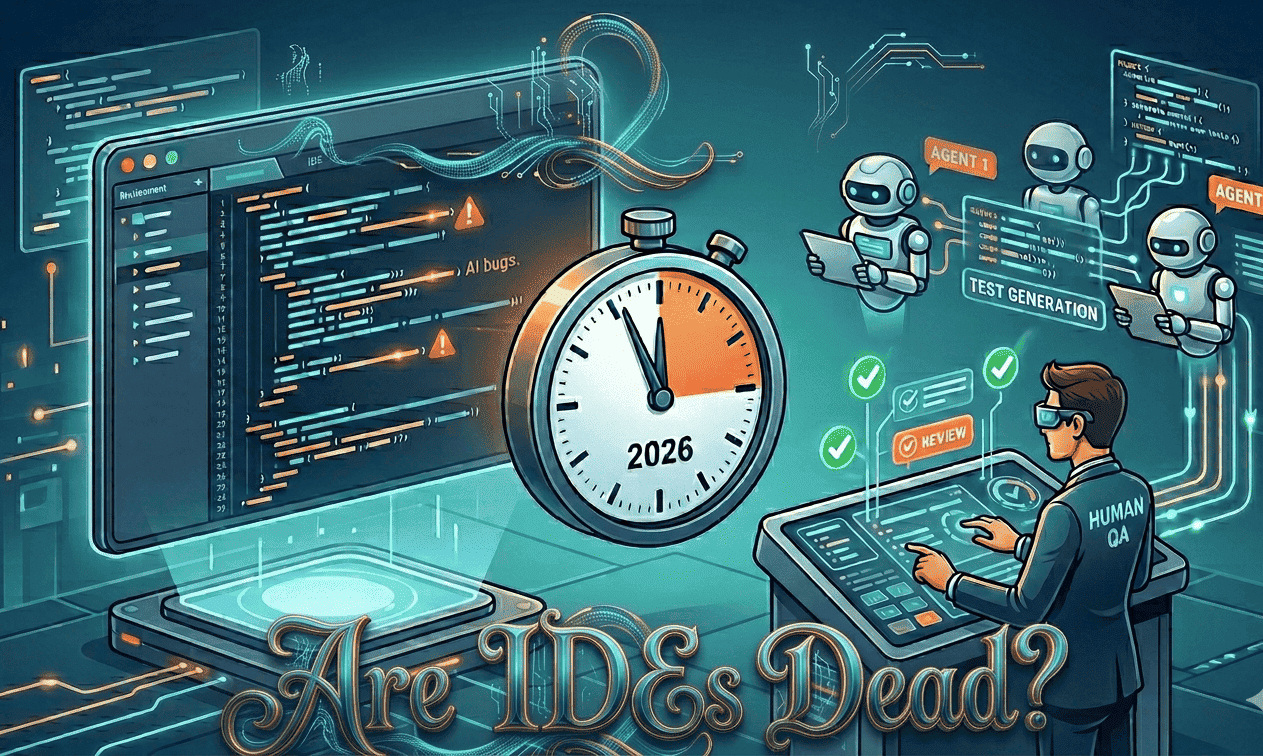
Here’s what’s actually going to happen: IDEs won’t disappear entirely. Instead, they’ll be reimagined as agentic platforms. Instead of serving mainly as coding environments, IDEs may evolve into platforms that coordinate multiple AI agents.
Rather than saying VS Code is dying, it’s more accurate to say that VS Code is becoming a control panel for AI agents. File lists and syntax highlights won’t have the same importance they once had. Instead, the layer that controls the agents will take precedence.
But the big question is how well developers will adapt to this change. The honest answer from those working in the field is that they are not quite ready. Early adopters have pointed out some issues with multi-agent orchestration: there is confusion when multiple agents run in parallel, errors in file editing, and the struggle to keep everything under control. In short, the technology is evolving faster than many teams can effectively adapt to it.
A Word of Caution
According to data released by CodeRabbit, which analyzed 470 real-world GitHub pull requests, AI-generated code has approximately 1.7 times more bugs than human-written code. The findings raise important concerns about software quality and maintainability.: 75% more logic errors, up to 2 times more security flaws, a 3 times increase in code readability problems, and nearly 8 times more performance inefficiencies.
According to a 2026 report by Cortex, while the number of code submissions increased by 20%, the number of incidents per pull request increased by 23.5%, and the change failure rate increased by almost 30%.
In short, the pace of work has increased, but the stability of the system is at risk. By 2026, 75% of tech leaders are expected to face moderate to severe technical debt problems due to the rapid pace of software development using AI.
Why Should Testers Take This Seriously
With the advent of agentic coding, the process of software testing is not becoming irrelevant. Instead, verifying AI-generated code is becoming the most important responsibility in engineering, especially with the rise of AI agents in QA.
Consider the promise of autonomous test generation systems: AI agents can write, run, and self-heal tests without human intervention. A tester can simply describe a scenario in plain language, and the agent will generate test coverage for it. Test suites that adapt automatically as the UI changes are a major revolution.
However, one important reality remains: it’s not yet time to leave AI agents unattended. The incident reports we discussed above make this clear.
A human-in-the-loop (HITL) QA review is essential.Continuous quality validation is necessary to maintain both development speed and software reliability. This balance is becoming more important in modern shift-left vs. shift-right AI testing strategies.
In short, the work of QA professionals is not decreasing, but increasing. The field is expanding into areas such as detecting AI drift, evaluating prompt-based testing, and monitoring the performance of various agents. Even highly autonomous AI systems still require human oversight and governance.
AI in Testing: What Teams Are Doing Now
- Autonomous Test Generation: By generating tests from plain-language descriptions, teams can save time without sacrificing test coverage.
- Self-Healing Test Suites: AI automatically locates the correct elements, even when the application’s UI changes. This eliminates the most expensive and time-consuming maintenance work in traditional automation.
- AI Drift Detection: This helps detect subtle changes in the behavior of models and ensures that existing test assertions reflect the true state of the system.
- Deterministic AI Wrappers for Non-Deterministic Outputs: This helps test the different responses provided by AI-driven conversational interfaces with accuracy and consistency.
For example, generative AI-based test automation platforms like testRigor help teams write tests in plain English without coding knowledge. AI helps maintain these tests as changes are made to the application. This allows the broader QA team to participate in test automation efforts.
Not just those who know Python or JavaScript. It also helps directly test AI features to check accuracy, relevance, and security. This has become a major responsibility in this era, where AI-generated code is part of the product.
A New Era Begins
Agentic coding is not the end of software testing, but the beginning of a new era.
Many teams’ testing practices are not keeping up with the speed at which code is being produced today. This gap is the real risk. Only teams that bridge this gap through AI-driven quality engineering, human-supervised testing, and test generation that happens alongside code production will be able to release products with speed and reliability.
Those that don’t will spend time fixing bugs in production instead of building new features.
Software testing isn’t going anywhere. But if your testing practices were designed for a time when only humans wrote code, it’s time to revamp them for this new era of AI agents.
Learn how testRigor helps QA teams validate AI-generated software at modern development speed: testrigor.com
| Achieve More Than 90% Test Automation | |
| Step by Step Walkthroughs and Help | |
| 14 Day Free Trial, Cancel Anytime |