
QAOps: Framework and Best Practices to Know About
 |
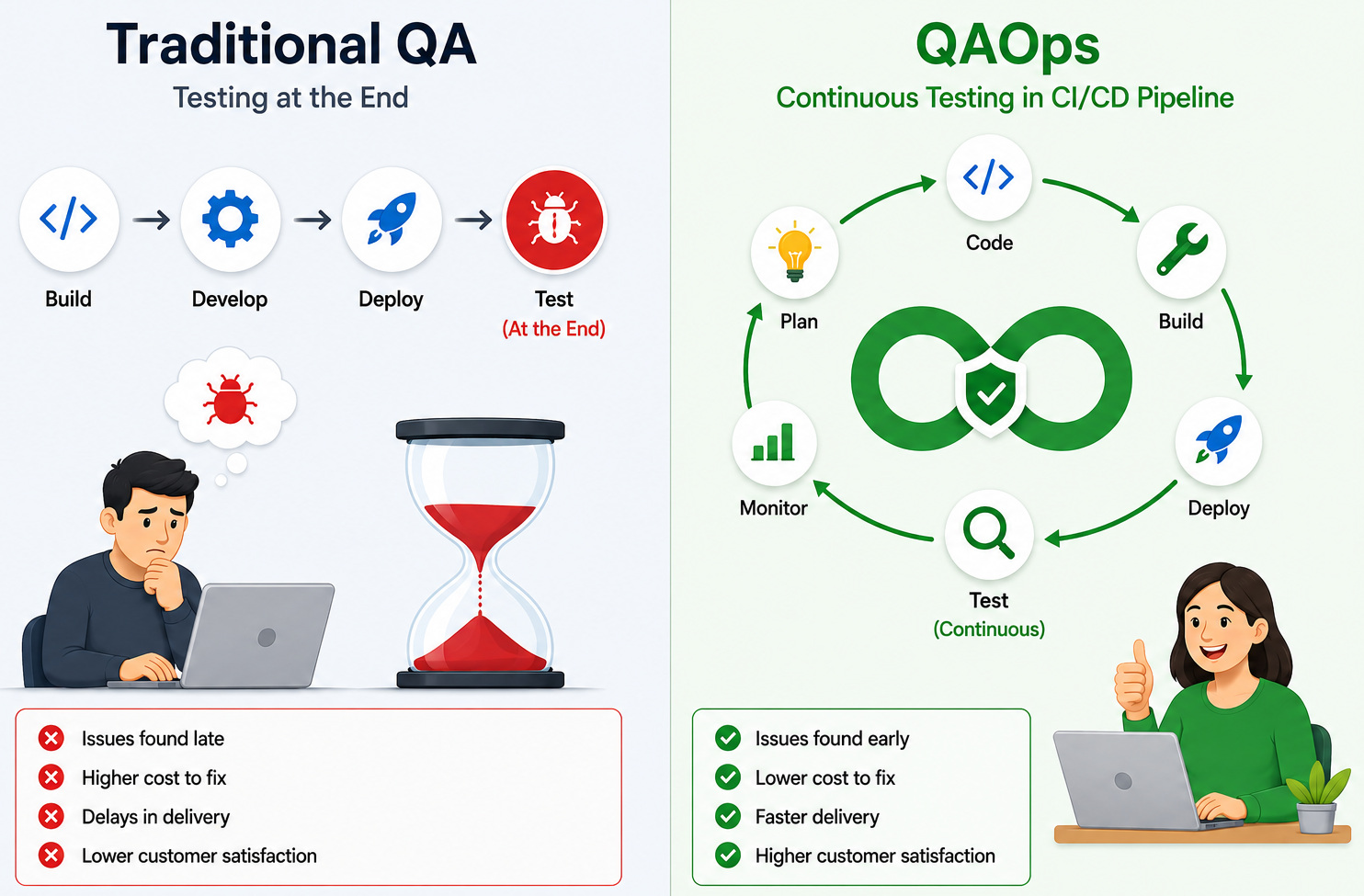
As someone in the QA industry, you would be cognizant of the fact that software testing has changed quite a lot. Modern software teams are expected to deploy releases faster without sacrificing quality. The typical QA strategies where testing is conducted at the end of SDLC are redundant in agile and cloud-native environments. This makes QAOps an essential and not a good-to-have.
It combines quality assurance, CI/CD, automation, observability, and DevOps practices into a continuous quality engineering method. Rather than considering QA as a separate step, QAOps integrates testing into each stage of the software delivery pipeline.
| Key Takeaways: |
|---|
|
What is QAOps?
QAOps is a strategy that smoothly integrates QA (Quality Assurance) into the software delivery pipelines. It requires the QA team to work directly with the development and operations teams.
To successfully achieve this, we need to combine SDLC with QA procedures, automation, and a QA reporting dashboard. By using QAOps, the developer and tester teams will collaborate more closely during the SDLC.
QAOps Beyond Automation
For QAOps, test automation is a core component. But QAOps is far more than just automated testing. It is a comprehensive approach that extends the DevOps principles of collaboration, continuous feedback, iteration, and automation to the entire quality phase.
Key Components of QAOps
Let us see what QAOps is built on.
Shift-Left and Shift-Right(H3)
- Shift-Left: Testing is integrated earlier in the development process. Testers work with developers, analyze code, write tests before code is finished, and interact in static code analysis. This detects bugs when they’re less expensive to fix.
- Shift-Right: Don’t finish off testing at release. Implement monitoring, A/B testing, and observability in production to gather real-world user feedback and consistently improve quality.
- Continuous Testing: Testing is a continuous activity. Every code commit leads to automated tests (integration, unit, UI, API). Quality gates are included throughout the CI/CD pipeline, automatically rejecting builds that don’t adhere to predefined quality expectations.
Infrastructure as Code for Testing
IaC (Infrastructure as Code) handles test environments, test frameworks, and test data using code. This paves the way for consistent, iterative test environments that can be spun up and down as needed, similar to production infrastructure.
Collaboration
Eliminate the isolated silos between Ops, Dev, and testers. Everyone is equally responsible for quality. Testers are included in design discussions; developers help create automation scripts; operations offer feedback from production monitoring.
Read: A Tester’s Guide to Working Effectively with Developers.
Feedback Loops and Observability
Set up fast feedback loops. When a test crashes, the specific team members are informed. Utilize dashboards to visualize quality metrics, test coverage, and pipeline health. Use production monitoring to input insights into the testing process.
Benefits of QAOps
- Faster bug detection and resolution
- Improved release confidence
- Continuous testing throughout development
- Decreased manual testing effort through automation
- Better collaboration between QA, developers, and DevOps teams
- Rapid and more reliable deployments
- Better application stability and user experience
Challenges of QAOps
- Maintaining large automation frameworks
- Managing flaky or unstable tests
- Complex tool integration across pipelines
- Instability of the environment and inconsistent test data
- Skills gaps in automation and DevOps practices
- Delayed pipelines due to excessive testing
- Scaling testing infrastructure for large applications
Types of Testing Used in QAOps
Let us look into the testing types that aid QAOps:
Automated Testing
Instead of depending on manual testers to write test scripts, you use tools like testRigor to build automated test suites. These can then be integrated into your CI/CD pipeline to automatically validate functionality, performance, integrations, and security of your app throughout the development phase.
Parallel Testing
Parallel testing allows you to execute multiple test suites at the same time across different devices, browsers, environments, and configurations. This allows for a significant decrease in the testing time. Scalable cloud infra and containerization allow you to manage broad coverage while also accelerating release cycles.
Scalability Testing
Scalability testing assesses how well the software operates under different usage, and whether it can scale up and scale down resources as per requirement. It focuses on non-functional features. In simple terms, it checks whether the system can grow and perform efficiently when the number of users, transactions, or data volume increases. This testing helps evaluate the app’s capability to manage changes in demand.
Exploratory Testing
Exploratory testing is a software testing approach where the tester simultaneously learns the application, designs test cases, and executes tests on the fly. Instead of strictly following predefined test scripts, the tester actively explores the software like a curious user, while observing behavior, asking “what if?”, and investigating unexpected outcomes.
Geolocation Testing
Geolocation testing is a type of software testing that verifies whether an application behaves correctly based on a user’s geographic location. It checks how the app responds when users access it from different countries, cities, regions, GPS coordinates, or IP locations.
QAOps Lifecyle
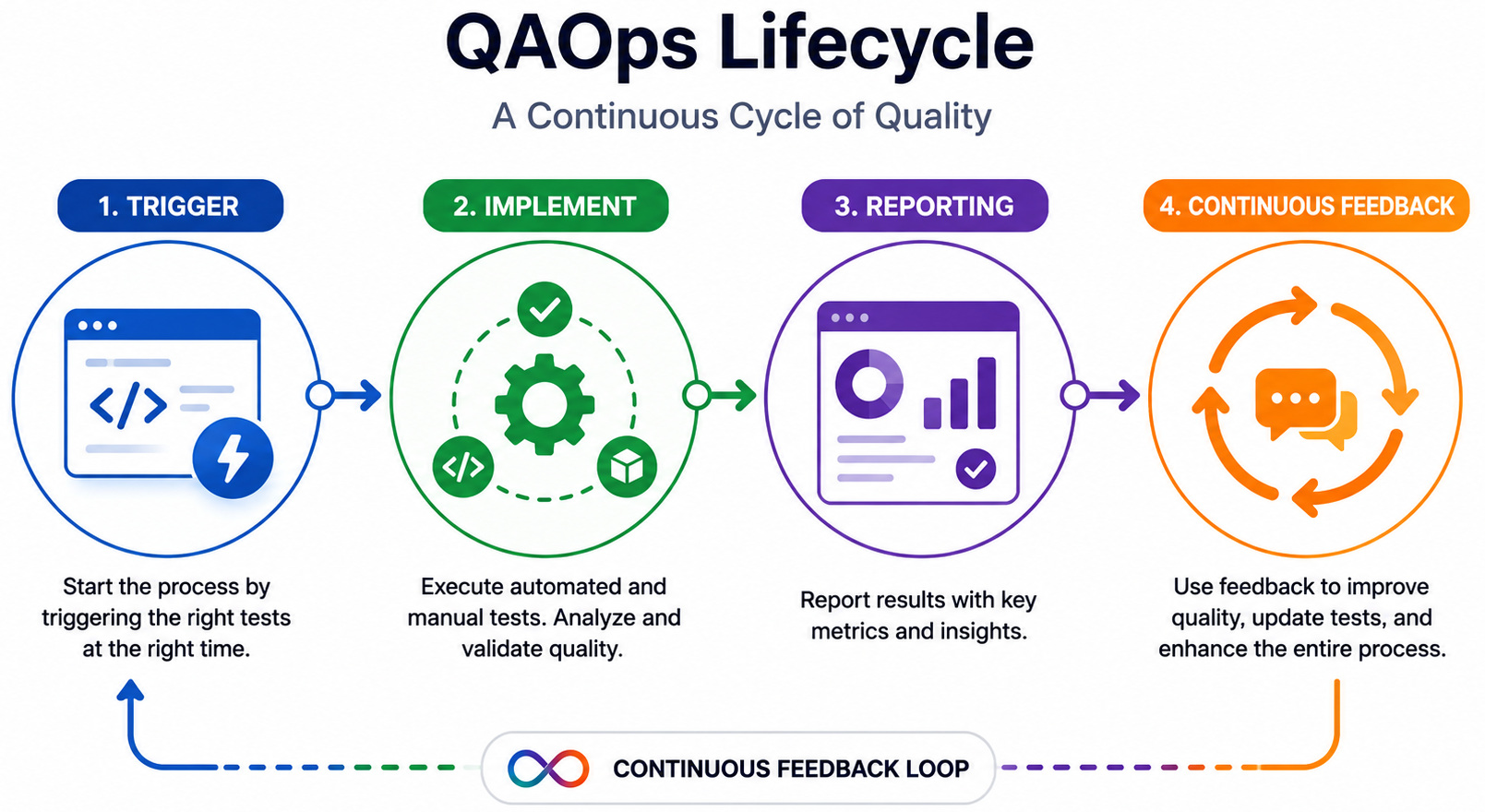
QAOps makes sure new code is validated using the right tools on the CI/CD pipelines. It has three steps:
Trigger
This is the start of the process. You need to trigger the correct tests at the relevant time in your CI/CD pipeline. Concentrate on changes in functionality to avoid wasting time on irrelevant tests or ignored edge cases. Planning this phase right ensures confidence in the product release.
Actions:
- Commit code updates to the repository.
- CI/CD tools catch changes and trigger tests automatically.
- QA teams or developers can manually trigger the processes when required.
Implement
When the trigger phase is approved, the next phase is implementation. This includes parallel testing for the framework, along with the software quality, to make sure that developers have everything they need to produce results as required. Testing is done with DevOps to keep things seamless.
Actions:
- Use automated tests: unit, integration, and end-to-end.
- Execute manual testing for complex scenarios.
- Analyze code for issues like security gaps or performance limits.
- Test performance with tools like JMeter.
Reporting
This is the final stage. It includes reporting the results of the trigger and implementation stages. The final report offers a detailed description. The right reporting module design includes a summary and holistic data, all inside a snapshot.
Actions:
- Efficiently track metrics such as pass/fail rates and defect density.
- Use visual reports and set alerts for critical bugs.
- Communicate findings with product and development teams for fast fixes and strategy updates.
Comparison Between QAOps and DevOps
| Aspect | QAOps | DevOps |
|---|---|---|
| Focus | Continuous testing and software quality | Faster development and deployment |
| Goal | Deliver reliable, bug-free software | Speed up software delivery |
| Main Area | Test automation and quality engineering | Infrastructure and deployment automation |
| Key Practices | Shift-left testing, regression testing, CI/CD testing | CI/CD, Infrastructure as Code, monitoring |
| Team Involvement | QA, developers, automation engineers | Developers and operations teams |
| Monitoring | Focuses on quality metrics and test stability | Focuses on system performance and uptime |
| Outcome | Stable and continuously tested releases | Faster and scalable deployments |
QAOps Best Practices
Successfully enforcing QAOps needs more than just adding automation tools to a CI/CD pipeline. Teams need a QA strategy that supports scalability, collaboration, and continuous improvement.
Shift-Left Testing
Shift-left testing concentrates on moving testing earlier in the SDLC instead of waiting until development is finished. Developers begin validating code through unit tests, static analysis, API testing, and security checks during development itself.
This method helps teams catch anomalies earlier, reduce bug-fix costs, improve collaboration, and prevent delays later in the release cycle.
Test Automation
Automation is an important part of QAOps because modern teams cannot depend fully on manual testing while maintaining rapid release cycles. Automated testing helps validate software continuously across different environments while decreasing repetitive effort.
Automation also speeds up feedback loops by detecting issues immediately in the pipeline. With test automation, you are sure of immediate code verification as they get modified by the developers.
CI/CD Integration
QAOps depends heavily on integrating testing directly into CI/CD pipelines. Every code commit should trigger automated quality tests like build verification testing (BVT), security scans, and deployment verification.
This continuous testing process enables teams to detect issues faster, boost release confidence, and maintain application stability even with regular deployments.
Stable and Reproducible Test Environments
Unstable environments are one of the major causes of unreliable testing. QAOps teams leverage technologies like Docker, Kubernetes, and Infrastructure as Code to build consistent and isolated testing environments.
Stable environments bring down flaky tests, improve debugging accuracy, and support scalable parallel testing.
Observability and Continuous Monitoring
QAOps goes beyond deployment by including production monitoring and observability. Monitoring tools track metrics such as API failures, latency, crash reports, and infrastructure efficiency in real time.
This feedback allows teams to detect issues proactively, improve the user experience, and continuously update testing strategies based on real production behavior.
Reducing Flaky Tests
Flaky tests lead to inconsistent results and decrease trust in automation frameworks. QAOps teams reduce flaky tests by improving synchronization, isolating test data, stabilizing environments, and using reliable selectors.
Reliable automation pipelines help maintain confidence in continuous testing and deployment workflows.
Risk-based Testing Prioritization
Not every test carries the same business impact. QAOps teams prioritize testing based on application risk, critical user flows, security exposure, and frequently changing modules.
Risk-based testing helps optimize execution time, reduce pipeline bottlenecks, and focus automation efforts where failures would hurt the business most.
Service Virtualization and Test Data Management
Modern applications often depend on third-party APIs, microservices, and external systems that may not always be available during testing. QAOps teams use service virtualization and synthetic test data to simulate dependencies consistently.
Proper test data management improves test reliability, prevents environment conflicts, and supports parallel execution at scale.
Security Testing Integration (DevSecOps Alignment)
Security testing should be embedded directly into QAOps pipelines instead of being treated as a separate final-stage activity. Teams integrate SAST, DAST, dependency scanning, container security checks, and secret detection into continuous workflows.
This approach helps identify vulnerabilities early and reduces security risks in rapid deployment environments.
Read: Top 5 QA Tools to Look Out For in 2026.
AI-Powered Automation in QAOps
Organizations have increasingly adopted AI-powered test automation platforms such as testRigor to bring down automation maintenance and improve testing efficiency. Typical automation frameworks often need consistent script updates at any time UI changes take place. This often delays fast-moving development teams.
testRigor helps resolve this problem by using Gen AI-driven and low-code test automation methods. Rather than depending heavily on complicated scripts, teams can build end-to-end tests using plain English instructions. This makes test maintenance easier and scaling across large apps.
In addition, the tool also helps bring down flaky tests, optimize test stability, and speed up regression testing within CI/CD pipelines. For QAOps teams focused on continuous delivery and rapid releases, these tools can drastically bring down maintenance overhead while boosting overall testing efficiency.
Final Thoughts
QAOps isn’t about eliminating testers with automation. It’s about boosting the role of QA in the software ecosystem. It converts QA from a gatekeeper to an enabler. It integrates quality as a shared responsibility across development, QA, and operations.
By reducing the gap between speed and quality, QAOps makes sure that the organization can produce high-quality software at the frequency demanded by the market. Thus, QA turns into a competitive edge and less of a bottleneck.
Frequently Asked Questions (FAQs)
- What is the difference between QAOps and traditional QA?
A: Traditional QA usually happens towards the end of the SDLC, whereas QAOps integrates testing continuously throughout development, deployment, and production monitoring. QAOps also improves automation, CI/CD integration, collaboration, and observability.
- Why is QAOps important for DevOps teams?
A: QAOps enables DevOps teams to maintain software quality while releasing updates faster. It reduces production bugs, improves release confidence, and ensures continuous testing within CI/CD pipelines.
- What are the biggest challenges in QAOps?
A: Some common QAOps challenges include maintaining automation frameworks, managing flaky tests, integrating multiple tools into CI/CD pipelines, handling unstable environments, and scaling testing infrastructure.
| Achieve More Than 90% Test Automation | |
| Step by Step Walkthroughs and Help | |
| 14 Day Free Trial, Cancel Anytime |