Will AI Replace Developers or Increase Demand for Skilled Engineers?
 |
Since the AI wave began, the question we hear most often is, “Will AI replace developers?” Whether you look at LinkedIn, Google, or any other platforms, this is the discussion everywhere. AI may be able to generate code within seconds, but completing reliable, scalable software projects still requires experienced developers.
The growing confidence of developers who rely heavily on AI without formal programming knowledge reflects how accessible software creation has become. Many share examples on social media of applications built primarily using AI tools. This may be possible. But if an unexpected technical issue arises in that project, the question of Developers without strong technical foundations may struggle to identify root causes and resolve complex system issues. All they can do is keep giving prompts to the AI and try again. But an experienced developer can handle it effortlessly. In my opinion, AI is only a tool to make our work easier. It is not a replacement for developers.
| Key Takeaways: |
|---|
|
The Layoff Landscape in 2026
The layoffs at Amazon and Oracle, along with the changes being planned by companies like Microsoft, Google, and Meta, are all concerning. It’s natural to wonder, will software engineers be replaced by AI? Still, one thing is certain: at some stage, these companies will need highly skilled and expert developers. While the fear of AI replacing software engineers is high, many organizations are adapting to the growing engineering complexity introduced by rapid AI-assisted development.
The most important point to note is this: AI may be writing more code today than ever before, but that code often appears accurate on the surface while hiding dangerous errors underneath.
Review Fatigue: A New Crisis
The growing volume of AI-generated code changes has introduced a significant challenge known as review fatigue. The challenge is not that AI cannot generate code effectively, but that it can’t check for itself whether what it has written is correct. This is why the idea of developers being replaced by AI is still a premature concept. Someone must be there to verify the output produced by AI.
Now, how do we control the quality of the code that AI is producing? This presents a new challenge for software engineers and quality assurance (QA) teams. AI has taken over the easier part of software development by writing code in seconds. But it has also increased the burden of debugging, system design, and integration testing.
100 Lines vs 1000 Lines: The New QA Nightmare
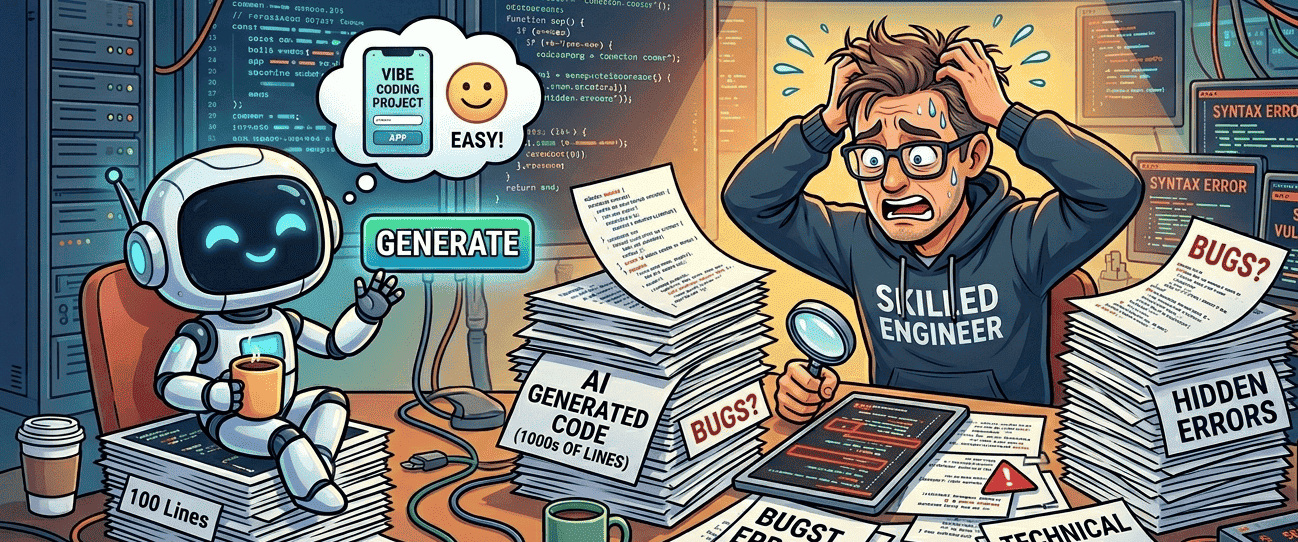
The biggest hurdle in software development today is not writing code, but validating it. When a human writes 100 lines of code, they have a clear understanding of why each line was written. But when an AI produces 1,000 lines of code, a developer has to spend significantly more time to find hidden security issues or regressions that affect older features. For those wondering “Will AI replace web developers?”, the answer lies in the complexity: UI is easy to generate, but it’s not that easy to generate a secure logic that never breaks.
While AI tools like Copilot, Cursor, and Claude help in building code faster, quality assurance (QA) is becoming a challenge for testing teams.
| Feature | Human Development | AI-Assisted Development |
|---|---|---|
| Code Volume | Moderate and written with clear intent | High & often over-generated |
| Context Awareness | Strong understanding of business logic | Limited, mostly pattern-based generation |
| Debugging Effort | Grows in a steady, predictable way | Increases quickly due to verification overhead |
| Security Risk | More intentional and easier to reason about | Harder to detect, can include subtle issues or unexpected outputs |
From Manual Tests to Quality Engineering
AI-assisted development is bringing about major changes in the field of Quality Assurance (QA). If we can replace developers, the need for testing tools would have diminished. But the opposite is happening here. With the advent of vibe coding, where apps are built using AI without understanding programming concepts, we are seeing major issues in the reliability of the system.
If there is an unexpected problem in the coding, a vibe coder cannot find the root cause or debug it. They can only try their luck by giving the AI another prompt. But only a professional developer or QA engineer can understand the exact state of the system.
- When code is being built 10x faster, testing is not something that should be done at the last minute. It should be there from the start.
- It’s not about how much code you generate, but how accurately you can observe what you build while it’s running.
- We don’t need tools that just generate code. We need tools that make sure that the code works correctly.
Are Developers Losing Their Jobs?
If we look at the reality of 2026, will AI replace software developers?
AI may replace very simple entry-level jobs. But the need for expert architects and quality engineers is actually increasing. They are the ones who need to clean up the mess created by AI and make the system accurate.
Although layoffs are happening at companies like Meta and Microsoft, they are often restructuring as part of business strategies. These companies are quickly realizing that they need humans to manage the technical debt created by AI. With problems getting so complex, AI-built software could collapse without a robust automated testing method.
The Real Path Forward
While we wait and see how AI will change the world, one thing is certain: companies that replace developers with robots will not survive in the future. Instead, companies that empower their engineers with better testing tools will succeed.
To manage this bulk of code that AI is creating, our perspective on automation needs to change. This is where generative AI-based tools like testRigor come in. They help teams write simple, highly accurate tests in plain English. This bridges the gap between rapid AI development and testing. If you are a product owner, this is your goal: the speed of AI should never affect the quality and security of your product.
| Achieve More Than 90% Test Automation | |
| Step by Step Walkthroughs and Help | |
| 14 Day Free Trial, Cancel Anytime |