
How to Add Inclusivity During Testing?
 |
Inclusion in software testing goes beyond being a social or ethical responsibility. It is strategically critical for the modern world, which places an ever-growing importance on diversity and access. When products are built and tested with an eye toward inclusivity, they don’t just become accessible to people with disabilities or various needs; they also become easier to use, more resilient, and more accommodating for all. Testing with inclusivity in mind means that everybody can use the product, no matter his or her age, gender, culture, language, abilities or access to technology.
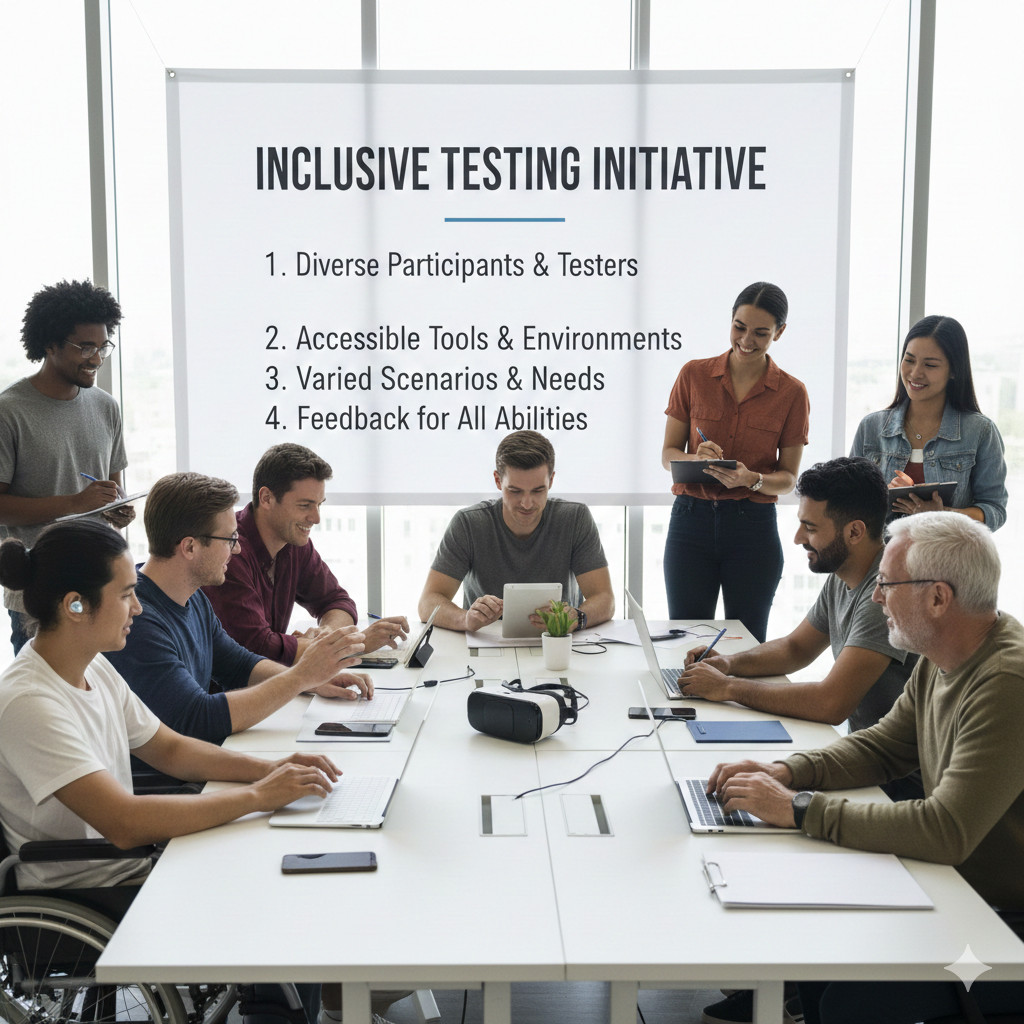
For QA, this change requires a new level of awareness of how biases introduced by the design, code, data quality or testing process can exclude certain users. Empathy and technical precision are necessary for inclusive testing, the researchers say. It requires testers to think beyond the box of traditional functional validations and test experiences from various human perspectives.
| Key Takeaways: |
|---|
|
Understanding Inclusive Testing
- Every User’s Voice Matters: Whether the user is using a screen reader or just on bad wireless service, they deserve the same quality of experience.
- Biases are Identified and Mitigated: Testing is one way to check for any hidden bias in algorithms, data sets, and interface designs.
- Real-world Diversity is Simulated: The test scenarios that are covered represent a wide variety of users, various devices, various connectivity conditions, different ages, and genders of human beings in a broad context.
Ultimately, inclusivity ensures that technology empowers people instead of excluding them.
Read more: Accessibility Testing.
Why Inclusivity Matters in Testing
Beyond meeting moral responsibilities and business goals, inclusive testing also reduces the risk of reputational damage, legal exposure, and costly rework caused by excluding or misrepresenting user groups early in the development lifecycle. Let’s explore why it’s essential.
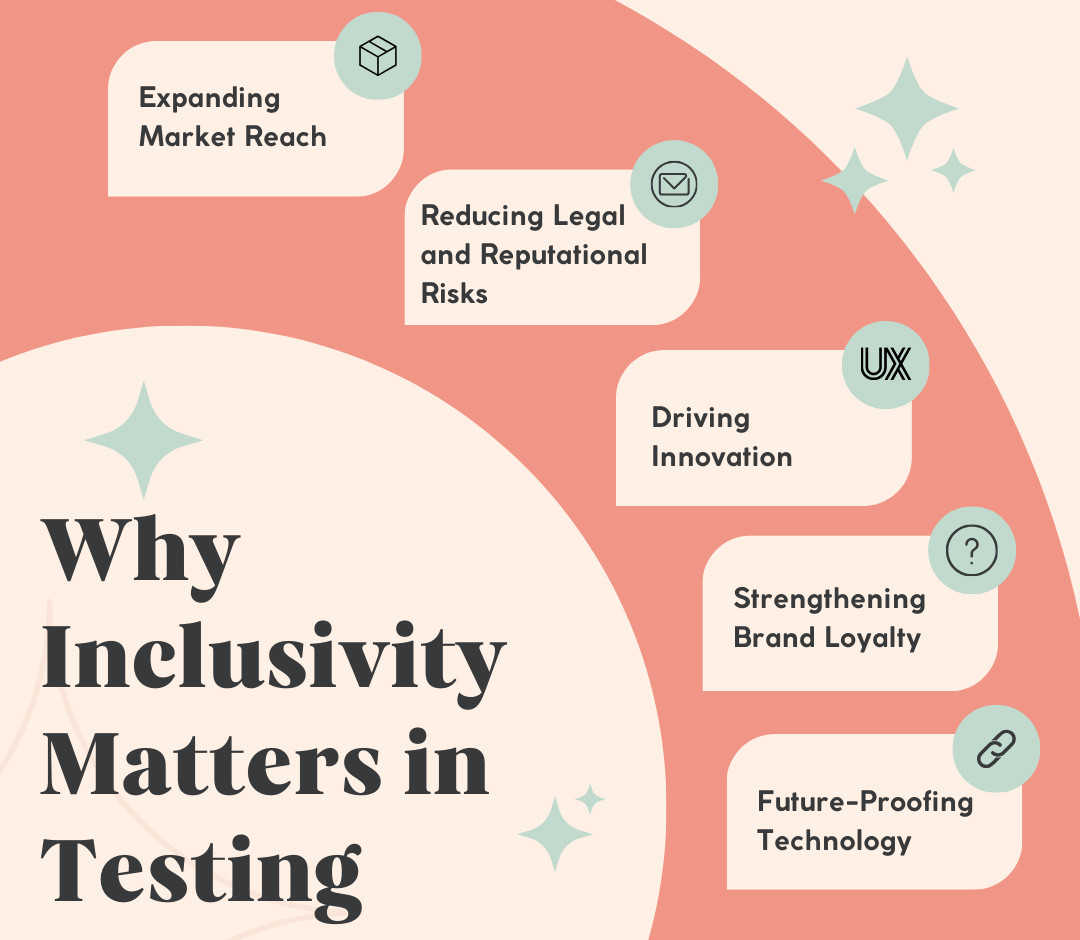
Expanding Market Reach
By making products more usable to a wider range of people, such as those who are older, differently-abled or from different linguistic and cultural backgrounds, organizations gain access to previously ignored markets. More than 1.3 billion people live with some type of special needs, states the World Health Organization. Software development that features inclusivity means this group does not become the forgotten people.
Read: How to Build an ADA-compliant App.
Reducing Legal and Reputational Risks
Non-inclusive applications pose a risk of non-compliance with, for example, the Americans with Disabilities Act (ADA), Section 508 in the US, EN 301 549 in the European Union, and Web Content Accessibility Guidelines (WCAG). These regulations require that digital products be accessible to users with special needs in both the public and private sectors. Non-compliance can lead to legal action, monetary fines, and a major negative impact on an organization’s brand reputation.
Driving Innovation
Inclusivity encourages design creativity. For instance, accessibility-related applications, such as speech-to-text, were originally designed for voice recognition but are now changing the way millions of people interact with technology through voice-first assistants. Inclusivity often leads to main market innovation.
Strengthening Brand Loyalty
When users feel seen and supported, they trust. A firm that puts inclusivity first sets a signal that each and every customer will be valued the same, hence driving up loyalty and advocacy.
Read: How to Build Accessible Software?
Future-Proofing Technology
The spectrum of technology a tester needs to cover is broadening, including smart watches, AR/VR headsets, IoT products, and voice-based assistants, which will all need testing beyond screens. Inclusive is durable in an uncertain digital environment.
The Pillars of Inclusive Testing
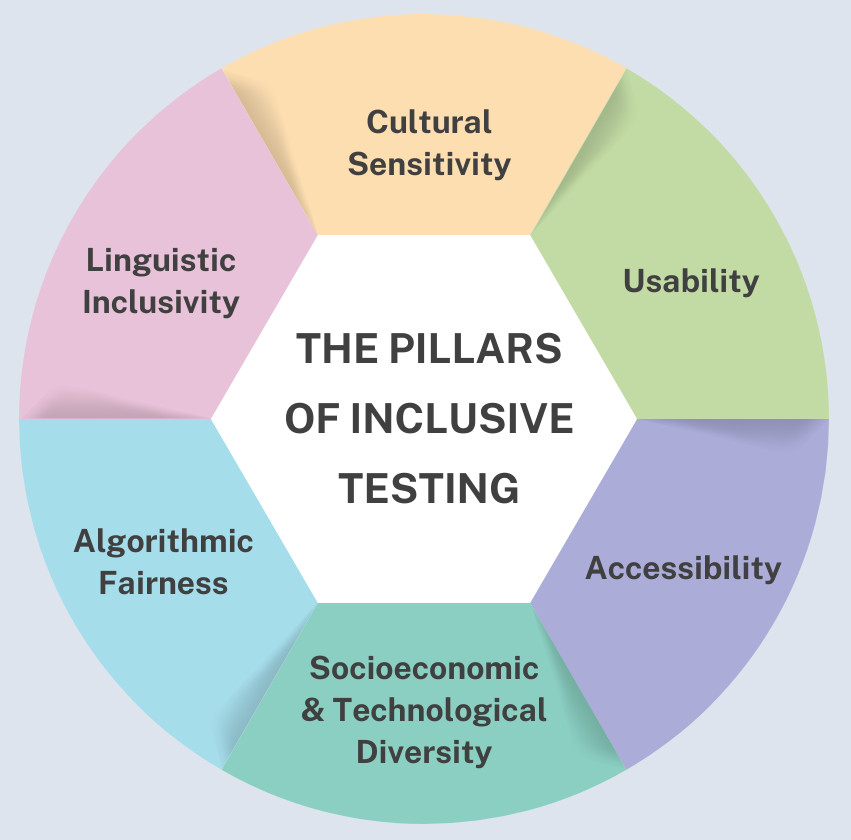
- Accessibility: Making sure people with disabilities, like visual, auditory, cognitive or motor, can use the product. Accessibility tests look at things like screen readers, keyboard navigation, color contrast, and captions.
- Usability: Inclusivity is more of a collective measure of how easy and intuitive something is for anyone. Can a senior citizen use it? Is it easy for a non-technical person to navigate? Read: UX Testing: What, Why, How, with Examples.
- Cultural Sensitivity: Testing for inclusivity involves verifying that the application honors cultural values, including date formats, colors, language idioms, and images, and shouldn’t exclude or offend users.
- Linguistic Inclusivity: The language that we use is incredibly important for inclusivity. It should be tested for localization correctness and also right-to-left (RTL) text alignment, as well as tone of language correctness, without using jargon or gender-based language.
- Socioeconomic and Technological Diversity: It’s important to remember that not everyone has the newest model smartphone or high-speed internet. It’s very important to test on low-end devices and with bad network connectivity for inclusivity.
- Algorithmic Fairness: Inclusive also means non-biased predictions and recommendations in AI-powered systems. This requires machine learning practitioners to verify whether their models are fair both demographically and representatively.
Read: AI Compliance for Software.
Common Barriers to Inclusivity in Testing
- Lack of Awareness: Many teams still equate accessibility with inclusivity, missing the broader perspective.
- Insufficient Training: Testers often lack exposure to accessibility standards or tools like screen readers.
- Limited User Representation: Test cases rarely reflect the diversity of real-world users.
- Biased Data Sets: In AI or analytics systems, biased data leads to unfair predictions or exclusionary features.
- Time and Resource Constraints: Inclusive testing is sometimes deprioritized to meet delivery deadlines.
- Inconsistent Design Practices: When inclusivity is not embedded at the design stage, testing can only catch partial gaps.
Recognizing these challenges helps QA leaders strategize for sustainable inclusivity integration.
Integrating Inclusivity into the Software Testing Lifecycle
To integrate inclusivity into your QA culture, it needs to be integrated throughout the STLC in a systematic way. Read: What Is the Software Testing Life Cycle? A Complete Guide.
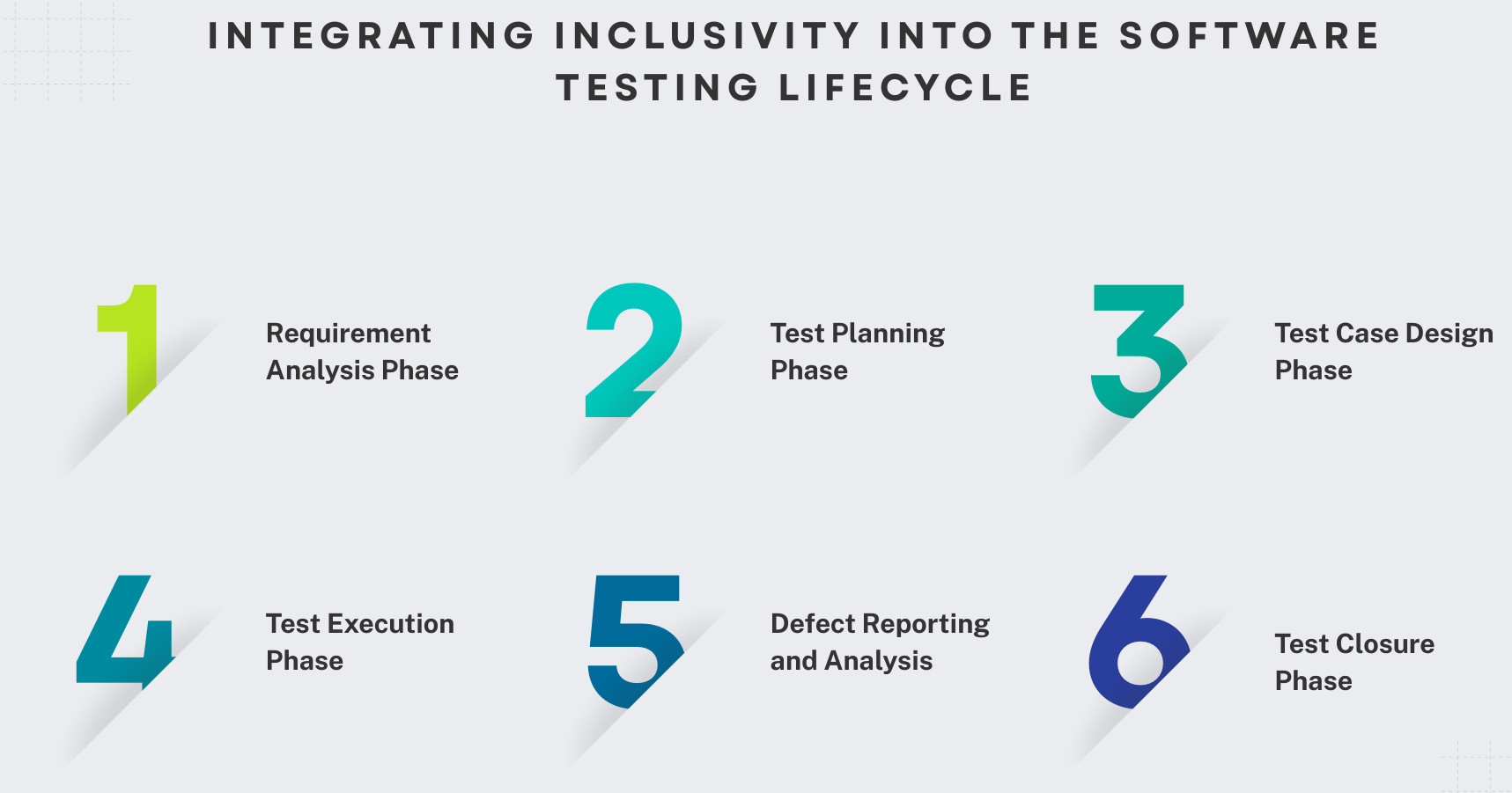
Requirement Analysis Phase
In the requirement gathering stage, QA should work in close collaboration with UX and product teams, so that accessibility and inclusivity are added to the acceptance criteria itself. Personas should be created to accommodate diverse demographics in terms of age, proficiency, device, and language. And finally, non-functional requirements must also have specific metrics for usability, accessibility, and fairness.
Test Planning Phase
Teams should develop a comprehensive test plan during the planning phase that clearly includes testing for accessibility based on WCAG 2.1 or 2.2 guidelines. The plan also needs to cover linguistic and cultural validation, as well as serving across a wide diversity of devices, browsers, and network conditions. Measurable success criteria, such as keyboard navigability and color contrast ratios, will define inclusiveness as you strive to reach them.
Test Case Design Phase
During the test case design phase, you should be simulating different user flows, including those using assistive technology such as a screen reader or voice navigation. Negative accessibility cases (e.g., low color contrast) should be represented to test graceful failure and clear user feedback. A further set of cases should also guarantee that error messages are descriptive and translated, as well as that all the UI elements can be reached using keyboard or tactile commands.
Test Execution Phase
In the testing phase, an inclusive test should be a mixture of manual and automated testing to cover all its aspects. Empathy-based validation is what manual testing should focus on, with testers attempting to get into the shoes of differently-abled users and experience real-world usability pain points. Automated tools, like Axe, WAVE, and Lighthouse help this by surfacing high levels of accessibility violations across your site quickly.
Defect Reporting and Analysis
When reporting and analyzing inclusivity-related issues, it’s important to clearly label accessibility, cultural, or bias as appropriate to ensure your team can see them and prioritize them properly. We need to grade them based on the actual effect on end users, not just technical difficulty. Defect reports should contain concrete guidance to developers and a citation to the applicable inclusive design or accessibility standard.
Test Closure Phase
During test closure, metrics of inclusivity should be recorded in close-out reports and provide an indication as to the quality of the release. This continues down and includes the number of accessibility test cases passed and how diversified you are in coverage for user personas and devices. Key takeaways and lessons learned should also be documented to inform the development of inclusivity in future releases.
Embedding inclusivity in STLC ensures that it’s not treated as a one-time initiative but as a continuous responsibility.
Testing Techniques for Inclusivity
- Accessibility Testing: This is about guaranteeing that an application is usable to individuals with visual, auditory, physical, and/or cognitive impairments. It checks to see if a user can explore and use the app with only keyboard Input, that the text content and background color have sufficient contrast-ratio, and that non-text content is labelled correctly. Testing in this manner makes all functions available to anyone regardless of physical capabilities.
- Localization and Internationalization Testing: This helps to verify that software works seamlessly in various languages and regions. It supports language translations, multiple character encoding support that includes Unicode UTF-8 and RTl (Right-to-left) design, as well as region-specific date formats and time/currency representations. This testing also verifies that the translated content is contextually correct and culturally relevant for the audience being targeted. Read more: Localization vs. Internationalization Testing Guide.
- Usability Testing: Measures general usability across all demographics. Run user testing sessions with participants of varying ages, backgrounds, and abilities.
- Compatibility Testing: Examines performance across devices, browsers, operating systems, and networks. This ensures inclusivity for users with deprecated hardware or limited internet connections.
- Cognitive Testing: Makes the interface elements and processes easier to use with people who have cognitive deficits. Use easy-to-understand language, intuitive navigation, and uniform page design.
- Fairness Testing (AI Systems): If your product uses AI or machine learning, test algorithms for bias using fairness metrics like demographic parity and equal opportunity difference.
Role of AI and Automation in Inclusive Testing
AI and automation can significantly accelerate inclusivity efforts when applied thoughtfully. With testRigor, many organizations have enabled their non-technical stakeholders to create and update automation scripts using plain English, reducing skill and language barriers in testing.
With the support of Vision AI, testRigor can visually understand and interact with application interfaces the way a human user would, enabling tests to remain stable across UI changes while also validating experiences for users with visual or interaction-related accessibility needs.
This capability allows teams to focus less on test maintenance and more on expanding coverage for inclusive scenarios such as diverse user journeys, devices, and interaction patterns. By validating applications through real user behavior rather than fragile technical selectors, testRigor helps uncover usability and accessibility gaps that traditional automation often overlooks.
- Plain-English automation for inclusive collaboration, enabling product owners, designers, and QA professionals from diverse backgrounds to contribute equally to test creation.
- Vision AI-driven stability, ensuring inclusive test cases remain reliable despite frequent UI changes or redesigns.
- Human-like interaction validation, allowing tests to reflect how users with different abilities interact with the application.
- Low-maintenance test suites, freeing teams to invest more effort in testing accessibility, localization, and device diversity.
- Consistent cross-platform validation, helping ensure inclusive experiences across browsers, devices, and environments.
Together, these capabilities make inclusivity practical, scalable, and sustainable within modern QA processes, turning inclusive testing from an aspiration into a repeatable reality.
Building an Inclusive Testing Culture
- Train Your QA Team: Teach testers how to apply accessibility standards, inclusive design principles, and assistive tools. Encourage empathy by conducting exercises that simulate real-world challenges. For example, testing with your eyes closed, or only using a keyboard.
- Collaborate Across Functions: Engage the designers, developers, and product owners early. Inclusivity is most impactful when it is integrated into the DNA of a product, not an afterthought.
- Define Inclusive KPIs: Defining inclusive KPIs will help teams determine the success of how inclusivity is being integrated into the testing. Benchmark metrics could be, such as access pass rates, coverage across different user personas, and percentage of accessibility related defects fixed per release.
- Engage Diverse Testers: Recruit or engage users who truly reflect the diversity out there in terms of ability, gender, and culture to ensure participation in beta/usability testing.
- Celebrate Inclusivity Wins: Celebrate and acknowledge work toward greater inclusivity. If a volunteer tester makes an update for screen reader accessibility or localizes a feature we forgot about, what they have done is commendable.
The Human Element of Inclusivity
Inclusivity testing isn’t just about achieving some standard or other, it’s about caring for our fellow humans. Testers are advocates for those who cannot advocate for user needs in a development organization. With their open mind, quality assurance teams can contribute to turning technology into an enabler rather than a double whammy.
To build empathy, teams can integrate authentic user stories of people who encounter accessibility issues into their testing decisions. Forming feedback loops with customer support is a way to make the real-world inclusivity issues visible early on. So too does driving your QA engineers to actually “walk in the user’s shoes” while testing, leading to better understanding and human-centered validation.
Conclusion
Inclusive testing is no longer optional, it’s a necessity for creating great software that meets the needs and expectations of a diverse world. Through integrating inclusivity into the testing process, using tools powered by AI such as testRigor, and instilling within its team members a culture of empathy, companies can develop products that are fair, accessible, and robust.
At the end of the day, inclusive testing is about ensuring that technology works for everyone, regardless of ability, background, or context, and raises everyone’s expectations when it comes to quality and excellence.
| Achieve More Than 90% Test Automation | |
| Step by Step Walkthroughs and Help | |
| 14 Day Free Trial, Cancel Anytime |