
How to Perform OTT Testing?
 |
OTT media has fundamentally revolutionized the way content is produced, distributed and consumed. Today’s viewers want immediate access to movies, TV shows, including live sports, breaking news, and up-to-the-minute weather coverage on any screen and anytime. From Netflix and Amazon Prime Video to Disney+, Hulu, Apple TV+, Hotstar, and countless regional platforms, OTT services are no longer entertainment products but mission-critical large-scale software systems.
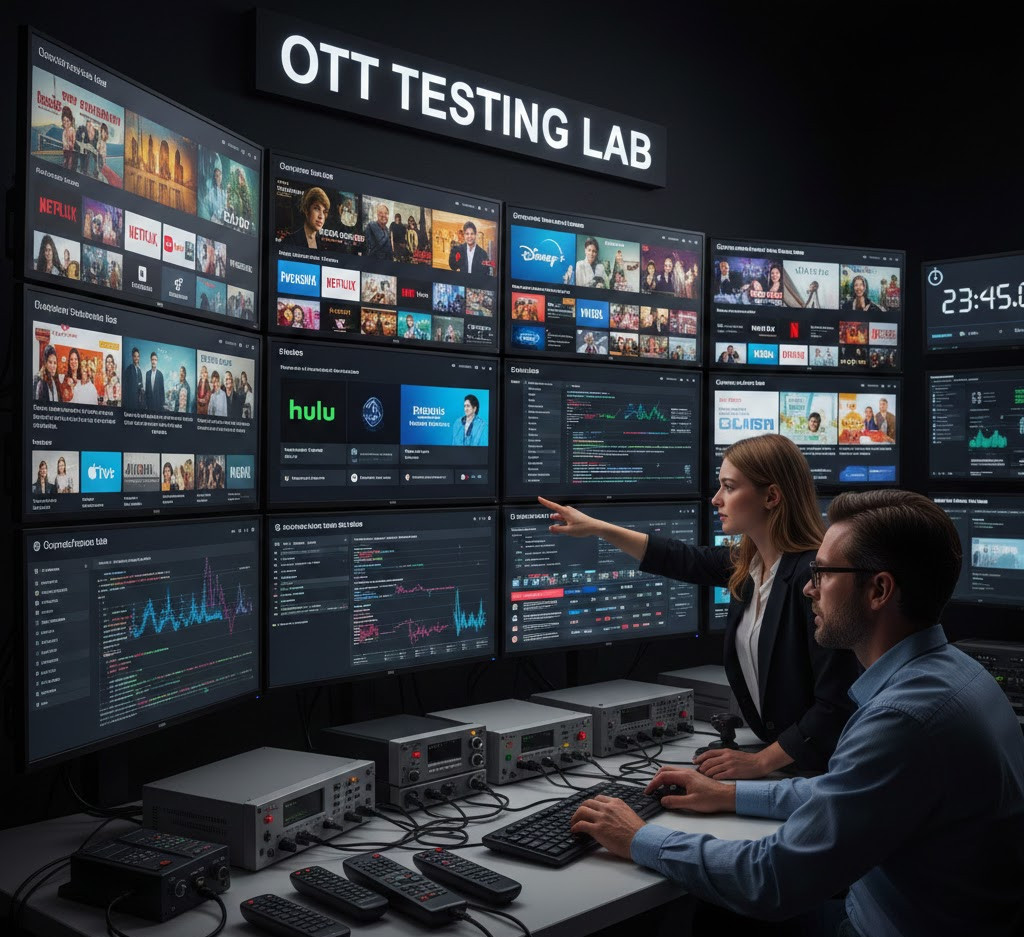
Behind every successful OTT platform is one invisible yet critical practice: OTT testing.
OTT testing is more than just checking if a video plays. It’s about verifying end-to-end streaming quality, device compatibility, network resiliency, security performance at scale, and consistent user experience, all in real-world conditions that can get messy.
| Key Takeaways: |
|---|
|
Understanding OTT Platforms Before Testing
What makes OTT testing different?
Before we get into how to test OTT platforms, let’s first take a look at what differentiates them from standard web or mobile applications. The OTT apps are functioning in a highly disjointed environment of devices, networks, and the content delivery pipeline. Therefore, the quality validation is challenging than a single app UI test.
What is an OTT Platform?
An OTT platform is a service that delivers video through the internet directly to devices, like smartphones and computers, bypassing cable, broadcast television, and film distribution. Unlike typical web or mobile apps, an OTT platform is centered around a stream of endless content rather than defined user interactions. They process streaming data in real-time or near-real-time, causing a number of specific performance, latency, and buffer management issues. This streaming-first behavior has a profound impact on the way reliability and user experience need to be measured.
Additionally, OTT platforms serve millions of users simultaneously across various regions and under different network conditions. They automatically change the quality of the content depending on bandwidth and device capability, ensuring continuous play.
These platforms work across dozens of device types, operating systems and screen shapes, from smart TVs to mobile. In addition, due to stringent content licensing regulations, they also implement digital rights management; hence, OTT platforms are not just standalone apps but rather complex environments.
Read: Cloud Testing: Needs, Examples, Tools, and Benefits.
Why OTT Testing is Business-Critical
In OTT businesses, quality translates directly to revenue, especially during peak events such as live sports. One buffering problem can create mass user churn, social media backlash, and immediate churned subscriptions. Eventually, those failures destroy user trust and incur long-term brand damage, from which it is very tough to recover.
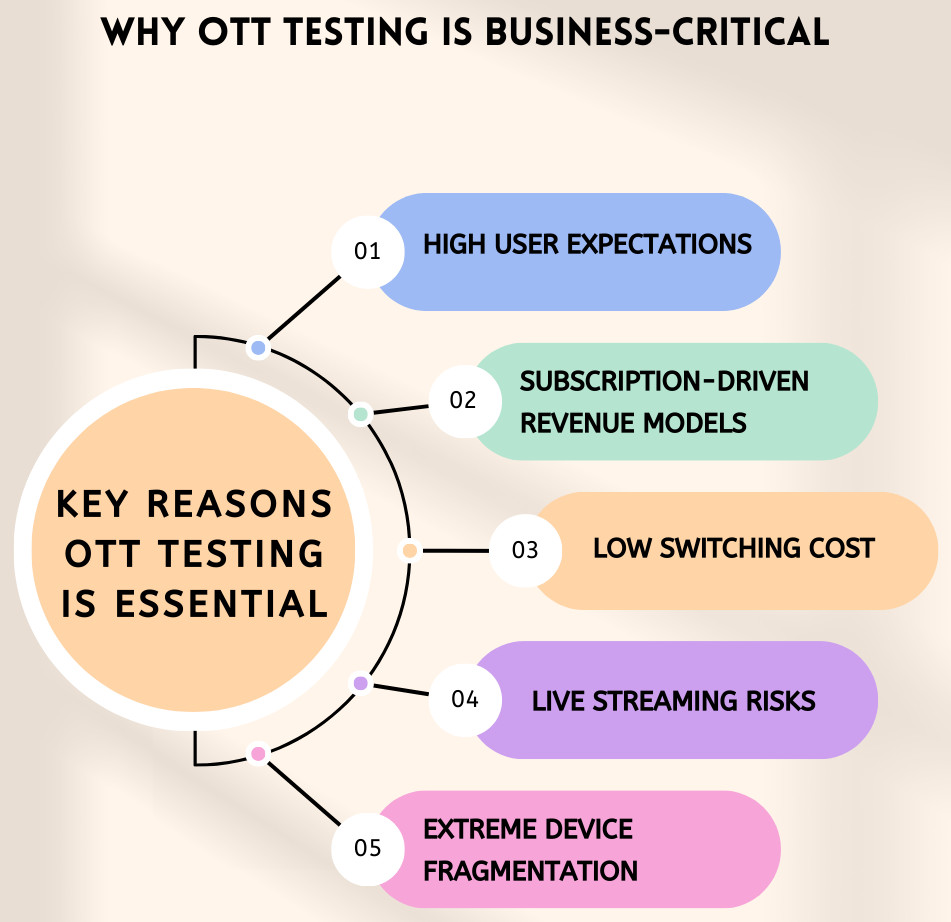
Key Reasons OTT Testing is Essential
- High User Expectations: Users want to press ‘play’ and watch with no buffering, on any device. Even the smallest delays or degradations in quality are readily apparent and lead to dissatisfaction from users.
- Subscription-driven Revenue Models: OTT platforms depend significantly on subscription-based revenue for continued profitability. Any small quality problems can easily be the tipping point for users to cancel at any time they think the service is not worth paying for.
- Low Switching Cost: It is easy for users to change from one OTT address to another with little or no effort. As a result, tolerance for lousy service is much lower than with services from traditional media.
- Live Streaming Risks: For live events such as sports or concerts, there’s no room to correct issues after the fact. Failure is, when it happens, worldwide in the blink of an eye
- Extreme Device Fragmentation: OTT services operate on thousands of different device models with their own unique hardware and operating systems. One single compatibility breakage will affect a very large number of users at the same time.
OTT testing is not a nice-to-have; it’s a competitive survival tactic. If you can’t provide a high-quality, dependable streaming experience, users will leave in droves for speedier competitors.
Read: How to Automate Web Testing with testRigor.
How an OTT Platform Works
Successful OTT testing requires a deep comprehension of the platform architecture and what every piece contributes to the final user experience. As OTT platforms constitute not isolated, but networked environments, testing has to focus on verifying individual elements as well as their interplay in a real-world environment.
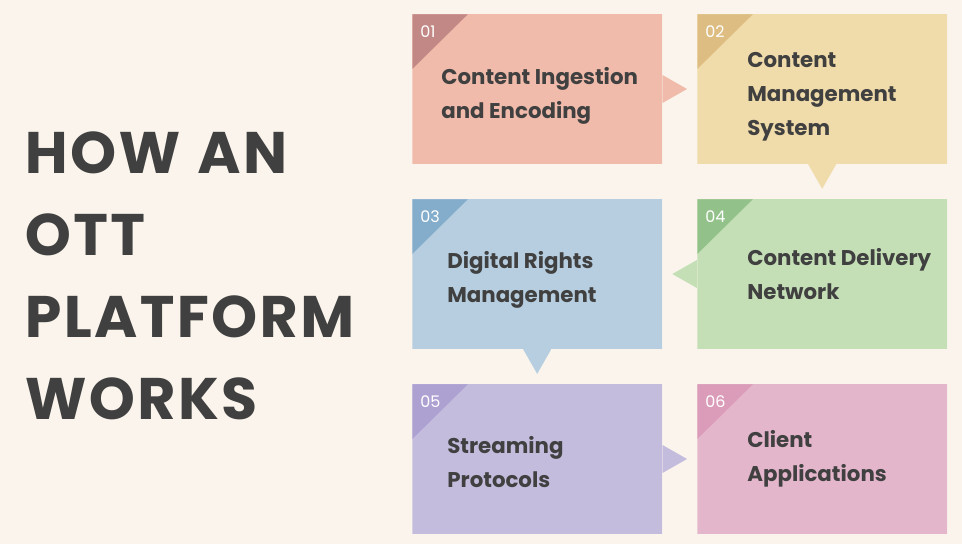
Content Ingestion and Encoding
Raw video files are ingested and transcoded to multiple formats, resolutions, and bitrates on-the-fly for different devices and network bandwidths. This mechanism provides consistent playback on various screen sizes and bandwidths. Any issue at this stage directly affects video quality and stream reliability.
Testing impact: The testing priority will be to test encoding accuracy, ensure the video and audio stay in sync during playback, and confirm compatibility with all supported codecs.
Content Management System (CMS)
The CMS takes care of content metadata like titles, descriptions, genre types (drama, comedy and so forth), thumbnails, and license info. It is central to how content on the platform is discovered and engaged with by users. Mistakes in the data from CMS can result in a bad user experience or wrong content served.
Testing impact: Testing is specifically concentrated on metadata, content classification, and validation of the correctness of search and recommendation relevance.
Digital Rights Management (DRM)
Premium content is protected against piracy, and only licensed end users have access to the licensed media. It applies policies according to user rights, type of device, and location. DRM mishaps can lead to crappy content being leaked or prevent regular users from accessing even legitimate content.
Testing impact: License acquisition, playback authentication, policy-based restrictions by region, and offline viewing policies must be thoroughly tested.
Content Delivery Network (CDN)
CDNs scatter content over a network of worldwide edge servers (with the goal of low latency and distributing response requests efficiently). They are crucial for ensuring smooth latency during peak loads, especially in live environments. Every CDN problem can cause buffering or service downtime.
Testing impact: Testing ensures correct geo-based content delivery, proper CDN failover mechanisms, and stable load-balancing behavior under high traffic.
Streaming Protocols
Adaptive media content is served by the OTT platforms using streaming protocols like HLS, MPEG-DASH and Smooth Streaming. These protocols enable the player to adapt video quality depending on the current network state. There are protocol-level mistakes that can significantly impact the performance of playback.
Testing impact: Testing needs to verify protocol support on devices, adaptive bitrate behavior, and player resilience during network fluctuations.
Client Applications
OTT apps are functional across mobile platforms, Smart TVs, browsers, streaming devices and gaming consoles. Every client has different HW capabilities, OS and UI behaviour. This variety adds much to the range and challenge of testing.
Testing impact: Testing must ensure consistent functionality, performance, and user experience across all supported devices and operating environments.
Types of OTT Testing
OTT testing needs to be multi-dimensional by nature as it has to validate the functionality, performance, quality, security, and user experience at once. Streaming workflows are not safe to be tested by any methodology on their own, considering their complexity of, the fragmentation of devices, and the variability over networks. A well-rounded OTT testing approach uses a variety of testing and quality assurance techniques to achieve high reliability, scalability, and user experience.
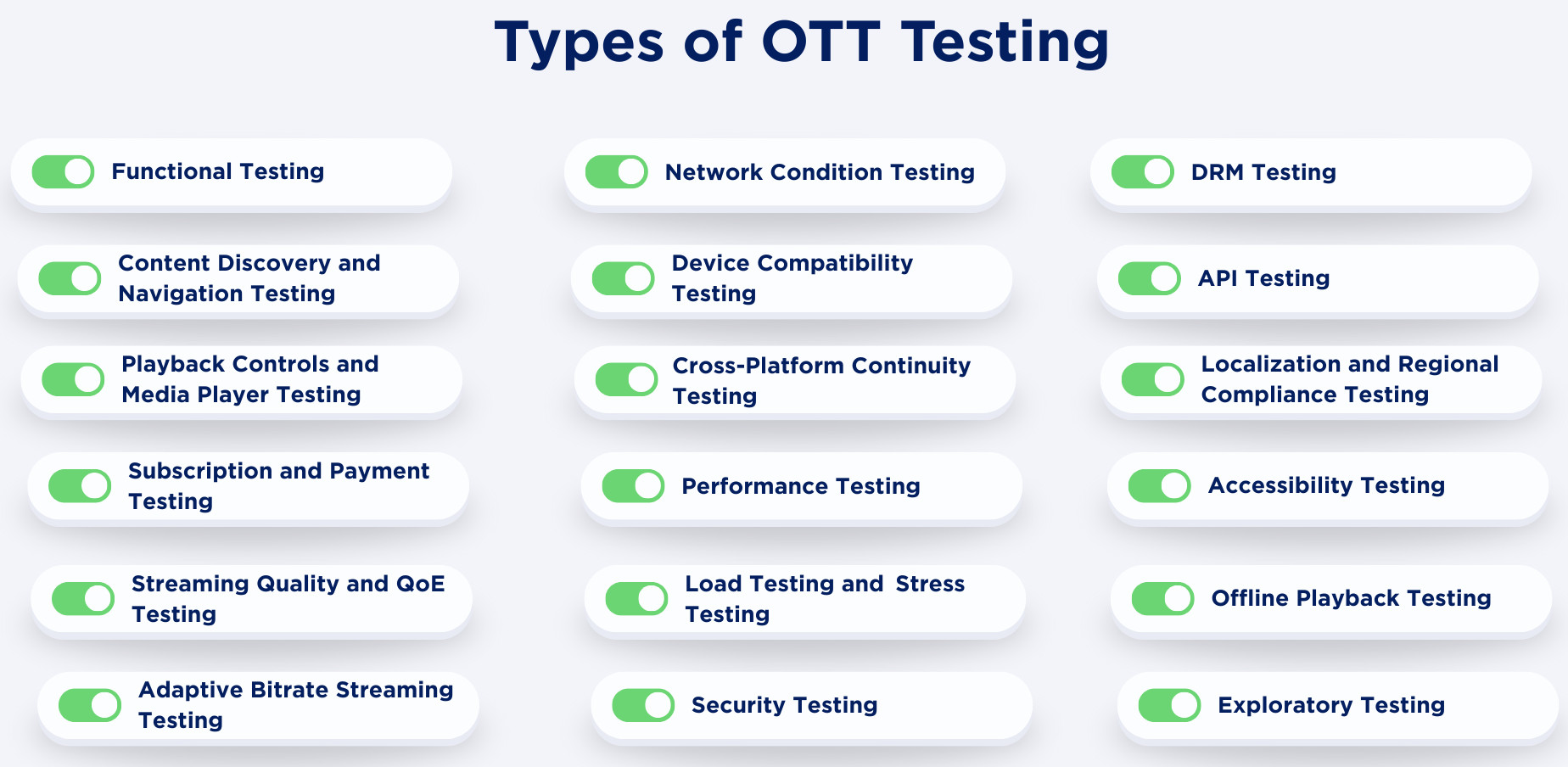
- Functional Testing: This is to make sure the OTT platform behaves in a particular way, dictated by business and user requirements. This checks essential process flows in areas like user authentication, profile management, content access and session management. A failure here may directly block the user from using the service. Read: Functional Testing Types: An In-Depth Look.
- Content Discovery and Navigation Testing: Content recommendation is an important component of user engagement and content consumption. Testing is on the personalization logic, proper categorization, search relevancy, and navigation flows. Even slight differences in metadata will prevent their content from being as visible or just reduce its retention.
- Playback Controls and Media Player Testing: The media player is the engine of the OTT experience, and should run perfectly at all times. Testing underlines playback controls, resume feature, subtitles, audio choice, and stability during long viewings. Player decay is directly observable by users and is not at all trustworthy. Read: How to Automate Searching for Music Tabs Testing.
- Subscription and Payment Testing: Ensure that money-related workflows function without errors. It includes free trials, plan upgrades, renewal, cancellation, refund, and failure logic. Weakness here causes immediate loss of both revenue and customer satisfaction. Read: How to Do Payments Testing: Ensuring Secure and Seamless Transaction Processing.
- Streaming Quality and QoE Testing: In Quality of Experience (QoE) test content evaluation, the perception by users of how streaming works is considered, rather than purely technical metrics. It pays attention to startup time, buffering way, audio-video synchronization issues, frame drops, and resolution steady rate. Quality of Experience should be kept uniform under different network conditions. Read: Automated Testing for Real-Time Streaming Applications.
- Adaptive Bitrate Streaming (ABR) Testing: Verifies that the platform is able to handle rapid video quality adjustments in response to bandwidth variations. You get a nice transition between resolutions with no apparent buffering, freezing or jerking. Typically, ABR failures due to logic errors cause negative viewing experiences when the network conditions change. Read: How to do audio testing using testRigor?
- Network Condition Testing: Simulates various network connection conditions, including low bandwidth, high latency, packet loss, and intermittent disconnection. On the other hand, OTT viewers receive content over diverse networks, and such testing is very important. Without simulating the network, a lot of real-user problems pass unnoticed. Read: Neural Networks: Benefits in Software Testing.
- Device Compatibility Testing: OTT platforms need to support a diversity of devices in terms of hardware, codecs, and interaction paradigms. Testing can help ensure that functionality, playback quality, and UI operation are consistent across smartphones to TVs, streaming devices to consoles, and browsers. Testing for device compatibility is usually the QA team’s most significant effort. Read: Cross-Device Testing: Strategies and Tools.
- Cross-platform Continuity Testing: Verifies that the user experience works across different devices. It keeps track of watch history, playback position, favorites, and recommendations. Failures in this area destroy the illusion of a connected, intelligent platform. Read: Cross-platform Testing: Web and Mobile in One Test.
- Performance Testing for OTT Platforms: Extends beyond traditional response-time validation. It tests stream startup time, concurrent stream performance, backend scalability, API fidelity and CDN throughput. This is important to test before significant releases and high-traffic events. Read: What is Performance Testing: Types and Examples.
- Load Testing and Stress Testing for Live Streaming: Live streaming presents some highly challenging and unpredictable load patterns. The testing simulates users in the millions logging in at once, massive geo-distributed traffic spikes, and real-time interaction. Stress testing is useful to determine the limits of a system before it breaks in front of an audience.
- Security Testing in OTT Platforms: Ensures that sensitive user data and premium content won’t be exposed. It confirms authentication, authorization, secure streaming URLs, DRM regulation, payment security, and API call restricting. Security lapses can lead to the type of piracy, hacking, and legal woes that would substantially harm producers. Read: Security Testing.
- DRM Testing in OTT Platforms: DRM certification is to make sure the rules for the DRM task are passed through all zones and all devices. It confirms the purchase of licenses, the expiry of offline playback, region-based restrictions, and screen recording inhibition. The problems with DRM are very conditional on the device and OS combination.
- API Testing for OTT Platforms: APIs are key to OTT ecosystems, which bridge clients and backend services. The test verifies authentication, metadata access, playback entitlements, recommendations, and billing APIs. Robust API testing can catch bugs early on, before they reach the UI. Read: How to do API testing using testRigor?
- Localization and Regional Compliance Testing: OTT platforms have a presence in several countries, each with its own languages and rules to follow. Testing is implemented to guarantee that translations, subtitle alignment, audio dubbing, and the rendering of UI are accurate in all locales. It also verifies adherence to regional licensing, age rating, data protection, and scoop shape laws. Read: Localization vs. Internationalization Testing Guide.
- Accessibility Testing for OTT Platforms: With accessibility testing, OTT platforms can be used by all. It checks that your app has support for screen readers, customizable subtitles, high-contrast mode, voice control, and remote navigation. This is more of a legal and ethical obligation. Read: Accessibility Testing: Ensuring Inclusivity in Software.
- Offline Playback Testing: This introduces and complicates further the content delivery and resource synchronization. Testing involves download quality, storage limits, expiration of content playback without internet, and syncing on reconnect.
- Exploratory Testing in OTT Platforms: Exploratory testing serves as an automation sidekick, as it discovers real-world usability and edge-case usage issues. Testers replicate natural user actions to uncover UX inconsistencies, device-specific matters, or any potential crashes. Human intuition-driven exploration is an excellent advantage for OTT platforms. Read: How to Automate Exploratory Testing with AI in testRigor.
Automation Strategy for OTT Testing
OTT testing must be automated to accommodate multiple device types and complex workflows across frequent releases. An automation strategy that is clearly defined and concentrates on areas with high impact
What to Automate
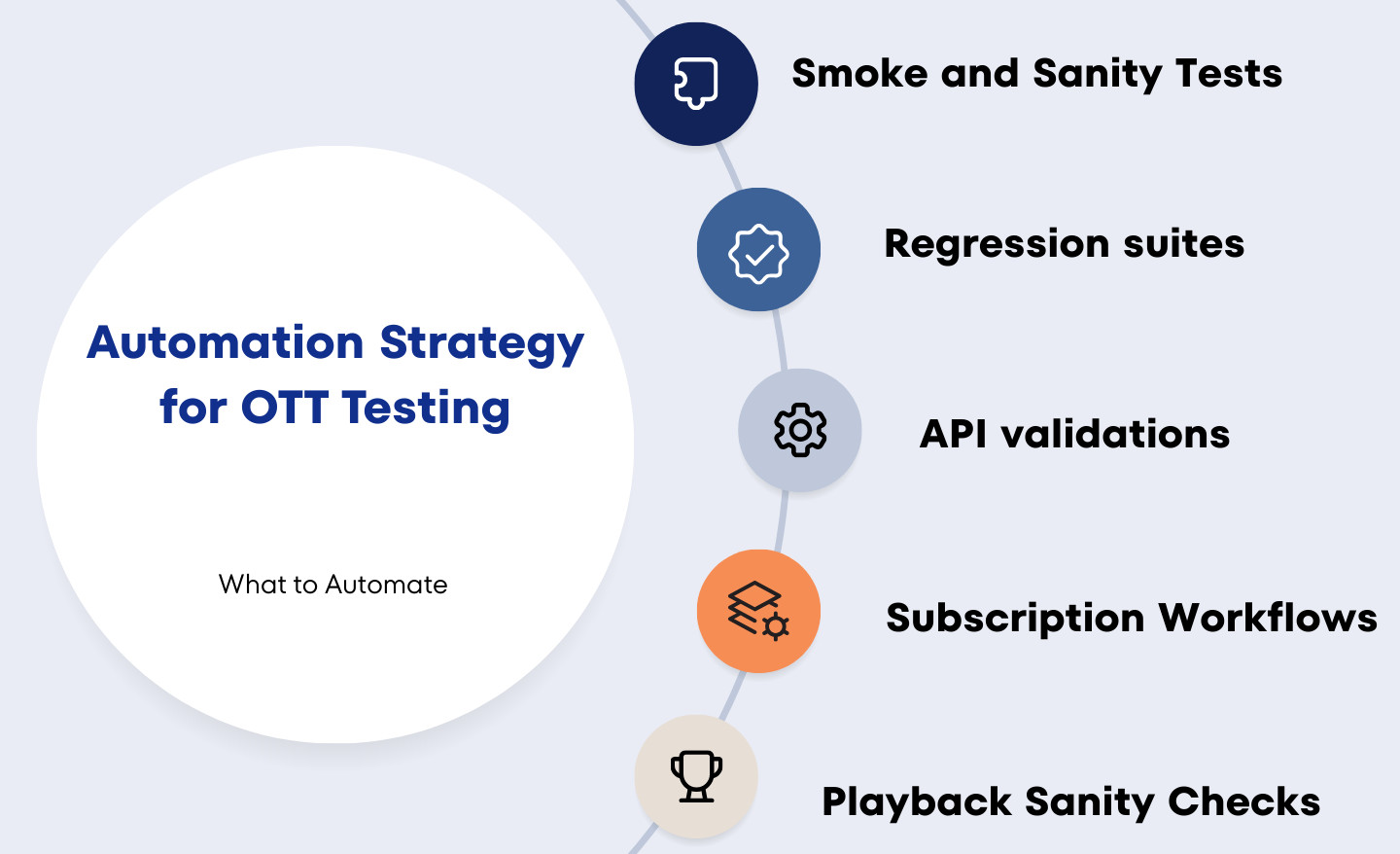
- Smoke and Sanity Tests: These tests serve as a sanity check to ensure fundamental platform features like login, content access, and basic playback are functioning appropriately. They serve as the first quality gate for all builds.
- Regression suites: Regression automation makes sure that the current functionality still works once the new changes are deployed. It shields critical user journeys from being broken by rapid changes.
- API validations: API tests verify backend services, including authentication, content metadata, playback authorization, and billing. Automated APIs make it easier to catch things earlier before they pop up on the UI.
- Subscription Workflows: Automation covers free trials, plan changes, renewals, cancellations, and payment failures. These workflows are business-critical and must remain consistently reliable.
- Playback Sanity Checks: Playback automation validates basic video start, pause, resume, and stop functionality. It ensures that the media player remains stable across builds without deep performance analysis.
Challenges in OTT Testing
OTT testing comes with peculiarities that make things much more complicated than the simple application test.
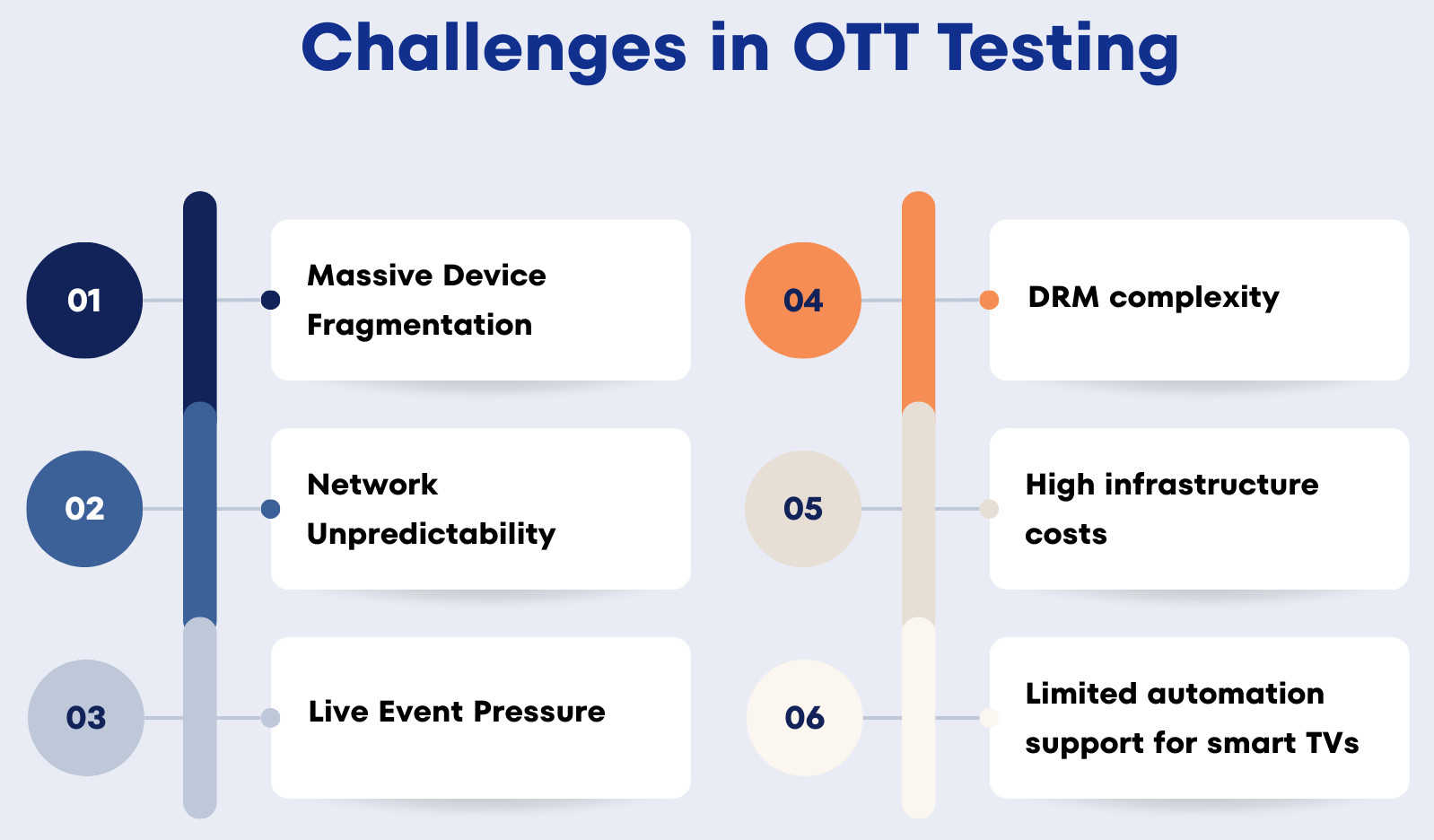
- Massive Device Fragmentation: OTT service providers will have to be backwards compatible with at least thousands of device makes, models and versions, which all have various hardware capabilities, operating system platforms and playback behaviours.
- Network Unpredictability: For users, OTT content is delivered through a very diverse set of networks, and the real-world streaming conditions are not trivial to emulate.
- Live Event Pressure: The zero failure tolerance of live events, where millions of users are all impacted at the same time with no chance to retry or do over.
- DRM Complexity: DRM itself behaves differently under different devices, OS and regions; it is impossible to verify the protection of your content completely.
- High Infrastructure Costs: Large-scale testing involves substantial investment in devices, environments, network simulation and CDN resources.
- Limited Automation Support for Smart TVs: Smart TV platforms often lack mature automation frameworks, forcing teams to rely heavily on manual testing.
Acknowledging these challenges helps teams plan realistically.
Conclusion
OTT testing is relatively more difficult than usual software testing since OTT systems are large-scale, complex, and real-time in nature. For successful OTT testing, you need to have a strong understanding of the platform architecture. Additionally, it requires layered test strategies with intelligent automation investments and the ability to reproduce real-life conditions at all times. User expectations continue to rise, and quality issues are no longer acceptable, as they directly affect not only revenue but brand loyalty. It is in this world that vigorous OTT testing becomes the make-or-break factor for which platform users will depend on, and which one they will easily leave behind.
| Achieve More Than 90% Test Automation | |
| Step by Step Walkthroughs and Help | |
| 14 Day Free Trial, Cancel Anytime |