
How to Test a Multi-agent Ecosystem Effectively?
 |
Software testing has evolved in response to architectural changes throughout history. From monoliths to microservices, APIs, and event-driven architectures came a new way of thinking about how to assure software quality. Multi-agent systems are the next such leap, and maybe, the most disruptive one so far.
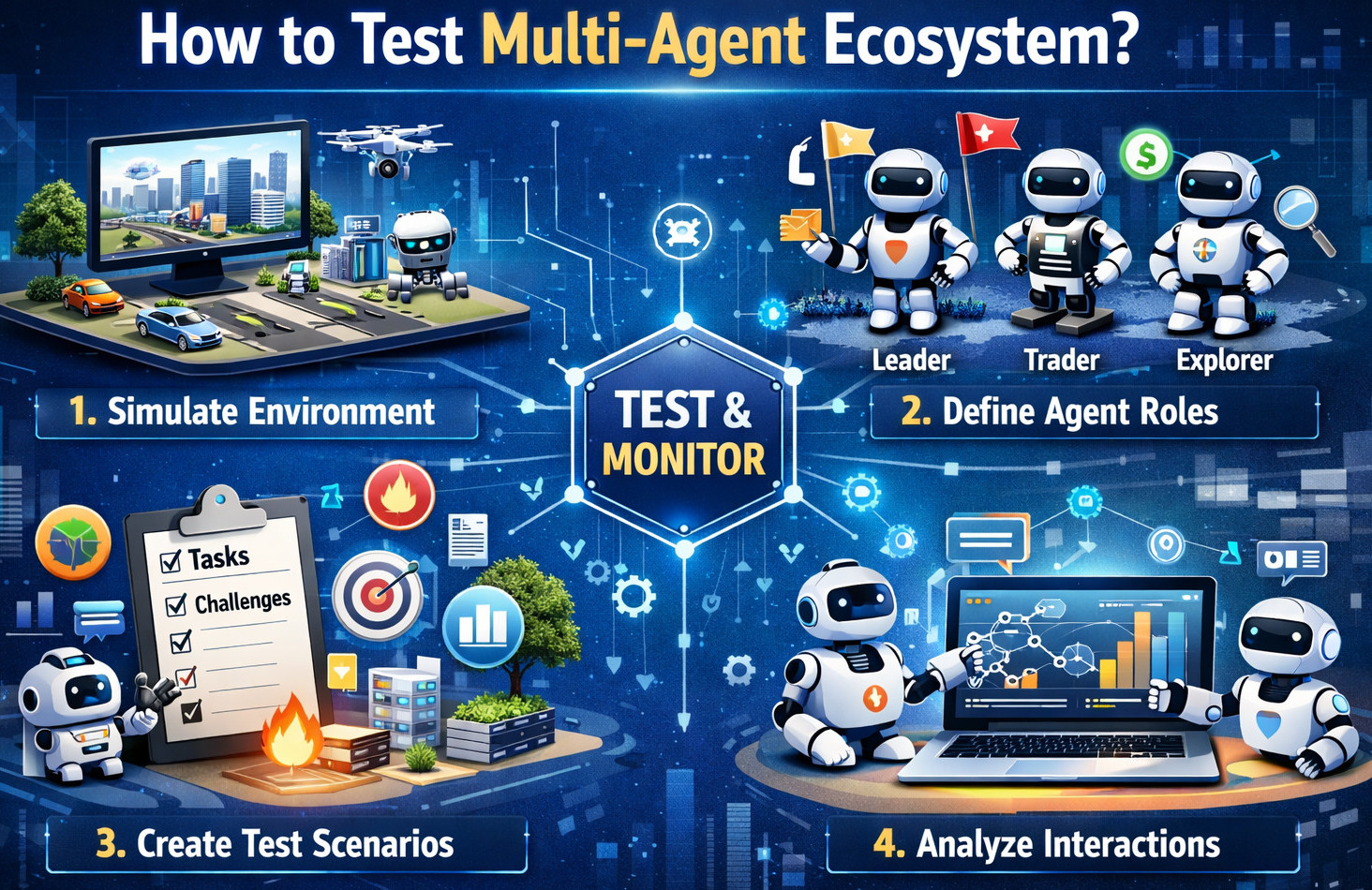
A multi-agent system is more than a kind of distributed system having several components. It’s a collection of individual, decentralized agents (either completely or partially autonomous), each with its own perception, reasoning, decision-making, and action capabilities. These agents can cooperate, compete, negotiate, learn, adapt, and they can also change their behaviour in the long run.
- Behavior is deterministic
- Control flows are predictable
- System boundaries are static
- Correctness can be verified with fixed assertions
Multi-agent systems exhibit emergence, non-linearity, dynamics, coordination, and context-sensitive behavior instead. And the nature of testing changes from checking what the system is doing to testing how it behaves as the situation progresses.
| Key Takeaways: |
|---|
|
Understanding a Multi-Agent Platform
A multi-agent system differs from traditional systems in that it introduces multiple autonomous or semi-autonomous agents. Every agent sees the environment, thinks independently, and acts according to its objective. These agents inhabit the same or a partially shared environment, and their decisions affect each other at all times. Communication can either be explicit (i.e., through specified protocols) or implicit (through shared state and environmental signals), facilitating dynamic coordination as well as competition.
From the QE standpoint, this independence shatters the deterministic control flows that conventional testing relies on. Different answers can be obtained from the same inputs, due to timing, learning conditions, or previous interaction among the agents. The boundary of a test dissolves as faults propagate from interaction among agents but not within an individual, stand-alone component.
Read: AI Agents in Software Testing.
- AI copilots coordinating task execution
- Microservices with autonomous scaling and decision logic
- Chatbot swarms handling customer support
- Autonomous trading agents in financial systems
- Workflow agents coordinating software delivery
- Simulation agents modeling traffic, supply chains, or logistics
From a testing perspective, the defining characteristic is interdependence. No agent operates in isolation; every action can cascade across the system.
Why Multi-Agent Systems Break Traditional Testing Models
Typical testing assumes known inputs, predictable outputs, repeatable behavior, and tightly controlled state transitions. In a multi-agent system, autonomous agents follow, act, and affect each other’s shared state, making these assumptions false. As such, the same test parameters can have varying results with time, so that predictability and repeatability are difficult to achieve.
The same testing process can give two different results due to timing, order of interaction or learning on the part of an agent. Even if the endpoint can be the same, agents can get there taking completely different paths. Drifts may be either weak enough to manifest themselves only after prolonged interaction, hiding problems in short or sparse test runs.
For Quality Engineering, this marks the shift from verification to behavioral assurance. Read: How to Automate Exploratory Testing with AI in testRigor.
Core Principles to Test Multi-agent Ecosystem
This concentrates on the basic concepts needed for testing systems built from multiple autonomous agents. Unlike conventional testing, it is about interactions, coordination, and emergent behavior, not isolated correctness. These axioms guarantee that the system remains secure even if agents are acting on their behalf, adapt to the threats or evolve over time.
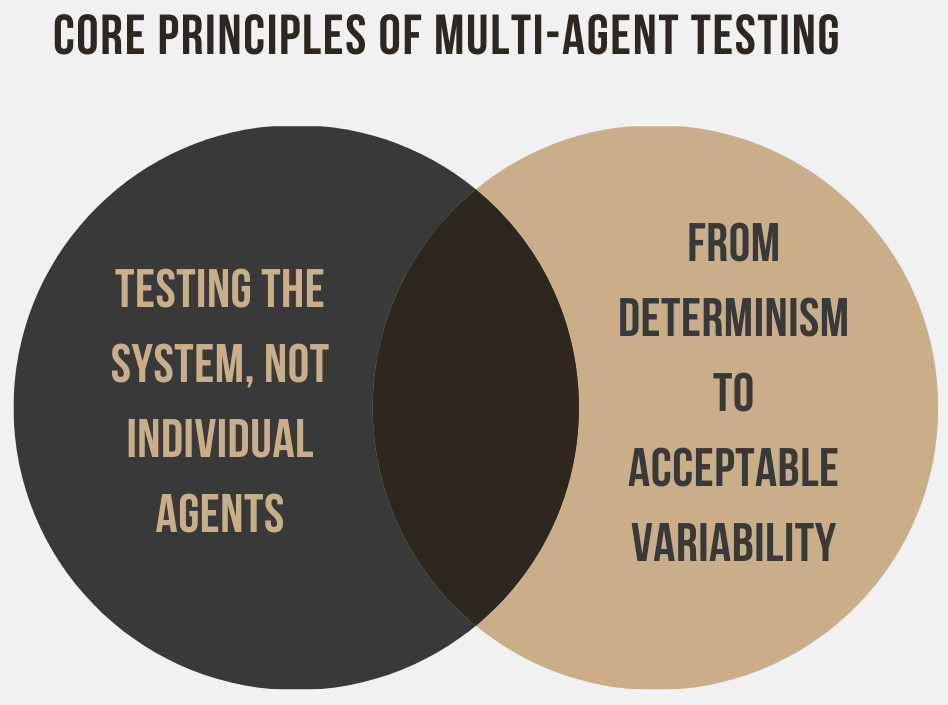
Testing the System, Not Individual Agents
One of the pitfalls in multi-agent testing is to test agents individually and not as a whole. To have a strong multi-agent setting, an environment is enforced to be safe and consistent in the agent-environment interactions, and stable under dynamics and unpredictability. Also, algorithms in this system must conform to business goals and moral limitations, not only be technically expedient.
Testing consequently needs to be multilayered, not unidirectional. It ought to verify each agent’s conduct, critically looking at two-agent interactions and group dynamics as agents cooperate or compete. Finally, testing needs to consider system-level emergent behavior, whether the overall system remains stable, predictable, and aligned with its intended purpose.
The focus shifts from “Does this agent work?” to “Does this agent behave responsibly within the ecosystem?”
Read: AI-Based Self-Healing for Test Automation.
From Determinism to Acceptable Variability
In multi-agent systems, the requirement of exact output matching is unrealistic as autonomous agents contribute variation via learning, adaptation, and interaction. Instead, testing aims at establishing ranges of acceptability in the form of operational bounds, performance thresholds, safety margins, consistency rules, and fairness checks.
Therefore, tests should no longer describe “what the system does” but instead ask if a given output was produced. Instead, they check if the system stayed within acceptable behavioral bounds under different conditions. This shift in mindset is critical for achieving successful multi-agent QA, since it models testing after how such systems will function when used out in the world.
Testing Dimensions in a Multi-Agent Ecosystem
The testing dimensions define the key aspects that need to be checked to ensure proper and safe functioning of multi-agent systems. It focuses on agent autonomy and decision-making, inter-agent communication and coordination, as well as emergent systems behaviour that derives from interactions among complex systems. These dimensions together serve to identify risks which manifest at scale, over time or through agent cooperation rather than in isolation.
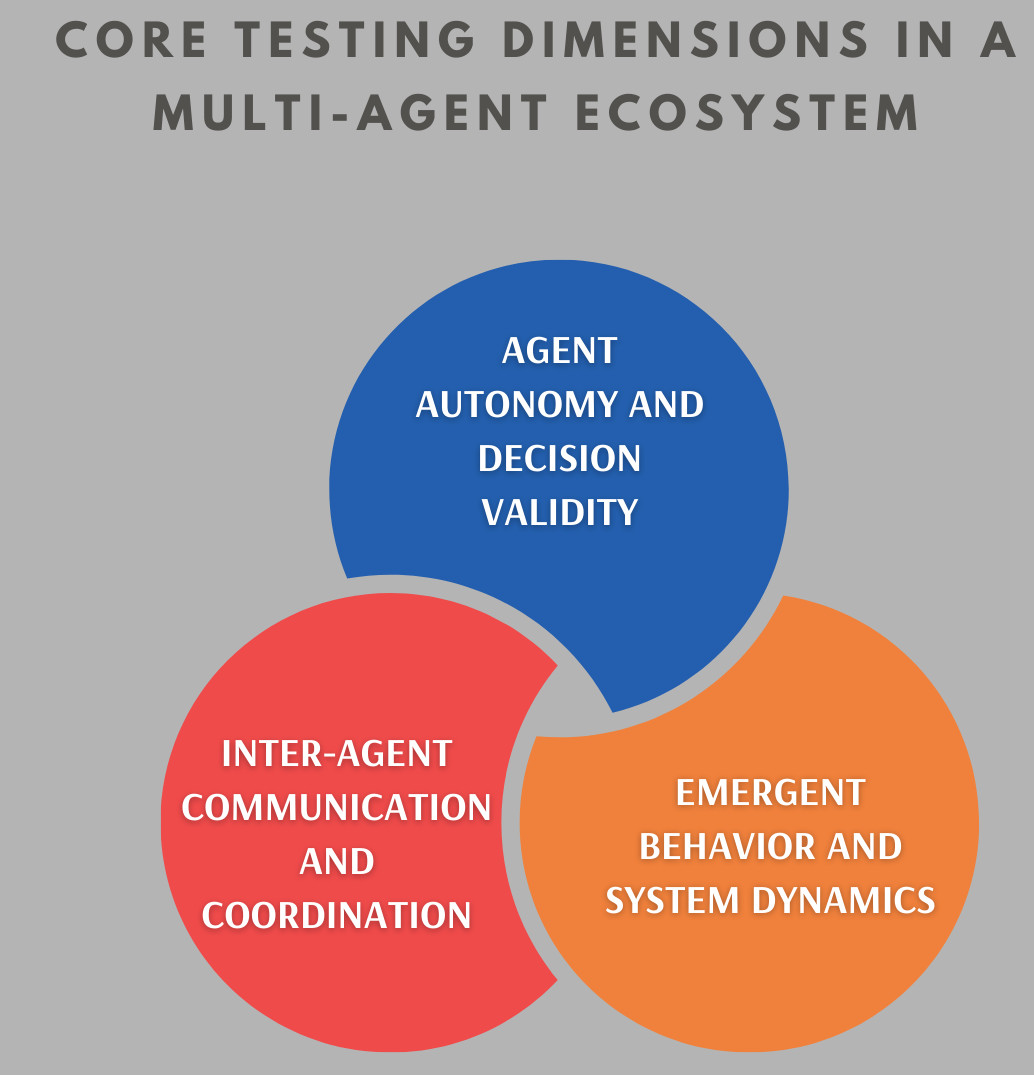
Agent Autonomy and Decision Validity
Through agent autonomy and decision validity, each of the agents will operate based on its designated role and make good decisions. Testing must demonstrate that the goals are aligned with the code. This includes that the code is correct under normal conditions and stable when uncertainty is present. Also, it can handle incomplete or conflicting information without deviating into an unpredictable state.
Some relevant testing questions include how often the agent follows its role descriptions, it can be induced to not take illegal or unsafe actions, and at what point it will degrade quickly in the face of ambiguity. It is also important to determine whether other agents may be able to manipulate or affect the agent in a way that would jeopardize its autonomy and integrity.
Autonomy testing validates that agents act independently without acting irresponsibly.
Read: AI Agency vs. Autonomy: Understanding Key Differences.
Inter-Agent Communication and Coordination
Inter-agent communication and coordination include the way in which agents communicate with each other. Also, how they collaborate to achieve common or related goals. Testing in this category looks at message types, protocols, timing, and synchronization. As well as handling of messages lost or duplicated, deadlocking and livelocking avoidance in case instructions collide.
Key testing issues include whether agents have the same understanding of a message and whether a lack of clarity can propagate to failure throughout the system. It also examines the predictability in agents’ conflict resolution strategies and how robust coordination is under agent failures or intentional deviant behavior. This dimension often reveals issues that never appear in unit or API tests.
Emergent Behavior and System Dynamics
They are the results not specifically programmed in a model, but which develop from the interactions of agents. This is caused by the agents that can interact with each other in a nonlinear fashion. These results may contain something good or they may not. It’s hard to say just based on the environment and an isolated test. Therefore, to understand emergence, we need to see how the system changes over time and at scale.
Testing emergent behavior depends on long-term simulations, stress cases, random input, and scaled agent populations to discover hidden risks. When they do, emergent failures are characterized by resource competition, positive feedback loops that grow minor mutations, agents teaching and reinforcing the wrong lessons, and convergence on suboptimal strategies. The goal is to discover and manage hazardous emergent phenomena without squashing beneficial emergence.
The goal is not to eliminate emergence but to detect dangerous emergence early.
Read: What is Autonomous Testing?
What to Actually Test in a Multi-Agent Ecosystem?
So let us see how we can actually test a multi-agent ecosystem effectively.
Testing for Stability and Convergence
The focus here is on ensuring that multi-agent systems remain reliable as environments change and agents interact over time. It evaluates whether the ecosystem can recover from disruptions, avoid unstable oscillations, and converge toward consistent and desirable outcomes. Stability and convergence are understood as properties of the overall system, emerging from interactions rather than from individual agents alone.
System Stability Under Change
Robustness under change looks at the stability of systems of interacting agents when presented with a world that changes over time. As agents come online or offline, data distributions change, task specifications are redefined, and external dependencies fail, the system has to keep running without crashing or faulting.
Stability certainly focuses on whether the system can return from disturbances, if it oscillates, diverges or converges, and how long stabilization takes. It also aims to develop tools able to detect these tipping points after the fact, enabling teams to see how far they can push a system while it still recovers. Stability is a property of the ecosystem, not individual agents.
Read: AI Features Testing: A Comprehensive Guide to Automation.
Convergence and Consistency
This addresses the question of whether agents in a multi-agent system can align with common objectives when necessary. This involves reaching agreement, acting in coordination, and conflicting goal resolution without collapsing the system.
Convergence testing measures how long it takes for agents to agree, and whether or not shared state or beliefs are achieved across the system. It also searches for any signs of fragmentation when subgroups develop opposing views or behaviors.
Possible failure cases include eternal negotiation, premature convergence to an incorrect solution, and sustained disagreement between agents. Yet another hazard is the dominance of hostile agents that shut out diversity in input, producing biased or brittle results.
Testing for Failure, Chaos, and Resilience
Multi-agent systems must be assessed not only for their correctness, but also for what happens when things fail. This type of testing is about failure injection and controlled chaos that can be used to understand if the ecosystem can survive an impact. We aim to test resilience (detection, containment, recovery) rather than requiring ideal initial conditions or perfect agents.
Agent Failure Injection
Injecting agent failures aims to check in a multi-agent environment how the system works when some agents do not behave properly or even crash. Failures could be due to internal bugs, model hallucination, data corruption, or network failure, and testing must simulate silent failures, partial failures, and, in some cases, Byzantine behavior where agents act wrongly but believably.
Some key testing questions address whether the ecosystem is able to contain failed agents, avoid cascading failures, and permit healthy agents to recover. It also determines the rate at which failures are discovered and verifies that recovery processes are activated in time to maintain global system stability.
This is where resilience testing replaces reliability testing.
Chaos Testing in Multi-Agent Systems
Chaos testing of a multi-agent system intentionally injects instability to see how the ecosystem reacts to the stress. Random agent deaths, misinformation of the current state, misaligned goals, and destruction between agents in environments lead to behaviours that we often do not see otherwise.
The objective is to uncover latent couplings, brittle coordination mechanisms, and validate failure recoveries. It also allows teams to see if agents adjust or exacerbate their errors, which crucially reveals the true resilience of the system.
Unlike traditional chaos engineering, the focus here is behavioral chaos, not just infrastructure chaos.
Ethical, Safety, and Governance Testing
The emergence of multi-agent systems presents novel ethical, safety, and governance considerations, as autonomous agents have the potential to impact decisions, outcomes, and behavior at scale. By testing in this area, we ensure that agent actions stay aligned with human intent, business goals, and regulatory compliance even when under stress or optimizing towards a goal. The emphasis is now no longer on verifying functional correctness, but rather on extending boundaries to safeguard individuals, institutions, and society.
Alignment with Human and Business Intent
Aligning with human and business intent guarantees that multi-agent systems behave in a manner consistent with actual organizational goals and values. Testing is needed to check that such goals are indeed aligned, confined, and not unintentionally optimized in a way that distorts the intended outcome.
Practical testing concerns whether optimising agents violate compliance rules and cost-reduction agents lower the level of user experience, or whether they take advantage of loopholes in objective definitions. These use-cases go some way to proving that optimization needn’t be at the cost of trust, ethics or business value over the long term.
This requires intent-based testing, not requirement-based testing.
Safety and Guardrail Validation
Safety and guardrail validation is how we ensure agents always act within certain limits, such as privacy rules, security boundaries, ethical practices, or those defined by law. It must be verified that these guardrails are robust, irrespective of the level of the agent’s autonomy and the complexity of decisions.
Key requirements include making sure restrictions cannot be violated, even with agents attempting to bypass them collusively or indirectly. Testing also ensures that safety mechanisms succeed under load and scale, as interactions and decision volume increase substantially.
Safety testing becomes more complex when agents influence each other’s decisions.
Observability and Testability Challenges
It is well known that the design of multi-agent systems brings significant observability and testability problems due to distributed, non-transparent decisions taken by independent components. Effective testing assumes that agent behavior is observable and traceable across interactions, rather than observation of internal states via direct access.
The Black-Box Nature of Agent Decisions
Many agents, especially AI-based ones, are black boxes, which means you can’t rely on examining their internal states to test them. Instead, QA has to develop a theory of how agents behave based on behaviour observation, input-output correlations, trace analysis, and pattern detection over time. Strong observability is therefore the precondition of good testability in multi–agent systems. This makes observability a prerequisite for testability.
Distributed Traceability Across Agents
Failures in distributed multi-agent systems often have a cross-agent impact where there is a gap between fault triggering and symptom presentation. This makes the analysis of root cause difficult in the presence of weak traceability between agents. Testing has to confirm how effective tracing propagation, event correlation, and the reconstruction of causal graphs throughout the whole ecosystem are. Without this, debugging becomes guesswork, and testing loses credibility.
Scenario-Based Testing for Multi-Agent Ecosystems
Scenario-based testing is all about validating how multi-agent ecosystems will behave in complex, realistic, and unpredictable environments. Rather than checking fixed results, it checks if the system preserves the desired properties in the absence of real-world challenges and adversarial situations.
Realistic Scenario Construction
Realistic scenario construction must include test scenarios that reflect real user goals, complex workflows, competing priorities, and environmental ambiguity. Unlike classical test cases, these may run for a long duration, are nondeterministic, but they also include randomness as well as indefinite and non-deterministic success criteria in terms of system properties instead of fixed outcomes.
Adversarial and Edge Scenarios
The adversarial and edge scenarios bring malicious agents, misalignment incentives, ultra resource constraints, or unpredictable composition of the agents to test beyond the normal setup. Such testing highlights security vulnerabilities, ethical blind spots, and coordination failures, underscoring the special importance of adversarial testing in autonomous ecosystems.
Conclusion
This is a fundamental change for testing a multi-agent system from verifying deterministic outputs to measuring the suitability of behavior, coordination, and alignment. Quality engineering in this space is less about demonstrating correctness and more about ensuring resilience, safety, and reasonable behavior under uncertainty and emergence. The more testable, the greater the autonomy becomes. Testing is the discipline of assuring trust in systems with increased autonomy that can no longer be fully commanded, but only sensibly watched and steered.
| Achieve More Than 90% Test Automation | |
| Step by Step Walkthroughs and Help | |
| 14 Day Free Trial, Cancel Anytime |