
How to Validate Composable ERP: A Modular Testing Guide
 |
Organizations need solutions that provide scalability and flexibility to sustain in the rapidly evolving software world today. Modern enterprises no longer rely on a single ERP vendor. Instead, they assemble best-of-breed applications for finance, HR, procurement, CRM, and more. These systems are stitched together into what we now call a composable or modular ERP ecosystem. It’s flexible, scalable, and future-proof, but from a QA perspective, it introduces an entirely new class of challenges.
This is where composable ERP testing becomes critical. You’re no longer validating a system; you’re validating how multiple independent systems behave as one.
| Key Takeaways: |
|---|
|
What is Composable ERP?
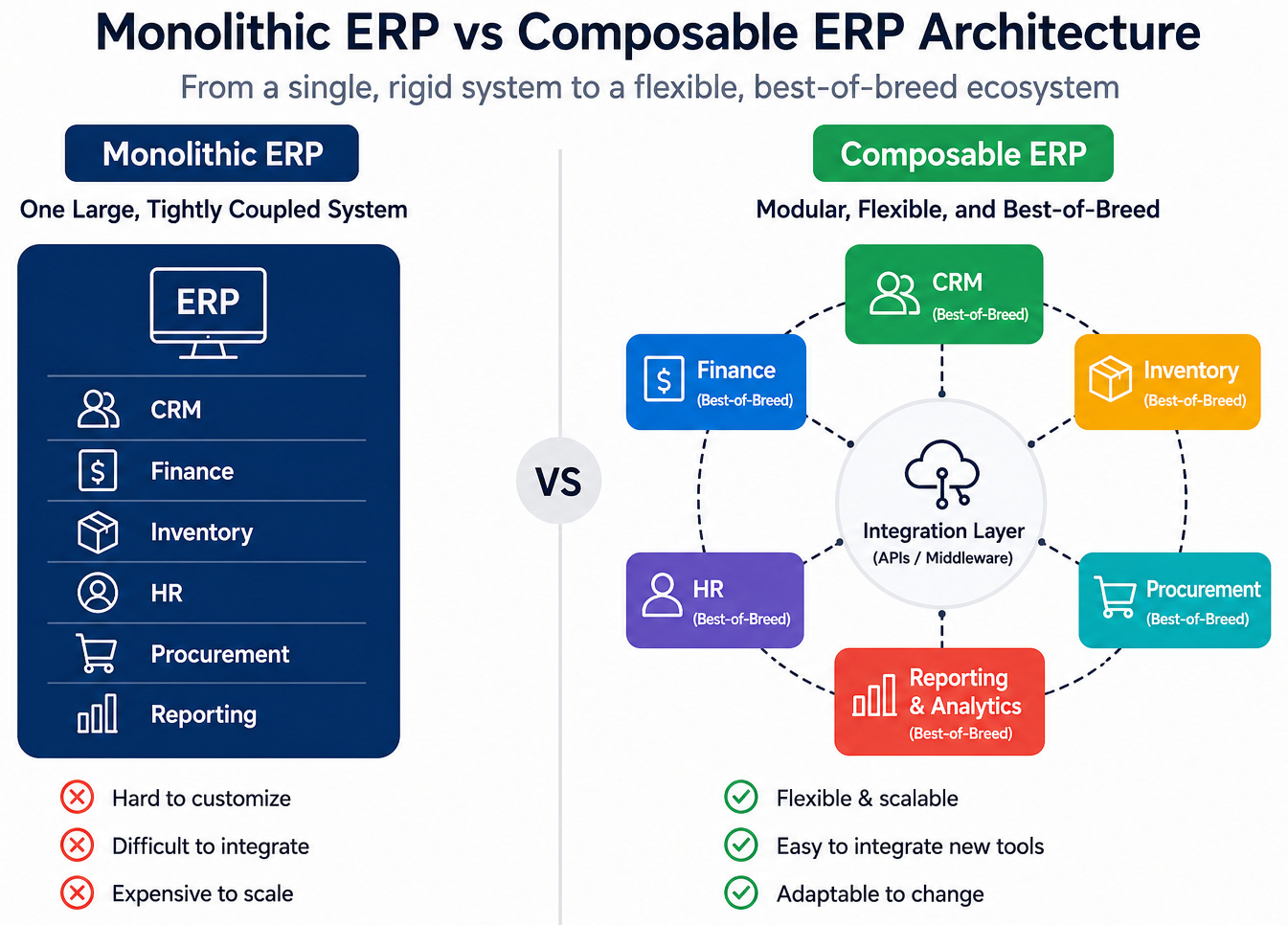
Traditional ERP testing focused heavily on system-level validation. You would build an environment, execute functional and regression tests, and sign off once everything worked within that boundary.
With composable ERP, that mindset changes quickly. A composable ERP is the system layer that enables a modular, change-ready business architecture, giving you the freedom to organize, swap, and transform system components without regenerating core operations.
Everything comes bundled together in a traditional ERP. However, composable ERP integrates only the tools you select, utilizing a unified data layer to centralize data from separate tools.
Imagine this: your finance module works perfectly, your inventory system is stable, and your CRM is passing all tests. Yet, when a customer places an order, something goes wrong. The issue isn’t in any single system; it’s in how they interact.
This is why composable ERP validation shifts the focus from inside the system to between systems. QA engineers now spend more time validating integrations, data flow, and orchestration than individual features.
Monolithic ERP vs. Composable ERP
| Aspect | Monolithic ERP | Composable ERP |
|---|---|---|
| Architecture | Single, tightly coupled system | Modular, loosely coupled components |
| Flexibility | Limited flexibility, hard to customize | Highly flexible, easy to adapt and extend |
| Integration | Complex, often requires custom coding | API-first, easier integration with external systems |
| Scalability | Scaling requires upgrading the entire system | Scale individual components as needed |
| Deployment | Large, infrequent releases | Continuous updates and independent deployments |
| Vendor Dependency | Usually tied to a single vendor | Best-of-breed approach with multiple vendors |
| Data Management | Centralized database | Distributed data across systems |
| Change Management | Slow and risky | Faster, incremental changes are possible |
| Testing Approach | System-level testing | Ecosystem-level (Composable ERP Testing) |
| Failure Impact | One failure can affect the whole system | Failures can be isolated to specific components |
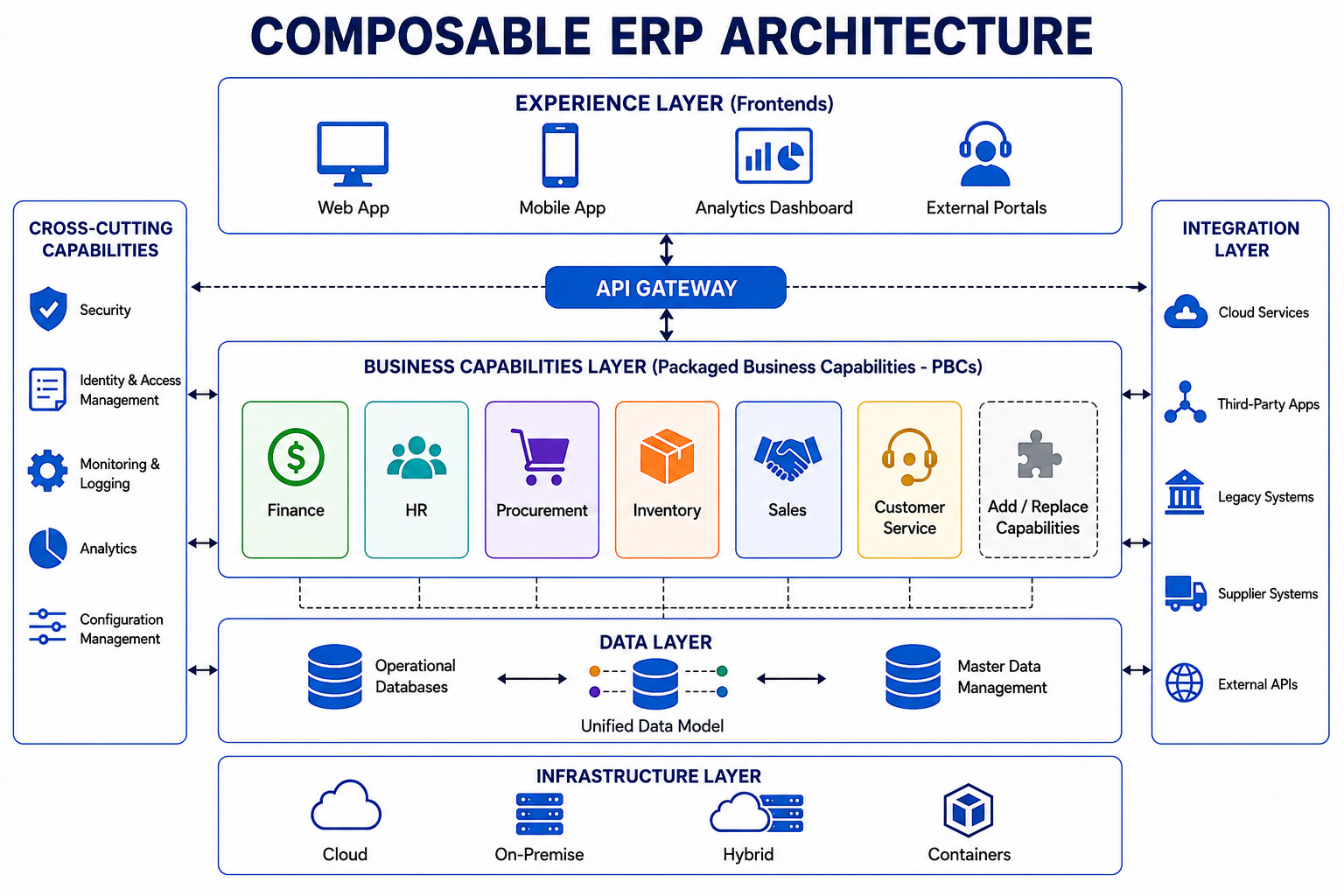
The Composable ERP Architecture: How it Really Works
Composable ERP isn’t just a technical upgrade; it’s a different method of organizing enterprise systems. At its core, it depends on a few fundamental ideas that distinguish it from traditional ERP models.
First, modern ERP systems are headless and API-first. Unlike older systems, where the user interface and backend were tightly coupled, composable ERP separates the two. Data lives independently and is exposed via APIs, making it easier to integrate with CRMs, shop floor systems, or supplier platforms without excessive customization.
Second, in place of large, generic modules, composable ERP uses Packaged Business Capabilities (PBCs). These are focused, self-contained components built to solve specific business needs, like managing warranty claims or analyzing production waste. Organizations can pick and choose only the functionalities they actually need, rather than embracing an entire module.
Third, integration has become far more accessible through low-code or no-code tools. Many modern ERP platforms allow non-technical people, such as operations managers, to configure workflows and connect systems without extensive technical expertise. This reduces dependency on IT teams and speeds up implementation significantly.
Testing Composable ERP: Where Complexity Comes Up
When any company embraces a best-of-breed strategy, they’re essentially choosing different vendors for different capabilities. One system might expose REST APIs, another relies on event streams, and a third might still depend on batch processing.
From a QA viewpoint, testing best-of-breed ERP means dealing with inconsistent standards, varying data models, and asynchronous behaviors.
Let’s say you’re testing an order-to-cash workflow. The order comes up in a CRM, inventory is checked in a warehouse system, billing happens in a finance tool, and everything is connected through middleware. No single system owns the workflow, yet the business expects it to work seamlessly.
That’s the main challenge.
ERP Integration Testing
It is important to understand that in a composable ERP, integration is not one individual layer of testing; it is the system.
POST /inventory/reserve
{
  "productId": "SKU123",
  "quantity": 2,
  "orderId": "ORD456"
}
- What happens if the inventory service is down?
- What if the request times out but still gets processed?
- What if the response schema is modified slightly?
They are everyday occurrences and not just niche edge cases anymore.
This is also where middleware stability becomes important. Middleware often manages routing, transformation, and retries. If it behaves unpredictably, even perfectly working services can crash as a group.
Read: How to Automate ERP Testing.
API Contract Testing for ERP
One of the better ways to stabilize integrations is via API contract testing for ERP.
Rather than just testing if an API works, contract testing makes sure that both the source and destination agree on the structure of requests and responses. This is like a formal handshake between services.
{
  "status": "SUCCESS",
  "reservedQuantity": 2
}
Now, say a developer modifies reservedQuantity to qtyReserved without letting the downstream teams know. Without contract testing, this small change could break the entire workflow silently.
With contract tests in place, such changes are caught immediately during CI/CD pipelines. This becomes particularly important in environments where services are deployed independently.
Read: API Contract Testing: A Step-by-Step Guide to Automation.
Event-driven Architecture Testing
Often, composable ERP systems depend on asynchronous communication using events. Rather than calling APIs directly, services publish and consume events.
For QA engineers, this brings in a new metric: time.
- If it arrives at the right consumers
- If it’s processed in the correct order
- Whether duplicate events cause unexpected side effects
Imagine a payment event being published twice due to a retry mechanism. Without proper handling, the system might record duplicate transactions. This is where idempotency testing in ERP becomes necessary, ensuring that repeated operations do not corrupt data (it should have the same result as executing it only once).
Data Synchronization Audits
In monolithic ERP systems, data consistency is usually guaranteed by a single codebase. In a composable ERP, data is distributed, and that changes everything.
Data synchronization audits are critical to make sure that different systems align on the same reality.
- The CRM shows an order as “confirmed”
- The inventory system shows it as “pending”
- The finance system hasn’t recorded it at all
Each system might be technically accurate based on its own state, but from a business perspective, this is chaos.
QA teams often run reconciliation jobs or compare datasets across systems to identify such inconsistencies. Interestingly, many engineers find that using real production-like data during testing catches far more issues than synthetic datasets.
Microservices ERP Validation
Composable ERP systems are often built on microservices, and testing them needs a slightly different mindset.
In microservices ERP validation, you’re not just testing whether a service works; you’re testing how it behaves when things go wrong.
- If the pricing service fails, does the checkout process stop gracefully?
- If the notification service is down, does the transaction still complete?
This kind of testing often involves intentionally breaking things: shutting down services, injecting latency, or mimicking network failures.
It is more focused on resilience and less on perfection.
Also read: How to Test in a Microservices Architecture?
End-to-End (E2E) Cross-Platform Workflows
Regardless of the volume of unit or integration testing executed, the real proof is achieved from end-to-end (E2E) cross-platform workflows.
- Creating a purchase request
- Approving it
- Sending it to a supplier
- Receiving goods
- Processing payment
Each step will involve a different system, but the workflow must be completed without errors.
E2E testing often reveals anomalies that no other testing layer can catch, especially those related to timing, sequencing, or data transformation.
Read: Why Selenium Sucks for End-To-End Testing in 2026.
Regression Testing for Modular Systems
One of the biggest challenges in composable ERP is the constant pace of change. Teams deploy updates independently, and even a small change can have cascading effects.
That’s why regression testing for modular systems is not optional; it’s continuous.
- API contracts
- Critical workflows
- Data integrity checks
And they need to run regularly, ideally as part of every deployment pipeline.
Service Level Agreement (SLA) Monitoring
In composable ERP, validation doesn’t end in QA environments. Production systems need continuous monitoring.
Service Level Agreement (SLA) monitoring helps make sure that systems adhere to performance and availability expectations. If an API suddenly starts responding more slowly than usual, it might not fail tests, but it can still impact business operations.
This is where observability tools: logs, metrics, and traces, become part of the validation strategy.
Best Practices for Composable ERP Testing
- Automate Everything: Automation is key for scalability and speed.
- Test Continuously: Testing should be part of CI/CD pipelines.
- Focus on Integration: Most failures occur between systems.
- Use Real Data: Real-world scenarios uncover hidden issues.
- Plan for Change: Always verify recomposition scenarios.
Common Mistakes to Avoid
- Treating composable ERP like monolithic ERP
- Ignoring integration testing
- Skipping data validation
- Neglecting regression testing
Example: Retail ERP Modernization
- CRM for user interactions
- An individual inventory management system
- A cloud-based finance platform
- Middleware to orchestrate everything
- Orders occasionally fail due to API timeouts
- Inventory updates lag behind real-time demand
- Duplicate payment events create reconciliation issues
By introducing ERP integration testing, API contract testing for ERP, and event-driven architecture testing, the QA team gradually stabilizes the system. They also implement idempotency testing in ERP to handle duplicate events and run regular data synchronization audits to ensure consistency.
The key takeaway? Most issues didn’t come from individual systems; they came from how those systems interacted.
Where AI-Powered Testing Helps
Testing composable ERP systems can become chaotic too fast. There are too many integrations, too many workflows, and constant changes. That’s where AI-powered tools like testRigor come in. Instead of writing complex scripts, you can create tests in plain English, which makes it easier for both experienced QA folks and non-technical professionals to contribute.
testRigor supports different types of testing, such as native desktop, web, mobile, API, mainframes, visual, exploratory, AI features, accessibility testing, and many more.
This makes it easier to validate end-to-end (E2E) cross-platform workflows and reduces the effort needed for regression testing for modular systems.
Here is an All-Inclusive Guide to Test Case Creation in testRigor.
Final Thoughts
Composable ERP systems are here to stay for the long run. They offer flexibility, but they also demand a more mature and thoughtful approach to verification.
Composable ERP testing is no longer about checking whether features work; it’s about making sure that an interconnected ecosystem behaves reliably under real-world conditions. QA teams can bring confidence back into an otherwise complex system.
The validation is done to make sure that, no matter how many moving parts exist underneath, the business experiences one seamless system.
Frequently Asked Questions (FAQs)
- Why is ERP integration testing critical in composable systems?
A: As integrations are the system. Even if individual modules work perfectly, failures often take place in communication between services, making ERP integration testing essential for reliability.
- What is API contract testing for ERP?
A: API contract testing makes sure that systems communicating through APIs follow established request/response formats. It prevents silent failures due to schema changes in distributed ERP environments.
- How does AI help in Composable ERP Testing?
A: AI-powered tools like testRigor simplify test creation using natural language, reduce maintenance effort, and make it easier to test end-to-end workflows in constantly evolving systems.
| Achieve More Than 90% Test Automation | |
| Step by Step Walkthroughs and Help | |
| 14 Day Free Trial, Cancel Anytime |