
Test Coverage vs Test Priority: What Should You Optimize For?
 |
All these years, test coverage has been the key metric to evaluate the effectiveness of software testing. If you have covered all the application features and functionalities, you would say this testing cycle is successful. So all this time, there was a straightforward logic that drove software testing effort – the more of the application you test, the fewer defects will escape into production.
However, this is not the truth anymore. Test priority has also infiltrated modern software development environments.
| Key Takeaways: |
|---|
|
This article explains the two approaches, test coverage and test priority, and tries to answer this question.
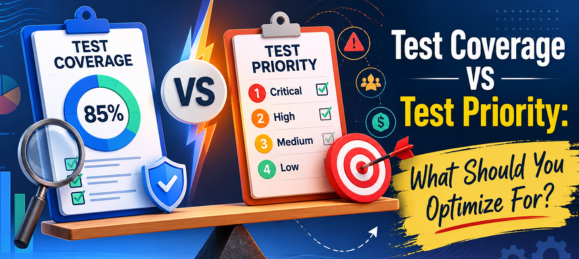
What is Test Coverage?
Test coverage is a qualitative software testing metric. It measures how thoroughly a test suite validates the application’s requirements, features, and user scenarios.
It identifies gaps, unhandled edge cases, and “dark corners” in the application and serves as an early warning system for evaluating the effectiveness of your QA testing strategy.
Test Coverage (%) = (Number of Executed Requirements / Total Number of Defined Requirements) x 100
For instance, if your development specifications outline 20 primary user requirements and your current functional test cases validate 16 of them, your test coverage is 80% (16/20 x 100).
This is one aspect of test coverage that caters to requirements; the other coverage types can be product, compatibility, risk, and more.
Using coverage metrics, you can identify areas that may not be adequately tested. Teams use these metrics to identify testing gaps and improve confidence in software quality.
Read: Code Coverage vs. Test Coverage.
Benefits of Test Coverage
- Increased Confidence: Higher testing coverage generally means more application areas are tested. This reduces the likelihood that untested functionality reaches production.
- Detection of Hidden Defects: It uncovers blind spots in product logic. Testing a broader range of code paths can also uncover issues that might otherwise remain hidden.
- Compliance and Regulatory Requirements: Regulated industries such as healthcare, aerospace, and finance often need documented testing coverage to satisfy compliance and regulatory standards.
- Improved Maintainability: Teams understand which areas of the application lack testing. This makes any future development and refactoring safer.
- Elimination of Redundant Tests: Test coverage flags overlapping or “fake” test cases that consume execution time without adding actual validation value.
- Informed Release Decisions: Stakeholders can gauge quantitative deployment readiness by balancing test outcomes against critical features.
Limitations of Test Coverage
- Coverage Does Not Equal Quality: Despite achieving 100% test coverage, the application may still fail to detect critical defects. Test coverage measures testing execution, not effectiveness.
- Diminishing Returns: Many tests target edge cases that may not affect customers at all, leading to limited business value.
- Maintenance Overhead: Test suites may grow larger and more expensive to maintain as test coverage increases. This results in more time spent on updating tests than identifying issues.
- False Sense of Security: Test coverage can create a false sense of security, even when critical business workflows remain untested, because organizations sometimes treat coverage percentages as quality indicators.
What is Test Priority?
Test priority is the process by which test cases are ordered so that tests with the highest risk, business impact, or likelihood of finding critical defects are executed first. It ensures that the most important features of the application are verified early and optimizes testing time, cost, and efficiency.
- Business criticality
- Risk exposure
- Revenue impact
- User frequency
- Historical defect patterns
- Recent code changes
- Production incidents
The goal of prioritizing tests is to maximize defect detection while minimizing testing effort.
Read: Test Case Prioritization Techniques.
Common Priority Levels
Test cases are typically assigned distinct priority levels as follows to structure the testing schedule:
| Priority Level | Description |
|---|---|
| Priority 1 (Critical) | Tests the core, essential functionality that the software cannot survive without. If these fail, the system is unusable, and further testing cannot proceed. |
| Priority 2 (High) | Tests critical functions that deeply impact the user experience, even if the system might still be partially functional. |
| Priority 3 (Medium) | Test standard, expected features that are useful but less immediate to daily or primary business operations. |
| Priority 4 (Low) | Tests edge cases, cosmetics, or infrequently used features. |
Benefits of Test Priority
- Faster Feedback: When tests are prioritized, the most important tests are executed first, helping teams receive actionable feedback earlier in the development cycle. This is especially valuable in CI/CD environments for rapid releases.
- Better Resource Allocation: Prioritization of tests ensures the testing effort is focused on areas with the greatest potential impact.
- Reduced Execution Time: By executing the highest-priority tests first, the testing duration is significantly reduced.
- Improved Risk Management: With prioritized testing, teams focus on protecting the features that are critical to customers instead of treating all functionality equally. This aligns QA activities with business objectives and risk profiles.
- Early Defect Detection: Prioritizing tests helps uncover showstopping bugs before they block subsequent testing phases.
- Cost and Time Efficiency: Wasted effort is minimized by verifying core functionality first.
Limitations of Test Priority
- Risk of Missing Issues: Low-priority tests may result in some defects remaining undetected, as those areas get less attention.
- Requires Continuous Analysis: As products evolve, priorities change. Thus, functionality that was once critical may become less important, while a new feature may introduce higher risks.
- Subjective Decision-Making: If clear criteria are not applied, prioritization may become inconsistent, and personal opinions may interfere with testing decisions rather than data.
Read: Test Case Prioritization in Agile: 2026 Strategy Guide.
The Test Coverage vs Test Priority Debate
Test coverage measures what and how much of your software is tested, while test priority dictates when and in what sequence those tests should be executed.
While test coverage provides a quantitative metric of completeness, test priority introduces a strategic sequence to optimize execution time and minimize risk.
However, the debate often emerges when organizations face constraints.
- 10,000 automated tests
- A two-hour testing window
- Multiple daily releases
Running every test before deployment may be impractical. So, how to go about this approach so that the maximum value is obtained within the given constraints?
Should the team maximize coverage or prioritize critical tests? Let’s evaluate both approaches:
Option A: Maximize Coverage
In this approach, as many tests as possible are run to cover the widest range of functionality.
This approach provides a broad validation with reduced testing gaps and higher confidence in overall application health.
However, the approach is time-consuming, leading to delayed releases and increased infrastructure costs.
Option B: Prioritize Critical Tests
This approach executes only tests that validate high-risk areas.
When you prioritize tests, you can have faster releases, rapid feedback, and make efficient use of resources.
But there is less comprehensive validation, and you might have potentially missed defects in lower-priority areas.
Overall, in practice, most teams find that prioritization often delivers greater business value than pursuing maximum coverage.
Why is Coverage Alone No Longer Enough?
- Rapid Release Cycles: Nowadays, application updates are deployed multiple times per day rather than a few times per year. With this change, there is not enough time to execute exhaustive test suites before every release.
- Increasing Application Complexity: Modern applications consist of various components like microservices, APIs, third-party integrations, cloud infrastructure, and mobile platforms. You cannot achieve complete coverage across all these components.
- Customer Expectations: Users are more interested in whether critical workflows function correctly and less about obscure administrative features that may only contribute to maximizing coverage. You should reflect these priorities when designing testing strategies.
- Data-Driven Quality Engineering: Modern quality engineering does not care much about metric-driven testing; rather, it emphasizes risk-based decision-making. The primary objective of testing modern applications is to reduce business risk and not simply to maximize test coverage.
When Should Test Coverage Be the Priority?
- Safety-Critical Systems: Applications in industries such as healthcare, aviation, automotive systems, and industrial controls require extensive coverage, as failures can have severe consequences.
- New Products: You cannot establish meaningful priorities in early-stage products that lack sufficient usage data. Test coverage can help identify defects across a broad range of functionality.
- Regulatory Environments: When industries have compliance requirements, they frequently mandate minimum coverage thresholds.
- Major Refactoring Projects: When you refactor large portions of an application, broader coverage provides protection against unintended regressions.
When Should Test Priority Be the Priority?
- Continuous Delivery Pipelines: When teams release products multiple times in a day, you need a faster feedback loop. In such cases, running a targeted subset of high-value tests is more practical than executing every test.
- Large Regression Suites: When you have thousands of automated tests, intelligent prioritization is more beneficial.
- Risk-Based Testing Programs: When you have identified high-risk areas using historical defect data, prioritization improves the efficiency of defect detection.
- Customer-Centric Development: Prioritizing tests around critical user journeys ensures the most important functionality remains protected.
Finding the Right Balance
For best results, successful testing strategies do not choose between coverage and priority. Instead, they integrate both concepts. A common approach is to structure testing into the following layers.
Tier 1: Critical Tests
These tests cover core business workflows, revenue-generating features, and high-risk integrations.
Critical tests may be executed on every commit, during pull requests, or before deployment.
Tier 2: Important Tests
Important tests validate secondary workflows, frequently used features, and historical defect hotspots.
They are executed daily and during regression cycles.
Tier 3: Comprehensive Coverage Tests
The comprehensive coverage tests include edge cases, rare workflows, and legacy functionality.
You can execute them weekly, before major releases, or during full regression cycles.
Adopting this layered strategy will provide you with both speed and breadth.
How AI is Changing the Optimization Decision?
Artificial intelligence (AI) is transforming how organizations approach testing. Traditional testing coverage metrics only provide static information about what is tested.
- User behavior
- Code changes
- Defect trends
- Test execution history
- Risk patterns
These insights enable dynamic prioritization of test cases.
With AI around, you no longer use manual methods to decide which tests matter. AI systems automatically identify the tests most likely to uncover defects.
For example, if a recent code change affects the payment module, AI will prioritize payment-related tests while temporarily deprioritizing unrelated areas.
This approach combines coverage intelligence with risk-based prioritization.
As a result, teams achieve higher quality outcomes without dramatically increasing testing effort.
Measuring Success Beyond Coverage
- Defect Escape Rate: This metric measures how many defects reach production.
- Mean Time to Detect: Measures how quickly the defects are detected.
- Test Effectiveness: This metric measures the percentage of executed tests that discovered issues.
- Risk Reduction: This metric measures how effectively the testing protects critical business functionality.
- Release Confidence: Determines whether teams can deploy quickly without increasing production incidents.
These metrics provide a more accurate picture of testing success than coverage alone.
Conclusion
The debate on test coverage and test priority is not about which is more important; rather, it is about understanding when each should take precedence.
Test coverage provides visibility, confidence, and protection against untested functionality. It is essential for compliance, safety-critical systems, and comprehensive quality assurance efforts.
Test priority, however, aligns testing with business value, customer impact, and risk management. In modern Agile and DevOps environments, prioritization often yields greater practical benefits by enabling faster feedback, shorter release cycles, and more efficient use of resources.
For most organizations, choosing only one is neither realistic nor desirable. Focusing only on coverage does not provide any business value. Likewise, focusing only on priority can leave important gaps in quality assurance.
The most effective strategy is to combine broad coverage with intelligent prioritization. You can ensure that critical workflows are always tested while maintaining sufficient overall coverage, and teams can maximize both software quality and delivery speed.
In the current development landscape, the ultimate goal is not to test everything but to test the right things at the right time.
Frequently Asked Questions (FAQs)
- Is high test coverage always better?
Not necessarily. High test coverage can increase confidence, but it does not guarantee software quality. A test suite can achieve high coverage while still missing critical defects if the tests are ineffective or not focused on important user scenarios.
- Can a project succeed with low test coverage but effective prioritization?
In some cases, yes. If the most critical workflows and high-risk areas are thoroughly tested, a project may maintain high quality despite lower overall coverage. However, relying solely on prioritization can leave untested areas vulnerable to defects.
- Should teams choose test coverage or test priority?
Most organizations should not choose one over the other. The most effective testing strategy combines sufficient test coverage with intelligent test prioritization to balance software quality, risk management, and delivery speed.
| Achieve More Than 90% Test Automation | |
| Step by Step Walkthroughs and Help | |
| 14 Day Free Trial, Cancel Anytime |