
Test Case Prioritization in Agile: 2026 Strategy Guide
 |
Time is a precious commodity in the software development community. With increasing pressure to release high-quality software at a faster pace, understanding how to prioritize test cases is an important skill before creating a testing strategy.
In Agile methodology, software testing needs the relevant, context-dependent tools and a well-defined structure for managing your QA process. Planning tests, tracking results, and risk reporting all need to be structured.
| Key Takeaways: |
|---|
|
What is Test Case Prioritization?
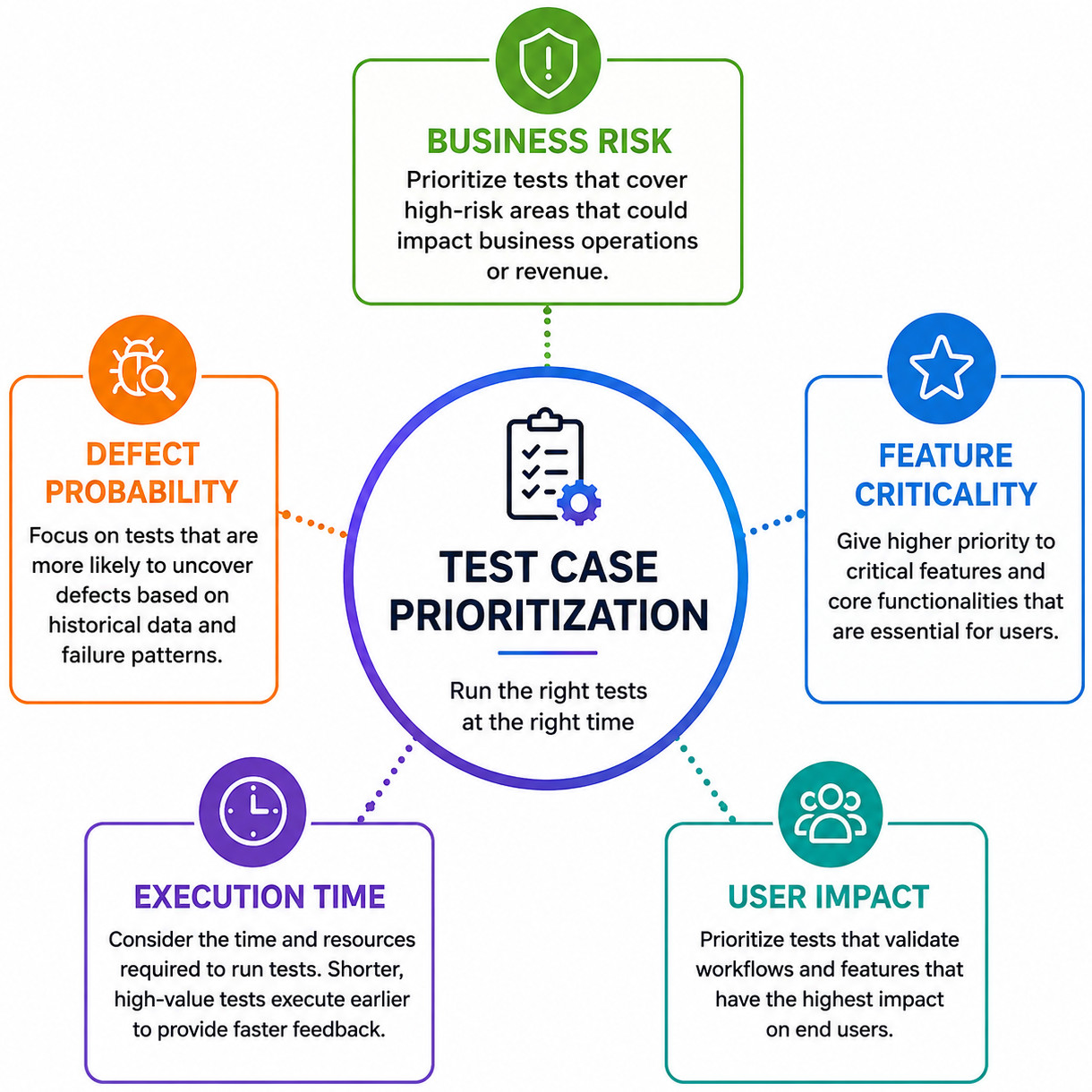
Test Case Prioritization is the process of structuring test cases so that the tests with the highest risk, potential of catching defects faster, or business impact are executed first. It helps teams target what matters most, enhance testing efficiency, and catch critical issues earlier in the cycle.
Prioritizing test cases makes sure that QA runs the right tests at the right times. This could mean testing critical functionalities first and utilizing specific software testing methodologies (like black box testing) over others. Running shorter tests before longer tests, or using other tactics that enable you to expose risks faster and maximize your QA team’s time.
Test case prioritization applies to tests you run manually and with automation; however, the way you prioritize them may vary between the two. Say, you might have prioritized specific automated tests by scheduling them to run before others in your automated CI/CD pipelines, while prioritizing manual tests (for eg, exploratory, functional, or acceptance tests) may merely involve selecting the tests with the highest priority to be executed first.
The Importance of Test Case Prioritization for Agile
As products mature, test suites grow aggressively. Every new feature introduces more scenarios. Every production defect usually adds additional validations. Automation coverage scales sprint after sprint, and finally, teams arrive at a familiar situation: regression execution takes longer than the release window itself.
The problem becomes more visible in Agile environments.
A team working with two-week sprints will deploy changes multiple times in the same week, often several times a day. Developers continuously merge code, CI pipelines trigger builds automatically, and QA teams are expected to provide rapid feedback without becoming a hurdle.
Under these conditions, executing every test after every change becomes inefficient. More importantly, it does not necessarily improve quality.
The challenge shifts from:
Rather than treating all tests equally, test case prioritization decides the order in which test cases run so that important failures appear earlier in the cycle. The goal is not simply to bring down test execution time. The objective is to amplify useful feedback while reducing wasted effort.
Why Full Regression Stops Working in Agile
Many teams try to solve quality concerns by continuously adding tests, such as:
- A login defect appears in production? Add validation scenarios.
- A payment issue escapes to customers? Add another regression case.
- An edge case breaks after deployment? Add one more automation script.
Separately, these decisions make sense. But collectively, they lead to a different problem. A regression suite that originally contained a few hundred tests can easily grow into several thousand.
Consider an e-commerce platform with:
- User authentication
- Product search
- Shopping cart
- Coupons
- Payment processing
- Recommendation systems
- Order management
- Customer profiles
Over time, automated regression may contain thousands of scenarios distributed across APIs, UI layers, databases, and integration points. Say a developer updates only the coupon calculation logic.
Does it make sense to immediately execute every search test, profile validation, recommendation engine scenario, and unrelated user interface test? Mostly not.
The majority of those tests provide little value for that specific change. This is where prioritization becomes important. Not all tests contribute equally toward confidence. Some tests immediately tell us whether critical workflows are broken. Others validate functionality with much lower business impact.
The challenge is understanding that difference.
Read: What is Regression Testing?
Test Prioritization Inside CI/CD Pipelines
Things become even more interesting when automation enters the picture. Modern teams commonly use automated pipelines where code triggers builds automatically. Once the developer commits code, the pipeline starts, tests run, and results are obtained. The hurdle is speed.
A developer wouldn’t be patient enough to wait 3 hours for feedback. So pipelines often use layers of prioritized testing. A simplified flow might look like this:
Smoke tests typically execute first because they answer basic questions:
- Can users log in?
- Does the application launch?
- Can major workflows execute?
If smoke tests fail, there is little use or value in executing hundreds of additional tests. This method brings down wasted execution time and provides developers with faster feedback.
Running the Right Tests at the Right Time
One of the biggest errors committed by teams in Agile environments is assuming that every test needs to run after every code change. In reality, the goal is not to execute more tests. The goal is to get useful feedback as quickly as possible.
Imagine a developer changes a small piece of coupon calculation logic in an e-commerce application. Running thousands of UI tests, API validations, and unrelated regression scenarios immediately after that change may not provide additional value. It simply delays feedback.
Good CI/CD pipelines are designed around layers of confidence.
Immediately after a code commit, teams typically execute a small set of fast-running tests. These are usually smoke tests and critical unit validations. Their purpose is straightforward: determine whether the application is still stable enough for additional testing.
If these tests pass, the pipeline can continue toward broader validation.
A practical flow often looks like this:
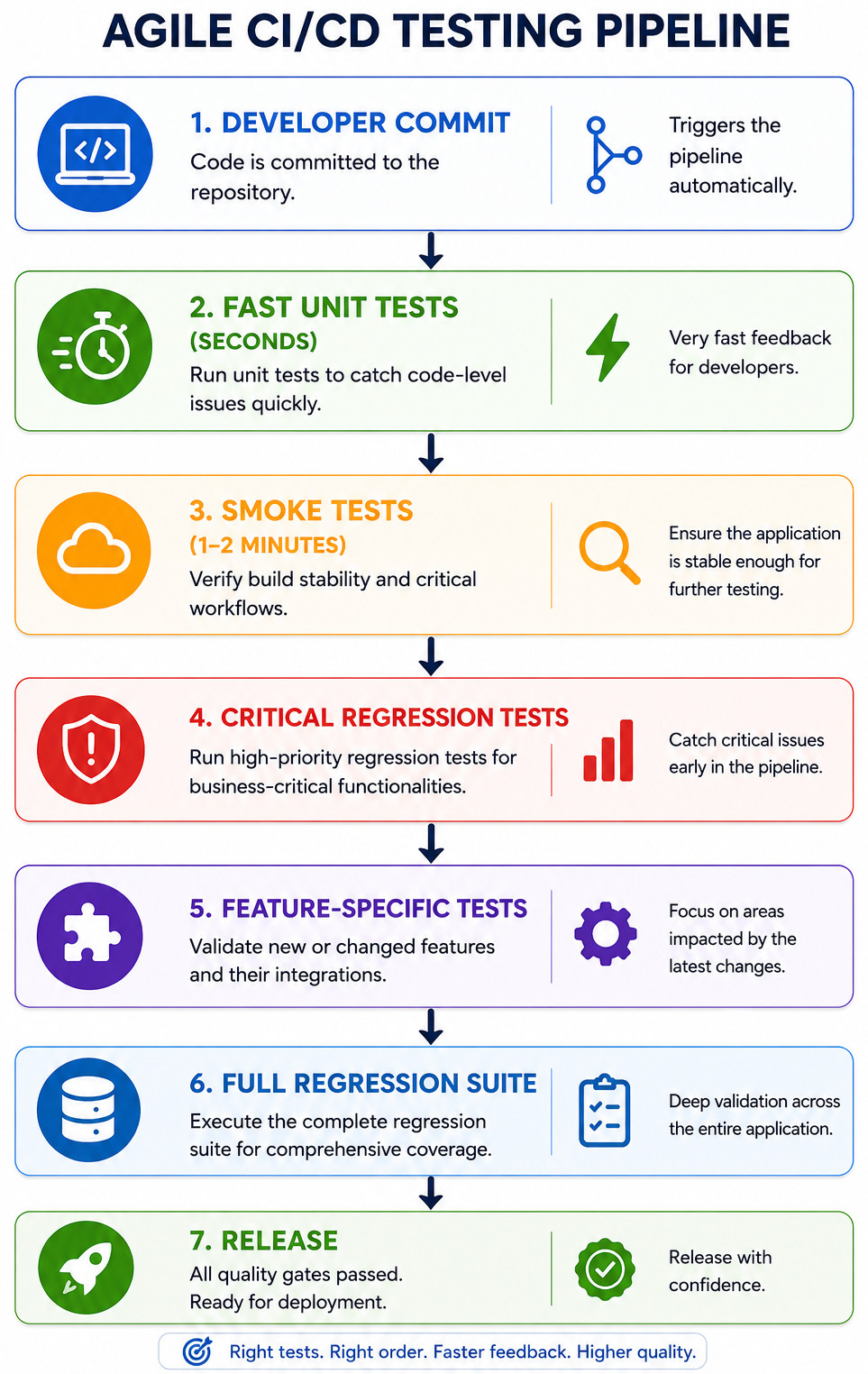
Not every test runs immediately. The bigger priority is fast feedback. Say a team has 2,000 automated test cases. Running the entire suite after every commit could take several hours. Developers would wait too long for results, slowing delivery and reducing productivity.
Instead, test execution can be coordinated with risk and timing:
- Code commit → Unit tests + smoke tests
- Pull request → Critical regression tests
- Feature merge → Related feature tests
- Nightly build → Full regression suite
- Pre-release → End-to-end validation
This method allows QA teams to catch important failures within minutes rather than hours. The value of test case prioritization in Agile is not simply deciding which tests are important. The real value is deciding when they should run. Because in fast-moving Agile environments, delayed feedback often becomes expensive feedback.
Understanding Whether TCP Works
One commonly used metric for evaluating prioritization effectiveness is Average Percentage of Fault Detection (APFD).
The concept behind APFD is quite simple. Imagine two regression strategies.
- Strategy A detects major defects after executing 80% of test cases.
- Strategy B detects those same defects after executing only 20%.
Even if both approaches finally catch identical issues, Strategy B is significantly more useful because important information reaches teams earlier.
Earlier defect discovery leads to:
- Faster fixes
- Reduced pipeline execution costs
- Better release confidence
- Shorter feedback cycles
The real value of prioritization is less about finding more defects and more about catching them faster.
What is Change Impact Analysis?
Change Impact Analysis is one of the most practical prioritization methods used in Agile environments. It’s a simple idea: when code changes, identify what parts of the application may also be impacted and run related tests first.
Suppose developers modify the following components:
Modified components:
- Checkout service
- Tax calculation engine
- Coupon logic
Affected workflows:
- Order placement
- Payment processing
- Invoice generation
- Discount validation
Prioritized execution may then become:
- Payment validation
- Coupon calculation
- Order confirmation
- Invoice generation
- Remaining regression suite
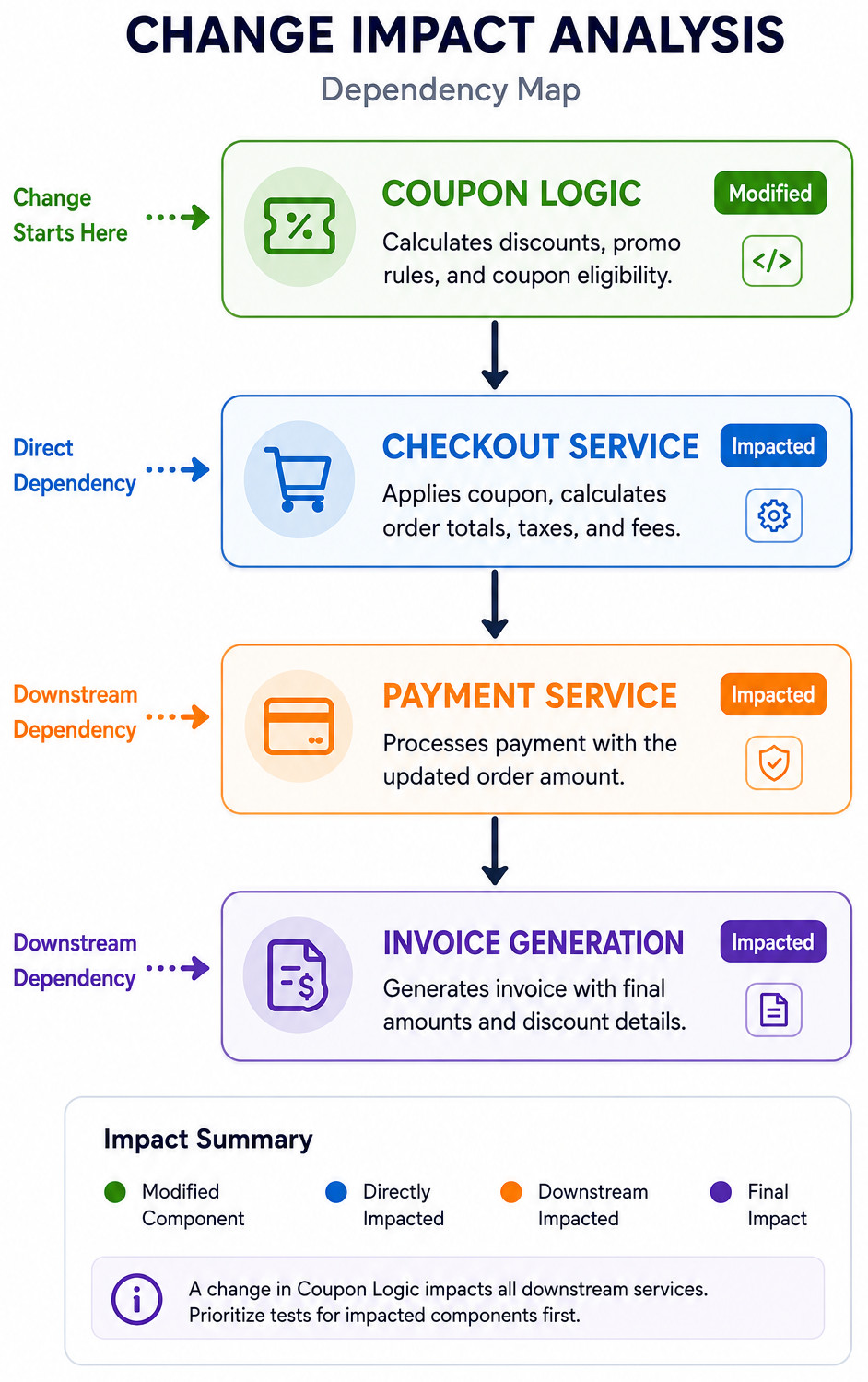
Without Change Impact Analysis, teams may spend hours executing low-value scenarios before zeroing in on the areas most likely to fail. With proper analysis, testing becomes focused and intentional.
Metrics of Test Prioritization Value
Prioritizing test cases only helps if it betters outcomes. Otherwise, teams are just changing the order of execution without gaining much value. That is why tracking a few practical metrics matters.
Test Coverage
One of the first things to look at is test coverage. This highlights how much of the app’s requirements are actually covered by tests. If critical workflows have low coverage, there is a higher chance that issues sneak through unnoticed.
Defect Detection Rate
Another useful metric is defect detection rate. In simpler terms, it tells you how good your test suite is at finding bugs. If prioritized tests keep catching important defects early, then your strategy is right.
Defects per Requirement
Teams also often track defects per requirement or defect density. Some features naturally become more unstable than others. If a particular workflow keeps producing defects consistently across releases, it means that area needs additional testing attention.
Execution time is important too. A regression suite that takes four hours to run after every commit builds slow feedback loops. Better prioritization should decrease unnecessary execution and help teams get results faster.
Change Failure Rate
You can also monitor the change failure rate, which calculates how often changes brought into production cause issues. If this number keeps escalating, it may mean that high-risk areas are not getting enough testing.
The important thing is not chasing one perfect metric. QA metrics are signals, not rigid answers. Looking at multiple indicators together usually gives a much clearer picture of whether the prioritization strategy is helping or needs changes.
Learning From Historical Failures
Seasoned QA engineers know that systems often fail repeatedly in the same places. Certain modules become common sources of production issues. An authentication module is most likely to break after session updates, reporting systems may crash after database changes, search features might become unstable under particular loads, and historical test data can expose such patterns.
History-based prioritization uses previous execution information, such as:
- Defect frequency
- Failed test trends
- Production incidents
- Test execution history
Suppose historical records show:
| Module | Failures in the Last 6 Releases |
|---|---|
| Payment Service | 14 |
| Search Service | 3 |
| User Profile | 1 |
Future test cycles would naturally assign greater priority to payment-related scenarios. The benefit here is quite obvious. Teams stop depending only on assumptions and start using evidence.
How AI-Powered Test Automation can Help
As applications expand, prioritization decisions become harder to manually handle. A team can have automated tests to the tune of hundreds or thousands executing across multiple environments. At some point, someone starts asking questions like: Do we really need to run everything right now? Which tests actually matter for this change?
This is where AI-powered testing starts becoming useful.
Tools like testRigor allow teams to reduce some of that complexity by making test automation easier to maintain and scale. Since test cases can be written in plain English and are less dependent on implementation details, teams spend less time fixing brittle scripts and more time focusing on what actually needs validation.
For Agile teams working with CI/CD pipelines, that matters. Faster maintenance and more stable automation can make it easier to organize critical tests, keep regression suites manageable, and support the larger goal of running the right tests at the right time.
Conclusion
Most QA teams in agile environments do not struggle because they are short of test cases; they have accumulated a high volume that is not manageable. Agile development and CI/CD pipelines need fast feedback, but running every potential test after every change leads to delays that eventually bring down efficiency.
Test case prioritization in Agile helps respond to this issue by enabling teams to run the right tests at the right time. As previously said, the goal is not to maximize the number of tests run, but to maximize the confidence. In modern software delivery, quality is often decided less by how much you test and more by how intelligently you decide what to test first.
FAQs
What is the main goal of Test Case Prioritization in Agile?
A: The main purpose of Test Case Prioritization (TCP) is to run the most valuable tests first. Instead of running every test case equally, teams focus on tests that are more likely to expose defects, affect business-critical workflows, or provide faster feedback.
How is Test Case Prioritization different from Test Case Selection?
A: Test Case Prioritization decides the order in which tests should run, while Test Case Selection decides which tests should run at all. For example, a team may select only payment-related tests after a checkout change and then prioritize those tests based on risk or business impact.
Can manual testing also benefit from test prioritization?
A: Test prioritization is not restricted to automation. Manual testing activities such as exploratory testing, acceptance testing, and functional testing can also be prioritized based on risk, business value, and feature criticality.
| Achieve More Than 90% Test Automation | |
| Step by Step Walkthroughs and Help | |
| 14 Day Free Trial, Cancel Anytime |