
Test Case Prioritization Techniques
 |
Time is an extremely precious commodity in the world of software development and testing. With greater pressure on teams to deliver high-quality products in shorter time frames, understanding which tests to prioritize is an important skill. The testing strategy is heavily relevant to it.
To put it in perspective, imagine that a new build drops. The sprint is about to finish. There’s stress to validate everything faster. However, your regression suite is massive, and running all of it is not realistic.
So, what can one do?
You don’t test everything first. You test the right parts first.
Let’s explore this essential survival skill in the real-world QA teams, i.e., prioritization.
| Key Takeaways: |
|---|
|
What is Test Case Prioritization?
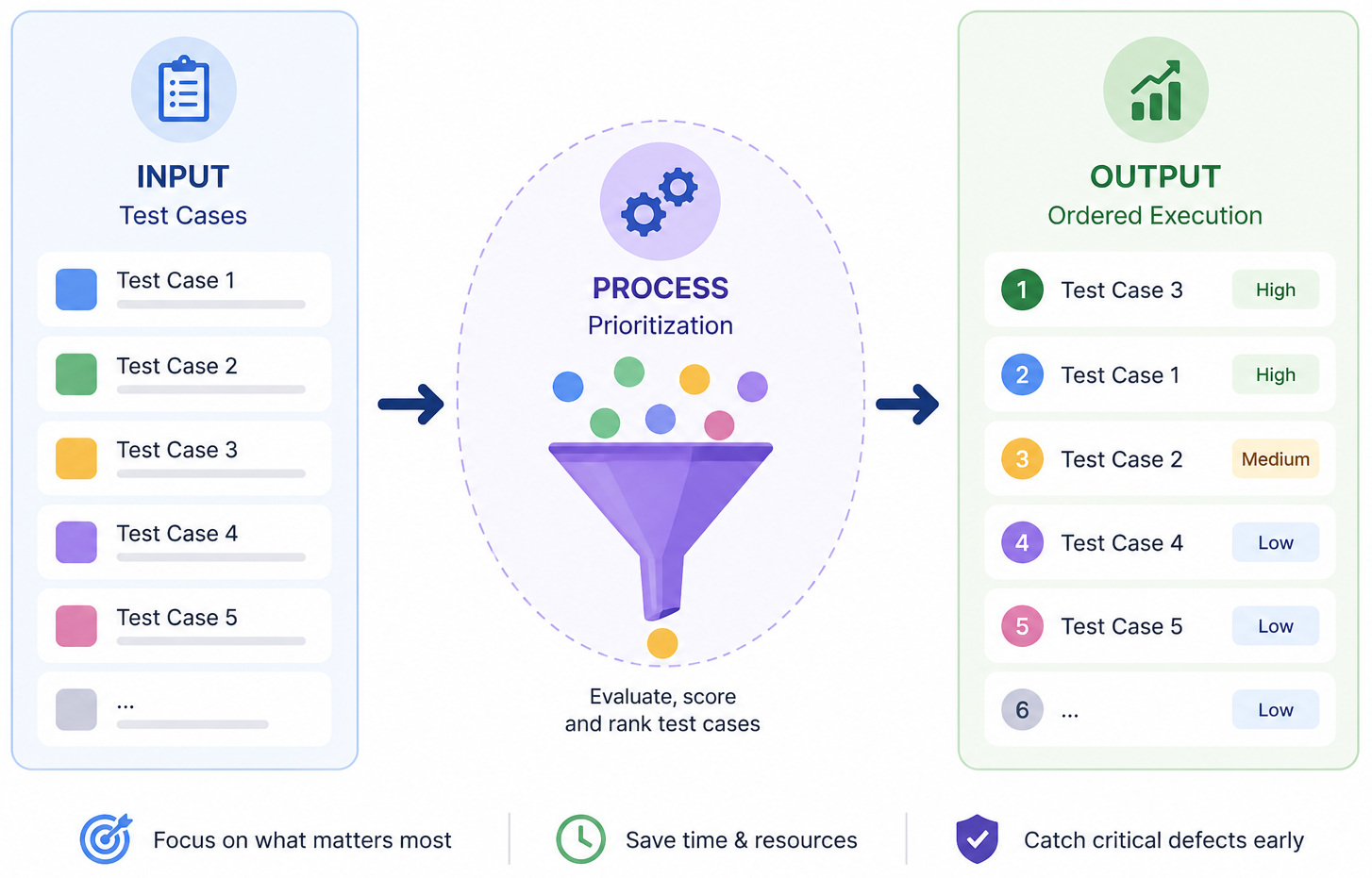
Test case prioritization is the process of ordering test cases so that the highest-priority ones are run first. The priority is based on risk level, business impact, or the possibility of catching defects faster. With this strategy, the teams concentrate on what is most important: increasing testing efficiency and catching possibly critical anomalies in the cycle.
Prioritizing test cases makes sure that QA runs the correct tests at the right times. This could lead to testing critical features first, leveraging certain test strategies like black box testing compared to others, and running shorter tests before longer tests. These tactics allow QA teams to catch risks faster and maximize their time best.
Test case prioritization applies slightly differently to manual and automation tests. For e.g., in test automation, you will prioritize specific automated tests by ordering them to execute before others in the automated CI/CD build pipelines. But in manual testing, prioritizing tests (say, exploratory, acceptance, or other functional tests) simply means selecting which test will have priority to execute.
Why Prioritization Becomes Important?
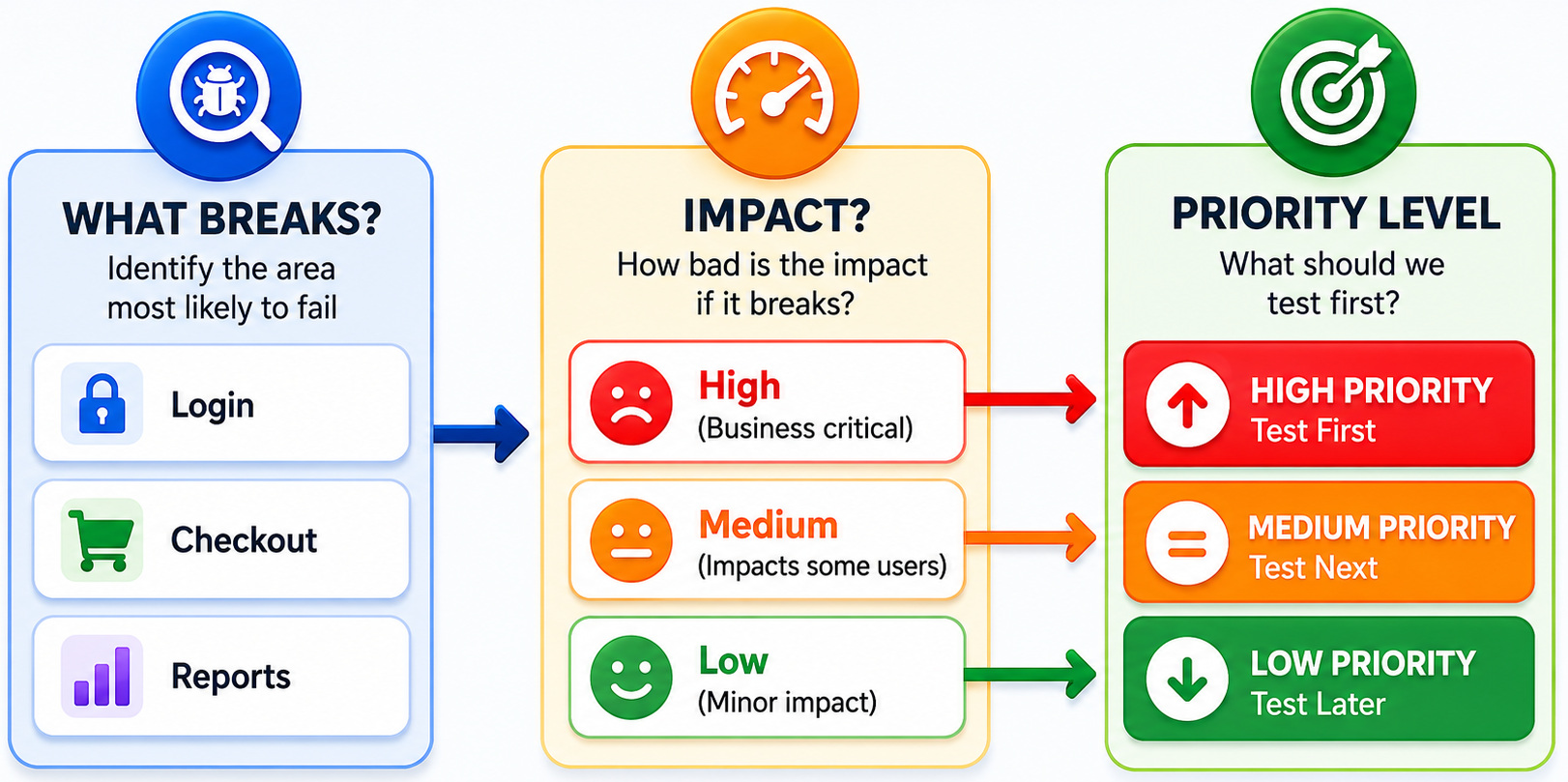
Test case prioritization allows optimization of test efforts by concentrating on the most important areas first. Release risks are reduced, and early bug detection offers teams faster feedback when it matters most.
In the existing Agile and CI/CD environments, where releases take place regularly, having a clear list for test execution is necessary. It makes sure that core features are validated first, preventing expensive bugs from reaching customers.
Prioritization usually becomes important in moments like a hotfix release that needs validation in under an hour, a regression cycle squeezed into half a day, or a CI pipeline that’s getting slower with every sprint.
Over time, most QA engineers develop an instinct for “what to test first.” Test case prioritization simply turns that instinct into something more consistent and repeatable across the team. It supports continuous delivery by helping teams deliver high-quality software more reliably and efficiently.
What Prioritization Really Means (In Practice)
In theory, test case prioritization is about scheduling test cases to maximize early defect detection.
- If something is broken, where is it most likely to impact the user?
- What tends to crash when this part of the system changes?
- What absolutely needs to work before we can even call this build usable?
That mindset is the foundation. The “techniques” come after.
Read: What is Regression Testing?
Key Factors that Guide Test Case Prioritization
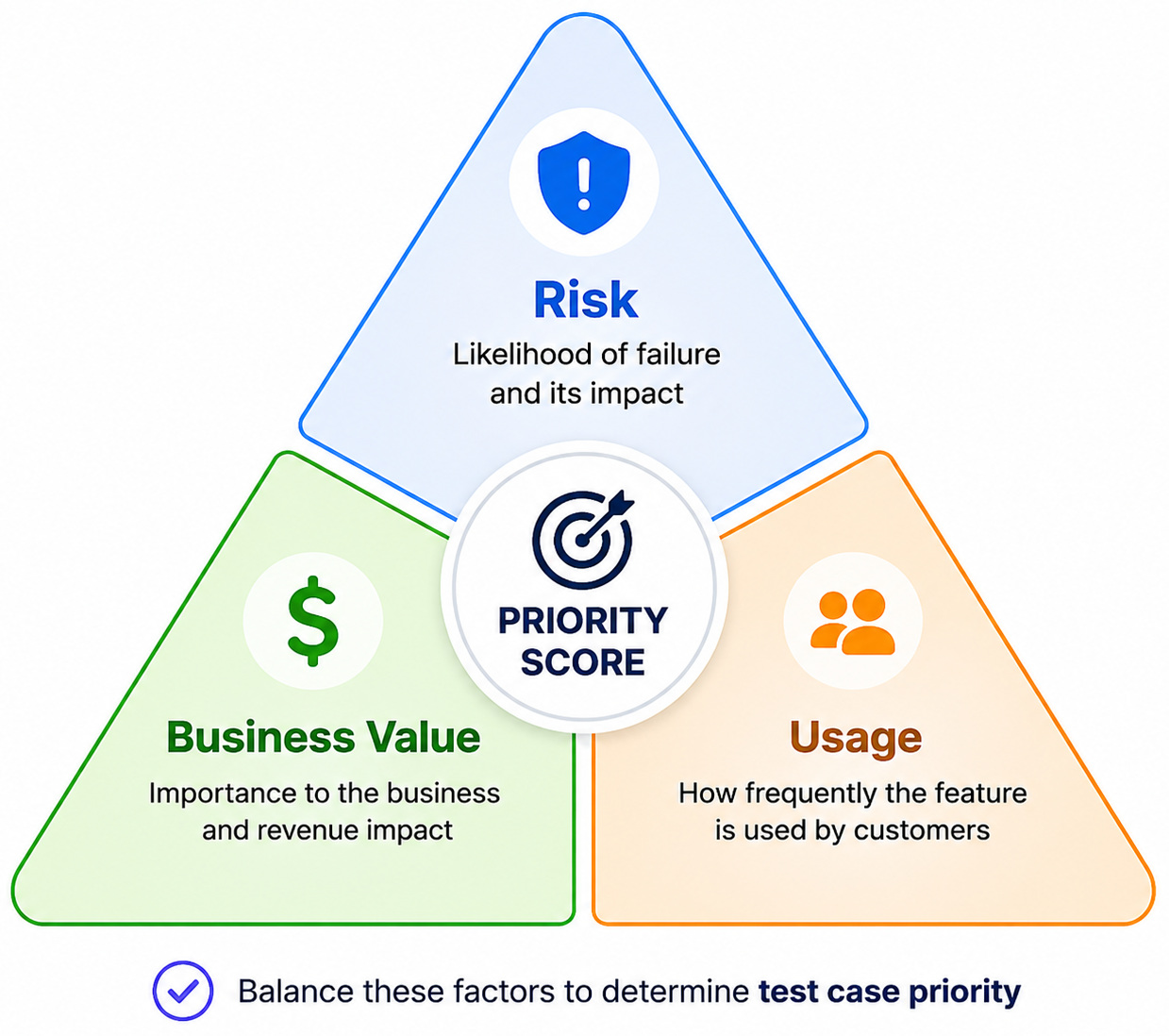
Test case prioritization is pretty sophisticated. However, in day-to-day QA work, it usually comes down to analyzing and understanding your system, its risks, and what matters most to the business.
Understanding Critical Functionality
Start with the modules of the application that really matter. These are the features users rely on and the ones that the business relies on.
For example, in an e-commerce product, the checkout flow is far more critical than UI customization because it directly impacts revenue. Test cases covering these flows should obviously be executed first.
Evaluating Risk
Risk is one of the strongest influencers of prioritization. It includes both the possibility of failure and the impact if something goes wrong.
- how error-prone a module has been in the past (fault proneness)
- how severe the impact of a failure would be
- how much the most recent code change has occurred
Fault-prone areas, like those that have historically produced more defects, are usually tested earlier. Similarly, high-severity issues that affect core functionality deserve priority attention.
Risk can also be calculated more intuitively. Features that are complex, regularly used, or highly visible to users generally carry a higher risk. If a failure could affect revenue, user trust, or retention, it should be prioritized accordingly.
Aligning with Business Priorities
Finally, prioritization should reflect what the business cares about right now.
If a new feature is being released to address a key customer need, its test cases should move up in priority. QA efforts should always stay aligned with product goals, making sure that the most critical functionality is validated first.
Different Methods Used to Prioritize Tests
Even though we don’t always label it during execution, most prioritization decisions fall into a few recognizable patterns. In real projects, these aren’t used distinctly; they blend together based on context.
Risk-based Prioritization
It is the obvious first step for most testers and QA teams.
You analyze an app and go straight for the jugular with areas that will be impacted most due to failures. For an e-commerce app, that would usually be the login, search, cart, and checkout.
And if the checkout is broken, none of the other functionalities matter.
This is risk-based prioritization. It’s driven by business impact and also by technical uncertainty. New functionalities, complicated integrations, and recently refactored modules tend to have more risk, so they get validated earlier.
Read: Risk-based Testing: A Strategic Approach to QA.
Requirements-based Prioritization
In Agile teams, requirement priority often directs testing order.
Say a particular feature is tagged critical in the sprint, the associated test cases move up the list. This keeps QA aligned with product expectations.
But expert QA teams don’t just blindly follow labels; they interpret them.
Sometimes a seemingly low-priority change impacts shared components or core flows. In those cases, it quietly becomes high-priority from a testing perspective.
Coverage-based Prioritization
These prioritize test cases based on code coverage and make sure that the most vulnerable and critical parts of code are tested first. These also have sub-techniques:
Total statement coverage prioritization: Test cases get priority based on the number of statements they cover. Say one test case covers 5 statements, the next covers 3, and another covers 10. So, the priority will be the third test case, the second test case, and the first test case.
Total branch coverage prioritization: Branch coverage refers to whether all paths of execution in an application are under test. In this context, branch coverage points to the coverage of each potential result of a condition.
Read: Code Coverage vs. Test Coverage.
History-based Prioritization
Every QA team has modules that always “break”.
This method takes into account the fault severity and the fault proneness of modules in the product to prioritize test cases. This method utilizes historical data, such as previous test execution results and fault detection rates. Tools like JIRA make this easier by showing patterns in past defects, helping you identify where attention is needed most.
Change-based Prioritization
In fast-moving projects, especially those with CI/CD, what changed in the latest build often determines what gets tested first. If the authentication module was updated, it makes no sense to start with reporting or settings. You go straight to authentication and anything connected to it. A quick look at commit history can give you a solid starting point.
Dependency-based Prioritization
One of the quieter aspects of prioritization is understanding dependencies.
If the login is broken, a large portion of your test suite might fail, not because those features are defective, but because they depend on authentication.
That’s why core features are usually validated first. It saves time and avoids confusion later.
Cost-based Prioritization
It is based on which test cases will provide the highest amount of benefits for the lowest cost. We usually consider the cost of each test case, i.e., test environment setup, execution time, and resources.
Other than the above-mentioned prioritization methods, there exist some less popular methods, such as user (which features will be used more), effort vs value-based (practicality of testing it, will it take longer to execute, but is not a critical functionality, etc.) prioritization.
How this is Implemented in a Real QA Workflow
Let’s say a new build is deployed.
- You start by validating if the build is stable enough to even test: basic smoke tests like login and navigation.
- Then you move to critical business flows, especially anything tied to revenue or core functionality.
- After that, attention shifts to areas that were recently changed or have caused issues in the past.
- Only if time allows, do you think of other lower-impact features or cosmetic validations.
What’s happening underneath is a combination of risk, history, coverage, and dependency-based prioritization; all working together.
Where AI-Powered Testing Fits into Prioritization
As test suites scale, prioritization becomes harder to manage manually. You can start with good instincts: risk, history, and recent changes, but at some point, the scale just gets too big.
That’s where AI-powered testing tools start to make a difference.
Instead of manually deciding what to run first every time, tools like testRigor help automate a lot of that thinking. Because tests are written in plain English and tied closely to real user behavior, it becomes easier to focus on high-impact scenarios without constantly maintaining complex test logic. Test maintenance is also made easier with the tool, which in turn allows QA teams to catch and resolve bugs faster.
Where Teams Usually Struggle
One common mistake is treating prioritization as a one-time setup. But systems evolve. Features change. Risk shifts. What was low priority last month might become critical after a new integration or refactor.
Another issue is relying purely on assumptions instead of data. That’s where defect history, usage patterns, and test results become valuable; they help ground decisions in reality.
Conclusion
Test case prioritization isn’t just a formal method; it’s a mindset that is built with experience.
Good QA engineers don’t just execute test cases. They constantly make decisions about what matters most right now.
And in today’s environments, where time is always limited, that skill makes all the difference.
Because in the end, it’s not about testing everything.
It’s about testing the right things at the right time.
Frequently Asked Questions (FAQs)
- What is the main goal of test case prioritization?
A: The main goal is to execute the most important test cases first so that critical defects are identified early. This helps teams save time, reduce risk, and improve release quality.
- Can test case prioritization be automated?
A: Yes, especially in modern testing environments. AI-powered tools like testRigor can help automatically prioritize tests based on user behavior, changes, and test stability, reducing manual effort.
- What are common challenges in test case prioritization?
A: Some common challenges include a lack of historical data, constantly changing requirements, large test suites, and maintaining test relevance over time.
| Achieve More Than 90% Test Automation | |
| Step by Step Walkthroughs and Help | |
| 14 Day Free Trial, Cancel Anytime |