
The $5M Apple Bug Bounty Program: Lessons for Modern QA
 |
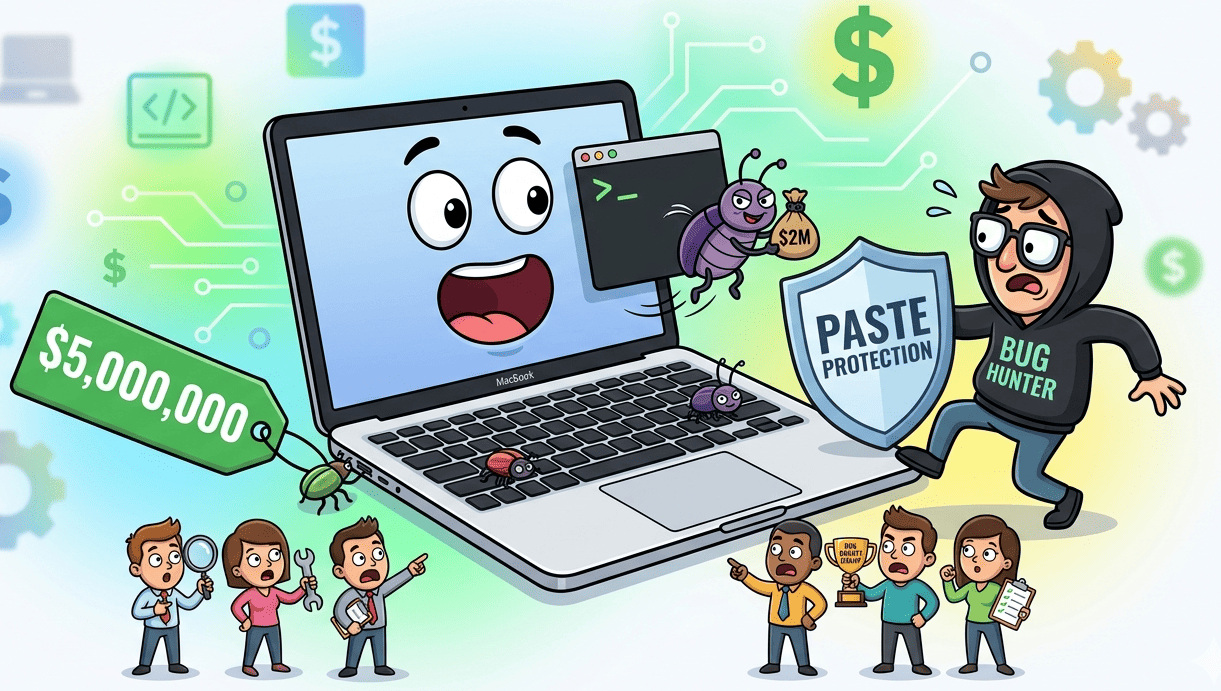
Are you a Mac user? If so, be careful.
Not only iPhones, but now even MacBooks are becoming targets for cyberattacks. Scams that trick people into running dangerous code through the “Terminal” application on their computers are becoming widespread.
However, Apple’s new Mac security strategy is set to strengthen protection like never before! Apple’s latest macOS update introduces a powerful new security feature designed to prevent such attacks.
More than just a regular software update, Apple is introducing major security measures designed to stop even the most skilled hackers. The first is protecting everyday users, and the second is offering huge rewards to security researchers who discover vulnerabilities in Apple’s systems through ethical hacking initiatives across the Apple ecosystem.
- No more easy tricks: The new security system will prevent users from copying and pasting malicious commands into the Mac Terminal as part of social engineering scams.
- Finding a bug could make you rich: If a cybersecurity expert discovers and reports security flaws (bugs) in Apple’s system, they can receive a massive reward. The maximum reward has now been increased to $2 million.
- Even bigger bonuses are available: If researchers uncover major security loopholes in certain high-risk categories, the Apple security bounty payouts can rise to $5 million, including bonus payouts.
Apple’s goal is to make macOS more secure by identifying threats early and encouraging some of the world’s best tech experts to help strengthen its systems. If you haven’t updated your Mac yet, it may be a good idea to do so soon.
| Key Takeaways: |
|---|
|
Why is This Update Important for Both Individuals and Large Companies?
For the average person, the ‘Terminal Paste Protection’ in macOS is a huge relief. When you unknowingly copy and paste code into the Terminal after visiting many links found on the internet, the system will now give you a proper warning. This will help you avoid malware attacks like ‘ClickFix’ and Infostealer, which trap many people.
At the same time, Apple does not intend to block developers’ work. The system evaluates clipboard contents to flag suspicious indicators (like non-TLS links or piped commands) rather than using a strict 24-hour bypass clock (Privacy Guides). The system intelligently blocks actions originating from dangerous sources.
- Improved Strength for XProtect: The ‘XProtect’ system will now be better equipped to automatically identify and defend against suspicious activities taking place in the background of the computer.
- FileVault Password App: ‘FileVault’ recovery keys that secure data on Mac can now be stored safely in the end-to-end encrypted ‘Passwords’ app.
- Quick Security Fixes: Small security issues in the system will be quickly resolved in the background without waiting for major software updates.
Since Apple made its ‘bug bounty’ program public, more than $35 million has been awarded to more than 800 researchers who found vulnerabilities in Apple’s platform. Security teams closely monitor critical macOS kernel vulnerabilities, especially threats like an Apple M5 kernel memory corruption or a Zero-click Remote Code Execution (RCE). To combat these, Apple relies heavily on Memory Integrity Enforcement (MIE).
Researchers using AI-assisted vulnerability research to discover complex privilege escalation exploit chains can submit their findings for Proof of Concept (PoC) validation. Under the new program rules, specific target flags accelerated awards are given for severe flaws, including lockdown mode bypass rewards.
In short, Apple is ensuring double security for users’ privacy and data through the new update, in addition to closing paths used by hackers.
Following these big announcements, the words written by security researcher Youssef Desouki, also known in the cybersecurity community as Zombie Hack, on his LinkedIn page are noteworthy:
“Welcome Back Apple Bug Bounty 🍎 I’m proud and grateful to share that my name has been added once again to the Apple Web Server Security Acknowledgements for 2026.”
There is no greater proof than this of how seriously Apple is moving forward in dealing with modern-day cyber threats.
What Lessons Should Software Testing Teams Learn From Apple?
The security of a system is actually part of its quality. Even world-class platforms like macOS have to constantly prepare new security updates and guard against fraud, which points to a major mistake many companies still make in their products.
Often, the thinking of many software testing teams is limited to, “Does this system work as intended?” But very few people ask, “How can this be misused?” The paste-based scams that Apple has now addressed and hacking through social engineering stem from one major issue: failing to think like a hacker during the development and testing phases.
We see similar mistakes when it comes to automation testing. Inconsistent tests, selectors that break after small changes, and overreliance on UI flows all ultimately lead to the same mindset: the assumption that “users will do everything right”! These are the loopholes that hackers love the most.
The best quality and security come from building systems that can withstand the unpredictable behavior of users or the environment they’re in. This is the biggest lesson Apple’s new changes teach us.
What Should Quality Assurance (QA) and Product Teams Do Next?
Teams need to bring the mindset of a hacker early into development, thinking not only about how to use a product but also about how to break it. We need to check whether our automation systems can defend against unexpected data or unusual actions when they enter the system. Testing methods need to change to anticipate risks, just as Apple’s new ‘XProtect’ does.
In addition, the product itself needs to be equipped with the ability to accurately monitor and prevent even small errors that occur during test runs. Above all, it is important to instill the idea that security and reliability are not just the responsibility of the security team, but the responsibility of everyone in the company.
At testRigor, we regularly see teams gain more confidence in their products when they move from old, code-heavy, and fragile automation to generative AI-based test automation that can be done in plain English. If your testing tools are crashing after even minor UI or requirement updates, it’s time to look for new ways to reduce maintenance costs and test important user paths and edge cases more accurately.
This new announcement from Apple reminds us that even the world’s most valuable companies don’t just see security and quality as a checklist, but as areas that require continuous investment. That’s what smart teams are doing now.
| Achieve More Than 90% Test Automation | |
| Step by Step Walkthroughs and Help | |
| 14 Day Free Trial, Cancel Anytime |