
GitHub Action vulnerability in Anthropic’s Claude Code: What Software Teams Need to Know
 |
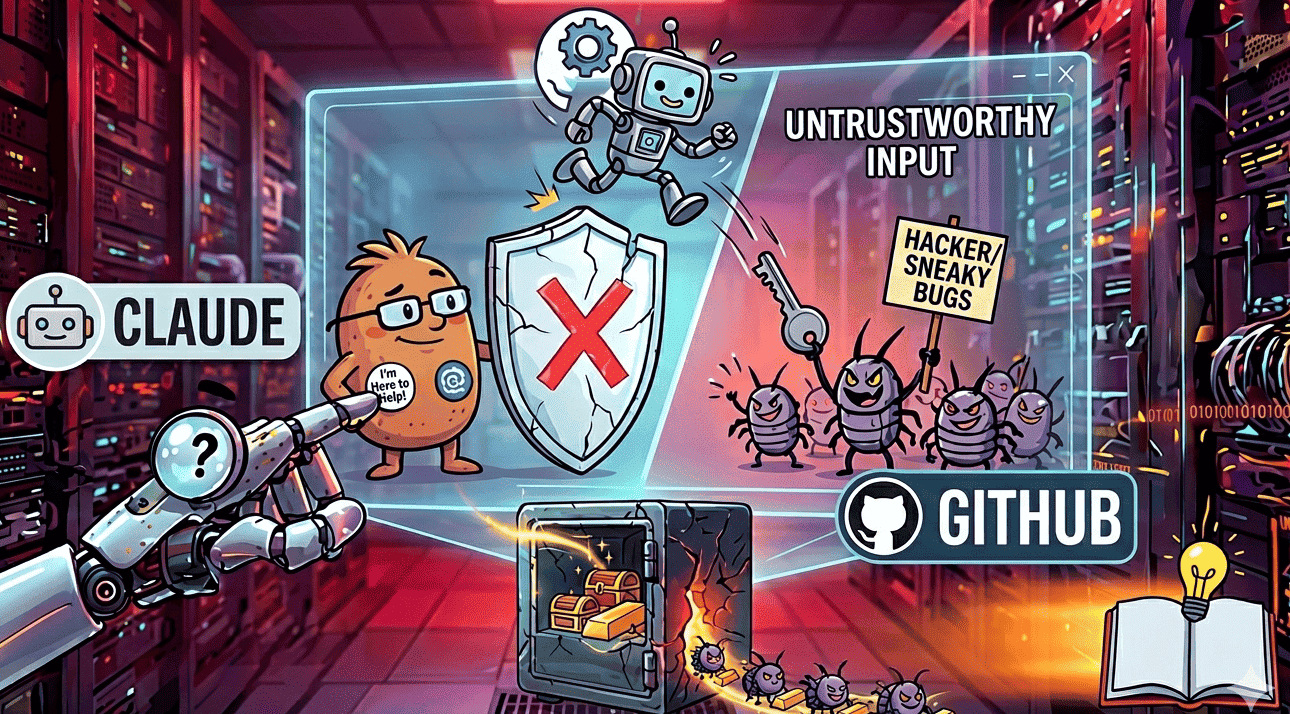
Are you someone using Claude in your software development workflows? You may trust AI to help write code, review changes, and manage tasks. But what happens when the information it reads cannot be trusted?
In early June 2026, a security report gained attention among the developer community. The report, released by security researcher Ryota K., revolved around Anthropic’s Claude Code GitHub Action.
Thousands of people open issues in GitHub every day to report bugs and suggest new features. But Ryota’s discovery indicated that a specially crafted issue could be a gateway for an attack in certain situations.
If this flaw could have been exploited in workflows running the Claude Code GitHub Action, it could have had serious consequences, such as bypassing security controls, accessing confidential information, and compromising repositories. This was a particular concern for teams that used AI-based code reviews and triage processes.
There is another point to note here. This was not a large-scale data leak or an incident where millions of accounts were hacked. It was a vulnerability that could have gone unnoticed. But in today’s world, where AI agents and automation systems are taking on more responsibility, such flaws have the potential to cause greater consequences.
Security experts therefore took the discovery seriously. Public repositories running Claude Code workflows could have been vulnerable to attack in some cases. In the worst-case scenario, if Anthropic’s own action repository had been compromised, the problem could have spread to many projects that depended on it.
➦ Claude Chrome Extension Vulnerability
| Key Takeaways: |
|---|
|
The Mechanics Behind the Vulnerability
The main goal of the Claude Code GitHub Action is to reduce the workload of developers. It can check issues, evaluate pull requests, and handle some repetitive tasks on its own. Therefore, it has many permissions that are necessary to work within the workflow. There were situations where it had read and write access to the code in the repository, as well as to issues and pull requests. So, what was the issue?
Claude Code was treating certain actions coming from GitHub Apps as trusted under specific conditions. Creating a GitHub App is not a complicated process. An attacker could create their own GitHub App and use it to create an issue or pull request in the targeted repository. That is where the attack could begin.
In the experiment conducted by Ryota K., the issue created by the researcher did not look like a normal bug report. Instead, it was written in a way that made it appear like a system error that needed investigation. When Claude started analyzing the issue, the hidden instructions within the message influenced how it handled the request.
During this process, Claude was able to check environment variables. The researcher showed that information, including OIDC-related credentials, could be accessed from locations such as proc/self/environ and then sent outside the system. If an attacker gained access to these credentials, they could potentially use them to perform actions like changing repository files, modifying code, or accessing sensitive information.
Some security settings that appeared harmless also contributed to the issue. For example, allowed_non_write_users: "*" may not appear risky when considered separately. However, this incident showed that when such settings are combined with certain permissions, they can create unexpected ways for attackers to interact with the system.
Anthropic quickly took action after the report was published. Starting with v1.0.94, actor verification was strengthened, protections against data exfiltration were improved, environment information was handled more securely, some summary features were temporarily restricted, and additional security controls were included. The flaw was given a severity rating of 7.8 on the CVSS scale. The researcher also received a bug bounty.
But the significance of this incident doesn’t end with a security patch. Many see it as a clear example of how even a small lapse in trust can become a major security issue when AI-based automation systems are incorporated into the development process.
Broader Implications for Software Teams
This incident cannot be seen as an isolated security issue affecting Claude Code. It is also an indication of a larger shift that has been occurring in the software development world over the past few years.
Today, AI agents are not just assistants that provide suggestions. They act as part of many workflows. They read issues, review pull requests, make decisions, and sometimes perform actions directly. To do so, they are given access to various tokens and credentials. That is where the main challenge arises.
The information that these AI systems handle on a daily basis is not always trustworthy. Anyone can add content to GitHub issues, comments, pull requests, and other sources. The risk naturally increases when a system reads such inputs while also holding highly privileged credentials.
The Claude Code incident is a reminder of that. The problem is not just about a specific bug. The bigger concern is what can happen when untrusted information and powerful automation systems end up in the same workflow.
QA, testing, and reliability engineering teams have a lot to learn from this incident. Automation is not a new concept. Software teams have been experiencing its benefits for years. But the history of automation reminds us this: when it works well, it can dramatically increase team productivity. At the same time, the impact of a bug that goes unnoticed or of a system being misused by someone else can be just as significant.
That’s why teams should carefully define what AI is allowed to do, because excessive permissions can create significant risks.
Beyond Test Cases
The main promise of AI-based workflows is speed. Pull requests can be checked faster, issue triage can be made more efficient, and developers can save time. That’s why many teams have now made such systems part of their development process.
- How does an AI agent respond if it receives dangerous or misleading inputs?
- How do you ensure that confidential information is not leaked?
Standard software testing methods don’t always provide clear answers to these questions. This is why attack methods like prompt injection are gaining more attention. Such attacks, which use inputs designed to cause AI systems to make wrong decisions, are one of the main concerns of security experts today.
Meanwhile, another challenge is observability. In many organizations, CI/CD workflows act like a “black box.” What’s going on inside is often not examined until a problem occurs. The Claude Code incident demonstrated once again how dangerous that approach can be.
That’s why the concept of shift-left security testing is gaining more importance now. Instead of only testing security at the end of development, risks need to be assessed from the workflow design stage. It is now time to check whether permissions are configured correctly, how the system will respond to malicious inputs, and how the AI agent’s behavior changes in a staging environment. The Claude Code incident may be just a warning. As AI, automation, and DevOps become more closely integrated, these questions are likely to become more common.
Conclusion
So where should a team start today?
Often, the answer lies in GitHub Actions workflows. A good place to start is to re-examine what permissions have been granted, especially in workflows that use AI. Many older projects still have permissions that were granted years ago and are no longer reviewed. It’s important to periodically check that only the permissions you really need are being maintained. Settings like allowed_non_write_users should be re-examined in the same way.
Security testing also needs to evolve. It’s not enough to just test whether a typical workflow is working properly. What happens if you try to mislead an AI agent? How will it respond if you give it a deliberately crafted issue or input? These kinds of questions need to be answered. Many teams can uncover weaknesses before they become real problems by conducting these types of tests.
Another point is that workflows can no longer be left running and forgotten. Monitoring systems that can detect unexpected command executions, access to environment variables, and unusual data movement are essential.
The approach to security is also changing. Performing workflow scanning and permission validation before merging pull requests is becoming a common practice in many organizations today. This is because it is much easier and less expensive to detect problems early than after they reach production.
It is also time to rethink the way we handle CI/CD secrets. The approach of using old CI/CD secrets for years is no longer considered very secure. Secret rotation and regular auditing are now practiced by many organizations as part of good security practices.
The Claude Code incident also reminded us of another important point. In the past, discussions about security mostly revolved around code. Today, the picture has changed. Configurations, workflows, automation systems, and AI agents are all potential attack surfaces. If any part of them is ignored, the impact can be huge.
Therefore, quality engineering in the AI era is not limited to writing test cases. It is an approach that continuously monitors and evaluates the entire development environment, from code to automation.
We kept these challenges in mind when designing testRigor. The platform is built to help teams manage complex testing workflows, identify inconsistent test behavior early, and gain better visibility into test execution. As AI becomes part of more development processes, reliable and low-maintenance automation approaches are becoming very important. Exploring how such tools fit into a broader quality strategy can help teams reduce risk and avoid unexpected problems in the long run.
| Achieve More Than 90% Test Automation | |
| Step by Step Walkthroughs and Help | |
| 14 Day Free Trial, Cancel Anytime |