
Defining Agile Testing Exit Criteria: A Complete Guide
 |
It is essential for any process-driven software company to understand the importance of following a methodical approach for quality assurance. You would probably agree that there is a need to adopt a systematic approach towards software testing, since it ultimately ensures that the delivered product is of the highest quality standards.
According to a rough estimate, annually, software failures amount to close to $3 trillion of the worldwide monetary impact.
Modern software development uses methodologies like Agile to ensure quality software and faster release. One key component of effective testing in Agile is defining clear Exit Criteria.
| Key Takeaways: |
|---|
|
This article explores the concept of exit criteria, why they are important in Agile testing, and how teams can effectively define and implement them.
What is Exit Criteria in Software Testing?
Exit criteria in software testing are predefined conditions that must be met before the testing phase, or iteration, can be considered complete.
The exit criteria ensure that sufficient testing has been performed and the established acceptance criteria have been met. Based on this, it is determined whether a product or feature has reached the required quality level and is ready for release.
In Agile environments, exit criteria are typically aligned with the Definition of Done (DoD) and user story acceptance criteria.
Definition of Done (DoD) in Exit Criteria
The Definition of Done (DoD) in Agile is an agreed-upon checklist of criteria that is shared with the team. Every product increment or user story must meet this criterion for a product to be considered “shippable”. DoD ensures all work is completed to a high standard in all phases (coding, testing, documentation) of the software development lifecycle (SDLC).
Read more: What is Agile Software Development?
Key Elements: Definition of Done (DoD)
- Code Quality: Perform a peer review of code to ensure it complies with standards.
- Testing: Perform unit, integration, and regression tests and ensure they have all passed.
- Functionality: User stories for product functionality should meet specified acceptance criteria.
- Documentation: Ensures technical documentation, user manuals, or release notes are up-to-date.
- Deployment: Deploy the feature to a staging/production-like environment first.
A strong DoD ensures consistent, predictable quality across all deliverables and provides a clear, shared understanding of work status for the team and stakeholders. It prevents unfinished work from being passed to later stages and helps maintain a sustainable pace as it avoids “almost done” work.
- “Code compiled and checked into the main branch.”
- “Unit tests written and passed (often with > 80 % coverage).”
- “Technical documentation (API docs, user guides) updated.”
- “No high-severity bugs”
- “Feature demoed to relevant stakeholders.”
Remember that the DoD is not the same as acceptance criteria. DoD is a global set of standards for all tasks, while acceptance criteria are specific to an individual user story.
Deciding Factors for the Exit Criteria in Software Testing
Exit criteria act as essential checkpoints that determine when a testing phase or iteration can be considered complete. Several key factors influence exit criteria, and it is essential to understand them for effective risk management, compliance, and project quality. These factors also verify that critical test case automation, test data requirements, and performance goals have been achieved.
The diagram below shows the primary factors that define exit criteria in software testing:
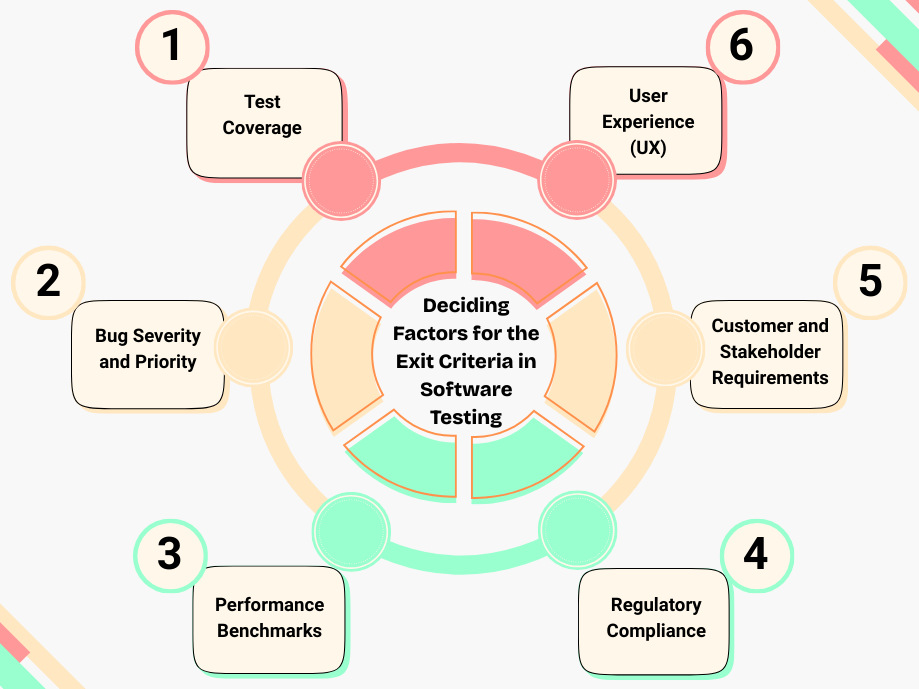
1. Test Coverage
Test coverage is the extent to which the software (code and functionality) has been tested, using a comprehensive range of test cases. Test coverage means both functional and regression testing are covered. With adequate test coverage, most defects are identified and addressed, and exit criteria can be set around specific metrics to support this goal.
- Percentage of Code Coverage: This is one common criterion and targets the codebase through tests, including automated unit, integration, system, and manual tests. This metric ensures that key areas of the software have been tested thoroughly.
- Functional Coverage: This metric ensures all main features are tested with both positive and negative scenarios to verify that the software functions as expected under various conditions.
- Risk-based Coverage: For this, teams focus on testing critical and high-risk areas of the software and prioritize the ones that could have the greatest impact if defects are present. With this strategy, essential operations are protected, and risks of undetected high-priority issues are reduced.
2. Bug Severity and Priority
The severity and priority of bugs identified during testing are important factors in defining exit criteria. Not all bugs require immediate attention; however, there are certain conditions that should be met before defining exit criteria:
- No Critical Bugs are Open: All critical bugs impacting core functionality must be resolved to meet exit criteria so that there are no blocking issues disrupting essential operations.
- Limited High-priority Bugs: There should be only a specific number of high-priority bugs that do not impact major functionality.
- No Blocking Bugs: Blockers or bugs that block further testing or development must be resolved to allow the project to proceed.
3. Performance Benchmarks
Test environments should simulate real-world usage to meet performance acceptance criteria. Exit criteria may include specific performance goals, especially for high-performance applications in sectors like finance and healthcare.
- Load Testing: The system must handle a defined number of users or transactions without degrading the performance. For instance, supporting 10,000 simultaneous users successfully without compromise in functionality or speed.
- Response Time: The system should respond to user actions swiftly. The response should not exceed the stipulated time limit.
- Scalability: The system must scale effectively when the load is increased, without failures or performance issues, even when the load is maximum.
Read more on performance testing here.
4. Regulatory Compliance
In strictly regulated industries like healthcare, finance, and aviation, exit criteria must align with specific compliance requirements outlined in the test strategy.
- Audit Trails: Logs that record actions and changes within the system are called audit trails. All necessary audit trails should be in place and record each and every action within the system.
- Data Protection: Sensitive data should be protected as far as possible. Whenever its use is inevitable, the data must be encrypted, masked, or de-identified according to industry regulations, such as PCI-DSS or HIPAA.
5. Customer and Stakeholder Requirements
- Acceptance Criteria: All acceptance criteria specified in user stories or requirements documents must be fulfilled by the software.
- Feature Completeness: All features must be implemented and work as expected.
- Documentation: Necessary documentation, such as user guides or API references, must be completed and verified.
6. User Experience (UX)
User experience is the key factor of exit criteria in modern software development. It ensures the software meets the required user expectations:
- Usability Testing: The software should be user-friendly and intuitive. It should pass all usability tests.
- Accessibility Compliance: The product should accommodate all types of users and stick to accessibility standards, such as WCAG.
Teams should balance these factors appropriately to develop effective, practical exit criteria.
Example of Exit Criteria
Exit criteria are integrated into the team’s “Definition of Done (DoD)” and can change based on project and team context. They are usually defined at the user story, sprint, or release level.
User Story Level Exit Criteria
- The QA team or the product owner has tested and ensured that all acceptance criteria are met.
- All associated development and testing tasks have been properly completed.
- All logged defects related to the user story are triaged, resolved, and retested.
- Relevant tests have been updated in the regression test suite and/or automation suite.
- Peer review of the code has been completed, and feedback has been provided.
Sprint Level Exit Criteria
- All user stories in the sprint backlog that were committed to are “Done”.
- No open critical or high-severity bugs remain from the current sprint’s work.
- The automated regression test suite has been executed and passed without issues.
- Code quality checks (e.g., static analysis tools) have been performed and passed.
- Evidence of compliance (e.g., FDA for health, PCI-DSS for fintech) is documented and finalized.
- The sprint review/demo meeting is held, and feedback is collected from stakeholders.
Release Level Criteria
- User Acceptance Testing (UAT) for the product/application has been successfully completed.
- All required documentation, including user guides, API references, etc., is complete and updated.
- Industry standards and regulatory compliance have been verified and found compliant.
- Formal approval or sign-off from key stakeholders or decision-makers has been secured.
Why is Exit Criteria Important in Agile Testing?
Exit criteria play a vital role in maintaining product quality and act as safeguards, especially in industries like healthcare or fintech, where precision is a must. In Agile environments, their importance becomes prominent with frequent releases and tight timelines.
- Ensures Product Quality: Exit criteria define the level of testing required to ensure that software meets quality standards before release. Without exit criteria, necessary tests could be overlooked, critical bugs could go undetected, and the release could be stalled.
- Provides Clear Completion Standards: Exit criteria tell you where exactly the testing should stop or can be considered complete. With this, developers, testers, and product owners are clear about the situation and no longer confused.
- Supports Compliance: Regulatory entities often require thorough documentation of testing processes and results. Exit criteria offer this and ensure the software meets compliance standards.
- Supports Faster Releases: Agile development often involves short sprints. With exit criteria, teams can quickly assess readiness and move ahead confidently.
- Improves Team Alignment: A clearly defined exit criteria provides an exact understanding of what “done” means. All team members are on the same page, and team alignment is improved.
- Helps Manage Risk: A well-defined exit criterion reduces the risk of releasing defective software as it ensures critical tests and validations are completed. It ensures that testing has been thorough enough to mitigate identified risks, specifically related to sensitive data, medical information, or transactions.
Challenges in Defining Exit Criteria in Agile
While exit criteria are essential, they face several challenges when defining them in Agile environments:
- Changing Requirements: Projects frequently evolve based on user and stakeholder feedback. Exit criteria must be flexible enough to accommodate these changes.
- Subjectivity of “Done”: Definition of Done should be clear and agreed-upon. Otherwise, it will lead to inconsistent releases, bugs escaping, and poor product quality.
- Short Development Cycles: Sprints in Agile typically last between one and four weeks. This leaves limited time for thorough testing.
- Continuous Integration and Delivery: Modern teams rely on CI/CD pipelines in which testing is continuous rather than limited to a single phase.
- Collaboration Across Roles: Exit criteria are expected to satisfy multiple roles, including developers, testers, product owners, and business stakeholders.
To overcome these challenges, exit criteria must be realistic, measurable, and adaptable.
Steps to Define Exit Criteria in Agile
Defining exit criteria requires collaboration and strategic planning. The following steps can help teams establish effective exit criteria.
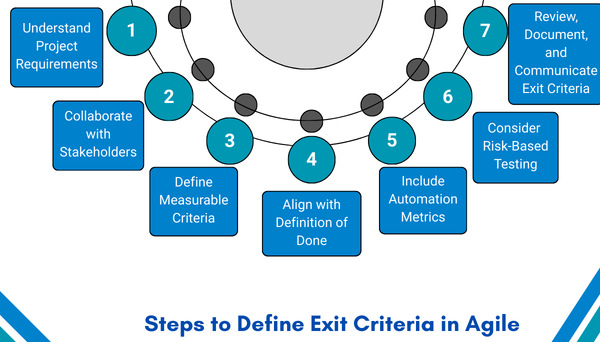
Step 1: Understand Project Requirements
Understand project goals, business requirements, and user stories thoroughly. Ensure that the exit criteria align with the product’s requirements.
Seek answers to queries such as the quality you require, risks that might pop up before release that are to be mitigated, or the testing activities that need to be completed before release.
Step 2: Collaborate with Stakeholders
Exit criteria should be the work of the entire team and not limited only to testers. Agile encourages collaboration across roles to establish, review, and gain sign-off on the criteria, including developers, QA professionals, product owners, business stakeholders, and scrum masters.
Step 3: Establish Measurable Criteria
Establish exit criteria at the beginning of the project, sprint planning, or release planning to prevent changing quality standards mid-way. Use measurable metrics such that teams can objectively determine when testing is complete. Exit criteria you define must be quantifiable.
Ensure criteria are specific and objective, for example, “100% of test cases executed” or “zero high-severity bugs”.
Criteria such as “Testing should be sufficient” do not quantify the statement and are difficult to achieve.
Step 4: Establish a Definition of Done
Agile teams maintain a Definition of Done (DoD), a list of items that describes when work is considered complete.
Exit criteria should align with the DoD by defining testing-specific conditions. Special technical requirements, such as code coverage thresholds or performance benchmarks, should be added. Criteria for user stories, tasks, or sprints are set before the activity begins. In this way, quality standards are met from the start.
- The code that was written has been reviewed
- Unit tests for the feature XYZ have passed
- Integration tests completed
- Documentation updated
Step 5: Include Automation Metrics
Automation is vital in Agile testing. Include automated testing goals, such as successful CI pipeline execution, minimum automated regression coverage, and automated build stability.
By integrating automation into CI/CD pipelines, teams can meet exit criteria faster and more efficiently.
Step 6: Consider Risk-Based Testing
Prioritize risk-based testing and include the information, such as additional exploratory testing, security testing, and performance validation, in the exit criteria.
For low-risk features, the criteria may be simpler.
Step 7: Review, Document, and Communicate Exit Criteria
Once defined, review the exit criteria, document them, and share them with the entire team. From time to time, revisit the exit criteria during team retrospectives to ensure they remain relevant to the project’s evolving needs.
Typical places to document exit criteria include test plans, sprint documentation, QA guidelines, and Agile boards or project management tools.
Clear and concise documentation ensures transparency and accountability.
Best Practices for Defining Exit Criteria
- Establish Measurable Metrics: Use objective, quantitative data to define success, such as “95% of test cases passed” or “zero critical, high-priority bugs”.
- Align with Business Goals: Criteria should reflect key objectives, such as security, usability, or performance, and should be realistic given project constraints.
- Involve Key Stakeholders: Collaborate with product managers, developers, and testers to ensure all perspectives are covered and secure formal sign-off to avoid ambiguity.
- Prioritize Risk-Based Testing: Focus on high-risk, critical features/areas first to ensure they are tested thoroughly.
- Document and Standardize: Record all criteria in the test plan or in tools like Jira/Confluence.
- Utilize Automation: Utilize automated tests and CI/CD pipelines to continuously check if criteria are met.
- Review Regularly: Update criteria throughout the project lifecycle to adapt to changing requirements, especially in Agile, where this is known as the “Definition of Done”.
Role of Automation in Meeting Exit Criteria
Automation is essential in Agile testing because it enables teams to validate features quickly and repeatedly. It plays a critical role in meeting exit criteria by providing efficient, consistent, and measurable verification of software and marking it ready for the next iteration.
Automation reduces tedious manual testing by enabling rapid, continuous, automated, and repeatable processes, which are vital for regression testing.
Read: Transitioning from Manual to Automated Testing using testRigor: A Step-by-Step Guide.
- Accelerates Testing & Development: Automation speeds up testing, enabling software to be released faster without compromising quality, which is critical for meeting deadlines.
- Ensures Consistent Quality: Human error is avoided, and effort is reduced by automating repetitive tests. It also ensures that every release meets defined quality standards, such as 100% test case execution and no open, high-severity bugs.
- Provides Comprehensive Test Coverage: Automation enables broader, more consistent test coverage (e.g., 80% or more of the codebase) across unit, integration, and system levels.
- Integrates with CI/CD: Using tools like GitHub Actions or Jenkins, automated pipelines enforce quality gates (like static analysis or code reviews) that must be passed before code can move to the next stage.
- Assists in Objective Decision Making: A decision whether exit criteria have truly been met can be made using automated, data-driven insights from test management platforms (e.g., Jira, TestRail) that provide objective metrics, such as bug status and coverage percentages.
Test automation is used to meet a few common exit criteria, such as test execution (100% execution of planned test cases), bug resolution (all critical/high-priority bugs are closed), code coverage (reaching specific percentage thresholds), and performance benchmarks (meeting speed/stability requirements).
Note that while automation handles repetitive tasks, it is often paired with manual exploratory testing to ensure complete, high-quality results.
Conclusion
For Agile testing to be successful, exit criteria are critical. They provide clear requirements to determine the completion of testing activities and the product’s release readiness.
Using measurable, realistic, and collaborative exit criteria, Agile teams can deliver high-quality software while shipping rapidly. Effective and clear exit criteria ensure collaboration among team members, reduce release risks, and improve overall development efficiency.
Exit criteria must be flexible enough to accommodate frequent changes in an Agile environment. At the same time, they should be continuously refined. With automation, risk-based testing, and strong collaboration, exit criteria are a powerful tool for delivering reliable and high-quality software in every sprint.
Frequently Asked Questions (FAQs)
- Who is responsible for defining exit criteria in Agile projects?
Exit criteria in Agile projects are typically defined collaboratively by QA engineers, developers, product owners, and scrum masters. This collaborative approach ensures that the criteria align with both technical quality standards and business expectations.
- How does exit criteria relate to the Definition of Done (DoD)?
Exit criteria are often a subset of the Definition of Done. While the Definition of Done covers all aspects required to complete a task or feature, exit criteria focus specifically on testing and quality validation conditions.
- Can exit criteria change during an ongoing Agile project?
Yes, it can. As teams gain experience, gather feedback, and identify risks, they may refine exit criteria to better balance quality, speed, and project requirements.
- How can you utilize test automation to achieve exit criteria in Agile?
Test automation helps teams meet exit criteria faster by running regression tests automatically, improving test coverage, and detecting defects early. Automation also supports continuous integration and continuous delivery pipelines.
- What are the repercussions if the exit criteria are not met?
If exit criteria are not met, the team typically delays the release, fixes critical issues, or carries the unfinished work into the next sprint. The goal is to maintain product quality rather than release unstable features.
| Achieve More Than 90% Test Automation | |
| Step by Step Walkthroughs and Help | |
| 14 Day Free Trial, Cancel Anytime |