
Stryker Cyberattack 2026: Lessons in Security, Automation, and Reliability
 |
| Key Takeaways: |
|---|
|
Stryker Cyberattack 2026: How Stolen Admin Access Wiped Thousands of Devices
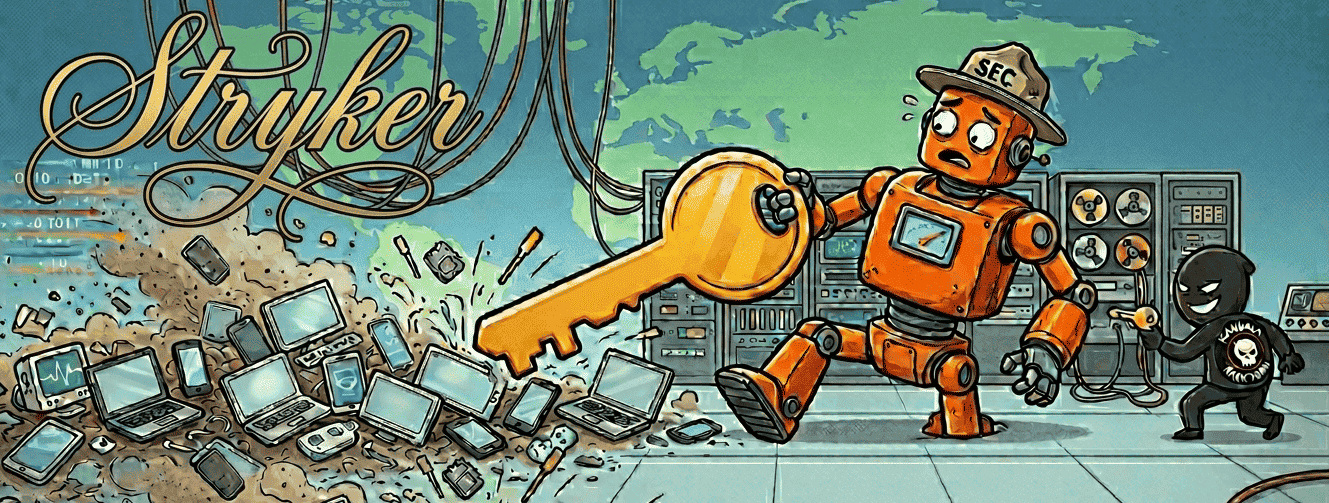
March 11, 2026. Thousands of employees at a medical devices and equipment manufacturing company, Stryker, were shocked to see their devices completely reset. All devices were reset to factory settings, and all data on them was erased.
This was not like the ransomware attacks we usually hear about. It was not a move to lock files or demand money. While Stryker initially reported that no major malware was found, security experts identified the incident as a wiper attack because the attackers allegedly used an administrative management platform to carry out the destructive actions.
Hackers obtained admin credentials by stealing session tokens or using phishing techniques to break into Stryker and then used the company’s own security systems against it. The attackers reportedly misused Microsoft Intune to execute large-scale device wipe commands. They achieved this by sending a mass wipe command to all devices.
Stryker is one of the world’s leading medical technology companies, which impacts over 150 million patients annually. Therefore, even a minor glitch in Stryker’s systems can directly affect hospitals, surgeries, and the medical equipment supply chain around the world.
According to reports, the Handala Hack Team, operating from Iran, which runs cyberattacks against U.S. and Israeli organizations, was behind it. The attackers reportedly did not require sophisticated malware or advanced exploit frameworks. They just gained admin access to the company itself. It was as simple as using the key in their hand, without breaking any locks. Stryker’s own Intune system did the rest for them.
While the world is worried about new types of cyber threats, a large company collapsed simply due to a password leak and uncontrolled automation systems. This incident reminds us that even with advanced security measures, mistakes in the fundamentals can lead us into danger zones.
Read ➤ Cybersecurity Testing
Lessons Beyond Security
- Privileged Action Validation: Are critical decisions, such as deleting data, subject to proper checks?
- Blast Radius Controls: How far can a flaw spread if it happens? Can we contain its impact to a small area?
- Safety Guardrails: How dangerous is it to blindly trust automation without proper controls?
According to new reports about the Stryker incident, the American agency CISA has intervened in the matter and instructed companies to tighten controls on endpoint management platforms. In short, this is not just cybersecurity news. It is also a big lesson about the reliability and quality of systems.
Read ➤ Reliability Testing
Guidelines for QA Teams
- Test Admin Tools: We usually test the features that customers use and their user journeys with great care. But admin tools and management platforms within the company are frequently overlooked. In fact, these automation systems should be given the same importance as customer features because they have the power to control the system as a whole.
- Control the Blast Radius: The blast radius is how far a failure can spread. Whether it’s a data deletion through Microsoft Intune or a production deployment, we need to have precise plans in place to prevent everything from crashing at once. Planning should include:
- Staging releases
- Multi-level approvals
- The Canary model, which controls where new changes are tested in a small area first.
- The Importance of Recovery Testing: How quickly can we recover our system if it goes down? Unfortunately, many teams do not give recovery testing the importance it deserves. We need to conduct mock drills at regular intervals to test how to restore data and the system from destructive scenarios.
With all of these in place, we can reduce the risk of a major disaster.
What happened to the Stryker company could happen to anyone, at any time. This incident reminds us that security is not just the responsibility of the security team, but also the responsibility of those who design and test the system.
Read ➤ Security Testing
Recommendations for Future Prevention
- Control Admin Access: Instead of giving everyone admin rights all the time, give access only when needed (just-in-time) and monitor each move carefully.
- Implement Safe Automation: Do not implement changes in all systems at once, but only in stages. Implement approval workflows and automated safety checks to reduce operational risk.
- Do Better Monitoring: Monitoring systems should provide real-time visibility into system changes, configuration updates, and suspicious activities.
- Conduct Recovery Training: In addition to automatically backing up information, you should also conduct periodic drills and practice how to quickly recover if the system completely crashes.
Final Words
The Stryker cyberattack reminds us that modern cyber threats are not limited to malware or ransomware. Even a single compromised or uncontrolled admin account or uncontrolled automation systems can bring down thousands of systems in seconds. Weak access controls, poorly planned recovery methods, and automation without security standards are the real risks.
Companies need to give their internal platforms and admin tools the same seriousness they give to the systems they provide to their customers. Regular recovery drills, phased deployments, and approval processes are all essential to a secure system.
When it comes to large-scale automation systems, it’s important to ensure their reliability. Teams need to be able to ensure security and reliability without slowing down the workflow. Test automation tools like testRigor, which help you write tests in plain English, are a great help here. This reduces test maintenance effort and helps you monitor your systems better.
Future cyberattacks may take different forms, but the lessons from the Stryker incident will always be relevant. Strong admin security, controlled automation, accurate monitoring, and the ability to quickly recover from disruptions are the backbone of a reliable system.
| Achieve More Than 90% Test Automation | |
| Step by Step Walkthroughs and Help | |
| 14 Day Free Trial, Cancel Anytime |