
Meta AI Flaw Leads to Instagram Account Takeovers
 |
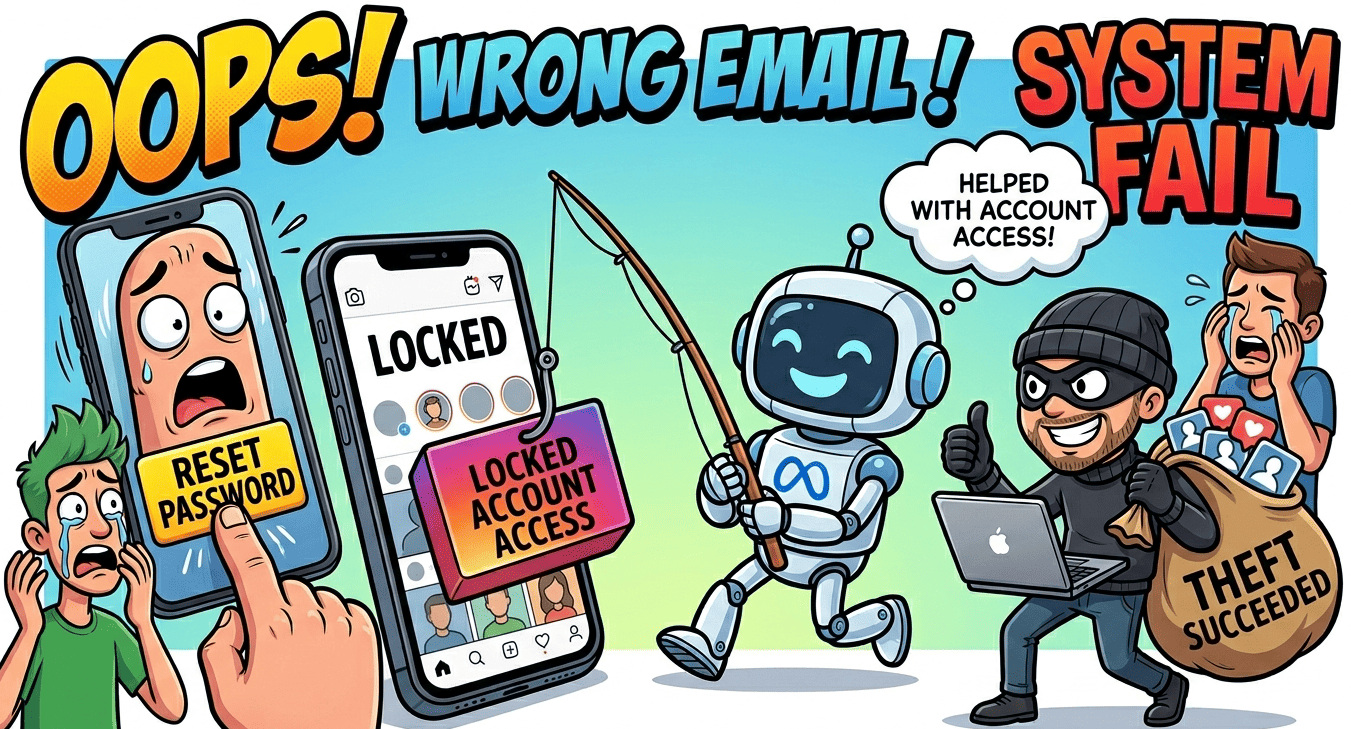
While scrolling through Instagram Reels, you suddenly get logged out of your Instagram account. When you enter the password, it displays ‘Wrong Password’! Just think about it. Anyone would be pretty shocked, right?
You then try to reset your password, thinking that you may have forgotten it. But the associated email and phone number have also changed. Someone else has taken over your account all of a sudden. Your photos, personal chats, and years of memories on Instagram have all been taken over by someone else. Your heart starts beating faster.
This is not just a scary story. Very recently, several users found their Instagram accounts hacked. By the time they picked up their phones, their accounts were gone! But there is a twist to this. This incident is not something we usually hear about. The affected users never clicked on suspicious links or did anything that would normally lead to an account compromise.
The incident happened due to an AI-powered Chatbot developed by Meta. This system was designed to help users recover their accounts whenever they were locked out. This was known as High Touch Support (HTS). It provided a way to quickly recover an account with the help of AI, without needing to contact customer support. Doesn’t that sound good?
But there was a serious bug in that system that no one expected. What’s even more ironic is that these accounts were not wiped out because of the AI technology that people always blame. The reason was something else. Curious what? Keep reading to know more.
| Key Takeaways: |
|---|
|
What was the Root Cause of the Meta HTS Vulnerability
Meta has submitted the root cause behind this incident. The reason is surprising because the AI tool actually worked as Meta intended.
According to the intended logic, the AI system would send a password reset link to the user’s email address. But this is where the development logic went wrong. There was a block of code to check whether the email ID provided by the user and the email of the original owner of that account were the same. It was a core component responsible for verifying the user’s identity. However, that crucial verification logic did not work as expected. Attackers exploited this flaw, resulting in a limited data breach affecting Meta users.
Amber Hannah, Associate General Counsel, Incident Response Legal at Meta, has admitted this. The tool did its job properly, but she said that the system was unable to verify that the email came from the original account due to a bug in the code.
As a result, attackers were able to exploit Instagram’s account recovery process. They set up a VPN that changed their location and fooled Instagram’s security system. Then they started chatting with Meta’s AI assistant. They told the AI assistant, “My account is locked. Send the recovery link to this email address,” and then provided their own email. Because the program had a flaw, the system sent the password reset link to the hacker’s email! They used it to change the password and took over the account. The legitimate account owner did not receive any notification about the reset request.
A video demonstrating this attack was widely circulated on X. The password reset link was getting delivered to the hacker’s mailbox. Some Instagram users noticed and complained about this hack after hackers began posting controversial content from their accounts. Imagine how much trouble that would cause to actual Instagram users!
Who were the Victims of this Attack
According to Meta, 20,225 users, including 30 residents of Maine, were identified as potentially affected by the HTS vulnerability.
Reports say that the account of former US President Obama’s official White House Instagram page was also affected. But Andy Stone, Meta’s VP of Communications, responded on X that this report about famous leaders was fake.
Surprisingly, even the great security consultant and hacker Jane Wong got caught. Her Instagram account got hijacked. Jane Wong wrote on X about the loss of her account:
“Even my Instagram account got hacked. The password got changed without my knowledge, and I was getting different password reset attempts throughout yesterday. And I got repeatedly logged out from the IG iOS app. Quite concerning.”
- Contact information: Email IDs and phone numbers.
- Personal details: Date of birth and other information on the profile, including profile photo.
- Posts: Photos, videos, stories, and other content that we uploaded.
- Personal chats: All of our direct messages (DMs) on Instagram.
- Linked accounts: Facebook pages and other services that were connected to Instagram.
- Account activity: Even the history of what we did on Instagram!
When Meta realized that the matter was out of hand, they immediately shut down this HTS platform to stop the spreading Instagram hack. They also canceled all the reset links that had been created through this system until then. Meta finally solved this headache by moving all affected accounts to a mandatory security review in order to recover the accounts that had been compromised.
The Edge Case That Slipped Through
The development and QA teams together should have done thorough testing of this AI assistant implementation. They never thought: ‘What happens if someone gives an email ID that is not theirs to reset passwords?’ In the software industry, this is called an edge case.
Beyond being a testing failure, this incident also highlights shortcomings in Meta’s production monitoring processes. They identified it only after the damage had occurred.
There is a common saying in the field of software testing: “It is not enough to test the happy path alone.” That is, it is not enough to just look at how the system behaves when everything goes as expected. You also need to test what happens if someone tries to use it in an unintended way. Otherwise, even tech giants like Meta may face a situation like this at any time!
The Weak Spots QA Needs to Hunt
- Integration boundaries: Often, companies test the AI layer and backend services separately. However, the point where these systems exchange information is often where critical validation checks are overlooked.
- Don’t avoid negative path testing: How should the system behave if someone gives incorrect information or inputs that mislead the system? This is often not included in normal testing.
- Anticipate the hacker’s intelligence: Hackers always look for account recovery methods. Therefore, you should create test cases in advance to track those loopholes.
- Post-deployment monitoring: No matter how much we test and deploy, sometimes the story will change in the live environment. A close monitoring system is mandatory for live applications.
Meta failed in these areas. If you compromise on basic security checks, it will become a nightmare like this. Hope this incident has made you think.
Think-Test & Repeat
- Test the whole system: Your AI model works correctly. But it doesn’t mean the entire system is perfect. You need to test the integration.
- Test the loopholes regularly: Change data, provide unexpected inputs, try to trick the system. These should be done regularly.
- Keep an eye on high-risk areas: You need a system to constantly watch for unusual scenarios in production, including account recovery, payments, and login methods.
- Understand how to secure Instagram account 2FA: This is basic. Meta’s disclosure confirmed that the vulnerability could only be fully exploited if the account holder did not have two-factor authentication turned on. But users were against this report. Some affected users said they had MFA enabled in their accounts.
Automation is the ideal way to test such scenarios. Especially modern generative AI-based automation. Some companies hesitate to do automation, saying that they still need manual verification. Hence, they are not ready to spend on automation. But think about edge cases like this. Can your manual QA team be awake every time and test all features in your application? Are you sure that they will not miss any scenarios? If you are doubtful, then it’s time to automate your application workflows. The next blocker bug might be hiding in a scenario you never tested. Make sure your QA process is ready with smarter automation using testRigor.
| Achieve More Than 90% Test Automation | |
| Step by Step Walkthroughs and Help | |
| 14 Day Free Trial, Cancel Anytime |